Workforce Identity has become the foundation of enterprise security as employees access apps and data from anywhere. Without strong identity controls and trusted devices, organizations face growing access risks. Hexnode helps IT teams strengthen workforce IAM by enforcing device compliance, visibility, and secure endpoint access across distributed work environments.
Modern enterprises no longer struggle with connecting employees to applications. They struggle with controlling who gets access, from which device, and under what conditions. Workforce Identity has become a critical challenge because employees now work across personal laptops, unmanaged smartphones, SaaS applications, and remote networks that traditional security models cannot fully govern.
This shift has exposed major gaps in enterprise security. Stolen credentials, excessive permissions, delayed offboarding, shadow IT, and unmanaged endpoints continue to create opportunities for attackers. At the same time, IT teams must support hybrid work without creating friction that slows employees down. Identity systems alone cannot solve this problem because user authentication without device trust leaves organizations exposed.
This is where modern workforce IAM strategies matter. Enterprises need identity systems that work alongside endpoint management to validate users, secure devices, and continuously enforce compliance. Hexnode helps organizations bridge this gap by giving IT teams centralized visibility and control across endpoints, making Workforce Identity enforcement more practical and effective in modern environments.
Workforce Identity refers to the digital identity framework organizations use to authenticate, authorize, and manage employees, contractors, vendors, and partners across enterprise systems and applications.
Unlike customer identity systems that focus on external users, Workforce Identity focuses on internal access management. It determines how employees access company resources, what permissions they receive, and whether their devices meet security requirements before access is granted.
A modern Workforce Identity strategy typically includes:
Authentication and verification
Single sign-on (SSO)
Multi-factor authentication (MFA)
Role-based access controls
Device trust validation
Access governance
Continuous compliance monitoring
For example, when an employee signs into Microsoft 365 from a company-managed laptop, the organization may validate multiple factors before granting access. The system can verify the user’s credentials, confirm MFA approval, check device encryption status, and ensure the endpoint complies with corporate policies. If the device fails compliance checks, access may be restricted automatically.
This approach reflects how enterprises now think about access security. Identity is no longer limited to usernames and passwords. It includes users, devices, context, risk posture, and continuous verification.
Why Workforce Identity Matters More Than Ever
The enterprise perimeter has changed permanently. Employees no longer work exclusively from corporate offices using company-owned desktops connected to internal networks. They operate across remote locations, personal devices, cloud platforms, and unmanaged environments.
This shift has made identity the new security perimeter.
Hybrid work expanded the attack surface
Hybrid work models introduced flexibility, but they also increased identity-related risks. Employees frequently switch between corporate networks, public Wi-Fi connections, and personal devices. Traditional VPN-based security models struggle to provide the visibility and control modern enterprises require.
Attackers actively target identities because compromised credentials often provide direct access to cloud applications and sensitive data.
SaaS adoption increased identity fragmentation
Most enterprises rely on dozens or even hundreds of SaaS applications. Every application introduces additional identities, permissions, and authentication flows. Without centralized visibility, organizations face identity sprawl that becomes difficult to manage securely.
Disconnected identity systems create serious operational issues, including:
Orphaned accounts
Excessive privileges
Inconsistent MFA enforcement
Delayed deprovisioning
Limited access visibility
Strong employee identity management practices help IT teams reduce these risks while simplifying user access.
Identity attacks continue to rise
Cybercriminals increasingly target enterprise identities through phishing, credential theft, MFA fatigue attacks, and session hijacking techniques. Once attackers gain access to valid credentials, they can move laterally across systems with minimal resistance.
This is why organizations increasingly adopt zero trust models that continuously verify users and devices instead of trusting them automatically after login.
Regulatory frameworks such as GDPR, HIPAA, SOC 2, and ISO 27001 require organizations to maintain strict access controls and audit visibility. Identity governance plays a major role in meeting these compliance expectations.
Enterprises must demonstrate:
Controlled access privileges
Timely offboarding
MFA enforcement
Device security controls
Audit-ready access records
Hexnode strengthens these efforts by helping IT teams enforce endpoint compliance policies that support broader Workforce Identity initiatives.
Workforce IAM vs Employee Identity Management vs Identity Lifecycle Management
Enterprise IT teams often encounter overlapping terminology when discussing identity security. While these concepts are closely related, they focus on different operational areas.
What is workforce IAM?
Workforce IAM, or Workforce Identity and Access Management, refers to the technologies and policies organizations use to authenticate users, manage permissions, and govern access across enterprise systems.
Workforce IAM focuses heavily on:
Authentication
Authorization
Access governance
Role enforcement
Security policies
Its primary goal is to ensure the right users access the right resources under approved conditions.
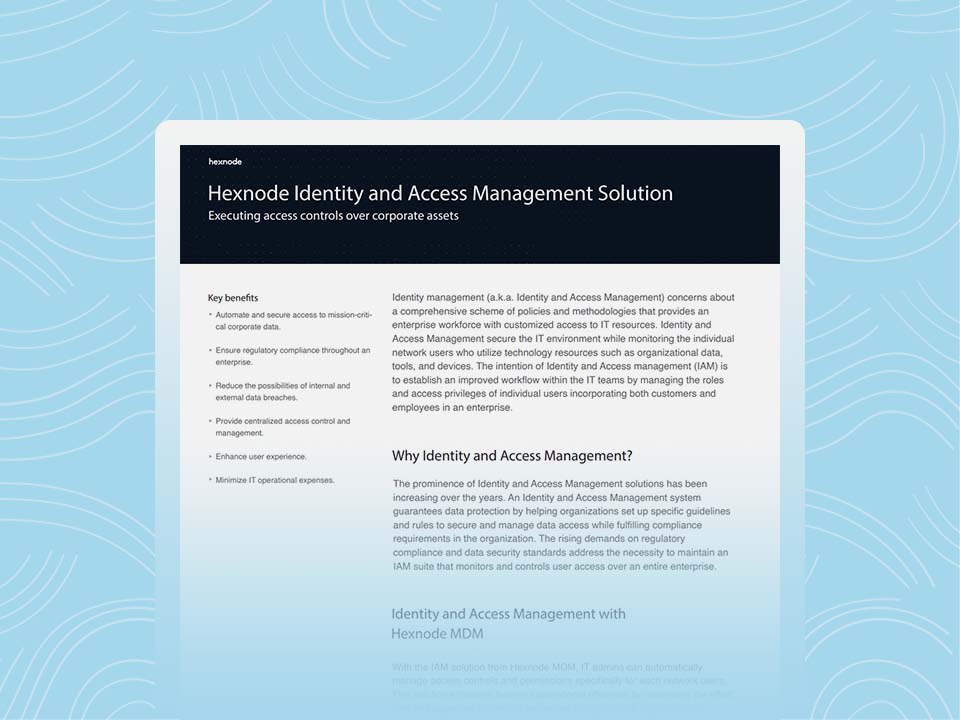
Featured Resource
Hexnode Identity and Access Management Solution
Discover how Hexnode IdP simplifies identity, access management, and secure authentication for modern enterprises.
Employee identity management focuses more specifically on managing employee accounts, identities, and permissions throughout their employment lifecycle.
This includes:
Account creation
Role assignments
Access modifications
Department transfers
Permission updates
It supports operational efficiency while helping IT teams maintain consistent access policies.
What is identity lifecycle management?
Identity lifecycle management governs how identities evolve throughout the employee journey. It automates onboarding, role transitions, and offboarding processes to reduce manual errors and security gaps.
A strong identity lifecycle management process ensures:
New hires receive appropriate access immediately
Role changes trigger permission updates
Departing employees lose access promptly
Without lifecycle automation, organizations often leave dormant accounts active long after employees leave the company.
How these concepts work together
These three areas support different layers of enterprise identity security:
Concept
Primary Focus
Key Outcome
Workforce Identity
Digital identity trust
Secure enterprise access
Workforce IAM
Authentication and governance
Access control
Employee identity management
Employee account administration
Operational efficiency
Identity lifecycle management
Joiner-mover-leaver workflows
Reduced security risk
Modern enterprises increasingly combine identity systems with endpoint management platforms like Hexnode to strengthen access enforcement using device posture and compliance data.
Core Components of a Workforce Identity Strategy
Strong Workforce Identity programs depend on several foundational technologies and operational practices.
Centralized identity providers
Identity providers such as Microsoft Entra ID, Okta, and Google Workspace centralize authentication and user management across enterprise applications.
SSO allows employees to access multiple applications using one set of credentials. This improves user experience while reducing password fatigue and weak credential practices.
Organizations benefit from:
Simplified authentication
Reduced password reset requests
Improved productivity
Better access visibility
Multi-factor authentication
MFA adds another layer of protection beyond passwords. Even if attackers compromise credentials, MFA significantly reduces unauthorized access risks.
Modern enterprises increasingly adopt adaptive MFA models that evaluate:
Device trust
Login location
Risk behavior
Access patterns
Role-based access control
Role-based access control ensures employees receive permissions based on their responsibilities. This supports least-privilege security models while simplifying access governance.
Automating onboarding and offboarding reduces operational delays and minimizes security gaps caused by dormant accounts or outdated permissions.
Lifecycle automation becomes especially important in enterprises with large distributed workforces and frequent personnel changes.
Device trust and compliance
Identity verification alone is no longer enough. Organizations must also validate whether the accessing device meets security standards.
Modern access decisions increasingly consider:
OS version
Encryption status
Patch levels
Rooted or jailbroken detection
Endpoint compliance posture
Hexnode helps organizations use device security and compliance status in access decisions through supported integrations such as Microsoft Entra Conditional Access and Okta Device Trust.
The Role of Devices in Workforce Identity Security
Many identity strategies fail because they focus entirely on users while ignoring endpoints.
A compromised device can bypass even strong authentication controls if organizations fail to validate endpoint security posture.
Identity without device trust creates blind spots
Attackers frequently exploit unmanaged or non-compliant devices using stolen credentials. Even legitimate employees can introduce risks if their devices lack encryption, updated software, or corporate controls.
This becomes especially challenging in BYOD environments where organizations must balance employee flexibility with security enforcement.
Conditional access depends on endpoint visibility
Modern conditional access policies rely heavily on endpoint intelligence. Organizations increasingly use device compliance signals to determine whether access should be granted, limited, or blocked.
Without endpoint visibility, identity systems operate with incomplete security context.
UEM and IAM must work together
Unified Endpoint Management and identity platforms now operate as complementary technologies within zero trust architectures.
IAM platforms verify users. UEM platforms verify devices.
Hexnode helps organizations operationalize this relationship by enabling IT teams to:
Enforce device compliance policies
Secure BYOD environments
Monitor endpoint health
Maintain visibility across distributed endpoints
This integrated approach helps enterprises strengthen Workforce Identity enforcement without creating unnecessary friction for employees.
Common Workforce Identity Challenges for Enterprise IT Teams
Despite major advancements in identity technologies, enterprises continue to face operational and security challenges.
Identity sprawl across SaaS ecosystems
Employees often accumulate access across multiple applications over time. Without centralized governance, organizations lose visibility into who has access to what.
Managing contractor and third-party access
Contractors and external vendors frequently require temporary access to enterprise systems. Manual provisioning processes increase the likelihood of excessive or lingering permissions.
Delayed offboarding
One of the most common identity risks involves delayed deprovisioning. Former employees may retain access to applications, cloud services, or corporate data long after leaving the organization.
Balancing security with user experience
Employees expect seamless access experiences. Security teams must enforce strong controls without creating excessive login friction or productivity disruptions.
Securing BYOD environments
BYOD programs improve flexibility, but they also introduce unmanaged endpoints into enterprise ecosystems. Organizations need visibility and policy enforcement without compromising user privacy.
Hexnode supports secure BYOD management by enabling IT teams to apply compliance controls while maintaining separation between personal and corporate data.
BYOD and GDPR: The art of crafting GDPR-compliant BYOD policies
Learn how to create GDPR-compliant BYOD policies that protect data and employee privacy.
Best Practices for Building a Strong Workforce Identity Framework
Enterprises should approach Workforce Identity as an ongoing security strategy rather than a standalone IAM deployment.
Adopt zero trust principles:Zero trust models assume no user or device should receive implicit trust. Every access request should undergo continuous validation.
Automate identity lifecycle management: Automated provisioning and deprovisioning reduce human error while improving operational efficiency.
Enforce MFA universally: Organizations should require MFA across all critical systems and applications, especially for remote access and privileged accounts.
Integrate IAM with endpoint management: Identity and endpoint security must work together. Device compliance should directly influence access decisions.
Continuously monitor device posture: Endpoint compliance changes constantly. Organizations should continuously evaluate device trust instead of relying on one-time authentication checks.
Conduct regular access reviews: Periodic audits help organizations identify excessive permissions, dormant accounts, and policy inconsistencies.
How Hexnode Supports Workforce Identity Security
Hexnode helps enterprises strengthen Workforce Identity initiatives by connecting endpoint security with access enforcement.
With Hexnode compliance policies and reports, IT teams can monitor enrolled devices’ compliance status and address configured compliance violations such as encryption, password, application compliance, geofence, inactivity, and jailbreak conditions.
This approach helps enterprises improve operational efficiency while strengthening workforce IAM strategies across distributed environments.
The Future of Workforce Identity
Enterprise identity strategies will continue evolving toward adaptive, continuous, and context-aware security models.
Passwordless authentication methods are gaining momentum as organizations reduce reliance on traditional credentials. AI-driven risk analysis will also play a larger role in detecting abnormal behavior and suspicious access patterns.
At the same time, identity systems will become increasingly dependent on real-time endpoint intelligence. Device trust, behavioral analytics, and continuous authentication will shape future access decisions.
Organizations that combine strong identity governance with unified endpoint visibility will be better positioned to secure hybrid work environments at scale.
Conclusion
Workforce Identity has become one of the most important pillars of enterprise security. Modern organizations can no longer rely on passwords and static access controls to protect users, applications, and sensitive data.
Strong workforce IAM strategies require continuous verification of both users and devices. Identity systems alone cannot fully secure enterprise environments without endpoint visibility and compliance enforcement.
Hexnode helps organizations strengthen Workforce Identity security by enabling IT teams to monitor devices, enforce compliance policies, and support secure access across distributed workforces. As hybrid work and SaaS adoption continue expanding, enterprises that integrate identity and endpoint management will build stronger, more resilient security foundations.
Secure Workforce Access With Hexnode
Enforce device compliance, validate endpoint trust, and secure workforce access with Hexnode UEM.
Workforce IAM secures internal users such as employees and contractors, while customer IAM focuses on external users like customers and consumers.
Why is identity lifecycle management important?
Identity lifecycle management helps organizations automate onboarding, role changes, and offboarding to reduce security gaps and improve operational efficiency.
Can Workforce Identity improve compliance readiness?
Yes. Strong Workforce Identity controls help organizations enforce access policies, maintain audit trails, and meet compliance requirements such as GDPR, HIPAA, SOC 2, and ISO 27001.
Content writer at Hexnode. Fueled by good coffee and the occasional cat cuddle, I enjoy crafting content that informs, connects, and resonates. Nothing excites me more than knowing my words have been read, appreciated, and maybe even bookmarked.