Distributed teams need speed, consistency, and control. Managing Linux with UEM gives IT teams a centralized way to oversee Linux devices instead of relying on scattered SSH sessions and one-off scripts. With Hexnode Linux Management, administrators can:
Standardize policies across all endpoints
Automate software deployment
Execute remote scripts at scale
Monitor device posture from a single console
This shift improves scalability, strengthens security, and supports governance across distributed environments.
Linux powers developer workstations and business-critical workloads across modern enterprises. However, many IT teams still rely on manual administration methods such as SSH access, local scripting, and VPN-dependent tools.
That model breaks down in distributed environments because it leads to:
Configuration inconsistencies across devices
Limited visibility into endpoint status
Delayed patching and update cycles
Increased dependency on individual administrators
In 2026, these gaps directly impact compliance and operational efficiency.
Managing Linux with UEM addresses this challenge by replacing fragmented workflows with centralized governance. With Hexnode and its Unified Endpoint Management solution, organizations can:
Apply policies consistently across all endpoints
Monitor device health in real time
Execute administrative actions without manual intervention
This approach transforms Linux management into a scalable and structured enterprise function.
Traditional Linux management methods struggle to scale because they rely heavily on manual processes.
1. The scripting bottleneck
Manual scripting depends on individual expertise. This creates:
Knowledge silos
Inconsistent execution
Difficult troubleshooting
Unmanaged Remote Bash Scripting increases risk when there is no centralized control.
Using custom scripts on Linux devices allows IT teams to:
Deploy scripts across multiple devices
Track execution results
Standardize administrative workflows
2. Lack of visibility
Without centralized tools, IT teams cannot easily verify:
Patch status
Installed applications
Device configurations
Security posture
This weakens Enterprise Linux Security and creates blind spots across the fleet.
3. Patch management challenges
Manual updates lead to:
Version drift across devices
Delayed security patches
Increased exposure to vulnerabilities
Without Linux Compliance Automation, maintaining consistency is difficult.
4. Scalability limitations
Manual processes do not scale. As the number of devices grows, IT teams struggle to:
Maintain consistency
Track device status
Execute changes efficiently
This is where Scalable Fleet Orchestration becomes essential, and why managing Linux with UEM is a necessary shift.
Stat:
Linux now powers approximately 49.2% of global cloud workloads as of 2025, making it a dominant platform in modern enterprise infrastructure.
What Enterprise Linux Fleets Actually Need
Modern enterprises require structured, repeatable management capabilities.
Core requirements for distributed Linux environments are:
1. Structured enrollment workflows
Linux onboarding typically relies on scripts rather than zero-touch provisioning. With Linux device enrollment, organizations can:
Standardize onboarding processes
Reduce configuration errors
Ensure devices enter management consistently
2. Security baselines
Organizations must enforce consistent configurations such as:
Password policies
Network settings
Access restrictions
This is critical for maintaining Enterprise Linux Security across distributed teams.
3. Centralized administrative execution
Controlled Remote Bash Scripting allows IT teams to:
Execute commands remotely
Automate maintenance tasks
Reduce dependency on manual access
4. Compliance and monitoring
With Linux Compliance Automation, organizations can:
Track device posture continuously
Identify non-compliant endpoints
Maintain audit readiness
5. Scalable fleet management
Through Scalable Fleet Orchestration, IT teams can:
Apply policies to groups of devices
Automate repetitive tasks
Manage large fleets without added complexity
These capabilities define what effective managing Linux with UEM should deliver.
Linux device management 101
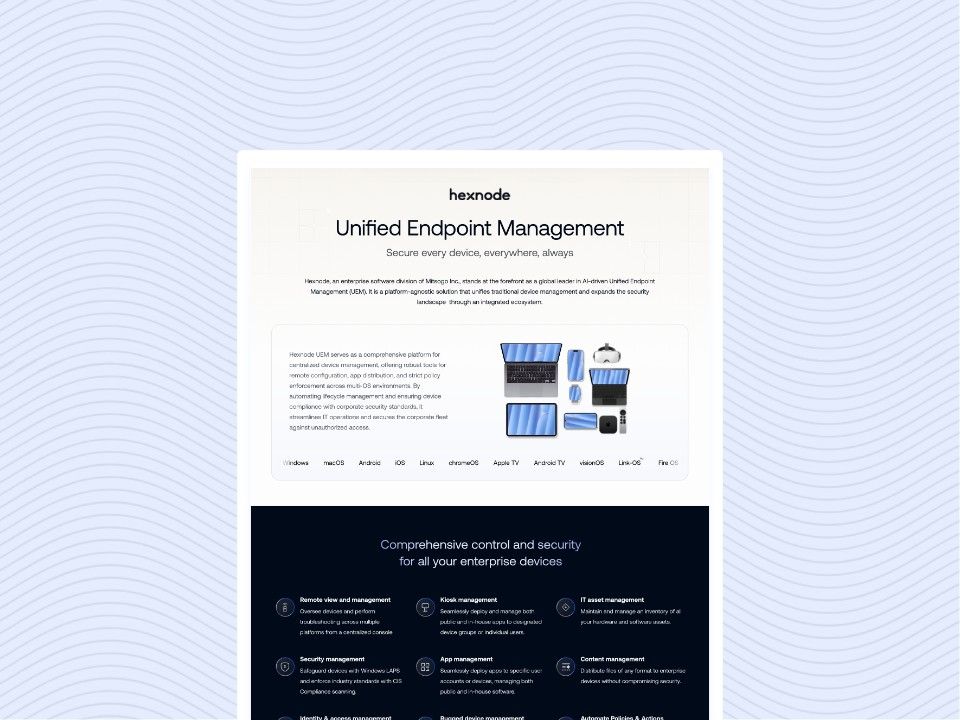
Learn how Hexnode simplifies Linux device management with centralized control and security enforcement.
How Hexnode Strengthens Managing Linux with UEM
To operationalize managing Linux with UEM, organizations need more than isolated features. They need a platform that connects execution, visibility, and governance into a single workflow. Hexnode delivers this by combining centralized control with script-driven flexibility, allowing IT teams to manage Linux environments in a structured and scalable way.
1. Centralized management
With Hexnode Linux Management, IT teams can:
Manage multiple Linux distributions from a unified dashboard
Monitor device status and health across the fleet
Control endpoints without relying on fragmented tools
This centralized model eliminates operational silos and strengthens overall control across distributed environments.
2. Script execution at scale
Using custom scripts on Linux devices, administrators can:
Automate routine administrative tasks
Execute scripts across multiple devices simultaneously
Schedule scripts for recurring operations
Reuse standardized scripts across teams
Track execution status and outcomes
This transforms Remote Bash Scripting from an ad hoc process into a controlled and repeatable workflow.
3. Policy-driven management
With policy-based device management, organizations can:
Apply configurations consistently across devices
Enforce operational and security standards
Align endpoints with organizational policies
This structured approach ensures consistency and supports long-term governance across Linux environments.
4. Dynamic device grouping and targeting
Hexnode enables intelligent grouping of devices based on attributes such as:
Department
Location
Ownership
This allows IT teams to:
Apply policies, scripts, and apps to specific device groups
Reduce manual targeting errors
Streamline large-scale deployments
This capability is essential for effective Scalable Fleet Orchestration.
This unified approach ensures that Linux endpoints are fully integrated into broader IT operations.
The Operational Impact
By combining centralized management, script execution, policy enforcement, and real-time visibility, Hexnode transforms managing Linux with UEM into a scalable operational model.
Instead of reacting to issues, IT teams can:
Standardize administrative workflows
Reduce manual overhead
Improve consistency across devices
Maintain control over distributed environments
This shift enables organizations to manage Linux proactively, aligning it with modern enterprise requirements for scalability, security, and efficiency.
Conclusion: A Better Model for Distributed Linux Operations
Manual Linux management cannot support modern distributed environments. It creates inefficiencies, inconsistencies, and security risks.
Managing Linux with UEM provides a structured alternative by enabling:
Centralized visibility
Policy-driven control
Automated administrative workflows
Scalable device management
With Hexnode UEM, organizations can bring Linux into a unified endpoint strategy and eliminate fragmented management practices.
For enterprises aiming to improve control and scalability, managing Linux with UEM is no longer optional. It is a foundational requirement for modern IT operations.
Simplify Linux Management at Scale
Take control of your Linux devices with a unified platform.
What are the primary business benefits of managing Linux with UEM?
Managing Linux with UEM replaces fragmented, manual workflows with a standardized orchestration layer. By using Hexnode, organizations can achieve: * Scalable Governance: Centralize management of multiple Linux distributions such as Ubuntu, Fedora, and Debian under consistent policy frameworks. * Operational Efficiency: Automate repetitive administrative tasks and software deployments, reducing per-device management overhead. * Improved Security Posture: Gain continuous visibility into device state and enforce security policies across distributed endpoints.
Does Hexnode support remote terminal commands for Linux fleet orchestration?
Yes. Hexnode enables IT teams to execute remote shell commands and custom Bash scripts across Linux devices through centralized script execution. This capability allows administrators to: * Perform system configurations * Automate administrative tasks * Run diagnostic checks across multiple devices All actions are executed through the Hexnode agent, eliminating the need for manual SSH-based workflows.
Can Hexnode manage a hybrid fleet of Linux, Windows, and macOS devices together?
Yes. Hexnode UEM is designed for heterogeneous environments and provides a unified management console for Linux, Windows, and macOS devices. IT teams can: * Monitor all endpoints from a single dashboard * Apply policies across different platforms * Reduce reliance on multiple management tools This unified approach helps eliminate tool fragmentation and improves operational consistency.
How does Hexnode streamline the Linux device enrollment process?
Hexnode supports Linux onboarding through script-based enrollment workflows. This approach allows IT teams to: * Standardize enrollment procedures * Reduce manual configuration errors * Ensure devices are enrolled consistently across environments Once enrolled, devices receive policies and configurations from the central console.
How does Hexnode ensure continuous Linux compliance and security?
Hexnode helps organizations maintain Linux compliance and security through centralized management and policy enforcement capabilities. Key components include: * Policy Enforcement: Apply configuration policies and security settings across managed devices * Script-Based Controls: Use custom scripts to enforce environment-specific configurations such as encryption or firewall settings * Continuous Monitoring: Track device status and identify deviations from expected configurations This approach supports consistent device governance and helps organizations maintain compliance across distributed Linux environments.
I write at the intersection of technology, process, and people, focusing on explaining complex products with clarity. I break down tools, systems, and workflows without any noise, jargon, or the hype.