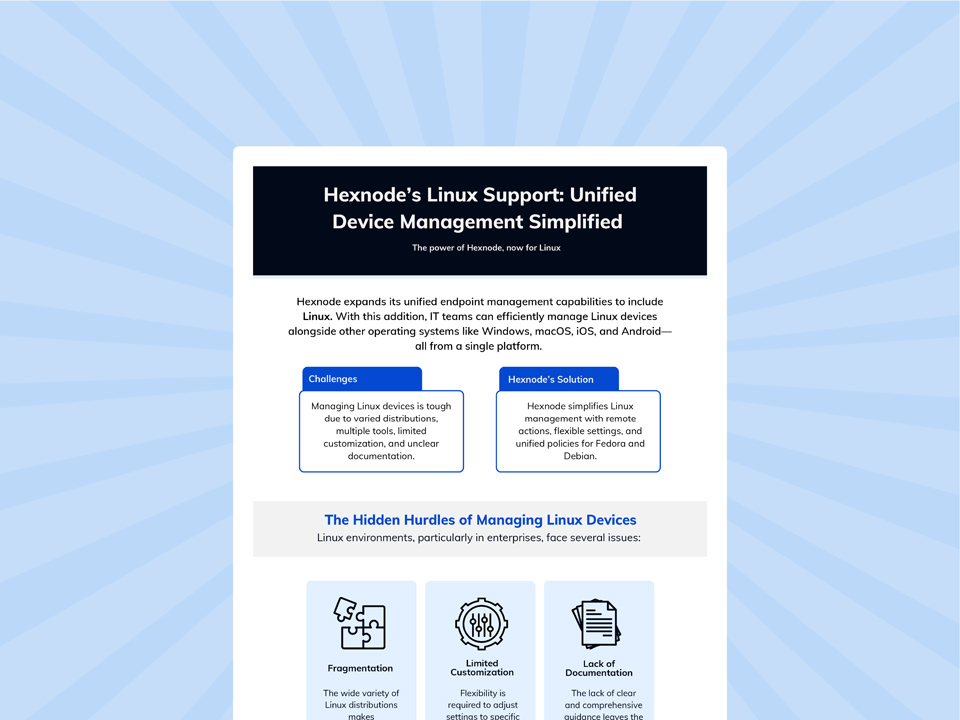
Manual Linux Management creates inconsistent configurations, delayed updates, and security blind spots. Threats such as SSH attacks and kernel exploits take advantage of these gaps. A unified platform like Hexnode UEM brings structure to system management, streamlines patch management, and maintains compliance across distributed environments.
Managing Linux endpoints has moved from a niche task to a core enterprise function. In 2026, organizations rely on Linux across developer environments, edge systems, cloud workloads, and employee devices. This shift has made Linux Management a strategic priority.
As Linux adoption grows, so does operational complexity. Teams that depend on scripts and manual workflows struggle to maintain consistency and security. The need is clear: enterprises must adopt a centralized, policy-driven approach to manage Linux endpoints to stay resilient and scalable.
The Rise of Linux in Modern Enterprise Environments
Linux now powers critical enterprise infrastructure across multiple layers, making Linux Management essential rather than optional.
This shift introduces new realities:
Expanded enterprise footprint: Linux runs across workstations, IoT devices, kiosks, and hybrid cloud environments, increasing the scope of managing Linux.
Security does not scale automatically: While Linux is secure by design, large deployments require structured controls and governance.
Need for unified control: Effective system management depends on centralized oversight and consistent policy enforcement.
Limitations of traditional methods: SSH-based workflows and scripts introduce inconsistency and do not scale efficiently.
Distributed work environments: Devices operate across networks and locations, requiring consistent management regardless of access conditions.
Enterprises must move from manual administration to scalable management frameworks.
Why Linux Management Becomes Complex at Scale
As environments grow, maintaining consistency across systems becomes increasingly difficult.
Key challenges include:
Distribution fragmentation: Managing Ubuntu, Debian, Fedora, and CentOS introduce variation in packages and configurations, complicating system management.
Limited visibility: Without a centralized view, IT teams cannot track device posture or enforce control effectively.
Unmanaged endpoints: Shadow devices create blind spots and increase risk in managing Linux environments.
Compliance barriers: Enforcing standards like ISO 27001 or SOC2 becomes difficult without centralized policy control.
Inconsistent enforcement: Lack of automation leads to misconfiguration and uneven security practices.
These factors make scalable Linux Management difficult without a unified approach.
Linux device management 101
Learn Linux management using Hexnode UEM to automate security, patching, and compliance.
The Risks of Ineffective Linux Management
Gaps in control and visibility translate directly into operational and security risks.
Delayed Linux patch management: Manual updates increase the likelihood of missed critical patches and exposure to exploits. The CISA Known Exploited Vulnerabilities (KEV) Catalog highlights actively exploited vulnerabilities in the wild, reinforcing the need for timely patching and centralized control.
Configuration drift: Devices gradually diverge, weakening baseline security across the environment.
Remote management gaps: Legacy tools limit control over distributed endpoints, leaving devices unpatched.
Expanded attack surface: Unmanaged systems create entry points for attackers.
SSH-focused threats: Weak credential enforcement increases susceptibility to credential-based attacks.
Limited response capability: Without centralized oversight, detecting and addressing issues becomes slower and less effective.
These risks highlight the need for structured and proactive Linux Management.
What Modern Linux Management Requires
To manage complexity at scale, enterprises need a structured and automated approach to Linux Management.
Core capabilities include:
Script-based enrollment: Onboard Linux devices using CLI-driven enrollment (e.g., authenticated scripts), ensuring they are managed from the moment they are deployed.
Continuous compliance monitoring: Maintain real-time visibility into device posture across environments.
Rapid remediation capabilities: Enable IT teams to quickly address issues through centralized actions.
Application governance: Control software distribution through approved sources to strengthen managing Linux environments.
Storage-aware operations: Maintain compatibility with advanced setups such as lvm Linux without disrupting system configurations.
These capabilities form the foundation of scalable and secure Linux Management.
Modern enterprises require more than fragmented tools to manage Linux effectively. Hexnode UEM provides a unified platform that brings control, consistency, and efficiency to Linux Management.
It enables organizations to:
Unify endpoint control: Manage Linux alongside other operating systems through a consistent Linux windows manager approach.
Standardize configurations: Enforce policies that maintain a stable and secure baseline across devices.
Streamline patch management:Automate update workflows to reduce delays and minimize vulnerabilities.
Enable lifecycle management: Apply Linux mdm principles to handle enrollment, grouping, and decommissioning.
Maintain compliance visibility: Monitor device posture and identify deviations quickly.
Support remote operations: Manage and troubleshoot endpoints without relying on network constraints.
These capabilities allow organizations to simplify managing Linux at scale while maintaining operational control. Hexnode operates alongside system-level configurations such as lvm Linux, ensuring flexibility without interference.
Here’s how these capabilities translate into real-world Linux Management outcomes:
Why Unified Linux Management is Critical for Scalability and Future Readiness
Modern IT environments operate across distributed networks and devices. Fragmented approaches to Linux Management cannot support this complexity.
A unified strategy enables organizations to:
Scale efficiently: Manage growing device fleets without increasing operational burden
Respond faster to threats: Address vulnerabilities through centralized control
Maintain consistent compliance: Enforce policies across all endpoints
Improve operational efficiency: Reduce manual effort in managing Linux systems
By combining system management, patch management, and compliance into a single framework, enterprises reduce complexity and strengthen security.
Hexnode supports this transition with a scalable platform designed for modern Linux Management needs.
Conclusion
Manual and fragmented approaches to Linux Management no longer meet enterprise demands. Organizations need unified control, consistent policy enforcement, and scalable operations.
Hexnode delivers this by simplifying system management, improving patch management, and enabling centralized oversight across environments.
If Linux is part of your infrastructure, modernizing your strategy is no longer optional.
Modernize Your Linux Management Today
Scale your Linux infrastructure without manual overhead.
What are the primary challenges of Linux endpoint management in an enterprise?
The primary challenges include managing fragmented distributions (Ubuntu, Fedora, Debian), lack of centralized visibility, manual patching workflows, and maintaining consistent security compliance across distributed fleets. Without a UEM solution, IT teams often face configuration drift and operational inefficiencies.
How do you secure Linux endpoints at scale?
Securing Linux endpoints at scale requires a UEM approach. Admins should automate patch deployment, enforce security configurations, restrict unnecessary services, and maintain centralized visibility. Hexnode enables this by allowing IT teams to apply and manage policies across devices from a single dashboard.
Can Hexnode automate Linux patch management?
Yes, Hexnode supports automated patch management for by enabling IT admins to schedule updates and deploy patches across supported distributions. This reduces manual effort and helps ensure systems stay updated against known vulnerabilities.
Why is manual scripting insufficient for Linux fleet management?
Manual scripting is difficult to scale, prone to errors, and lacks centralized visibility. Scripts can fail silently, leaving devices unpatched or non-compliant. A unified solution like Hexnode provides centralized reporting, real-time compliance tracking, and enables faster remediation through controlled administrative actions.
Does Hexnode support remote Linux management for hybrid work?
Yes. Hexnode uses a cloud-based architecture to manage Linux endpoints over any internet connection. IT teams can enroll devices, enforce policies, and perform remote troubleshooting without requiring a corporate VPN.
How does Hexnode ensure Linux compliance for SOC2 or ISO 27001?
Hexnode supports compliance efforts by enforcing security policies, monitoring device posture, and providing audit-ready reports. IT teams can track policy adherence, identify deviations, and generate reports that help meet standards such as SOC2 and ISO 27001.
I write at the intersection of technology, process, and people, focusing on explaining complex products with clarity. I break down tools, systems, and workflows without any noise, jargon, or the hype.