The Ultimate Guide to XDR (Extended Detection and Response)
See how XDR unifies security across endpoints, networks, and the cloud to automate threat detection and response.

Get fresh insights, pro tips, and thought starters–only the best of posts for you.

Today, enterprise security teams operate in an environment where threats evolve faster than traditional defenses can adapt. Attackers increasingly rely on file-less techniques, identity misuse, and zero-day exploits that bypass static detection mechanisms. At the same time, organizations manage a rapidly expanding fleet of endpoints across hybrid and remote environments.
As a result, this shift has made reactive security models insufficient.
In this context, AI in threat detection introduces a more adaptive approach. Specifically, it enables continuous behavioral analysis, real-time anomaly detection, and faster identification of suspicious activity. As a result, instead of relying only on known indicators, enterprises can detect deviations and investigate threats earlier in the attack lifecycle.
However, detection alone does not secure endpoints.
Therefore, security teams need the ability to investigate what happened, understand how an attack progressed, and respond effectively. This is where Hexnode XDR becomes central. It provides endpoint-focused detection, investigation, and response capabilities, working alongside Hexnode UEM to enforce controls.
Legacy threat detection systems rely on signatures and predefined rules. These approaches struggle in modern enterprise environments.
Key limitations include:
As a result, as endpoint environments expand, these limitations become more pronounced.
However, AI in enterprise security addresses detection gaps, but enterprises still require structured investigation and response workflows. Without these, alerts remain isolated signals rather than actionable insights.
| Capability | Traditional Detection | AI in Threat Detection |
| Threat Identification | Signature-based | Behavior and anomaly-based |
| Zero-day Detection | Limited | Strong |
| Alert Volume | High (noisy) | Reduced with context |
| Context Awareness | Low | High (user, device, process) |
| Investigation Depth | Minimal | Supported with telemetry |
| Response Speed | Slow/manual | Faster, automated |
| Adaptability | Static | Continuously learning |
AI enhances threat detection by introducing intelligence and scale into security operations.
Behavioral Analysis Across Endpoints
First, AI establishes baselines for normal device and user behavior. It monitors process execution, login patterns, and network activity.
When deviations occur, such as unusual process chains or unexpected access behavior, AI flags them. This strengthens AI anomaly detection cybersecurity capabilities and improves early detection.
Real-Time Anomaly Detection
Additionally, AI processes endpoint telemetry continuously. It detects suspicious activity without relying on known signatures.
This enables AI cybersecurity threat detection systems to identify zero-day threats and advanced attacks at earlier stages.
Predictive Threat Intelligence
Moreover, AI analyzes historical patterns and threat data to anticipate potential risks. It identifies indicators that suggest an attack may occur.
Predictive threat intelligence AI shifts security from reactive detection to proactive defense.
Faster Response Through Automation
Finally, AI enables faster response by triggering actions when suspicious activity is detected. However, response effectiveness depends on available controls and execution layers.
This is where endpoint-focused response capabilities become critical.
While AI in threat detection generates alerts, security teams still need to answer key questions:
Without this, endpoint-level investigation lacks depth.
This is exactly where Hexnode XDR plays a defining role. It enables IT teams to move beyond alerts and into structured investigation workflows.
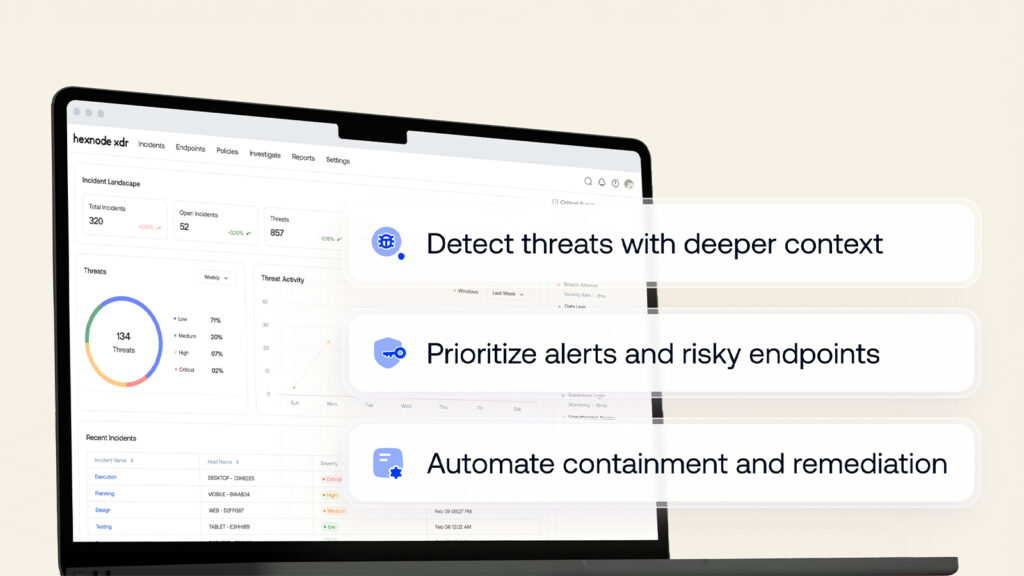
Hexnode XDR is built as an endpoint-focused detection, investigation, and response layer that works alongside Hexnode UEM.
More importantly, it is designed for IT teams that need actionable security without the overhead of running a full-scale SOC. Instead of overwhelming teams with raw alerts, it provides the visibility and tools required to understand and respond to threats at the endpoint level.
Hexnode XDR provides a unified console to monitor:
As a result, this ensures that security teams can move from detection to investigation without switching tools or losing context.
Effective AI in threat detection depends on high-quality telemetry. Hexnode XDR collects key endpoint events such as:
Consequently, this telemetry provides the foundation required to detect anomalies and investigate suspicious activity.
Hexnode XDR enables structured investigation through:
Here, the process tree plays a critical role by revealing process lineage, execution flow, and the likely attack path. This allows administrators to reconstruct incidents and understand how a threat progressed.
At this stage, once a threat is confirmed, Hexnode XDR enables immediate response through a focused set of actions:
These actions help contain threats quickly and reduce their impact without requiring complex workflows.
Hexnode XDR integrates with Hexnode UEM to enforce device-level controls.
Ultimately, this ensures that once a threat is identified, organizations can act on it consistently across their device fleet.

Learn how UEM-native XDR closes security gaps by combining proactive device hardening with reactive threat neutralization.
Download the whitepaperTo summarize how these capabilities come together, here is a quick view of what Hexnode XDR enables today:
| Capability | Traditional Detection | AI in Threat Detection |
| Threat Identification | Signature-based | Behavior and anomaly-based |
| Zero-day Detection | Limited | Strong |
| Alert Volume | High (noisy) | Reduced with context |
| Context Awareness | Low | High (user, device, process) |
| Investigation Depth | Minimal | Supported with telemetry |
| Response Speed | Slow/manual | Faster, automated |
| Adaptability | Static | Continuously learning |
Overall, this structure allows teams to move from detection to investigation to response without relying on multiple disconnected tools.
In practice, AI in threat detection becomes significantly more effective when combined with endpoint investigation and response.
Although AI in enterprise security improves detection, organizations must address several challenges:
To address this, Hexnode addresses these challenges by combining XDR capabilities with UEM-based enforcement.
Looking ahead, AI will continue to evolve, but its effectiveness will depend on how well organizations combine detection, investigation, and response.
For example, future developments will include:
Hexnode XDR is positioned as a practical foundation for this evolution, focusing on endpoint-level visibility and actionable response.
In summary, AI in threat detection enables enterprises to identify threats faster than ever before. However, detection alone does not provide security.
Therefore, organizations need to investigate incidents, understand attack paths, and respond effectively.
In this context, Hexnode XDR delivers this capability by providing endpoint-focused visibility, investigation tools, and guided response actions. When combined with Hexnode UEM, it ensures that enterprises can act on threats immediately and enforce security across all devices.
AI detects threats. Hexnode XDR helps you understand them. Hexnode UEM helps you control them.
See how Hexnode XDR helps you investigate and respond to endpoint threats in real time.
Try Hexnode NowAI improves threat detection by analyzing behavior and patterns instead of relying only on static signatures. This allows it to identify suspicious activity and potential threats, including previously unseen attacks, earlier in the attack lifecycle.
Hexnode XDR does not replace antivirus solutions. It complements them by providing endpoint visibility, investigation capabilities, and response actions such as device isolation, process termination, and malicious file deletion.
Yes. Hexnode provides unified endpoint management across multiple platforms, including desktops and mobile devices. Hexnode XDR focuses on endpoint threat detection, investigation, and response within supported environments, while Hexnode UEM ensures device-level control and policy enforcement.
XDR platforms like Hexnode XDR help operationalize AI in threat detection by providing endpoint-level visibility, investigation tools, and response actions. They allow teams to analyze alerts, understand attack paths, and take actions such as device isolation or process termination.
Hexnode XDR handles detection, investigation, and response, while Hexnode UEM enforces device-level policies. Together, they enable organizations to detect threats and immediately apply controls across endpoints.