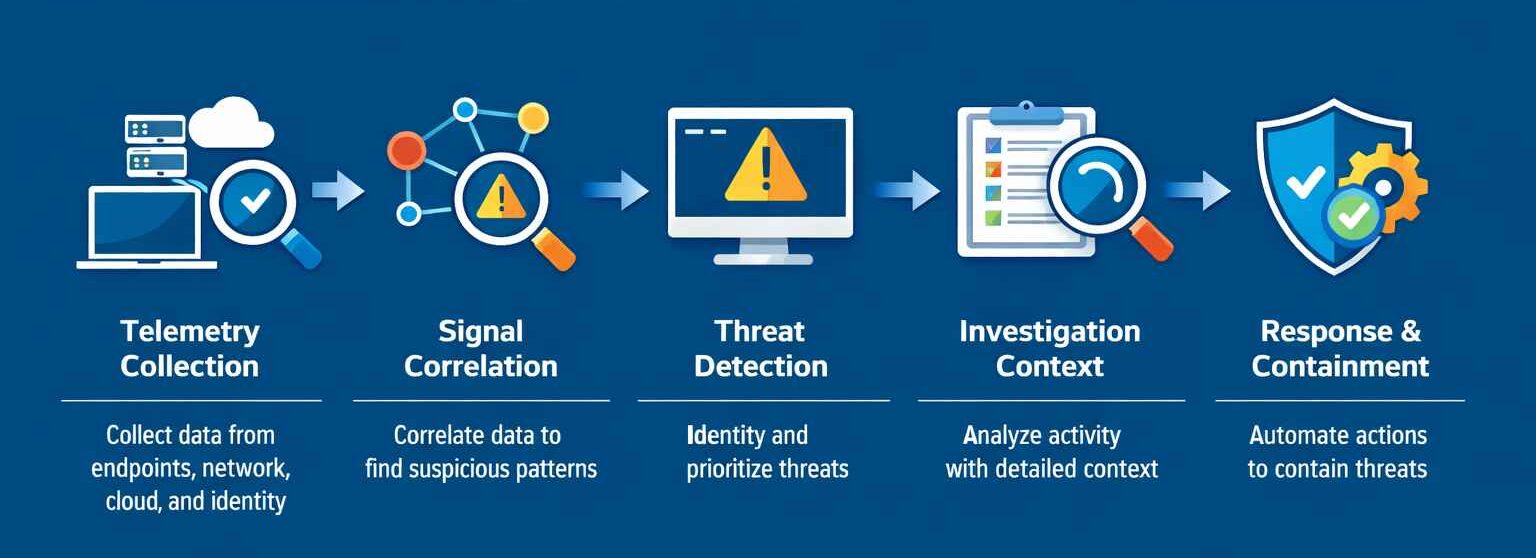
XDR monitoring is the continuous process of analyzing security signals across endpoints, networks, identities, and cloud systems using an Extended Detection and Response platform. Unlike traditional tools that monitor individual systems separately, XDR correlates telemetry across the entire environment to detect threats earlier and provide better investigation context. Platforms like Hexnode XDR, integrated with Hexnode UEM, strengthen this approach by combining endpoint visibility, device management, and threat detection in a single console, helping IT teams investigate incidents faster and respond more effectively.
Imagine an IT administrator investigating a potential security incident. Alerts are coming in from multiple tools, and each system is reporting suspicious activity. Yet none of these alerts provide the full picture of what’s happening across the environment.
Situations like this are becoming increasingly common as organizations adopt hybrid work models, cloud services, and diverse device fleets. While these technologies improve productivity and flexibility, they also expand the attack surface and introduce new security challenges. When monitoring tools operate in silos, identifying sophisticated attacks that move across systems becomes significantly more difficult.
This is where XDR monitoring becomes valuable, helping security teams make sense of scattered signals and investigate threats with greater context.
In this blog, we’ll explore what XDR monitoring is, how it works, and why it has become an essential capability for modern cybersecurity operations.
XDR monitoring refers to the continuous process of observing, analyzing, and responding to security events across an organization’s digital environment using an Extended Detection and Response (XDR) platform. Its goal is to identify suspicious activity by correlating signals from different parts of the IT environment, allowing security teams to detect threats earlier and investigate incidents more effectively.
Unlike traditional security tools that monitor individual layers independently, XDR platforms collect and correlate telemetry from multiple sources, including:
Endpoints such as laptops, desktops, and servers
Network infrastructure
Cloud workloads and services
Identity and access management systems
Email and SaaS applications
By consolidating security signals across these environments, XDR platforms provide the visibility required for effective XDR monitoring.
Why Traditional Security Monitoring No Longer Works
Before XDR monitoring emerged, organizations relied on a collection of specialized security tools to monitor different parts of their IT infrastructure. Endpoint protection platforms monitored device activity, network security tools analyzed traffic, and log management systems aggregated events from various applications and services. This fragmented visibility created several challenges.
Siloed visibility: Security tools monitor individual systems but fail to correlate events across the environment.
Alert overload: Large volumes of disconnected alerts make it difficult to identify real threats quickly.
Slow investigations: Analysts must switch between tools to gather context during incident analysis.
Incomplete attack context: Multi-stage attacks often appear as unrelated events across different systems.
Limited cross-environment detection: Threats moving between endpoints, networks, and cloud services can go unnoticed.
These limitations have pushed organizations toward more unified monitoring approaches, where security signals from across the environment can be analyzed together.
What XDR Actually Monitors
Effective XDR monitoring depends on several core visibility layers across the organization’s infrastructure.
Endpoint Monitoring
Endpoints remain one of the most common entry points for cyberattacks. Monitoring endpoints provides insights into:
Process execution
File modifications
Device health
User activity
Endpoint telemetry often forms the foundation of XDR detection capabilities.
Network Monitoring
Network activity reveals how data moves within and outside the organization. Monitoring network traffic helps identify:
Suspicious communication patterns
Lateral movement between systems
Connections to malicious servers
Identity Monitoring
Identity-based attacks are increasingly common. XDR monitoring tracks authentication events to detect anomalies such as:
Unusual login locations
Privilege escalation attempts
Credential misuse
Cloud Workload Monitoring
As organizations adopt cloud infrastructure and SaaS applications, monitoring cloud activity becomes essential for detecting unauthorized access and suspicious API behavior.
However, collecting visibility across these systems is only one part of the process. To turn these signals into actionable security insights, XDR monitoring must correlate and analyze them in real time.
The Ultimate Guide to XDR (Extended Detection and Response)
Explore the fundamentals of XDR, and why unified threat detection is becoming essential for modern security operations.
How XDR Monitoring Works
In practice, XDR monitoring follows a continuous security monitoring workflow that helps teams detect, investigate, and respond to threats more efficiently.
1. Telemetry Collection
The process begins with collecting security telemetry from across endpoints, networks, cloud workloads, email systems, and identity providers to gain visibility into security activity. This security telemetry includes events such as:
Login attempts
Process activity
Network connections and traffic
System configuration changes
Collecting data from multiple sources provides the visibility needed to monitor activity across the entire environment.
2. Signal Correlation
Once telemetry is collected, the XDR platform correlates signals across systems. XDR platforms analyze data from previously siloed tools in a consistent format to identify patterns and anomalies, enabling security teams to detect threats spanning multiple systems.
For example, an XDR system might correlate:
A suspicious login attempt
An unusual process running on an endpoint
An outbound network connection to an unknown domain
When analyzed together, these signals may reveal a single attack chain rather than isolated events.
3. Threat Detection and Prioritization
XDR platforms analyze correlated signals using behavioral analytics, threat intelligence, machine learning, and detection rules to identify potential threats. Many platforms also map suspicious activity to the MITRE ATT&CK framework, a widely used knowledge base of adversary tactics and techniques, helping administrators understand attacker behavior and prioritize incidents more effectively.
This helps reduce noise and allows security teams to focus on higher-priority threats.
4. Investigation Context
When suspicious activity is detected, XDR monitoring provides contextual insights such as attack timelines, affected devices, and related events. This helps analysts understand how an attack started, how it spread, and which systems may be impacted.
Having this context significantly speeds up incident investigation.
5. Response and Containment
Many XDR platforms also support automated response actions to contain threats.
These responses may include:
Isolating compromised endpoints
Terminating malicious processes
Blocking suspicious network connections
Disabling compromised user accounts
Automated containment helps reduce attacker dwell time and limits the potential impact of a breach.
XDR vs EDR vs SIEM: What’s the Difference?
Organizations have historically relied on endpoint tools such as Endpoint Detection and Response (EDR) and Security Information and Event Management (SIEM) to monitor security activity. While these solutions remain important, they serve different roles compared to XDR monitoring.
Technology
Primary Focus
Key Function
EDR
Endpoints
Detects suspicious behavior on individual devices
SIEM
Log aggregation
Collects and analyzes logs from multiple systems for security monitoring
XDR
Cross-environment visibility
Correlates signals across endpoints, networks, identities, and cloud systems
EDR focuses primarily on device-level activity, while SIEM platforms aggregate logs from across the environment. XDR expands on these capabilities by correlating security signals across multiple areas, enabling organizations to detect complex attacks that span systems.
This broader visibility is what makes XDR monitoring particularly effective in modern IT environments.
Common Threat Scenarios XDR Monitoring Helps Detect
Modern cyberattacks unfold across multiple systems, from email to endpoints to cloud services. XDR monitoring helps security teams identify attack patterns that might otherwise appear as unrelated events. Here are some cases where XDR monitoring helps:
Ransomware Campaigns
Ransomware attacks often start with a phishing email or malicious download before spreading across systems. XDR monitoring can correlate email activity, endpoint behavior, and network signals to identify ransomware campaigns before they escalate.
Phishing-Based Account Compromise
A suspicious login followed by unusual endpoint activity may indicate stolen credentials. XDR monitoring connects identity events with device and network signals to detect these compromises early.
Insider Threats
Unusual user behavior, such as large data transfers, unauthorized access attempts, or abnormal login patterns, can signal insider misuse or compromised accounts. Cross-domain monitoring helps flag these anomalies quickly.
Lateral Movement Across Systems
After gaining initial access, attackers often move between devices to expand their foothold. XDR monitoring detects these movements by analyzing authentication events, endpoint activity, and network connections together.
Across many of these scenarios, one pattern becomes clear: endpoints frequently serve as the starting point or pivot point for attacks. Whether it’s a malicious download, a compromised login session, or suspicious user behavior, endpoint activity often provides the earliest signals of a potential breach.
This makes endpoint visibility a critical component of effective XDR monitoring.
Where Endpoint Visibility Fits into XDR Monitoring
For XDR monitoring to provide meaningful insights, it must have strong visibility into endpoint activity. Without sufficient device-level data, security signals may appear incomplete, making it harder to understand how an incident originated or how it spread across systems.
Endpoint telemetry provides valuable context during threat detection and investigation. This can include signals such as:
Device health and security posture
Patch and update status
Operating system activity
User actions and application behavior
Maintaining visibility into endpoints with solutions like Hexnode UEM also helps organizations detect misconfigurations, outdated software, or suspicious device activity before they escalate into larger security incidents.
Featured Resource
Introduction to Hexnode XDR
Learn how to close the security loop by combining proactive device management with advanced threat detection and response.
While strong endpoint visibility improves XDR monitoring, organizations also need a platform that can analyze security signals, surface actionable insights, and enable fast response.
Hexnode XDR is designed to support this by bringing threat detection, investigation, and response capabilities into a single monitoring environment. The platform correlates endpoint signals and security events to help administrators identify suspicious activity, prioritize incidents, and respond quickly.
Several capabilities within Hexnode XDR help enhance XDR monitoring:
Unified threat visibility
Hexnode XDR provides a centralized dashboard that surfaces alerts, threat trends, and vulnerable devices in real time, helping administrators quickly understand their overall security posture.
Context-rich detection and investigation
Threat alerts are enriched with device activity, policy context, and event timelines. This additional context helps administrators understand how a threat originated and which devices may be affected.
Precision threat hunting
Administrators can query endpoint activity and historical security events to investigate suspicious behavior and uncover hidden threats within the environment.
Rapid response and containment
When threats are detected, administrators can take immediate action, such as isolating compromised devices, terminating malicious processes, or quarantining files, to limit the spread of an attack.
By combining unified visibility, contextual threat insights, and actionable response capabilities, Hexnode XDR enables IT administrators to move beyond simply monitoring alerts and toward actively detecting, investigating, and containing threats across their endpoint environment.
Bringing Clarity to Modern Threat Detection with XDR Monitoring
As IT environments grow more distributed and complex, traditional monitoring tools often struggle to provide the visibility needed to detect modern threats. Disconnected alerts, fragmented telemetry, and limited cross-system visibility make it difficult to identify attacks that move across endpoints, networks, and cloud systems.
XDR monitoring changes this by correlating security signals across the entire environment, enabling faster detection, investigation, and response to threats.
However, effective monitoring depends on having clear visibility into the devices where attacks often begin. Platforms like Hexnode XDR help IT administrators bring threat detection, investigation, and response into a single console, making it easier to understand incidents and act quickly.
Frequently Asked Questions (FAQs)
1. Does XDR monitoring replace antivirus or endpoint protection?
No. XDR monitoring complements endpoint protection by combining endpoint data with signals from networks, cloud services, identities, and other security tools to provide broader threat visibility and faster incident investigation.
2. Is XDR monitoring suitable for small and mid-sized businesses?
Yes. Organizations of all sizes can benefit from XDR monitoring, especially if they manage multiple devices, cloud applications, or remote users and need centralized visibility without juggling multiple security consoles.
3. What should organizations consider before implementing XDR monitoring?
Organizations should evaluate integration capabilities, endpoint visibility, automation features, scalability, and compatibility with their existing security stack to ensure the XDR platform delivers comprehensive and actionable threat detection.
Detect Threats Faster with Unified XDR Monitoring
Gain complete visibility across your endpoints, uncover suspicious activity with contextual threat insights, and accelerate incident response
Curious, constantly learning, and turning complex tech concepts into meaningful narratives through thoughtful storytelling. Here I write about endpoint security that are grounded in real IT use cases.