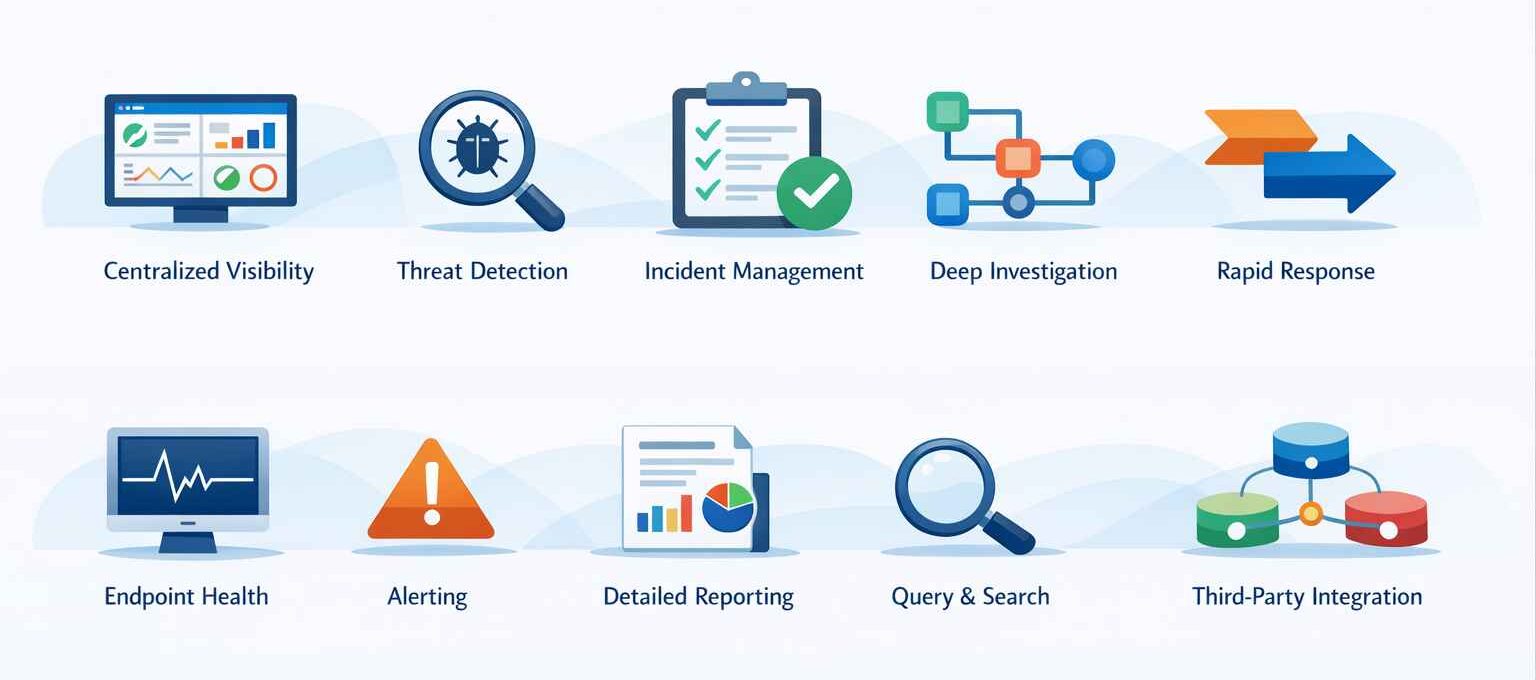
XDR brings together detection, investigation, and response into a unified platform, addressing the limitations of fragmented security tools. Key XDR capabilities include centralized visibility, context-driven threat detection, structured incident management, and direct response actions. However, effectiveness depends on how well these capabilities translate into everyday workflows. When evaluating XDR, organizations should focus on practical factors such as visibility, investigation depth, response speed, alert quality, usability, and integration with existing systems.
Cybersecurity today is not just about preventing attacks. It’s about being ready to detect, investigate, and respond when they happen. And the cost of a delayed or ineffective response is high.. Studies show that cybercrime is projected to cost $10.5 trillion annually, with organizations losing an estimated $333,000 every minute to attacks.
Despite the critical importance of cybersecurity, many teams still rely on disconnected tools and manual workflows to detect and respond to threats.
Extended Detection and Response (XDR) has emerged to address this challenge. Instead of treating alerts as isolated events, XDR helps teams understand what is happening across endpoints and act from a single interface.
But not all XDR platforms deliver the same value. The real differentiator lies in how effectively these capabilities are implemented.
In this blog, we break down the core XDR capabilities that define a modern platform and what organizations should expect when evaluating one.
For years, organizations have relied on a combination of endpoint, network, and log-based security tools to protect their environments. While each serves a specific purpose, they often operate in isolation. This leads to fragmented visibility and inefficient response.
Here’s where traditional approaches fall short:
Siloed visibility: Endpoint tools like EDR focus only on device-level activity, without broader context across users, systems, or environments.
Overwhelming alert volumes: Platforms like SIEM aggregate large amounts of data but often generate excessive alerts, many of which lack clear prioritization.
High operational complexity: Extracting meaningful insights from multiple tools typically requires specialized expertise and constant tuning.
Limited correlation across events: Even when threats are detected, security signals remain disconnected. This makes it difficult to identify how individual events are related to a larger attack.
This becomes a serious challenge in modern environments.
Today’s threats are:
Multi-stage, moving across systems rather than targeting a single point
Endpoint-driven, with devices often acting as the initial entry point
Designed to evade isolated detection mechanisms
The challenge is not just detection, but also making sense of related events and acting on them efficiently. To address this, organizations need more than additional tools. They need a set of capabilities that can connect signals, provide context, and enable faster response.
The Ultimate Guide to XDR (Extended Detection and Response)
Explore the fundamentals of XDR, and why unified threat detection is becoming essential for modern security operations.
Core XDR Capabilities: What Actually Matters
Once the need for XDR is established, the next logical step is to ask: What should an XDR platform accomplish? What capabilities are essential to support effective detection, investigation, and response?
The following XDR capabilities define what organizations should expect from a modern platform.
1. Centralized Visibility into Security Events
A fundamental capability of an XDR platform is the consolidation of security events into a unified interface. This eliminates reliance on multiple disconnected tools and enables teams to monitor alerts, incidents, and endpoint activity from a single location. Such visibility typically includes:
Aggregated views of threats and alerts,
Insights into affected or vulnerable endpoints
Activity timelines
By centralizing this information, organizations can improve situational awareness and streamline security operations without compromising depth or accuracy.
2. Context-Driven Threat Detection
Effective threat detection depends on the availability of contextual information. An XDR platform should enrich each alert with relevant details, including severity levels, associated processes, user and endpoint context, and alignment with recognized frameworks such as MITRE ATT&CK. This contextualization enables security teams to accurately assess threats, prioritize responses, and reduce false positives.
3. Structured Incident Management
An XDR platform should provide a structured and consistent approach to incident management, ensuring that security events are tracked and resolved efficiently. This includes centralized incident views, clear status indicators, and the ability to assign ownership to specific team members.
By structuring and formalizing workflows, organizations can ensure accountability, reduce response times, and maintain a clear record of actions taken during incident resolution.
4. Investigation with Process-level Visibility
Comprehensive investigation capabilities are essential for understanding how threats originate and evolve. An XDR platform should provide detailed visibility into process execution and the relationships between events. This typically includes process tree visualization, command-line arguments, file path information, and precise timestamps. Such granular insights allow security teams to:
Reconstruct attack sequences,
Identify root causes, and
Determine the full scope of an incident, thereby supporting more effective containment and remediation strategies.
5. Direct Response from the Same Interface
A critical aspect of XDR is the ability to execute response actions directly within the same interface used for detection and investigation. This eliminates the need to switch between multiple tools, reducing response latency and operational complexity.
Security teams should be able to terminate malicious processes, quarantine or remove files, isolate affected endpoints, and initiate remote remediation. This capability ensures faster and more consistent handling of security incidents.
6. Continuous Endpoint Health Monitoring
In addition to detecting active threats, XDR platforms should provide continuous insight into the overall security posture of endpoints. This includes visibility into device health status, connectivity, and potential vulnerabilities. Such information enables teams to proactively identify risks and prioritize remediation efforts before they escalate into incidents.
7. Configurable Alerting and Notification Workflows
An effective XDR platform should offer flexible alerting mechanisms that align with organizational workflows and priorities. This includes the ability to configure how alerts are generated, filtered, and delivered based on defined criteria such as severity or event type. By enabling tailored alerting strategies, XDR helps reduce noise, improve response efficiency, and ensure that critical events receive immediate attention.
8. Built-in Reporting and Auditing
Robust reporting capabilities are essential for both operational oversight and compliance requirements. An XDR platform should provide access to structured reports and comprehensive audit logs that capture system activity and response actions. These reports enable organizations to monitor performance, identify trends, and demonstrate compliance with regulatory standards. Additionally, support for exportable formats facilitates data sharing and further analysis, ensuring that reporting remains both practical and adaptable to evolving business needs.
9. Query-based Investigation and Search
Beyond predefined dashboards, XDR platforms should support advanced, query-based investigation to enable deeper analysis of security data. This functionality allows teams to search across devices, users, and processes, identify patterns, and investigate specific events with precision. The ability to create, combine, and reuse queries enhances efficiency and supports recurring analysis.
10. Integration with Endpoint Management Workflows
Integration with endpoint management systems is a key capability that enhances the effectiveness of XDR. By aligning security insights with device management controls, organizations can ensure consistent enforcement of policies and response actions across all endpoints. This integration enables seamless execution of remediation measures and improves coordination between security and IT operations. Ultimately, it contributes to faster response times, reduced operational friction, and a more unified approach to endpoint security management.
How XDR Capabilities Translate into Real-World Scenarios
The value of XDR becomes clearer in real-world scenarios, where security teams must quickly interpret and respond to evolving threats. In such situations, effectiveness depends not only on the presence of capabilities but also on how seamlessly they work together to provide clarity, context, and control.
Here are some common use cases that demonstrate how security challenges can be addressed through XDR capabilities.
1. Suspicious Process Activity on an Endpoint
Scenario:
A previously unknown process begins executing on an endpoint, with no immediate indication of whether it is legitimate or malicious. Without sufficient context, such activity can be difficult to assess and may escalate if not addressed promptly.
Challenge:
Security teams must quickly determine the nature of the process and assess its risk before it escalates into a larger incident.
How XDR helps:
Using context-driven detection and process-level visibility, XDR provides insights into process behavior, execution flow, associated commands, and affected systems. This enables teams to accurately assess the threat and take direct response actions such as terminating the process or removing related files.
Outcome:
The threat is identified and contained at an early stage, minimizing the risk of further compromise.
2. High Alert Volume with Limited Clarity
Scenario:
A large number of alerts are generated across multiple endpoints, often without sufficient context to distinguish between routine activity and potential threats. This makes it difficult to identify alerts that require immediate attention.
Challenge:
Security teams must prioritize alerts effectively and focus on high-risk incidents without being overwhelmed by volume or noise.
How XDR helps:
Through structured incident management and configurable alerting, XDR correlates related alerts into unified incidents and applies severity-based prioritization. It also enriches alerts with contextual information, enabling faster and more accurate triage.
Outcome:
Alert fatigue is reduced, and security teams can focus on critical threats with improved efficiency and response accuracy.
3. Identifying and Prioritizing At-Risk Devices
Scenario:
An organization manages a large number of endpoints with varying levels of exposure, making it difficult to identify which devices are vulnerable or already impacted by threats.
Challenge:
Security teams need to quickly identify high-risk endpoints and prioritize remediation efforts to prevent potential compromise.
How XDR helps:
With centralized visibility and continuous endpoint health monitoring, XDR provides insights into device status, risk levels, and associated threats. This enables teams to identify affected or vulnerable endpoints and take targeted remediation actions.
Outcome:
High-risk devices are identified and addressed promptly, strengthening the organization’s overall security posture and reducing its exposure to threats.
Featured Resource
Making XDR Accessible for Every Team
Learn about accessible XDR for IT admins by transforming your team into a proactive security force.
Choosing an XDR platform is not just about comparing feature lists. The real question is whether those capabilities improve detection, investigation, and response in practice. That is why the evaluation process should focus less on broad vendor claims and more on operational fit. Industry guidance consistently emphasizes areas such as visibility, investigation, response, integration, and usability when assessing XDR platforms.
A useful way to evaluate XDR is to look at five core areas:
Visibility and context: Can the platform give teams a clear view of incidents, alerts, and affected endpoints, with enough context to understand what actually matters?
Investigation and incident handling: Does it help teams track threats, assign ownership, and investigate root causes using timelines, process data, and related event histories?
Response speed: Can teams take action directly from the console through steps like isolating devices, quarantining files, or terminating malicious processes?
Alert quality: Does the platform reduce noise through prioritization, filtering, and configurable notifications, or does it simply create more alerts to manage?
Usability and integration: Can general IT teams use it effectively, and does it fit into existing endpoint management and security workflows?
Reporting should also be part of the evaluation. Built-in reports, audit visibility, and exportable data are often essential for internal reviews, compliance, and long-term operational visibility.
Evaluating XDR through this lens makes it easier to separate real capability from marketing language and focus on what improves security operations.
From Capability to Execution: How Hexnode Approaches XDR
While many XDR platforms offer a similar set of capabilities, the real challenge lies in how effectively those capabilities translate into day-to-day operations. In practice, security teams often face fragmented workflows, high alert volumes, and limited alignment between detection and remediation.
Hexnode XDR addresses this by focusing on execution rather than feature breadth. Instead of treating XDR as a separate layer, it integrates detection and response directly within endpoint management workflows. This reduces the gap between identifying a threat and taking action.
By combining security visibility with device-level control, teams can move from analysis to remediation without switching tools or losing context. This approach not only improves response speed but also simplifies operations for IT and security teams managing large endpoint environments.
In effect, Hexnode brings XDR closer to where actions actually happen, on the endpoint, making it more practical, accessible, and aligned with real-world operational needs.
Frequently Asked Questions (FAQs)
1. Is XDR suitable for organizations without a dedicated security team?
Yes, XDR can be particularly beneficial for organizations without a dedicated security operations team. By consolidating visibility, automating correlation, and enabling direct response from a single interface, XDR reduces the need for multiple specialized tools and expertise. This allows IT teams to manage security more effectively without the overhead of a full-scale SOC.
2. How is XDR different from EDR and SIEM?
EDR focuses primarily on endpoint-level detection and response, while SIEM aggregates and analyzes logs across systems. XDR extends beyond both by correlating data across multiple layers, including endpoints, users, and processes, and combining detection, investigation, and response within a unified workflow. This enables better context and faster, more coordinated threat response.
3. Does XDR replace existing security tools or work alongside them?
XDR does not necessarily replace all existing security tools but is designed to unify and enhance them. It can integrate with endpoint, network, and identity solutions to provide centralized visibility and coordinated response. In some cases, organizations may consolidate tools over time, but the primary value of XDR lies in improving how these systems work together.
Evaluate XDR Beyond the Feature List
See how Hexnode XDR delivers the capabilities that matter most—from centralized visibility and process-level investigations to rapid endpoint response and integrated device management.
Curious, constantly learning, and turning complex tech concepts into meaningful narratives through thoughtful storytelling. Here I write about endpoint security that are grounded in real IT use cases.