Fragmented IoT tools can contribute to visibility gaps, inconsistent security controls, and compliance challenges. This often happens when management processes aren’t effectively coordinated.
Kiosks, printers, signage, and wearables are often managed through separate tools. As a result, consistent patching, monitoring, and compliance oversight become harder.
This guide organizes a unified IoT device management strategy around three pillars: centralized visibility, consistent policy enforcement, and appropriate lifecycle automation.
Hexnode’s IoT device management solution brings lifecycle management, supported remote-management capabilities, device visibility, and compliance reporting into a centralized console.
A unified IoT device management strategy brings the monitoring, security, and control of IoT and traditional endpoints into a centralized management approach. Instead of juggling separate tools for different device types, IT teams can coordinate policy enforcement, compliance monitoring, and issue response more consistently.
IT environments today increasingly stretch far beyond laptops and phones. Kiosks, digital signage, printers, access control panels, and wearables now often connect to the same corporate network. The trouble is, these devices often don’t share a management tool.
Each device category tends to end up with its own dashboard, its own login, and its own patch schedule. For example, a retail kiosk might run through one vendor’s software, while an access control panel reports somewhere else entirely.
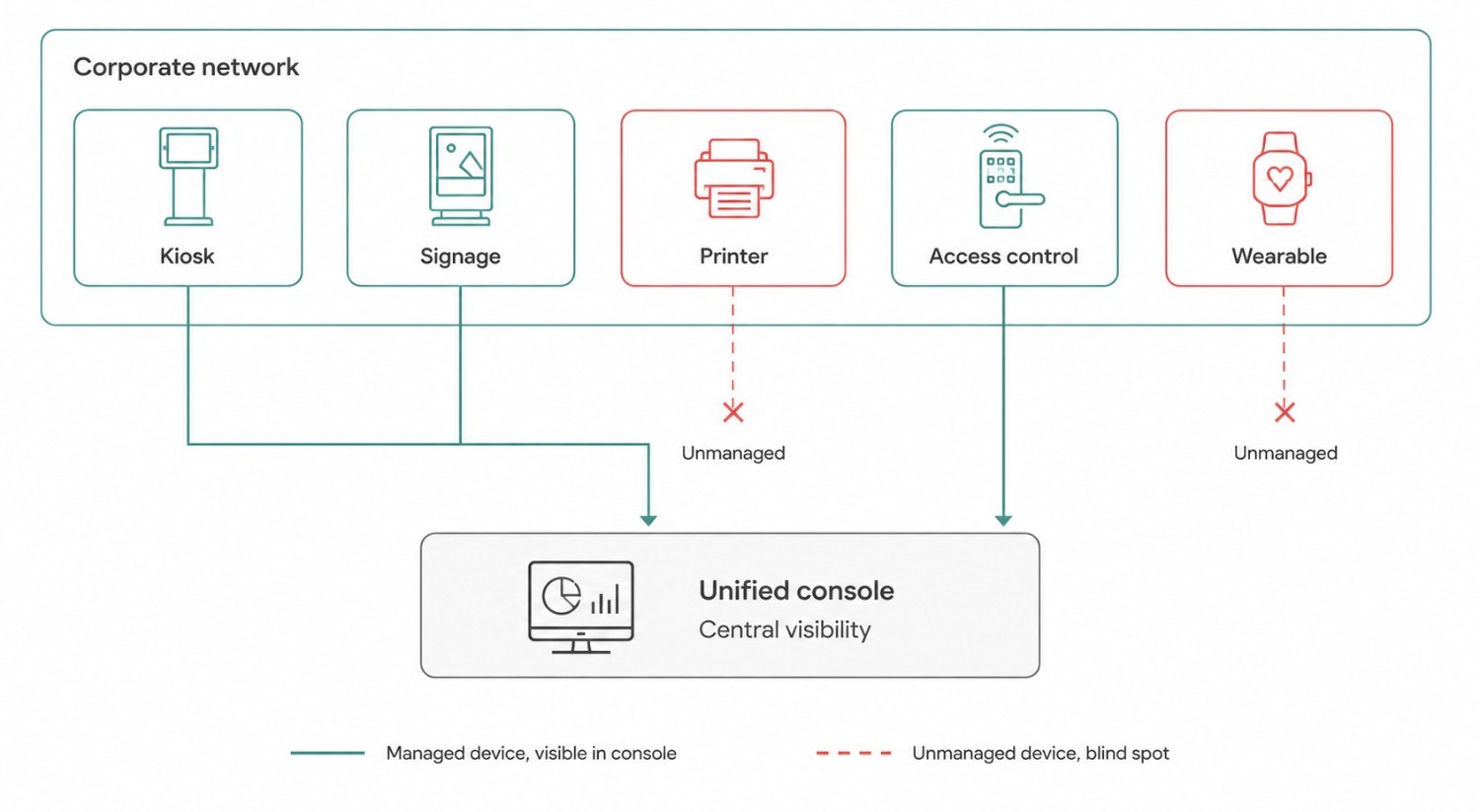
That fragmentation creates blind spots. When no single team owns full visibility, devices can go unpatched or unmonitored for extended periods without anyone noticing. As a result, the more IoT devices a business adds, the harder centralized oversight gets, unless a unified approach holds it together.
Unified IoT device management gap across kiosks, sensors, and access control devices, showing managed devices connected to a central console versus unmanaged printer and wearable devices left as blind spots
What Happens If IoT Devices Aren’t Managed Centrally?
Unmanaged or insufficiently monitored IoT devices can increase security and operational risk. They may also complicate compliance efforts. Because of this, organizations need appropriate inventory, monitoring, and cybersecurity-state awareness for the IoT devices they operate.
IoT devices can introduce security risk when organizations lack sufficient visibility into their configuration and cybersecurity state. These risks can include outdated software, insecure configurations, and inadequate access controls.
If compromised, an IoT device can give an attacker an initial foothold. From there, lateral movement may be attempted, depending on network segmentation, access controls, and other security measures.
Internet-connected edge devices, including routers, firewalls, VPN gateways, and some IoT systems, sit at network boundaries. Because of their position, they can be attractive targets for attackers. That’s exactly why visibility and secure configuration matter so much.
Depending on the applicable law, sector, and jurisdiction, inadequate IoT security controls can contribute to compliance findings or regulatory consequences. Fragmented management can also make it harder to collect consistent evidence for audits.
A gap in just one device category can raise questions during a compliance review. In turn, this can complicate the broader audit conversation.
Physical troubleshooting of distributed kiosks, printers, or signage adds administrative overhead. However, centralized and remote management can reduce the need for some site visits, though certain issues still require physical intervention.
What Is a Unified Approach to IoT Device Management?
A unified approach centralizes management and reporting where supported. This allows IT teams to apply coordinated security controls across different endpoint categories. At the same time, those controls adapt to each device type’s capabilities and risk profile.
Here’s how the two models compare in day-to-day use:
Siloed IoT management:
Separate dashboards for each device category (kiosks, printers, signage, wearables)
Inconsistent security policies across device types
Manual, device-by-device patching and troubleshooting
Fragmented audit trails that complicate IoT compliance reporting
The unified model:
Centralized management of supported IoT and traditional endpoints
Coordinated, risk-appropriate security baselines
Centralized monitoring and supported patch-management workflows
Consolidated reporting for audits and assessments
Fragmentation can increase management effort across multiple stages. A unified model, however, can consolidate supported management functions into more repeatable, scalable workflows, while still retaining device-specific tools where necessary. That shift is the foundation for the three pillars covered next
Core Pillars of a Unified IoT Management Strategy
A unified IoT device management strategy rests on three pillars: centralized visibility, consistent policy enforcement, and appropriate lifecycle automation. Together, they can reduce fragmented, device-by-device administration and support more scalable IoT management.
Centralized visibility means IT teams need an accurate, current inventory of managed endpoints, both IoT and traditional. This inventory should match the organization’s operational and security requirements. Centralized visibility helps consolidate device information, but discovery, inventory maintenance, and change-management processes are still needed to keep that information accurate.
Consistent policy enforcement means organizations should establish risk-based security baselines within each device category. These baselines can include secure configuration, data protection, access restrictions, and software-update requirements, applied according to each device’s capabilities and operational needs. Weak security controls within one device category can increase organizational risk, especially when those devices access sensitive systems without compensating controls. Consistent, risk-based policies help reduce these gaps.
Lifecycle automation means organizations should automate provisioning, patching, monitoring, and decommissioning where device capabilities and operational requirements allow. At the same time, human oversight should remain in place for activities that require assessment or approval. This kind of automation can reduce repetitive manual work while keeping that oversight intact.
These three pillars complement a broader unified endpoint management approach. Together, they apply centralized visibility, policy management, and lifecycle automation across supported IoT and traditional endpoints. Next: how to put these pillars into practice.
Featured resource
See Unified Endpoint Management in Action
Explore how Hexnode UEM brings traditional endpoints, wearables, and IoT devices into a centralized management approach.
How Do You Implement a Unified IoT Device Management Strategy?
Implementing a unified IoT device management strategy comes down to three steps: audit existing devices, consolidate policies under one console, and automate ongoing monitoring and response.
Many IT teams already have pieces of this in place. The problem is, those pieces tend to live in isolation, scattered across spreadsheets, vendor portals, and manual checklists that rarely get updated consistently. The real goal isn’t starting from scratch. Instead, it’s connecting what already exists into one coordinated workflow.
These steps provide a general framework. Organizations can adapt them to the capabilities, management interfaces, and risk profiles of their own IoT devices. Each step builds on the last, moving from discovery to standardization to automation.
Step 1: Audit and Inventory Connected IoT Devices
Step 1 means identifying the IoT devices currently on the network. This includes as many of the devices IT doesn’t officially know about as possible. This step forms the foundation of the entire strategy.
Network scans and DHCP records can be useful for identifying connected IoT devices. However, organizations should combine them with other asset-discovery and inventory sources, since neither method provides complete visibility on its own. These methods work best as starting points for finding devices that aren’t represented in the organization’s authorized inventory.
Once you’ve found them, sort each device by function: kiosk, signage, printer, access control, or wearable. Then, assign a risk level based on data sensitivity and network access. Flag any unidentified or unauthorized devices for review. Before allowing continued use, verify their ownership, configuration, firmware status, and security posture.
This inventory becomes an important input for the policy decisions in Step 2, alongside factors like device capabilities and organizational risk.
Step 2: Consolidate Policies Under a Single Management Console
Step 2 involves centralizing or coordinating management for supported IoT device categories where practical. At the same time, specialized vendor tools stay in place when they’re required for device-specific functions.
Group devices by type first, since kiosks, printers, and access control panels each need their own rules. Then group by location. For example, a retail kiosk in one city may need different network access than a warehouse scanner in another. This way, policies stay relevant to how each device actually gets used.
From there, establish appropriate security baselines for each device group. These can cover secure configuration, access restrictions, software updates, and network settings, based on each device’s capabilities and risk profile. Centralizing policies makes it easier to distribute supported configuration changes consistently, although deployment capabilities still vary by device type and platform.
Consolidation like this sets up the automation in Step 3.
Step 3: Automate Monitoring, Patching, and Remote Response
Step 3 focuses on making ongoing monitoring, patching, and response more scalable. This happens by automating appropriate tasks where device capabilities allow, while keeping human oversight where it’s needed.
Where supported by device telemetry, configure alerts for conditions like connectivity loss, compliance deviations, or security-state changes. These alerts help IT catch relevant issues between periodic manual checks. Where capabilities and change-management procedures permit, organizations can also automate approved patch deployments across appropriate device groups.
Remote diagnostics and management can reduce the need for site visits. Many software, configuration, and patching issues can be investigated or resolved remotely, though some problems still require physical intervention.
Put these three steps together, and manual, reactive management can shift toward something proactive and automated.
The ROI of Automated Patch Management for IT Teams
See how automated patch management can improve patching efficiency, and help teams manage endpoint risk at scale.
How Does Hexnode Unify IoT Device Management?
Hexnode brings supported IoT and traditional endpoints into a centralized management console. This helps IT teams manage enrolled devices through unified policy, monitoring, and lifecycle workflows.
Hexnode’s IoT device management solution covers digital signage, access control devices, printers, TV boxes, XR devices, AOSP devices, and wearables. It manages all of that alongside standard laptops and smartphones. IT teams can centrally view and monitor supported IoT devices once they’re brought under Hexnode management.
Lifecycle Management helps admins manage supported enrolled devices across stages like enrollment, provisioning, maintenance, and decommissioning. Available capabilities vary by platform and device type.
Remote Management works on supported devices and configurations. Hexnode provides remote viewing and, where available, remote control capabilities. These can help IT diagnose and resolve issues without physical access.
Kiosk Management can lock supported dedicated-purpose devices, including digital signage and public-facing endpoints, into controlled single-app or multi-app experiences. This restricts users to approved applications and functionality, cutting into the manual diagnosis work that usually slows teams down when managing a genuinely mixed device fleet.
For audits, Hexnode’s Reports and Dashboard provide centralized compliance and device-status information for supported managed endpoints. Available reporting depends on platform, policy configuration, and device check-in status.
Taken together, these capabilities give IT teams centralized workflows for managing supported enrolled devices throughout their operational lifecycle.
FAQs
Is IoT device management the same as UEM?
Not exactly. IoT device management focuses specifically on connected devices like kiosks, sensors, and wearables. Unified endpoint management (UEM), however, extends that same console to also cover laptops, smartphones, and tablets.
What devices count as IoT endpoints?
IoT endpoints commonly include digital signage, access control panels, printers, and wearables, along with other network-connected, purpose-built devices such as smart TVs, kiosks, and specialized handhelds. Broadly speaking, IoT endpoints include connected user, industrial, and purpose-built devices, such as sensors, controllers, and appliances, that exchange data over a network.
How much does unified IoT management cost?
Costs vary based on device count, platform coverage, and required features like automation or remote management. It’s worth requesting vendor pricing directly, since per-device licensing models differ quite a bit across UEM providers.
Ready to Unify Your IoT Device Fleet?
Fragmented tools slow IT teams down and leave security gaps sitting wide open. A unified IoT device management strategy can help reduce these gaps by centralizing visibility and supported management functions across IoT and traditional devices.
The audit, consolidation, and automation steps covered in this guide work best on a platform built to support them. Hexnode’s IoT device management solution supports centralized management of enrolled IoT endpoints, including device monitoring, lifecycle administration, supported remote-management capabilities, and compliance reporting.
Managing something more complex, kiosks, wearables, and access control systems all at once? A guided walkthrough tends to clear things up fast. Book a demo to see how Hexnode fits your specific setup before you commit to anything.
Bring Your Connected Device Fleet Together
Explore how Hexnode can help centralize management for supported IoT and traditional endpoints across your organization.
I write at the intersection of technology, process, and people, focusing on explaining complex products with clarity. I break down tools, systems, and workflows without any noise, jargon, or the hype.