How do you know when your current security stack isn’t enough?
Security tool gaps are often gradual and easy to miss. Antivirus, firewall logs, and basic monitoring may seem sufficient during normal operations because they block known threats and generate alerts. However, one of the clearest signs you need XDR solution capabilities is when an incident exposes how difficult it is to connect activity across endpoints, users, processes, and network events quickly.
The question is not whether tools generate data. It is whether teams can turn that data into a clear, actionable incident picture.
Common signs you need XDR solution capabilities include:
Analysts switch between multiple consoles for one investigation.
High alert volumes hide priority threats.
Teams cannot correlate activity across users and endpoints.
Investigations rely on incomplete telemetry or manual tracking.
Containment requires separate tools or handoffs.
Leaders lack clear detection and response metrics.
What happens when these signs are ignored
These gaps create direct business risk. Fragmented visibility can extend attacker dwell time, while delayed investigation gives attackers more time to access systems or sensitive data.
The effects compound:
Alert fatigue slows triage.
Slower triage delays containment.
Delayed containment increases incident scope.
Incomplete records weaken audit visibility.
Repetitive manual work contributes to analyst burnout.
Recognizing the signs that you need XDR solution support early helps teams close visibility and response gaps before a limited security event becomes a larger incident.
The 7 signs your organization needs an XDR solution
These are practical diagnostic indicators, not generic industry benchmarks. Compare them with how your team currently investigates, prioritizes, and contains security events. If multiple signs reflect daily operations, the environment may lack coordinated detection and response rather than just another point tool.
1. Your team is overwhelmed by alert volume
Disconnected tools create isolated alerts without showing whether they are related. An endpoint alert, unusual sign-in, and suspicious network connection may each reach analysts as separate events, forcing them to manually establish context.
Common indicators include:
Analysts routinely dismiss or delay alerts to reduce the queue.
Multiple tools generate duplicate notifications for the same activity.
Low-priority alerts consume more investigation time than high-risk events.
Analysts cannot investigate every alert they receive.
This is one of the clearest signs you need XDR solution capabilities. The problem is not alert volume alone; it is the absence of correlation and prioritization that helps teams focus on the activity most likely to require action.
2. You rely on signature-based detection alone
Signature-based detection compares files and indicators against known malicious patterns. It remains useful for known threats, but static matching alone has limits when attackers change code, use legitimate tools, or exploit unknown vulnerabilities.
A signature-only approach can struggle with:
Fileless techniques using built-in processes or scripting tools.
Zero-day attacks that exploit previously unknown hardware, firmware, or software vulnerabilities.
Suspicious behavior that does not match a known malicious file.
Behavioral detection adds context by examining actions such as unusual process execution, persistence attempts, credential access, or lateral movement. If security teams mainly ask whether a known malicious file was found, it is a sign they need XDR solution support that can investigate suspicious behavior beyond static signatures.
The Ultimate Guide to XDR (Extended Detection and Response)
Explore XDR detection, investigation, response, use cases, and implementation considerations.
3. Breaches are discovered after the damage is done
Finding an incident through a ransom note, service outage, fraudulent activity, customer complaint, or external notification can indicate that internal detection did not identify the activity early enough. These outcomes are not proactive detections.
Early attacker activity can include:
Suspicious process execution.
Unusual authentication behavior.
Privilege changes or new persistence mechanisms.
Movement between endpoints.
Attempts to access sensitive data.
When these signals remain isolated, teams may not recognize the attack sequence until the attacker has caused disruption. This is a sign you need XDR solution capabilities that provide a unified investigation view and help analysts assess related endpoint activity before damage occurs.
4. Your team lacks visibility across the full endpoint fleet
Separate, OS-specific security tools may provide useful local information, but they can make it difficult to see device health, active threats, incident status, and response progress in one place.
This fragmentation often means:
Analysts switch consoles to establish incident scope.
Related activity across different device groups is difficult to identify.
Teams cannot quickly confirm which endpoints have security coverage.
Leaders lack a consolidated view of threats and response status.
These gaps can delay detection and slow incident response across mixed-OS environments. If teams must manually reconcile multiple dashboards during an investigation, it is among the signs you need XDR solution capabilities.
5. Response to confirmed threats takes too long
A confirmed threat requires timely containment. If analysts must remotely access a device, use multiple administration tools, wait for approvals, or rely on scheduled remediation, an attacker has more time to continue operating.
Response delays commonly occur when teams cannot quickly:
Isolate an affected endpoint.
Terminate a suspicious process.
Quarantine a malicious file.
Track whether the required action was completed.
Preserve investigation evidence while containing the threat.
The absence of fast, centralized containment workflows indicates that current tooling may not match the speed of an active attack. XDR can help bring validated detections and response actions into a more coordinated investigation process.
6. You can’t reconstruct what happened during an incident
Post-incident review should show how activity began, which systems were affected, what the attacker did, and whether containment was complete. When teams must manually gather logs from separate systems and reconcile inconsistent timestamps, the investigation becomes slow and unreliable.
Warning signs include:
Analysts build incident timelines in spreadsheets.
Logs are incomplete, inconsistent, or difficult to search.
Teams cannot identify related activity after the initial alert.
Root cause remains uncertain after remediation.
Audit records do not clearly show response actions.
Weak investigation data can leave compromised credentials, persistence mechanisms, or affected endpoints undiscovered. It can also weaken audit evidence during compliance reviews. These are signs you need XDR solution support with centralized investigation data and searchable event history.
7. You can’t map threats to known attacker behavior
Alerts may show what happened, such as a suspicious PowerShell command or login, but not explain how it relates to an attacker’s objective. Without this context, analysts must guess whether activity indicates discovery, persistence, credential access, or lateral movement.
Framework-based context, including mapping to MITRE ATT&CK techniques, helps teams:
Understand why an alert matters.
Identify likely follow-on behavior.
Search for related activity across the environment.
Prioritize investigation and containment steps.
When alerts provide isolated technical details without attack-pattern context, teams are investigating with limited direction. This is another sign you need XDR solution capabilities that connect evidence to known attacker behavior and support more informed response decisions.
Featured resource
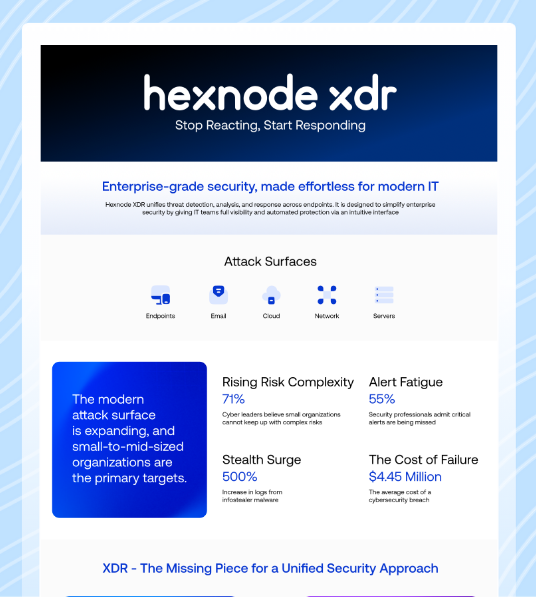
Hexnode XDR Info Sheet
Hexnode XDR unifies threat visibility, investigation, and response to strengthen endpoint security across managed devices.
Hexnode XDR helps security teams address the visibility, investigation, and response gaps that indicate point tools are no longer sufficient. It brings endpoint threat activity and response workflows into a centralized security operation.
Key capabilities align directly with the warning signs discussed above:
Alert Profiles allow administrators to configure notifications for relevant events. Remove the XDR-specific contextualized-alert claims.
Hexnode XDR supports device isolation and process termination to help contain a confirmed threat. Remove the file-quarantine claim.
For organizations seeing several of the earlier warning signs, Hexnode XDR provides a more coordinated way to prioritize, investigate, and respond to activity across managed endpoints.
FAQs
What is the difference between XDR and traditional endpoint security?
Traditional endpoint security primarily focuses on protecting individual devices and detecting known threats. XDR helps teams correlate endpoint activity with related security signals, investigate incidents with added context, and coordinate response actions.
When should an organization consider replacing separate security tools with XDR?
An organization should consider XDR when separate tools create investigation delays, duplicate alerts, or incomplete incident visibility. It is especially relevant when analysts must manually connect activity across endpoints, users, and security consoles.
Can XDR help reduce alert fatigue for security teams?
XDR can reduce alert fatigue by correlating related security events and adding context that helps analysts prioritize alerts. It does not eliminate alerts, but it can reduce the manual effort required to determine which events need investigation.
Assess Your Own Environment Against These 7 Signs
Recognizing even two or three of these signs is a strong indication that current security tooling has outgrown the organization’s threat landscape. The issue may not be a lack of alerts or endpoint data, but the inability to connect that information, investigate it efficiently, and contain confirmed threats quickly.
Assess whether your team can:
Prioritize high-risk activity without alert overload.
Investigate endpoint events with sufficient context.
Reconstruct incidents and act from a centralized workflow.
If these capabilities are missing, start a 14-day free trial with no credit card required or request a demo to see how Hexnode XDR can address these gaps across managed endpoints.
Identify security gaps before incidents.
Start your free trial and Strengthen response workflows.
A storyteller for practical people. Breaks down complicated topics into steps, trade-offs, and clear next actions—without the buzzword fog. Known to replace fluff with facts, sharpen the message, and keep things readable—politely.