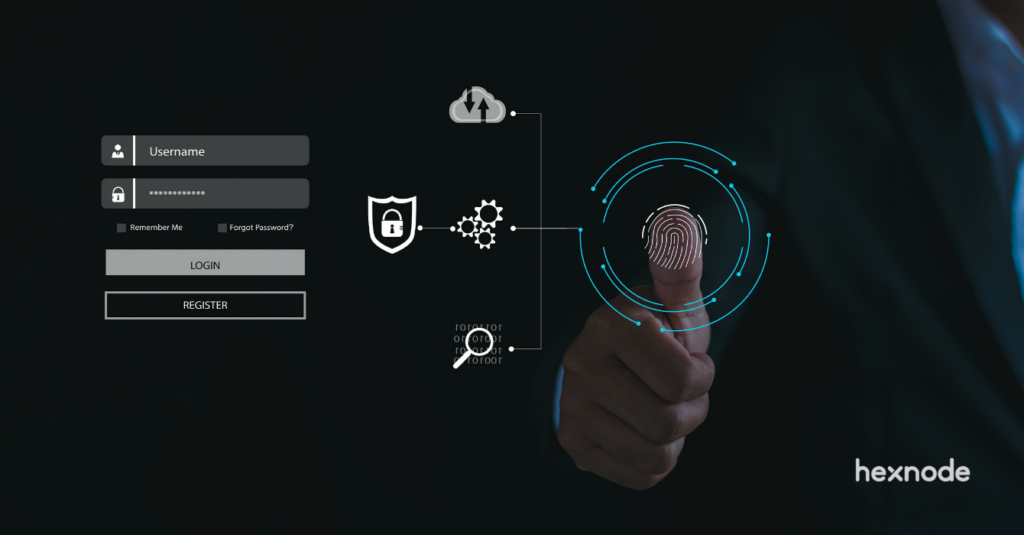
As hybrid work dissolves perimeters, identity has become the primary control plane. Centralized identity shrinks attack surfaces, simplifies compliance, automates user lifecycles, and anchors Zero Trust.
Combining identity with Hexnode device posture pairs user verification with endpoint health for defensible access. Audit your current access and device visibility gaps today to prevent compounding risk.
An identity provider (IdP) is the authoritative source that verifies who a user is and governs what they’re allowed to reach. Instead of every application maintaining its own credential store and access logic, the IdP becomes the single point of truth for authentication and authorization across your environment. When it works well, it’s invisible; when it’s absent, the gaps show up as orphaned accounts, inconsistent access policies, and audit findings.
For most of enterprise IT history, security was perimeter-centric. The corporate network was the trust boundary, and controls like firewalls and VPNs enforced the line between inside and outside. That model has been steadily dismantled by two forces: hybrid work, which put users and devices outside the perimeter permanently, and SaaS sprawl, which moved critical data and workflows off the corporate network entirely.
The result is that identity has become the new perimeter. Access decisions now hinge on who a user is and the context of their request, not where they’re connecting from.
This is why the timing matters heading into 2026:
App density is climbing. The number of applications each employee touches daily continues to grow, and every one is a potential access point that needs governing.
Workforces are more distributed than ever. Remote, hybrid, and contractor access is now the norm, not the exception, stretching legacy access models past their limits.
Attackers have shifted focus. Credential theft, phishing, and session hijacking have overtaken network intrusion as the dominant path to compromise. It’s easier to log in than to break in.
The five reasons that follow highlight the identity provider benefits that make an identity investment worth including on your 2026 roadmap — spanning threat exposure, compliance, operational cost, scalability, and zero trust.
Reason 1 — Credential-Based Attacks Are the Dominant Threat
The economics of attack have shifted decisively. Breaching a hardened network is expensive and noisy; harvesting a valid credential is cheap, quiet, and increasingly automated. For the modern adversary, the login page has replaced the firewall as the primary target — and the tactics are well-established:
Phishing remains one of the highest-yield entry methods, now augmented by AI-generated lures and adversary-in-the-middle kits that capture session tokens alongside passwords.
Credential stuffing weaponizes the billions of username-password pairs already circulating from prior breaches, exploiting the reality that users reuse credentials across systems.
MFA-fatigue attacks bypass a control many organizations assumed was sufficient, spamming push notifications until a user approves one out of frustration.
The structural problem is fragmentation. When every application maintains its own login, you have dozens of independent authentication surfaces, each with its own password policy, its own MFA configuration (or lack of one), and its own logging. That sprawl multiplies the attack surface and eliminates any consistent view of authentication events.
One of the key identity provider benefits is the ability to collapse that surface into a single, defensible control plane:
Uniform strong authentication — phishing-resistant MFA and passwordless methods enforced consistently, not app-by-app.
Conditional access that evaluates context (user, location, risk signals) before granting a session, rather than treating a valid password as a permanent trust token.
Consolidated authentication logs that make anomalous access visible instead of scattered across siloed systems.
There’s also a quieter risk that centralization addresses: dormant accounts and orphaned access. Without a single identity source governing the full lifecycle, deactivated users and stale service accounts linger — high-privilege, unmonitored, and ideal for lateral movement.
Identity controls are strongest when paired with visibility into the devices requesting access, and this is where Hexnode gives IT the device-side context that access decisions depend on.
Reason 2 — Compliance and Audit Pressure Keeps Rising
Every major compliance framework eventually converges on the same question: can you prove who has access to what, and demonstrate that access is appropriate? Access governance is no longer a checkbox buried in a controls matrix — it’s a recurring, load-bearing requirement across the frameworks most enterprises answer to:
SOC 2 and ISO 27001 demand demonstrable least-privilege enforcement and access review processes.
GDPR ties data access controls directly to the protection of personal data.
HIPAA and sector-specific rules impose strict authorization and auditability requirements on regulated data.
Without centralized identity, satisfying these requirements becomes an exercise in manual reconstruction. Proving who accessed what, when means pulling logs from dozens of disconnected applications, reconciling inconsistent formats, and hoping no system was missed. The result is slow, error-prone, and difficult to defend when an auditor asks a follow-up question.
Among the most practical identity provider benefits is turning that reconstruction into a byproduct of normal operations:
Unified access logs capture authentication and authorization events in one consistent, queryable record.
Provisioning and de-provisioning trails document the full lifecycle of every access grant — who approved it, when, and when it was revoked.
Least-privilege enforcement becomes systematic through role-based and policy-driven access, rather than dependent on individual admins remembering to trim permissions.
These identity provider benefits become especially clear during audit season. Instead of weeks of manual evidence-gathering, teams can produce access reports and attestations on demand, freeing senior staff from spreadsheet archaeology and reducing the risk of a finding rooted in incomplete records.
Identity answers the who, but compliance also depends on the endpoints touching regulated data being properly configured, encrypted, and reportable — an area where Hexnode gives IT the device-level enforcement and evidence that audits increasingly expect.
Featured Resource
Simplifying Compliance: An Actionable Guide for IT
Get a practical guide to compliance challenges and how device management can support stronger security foundation.
Reason 3 — Onboarding and Offboarding Are Costing You Time and Risk
The security case for identity gets the headlines, but the operational case is often what wins budget approval. Every hire, role change, and departure triggers a cascade of manual access work — and at scale, that work is a measurable drain on IT.
Consider the hidden cost of manual provisioning. Manual, app-by-app onboarding requires setting roles, groups, and approvals across dozens of separate systems. Applied across every hire and internal transfer, this creates an IT burden that scales with headcount.
Offboarding is where the cost turns into risk. Manual de-provisioning is slow and easy to get incomplete, which opens a dangerous access window:
A departing employee retains active credentials to SaaS apps, file stores, and privileged systems days or weeks after their exit.
Contractor and third-party access lingers well past the end of an engagement.
No single admin has a complete inventory of what a given user could still reach.
This gap creates a well-documented insider and post-employment threat vector, occurring whenever organizations fail to ground access controls in a single source of truth.
One of the operational identity provider benefits is closing this gap through automation:
Automated provisioning grants the correct access instantly based on role, eliminating manual per-app setup.
Automated de-provisioning revokes every downstream entitlement the moment a user is disabled at the source — collapsing the offboarding window to near-zero.
Self-service password resets and access requests offload high-volume, low-value tickets from the helpdesk, reducing operational load and mean time to resolution.
Onboarding is smoothest when identity setup and device readiness happen in parallel — while the IdP provisions the user, Hexnode handles the device side, so new hires are secured, configured, and productive on day one rather than waiting on IT.
Reason 4 — Your App Stack Has Outgrown Manual Access Management
Large enterprises now commonly run hundreds of SaaS applications, and departmental teams keep adding more without IT in the loop. That volume has quietly broken the manual access model. What worked when the portfolio was a dozen core systems collapses under a sprawling, constantly shifting app inventory.
The downstream effects are predictable and expensive:
Password fatigue drives users toward weak, reused credentials — the exact behavior that makes credential-stuffing attacks viable.
Shadow IT proliferates when official access is slow, leaving sensitive data in unsanctioned apps IT can’t see or govern.
Access drift accumulates as no one has a complete picture of who can reach which system.
Single sign-on (SSO) is the control that resolves the tension between security and usability. It’s often framed as a convenience feature, but the enterprise value is dual:
On the security side, SSO consolidates authentication behind one strongly protected identity, eliminating the dozens of independent passwords that each represent an attack surface.
On the productivity side, it removes login friction entirely — no repeated credential prompts, no password-reset tickets, no context-switching tax on the workforce. Reduced friction also undercuts the incentive to route around IT with shadow IT.
Beyond authentication, another of the major identity provider benefits is improved visibility. A unified view of application access makes entitlement reviews, anomaly detection, and least-privilege enforcement practical.
Scalability is another of the important identity provider benefits for growing organizations. Manual management requires rebuilding access provisioning for new applications and hunting down stale accounts upon retirement. With identity as the control plane:
New apps integrate into existing access policies and role structures on day one.
Retiring an app cleanly revokes access across all affected users.
The portfolio can grow or contract without proportional growth in administrative overhead.
Access management is only half the security equation. Hexnode distributes, updates, and manages fleet applications to ensure consistency from login to endpoint.
Reason 5 — Zero Trust Is No Longer Optional
Zero trust has moved from architectural aspiration to operational priority. Insurers, regulators, and boards increasingly demand demonstrable access controls and zero-trust baselines. This makes 2026 a practical inflection point to shift from planning to enforced policy. The four reasons already covered — threat exposure, compliance, operational cost, and app sprawl — are not separate problems. They’re symptoms of the same root cause zero trust is designed to address.
The principle is never trust, always verify: no user, device, or request is trusted by default, regardless of network location. And the enforcement point for that principle is identity. Every access decision begins with a verified answer to who is this, evaluated against policy before a session is granted.
This is a fundamental break from the legacy model of one-time authentication. In the perimeter era, a successful login granted a durable trust token — verify once, roam freely. Zero trust replaces that with continuous, context-aware verification:
Access is evaluated per-request, not per-session.
Signals like user risk, location, and behavior are assessed dynamically.
Elevated risk triggers step-up authentication or denial mid-session, not just at login.
The dependency is unavoidable: zero trust fails without a reliable identity foundation. You cannot continuously verify what you cannot authoritatively identify. Attempting Zero Trust without centralized identity creates fragmented, unenforceable policies—delivering the appearance of maturity without substance.
The identity provider benefits also extend to longer-term security and architectural readiness. A functioning identity-and-zero-trust foundation increasingly determines:
Cyber insurance eligibility and premiums, as underwriters demand demonstrable access controls.
Regulatory readiness as frameworks tighten around continuous verification.
Architectural headroom for whatever security requirements arrive next.
Critically, zero trust evaluates both who and what is requesting access. Combining identity policies with Hexnode device signals ensures that only managed, encrypted, and healthy endpoints gain access to corporate resources.
Pairing Identity With Device Intelligence for Stronger Access Decisions
An identity investment answers who is requesting access. But every one of the five reasons above shares an unstated dependency: the strength of an access decision is capped by what you know about the device on the other end. A verified user on a compromised, unmanaged, or non-compliant endpoint is still a risk your IdP alone can’t see. This is where Hexnode completes the picture.
Device-informed access decisions. Hexnode continuously monitors device posture, including encryption, patch status, and management state. Feeding these signals into Microsoft Entra ID ensures access policies enforce device health alongside user identity. The result is fewer blind spots in exactly the decisions that matter most.
Unified onboarding and control. As identity provisions the user, Hexnode provisions and hardens the device in parallel — automating setup, enforcing policy, and closing the configuration gaps that manual processes leave open. Organizations secure and empower new hires from day one while IT eliminates duplicate effort by unifying user and device onboarding.
Continuous visibility for compliance and zero trust. Hexnode surfaces fleet-wide compliance reporting and enforcement that turn device state into defensible audit evidence and contribute the device-posture signals a zero-trust architecture relies on. Rather than attesting only to user identity, organizations can prove that only compliant, properly managed devices accessed corporate resources—delivering the level of proof auditors and underwriters now demand.
Paired this way, identity and device intelligence reinforce each other: the IdP governs the user, Hexnode governs the endpoint, and access decisions draw on both — a stronger, more complete foundation than either delivers alone.
UEM for Endpoint Drift Management: Remediate Drift Automatically
See how endpoint drift creates compliance gaps and how automated remediation keeps devices aligned with IT policy.
Frequently Asked Questions
Is an identity provider the same as single sign-on or MFA?
No — SSO and MFA are capabilities an identity provider delivers, not the whole thing. The IdP is the central authority that verifies users and governs access, while SSO removes repeated logins and MFA adds authentication strength on top of it. Think of the IdP as the control plane, with SSO and MFA as features it enforces consistently across your apps.
Do I still need device management if I already have an identity provider?
Yes. An IdP confirms who is requesting access, but it has limited insight into the device making the request. Even a verified user poses a security risk on a compromised or non-compliant endpoint. Identity policies require device posture signals—such as encryption, patch level, and management state—to deliver complete access decisions. Identity and device intelligence cover different halves of the same decision.
How is a modern IdP different from just using Active Directory?
Traditional directories served the perimeter era, relying on the internal network as the primary boundary of trust. A modern identity provider extends authentication and authorization to cloud and SaaS apps outside that perimeter and supports context-aware, per-request verification rather than a one-time login. It’s the shift from “verify once inside the network” to “continuously verify regardless of location.”
Where should we start if we’re moving from manual access management?
Begin with an honest assessment rather than a purchase. Map who currently has access to what, review how offboarding actually works in practice, and check whether device state factors into access at all. The gaps that surface — orphaned accounts, slow deprovisioning, blind access grants — show you where to prioritize first.
Won’t rolling out an identity provider disrupt users during the transition?
A well-planned rollout usually reduces friction rather than adding it, since SSO removes repeated logins and self-service resets cut helpdesk dependence. Disruption tends to come from poor sequencing — migrating apps without mapping existing access first. Starting with an access inventory and phasing high-value apps in early keeps the change manageable.
Does zero trust require an identity provider, or can we build it another way?
Zero trust depends on a reliable identity foundation. Its core principle — never trust, always verify — needs an authoritative way to identify every user and request before evaluating policy. Without centralized identity, verification becomes fragmented and unenforceable, so most zero-trust efforts treat the IdP as the starting point, not an optional add-on.
Conclusion
The five reasons laid out here aren’t five separate arguments — they’re one. Threat exposure, compliance, costs, and zero trust share the same foundation. Each ultimately succeeds or fails on the strength of centralized identity. Manual, app-by-app access management cannot scale as identity complexity outpaces administrative capacity each quarter.
Viewed correctly, the identity provider benefits go far beyond a line item — they translate into risk reduction and operational leverage. It lowers breach exposure, accelerates offboarding, and cuts helpdesk and audit overhead. This builds the architectural flexibility to satisfy future security, regulatory, and insurance demands.
Delay isn’t neutral: attack surface, audit exposure, and orphaned access compound the longer the status quo holds, which is exactly why 2026 is the practical inflection point to act. Identity governs the user, but access decisions depend on device posture. Pairing your IdP with Hexnode creates a complete, defensible security foundation. The most useful first step isn’t a purchase; it’s an honest assessment of where you stand today. Map user entitlements, audit your offboarding workflows, and verify whether device posture enforces access decisions. The gaps that surface will tell you exactly where 2026 needs to begin.
Bring endpoint drift under control
See how Hexnode helps IT teams automate fixes, enforce compliance, and keep devices aligned with policy, at scale.
Associate Product Marketer at Hexnode focused on SaaS content marketing. I craft blogs that translate complex device management concepts into content rooted in real IT workflows and product realities.