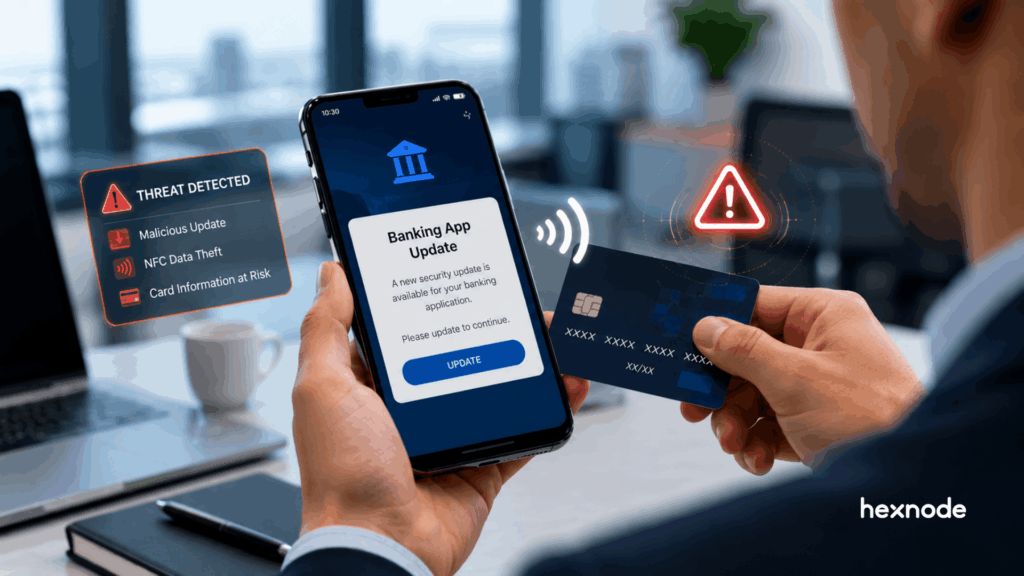
A recent NFCShare Android malware campaign is using phishing websites and fake banking app updates hosted on GitHub to target banking customers across Europe. Victims are directed to install malicious Android applications that imitate legitimate banking software and are then guided through a fake verification process that leverages the device’s NFC capabilities to collect payment card information. The campaign demonstrates how mobile threats are increasingly combining phishing, application impersonation, and NFC-enabled payment abuse to facilitate financial fraud.
Android banking malware continues to evolve beyond credential theft. The latest variants of NFCShare Android malware illustrate how threat actors are combining social engineering with trusted platforms and mobile hardware features to target payment card data.
The campaign uses phishing websites that impersonate legitimate financial institutions and directs victims to download purported banking app updates hosted on GitHub repositories. Once installed, the malicious application guides users through a fake verification workflow that involves placing a payment card near the device’s NFC reader and entering a PIN.
While the campaign primarily targets banking customers in Europe, the techniques employed highlight broader risks for organizations supporting mobile workforces, BYOD programs, and mobile-based access to business applications.
The attack chain relies heavily on social engineering rather than exploiting a software vulnerability.
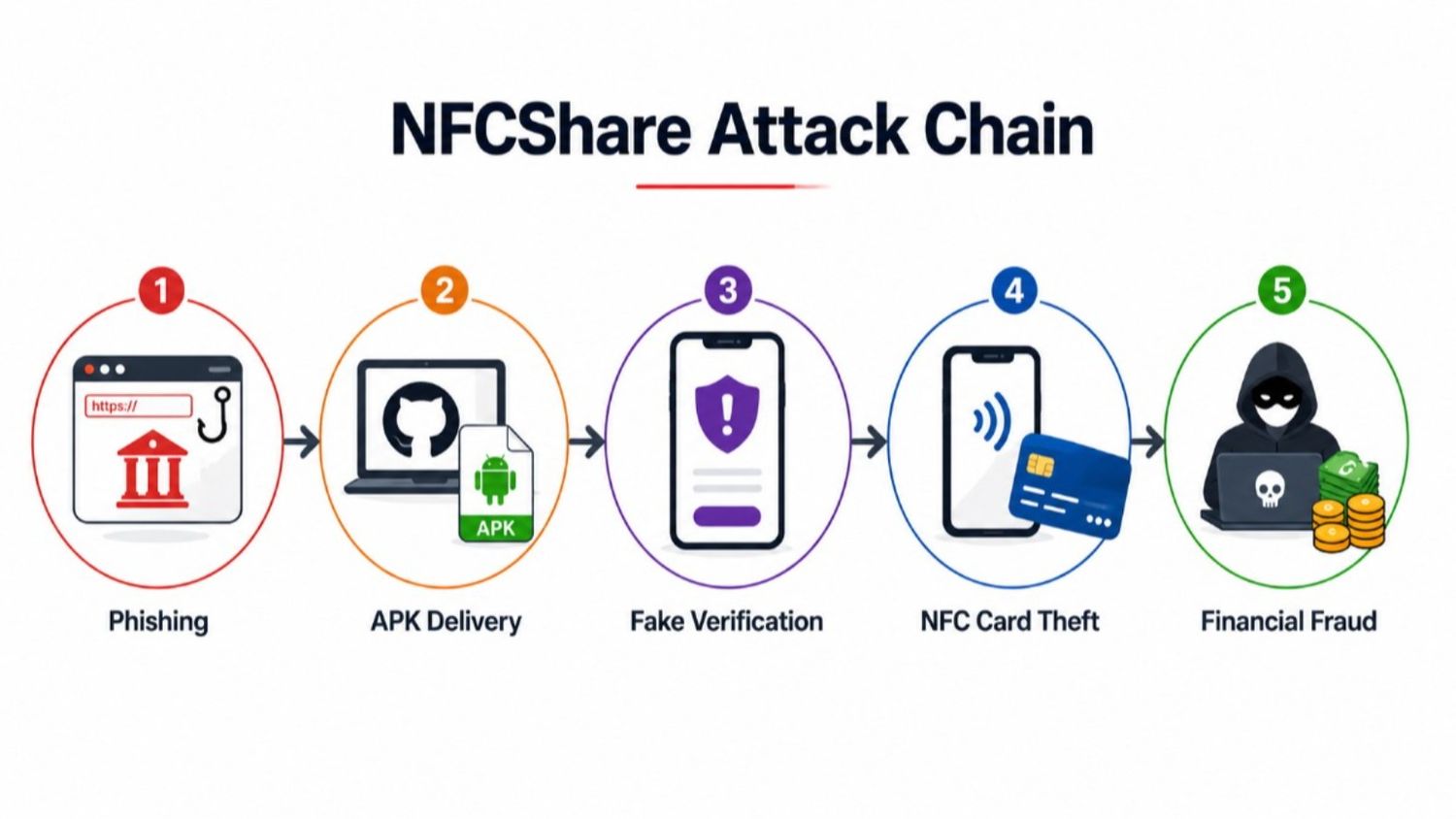
The observed infection flow begins with phishing websites designed to mimic legitimate banking portals. Victims are prompted to enter banking-related information and are subsequently instructed to install what appears to be a required banking application update. Instead of directing users to an official app marketplace, the campaign redirects them to GitHub-hosted APK files.
After installation, the malicious application presents a series of screens that claim a security or card verification step is necessary. Users are instructed to place their payment card near the device’s NFC reader and enter their card PIN as part of the process.
This approach allows the attackers to exploit user trust rather than relying on technical exploitation of the banking applications themselves.
NFCShare Android malware attack chain
Confirmed Attack Elements
Based on publicly reported analysis, the campaign involves:
Bank-themed phishing websites
GitHub-hosted malicious APK files
Banking application impersonation
NFC-based payment card data collection
PIN harvesting through fraudulent verification screens
Command-and-control communications using WebSocket connections
No public reporting has confirmed compromises of the targeted banks themselves.
Technical Analysis of the Malware
NFCShare Android malware leverages Android’s NFC capabilities to interact with payment cards placed near the device.
Analysis indicates that the malware uses Android’s IsoDep interface and EMV commands to communicate with payment cards during the fraudulent verification process. Through this interaction, the malware can obtain payment card information presented by the card during NFC communication.
The malware reportedly collects:
Payment card number
Card type information
Card expiration date
A four-digit PIN entered by the victim during the verification workflow
The collected information is then transmitted to attacker-controlled infrastructure using WebSocket communications. Public reporting indicates that this information may subsequently be used in NFC payment fraud schemes.
Evasion Techniques
Recent NFCShare samples also incorporate packaging modifications intended to complicate automated analysis.
Researchers observed malformed APK packaging structures designed to interfere with automated extraction and static analysis processes. While this does not necessarily prevent analysis, it may create additional challenges for automated inspection workflows.
This evolution suggests ongoing development efforts aimed at improving the malware’s resilience against security research and detection efforts.
What We Know and What Remains Unclear
Several aspects of the campaign have been publicly documented.
Confirmed
NFCShare is being distributed through fake banking update workflows.
GitHub repositories have been used to host malicious APK files.
Multiple banking brands in Europe have been impersonated.
The malware uses NFC functionality to interact with payment cards.
At least 56 unique APK samples were reportedly hosted in a distribution repository since April 2026.
Unconfirmed
Several questions remain unanswered:
The identity of the threat actor has not been publicly confirmed.
The full scale of victimization has not been disclosed.
The extent of any successful financial fraud resulting from the campaign has not been publicly reported.
While similarities to other NFC-focused banking malware families have been noted, definitive attribution has not been established.
Given the available evidence, it is most accurate to classify this activity as a malware campaign involving social engineering and financial fraud techniques rather than a breach of any specific banking institution.
Android metadata encryption: Enterprise guide to metadata security
Explore how Android metadata encryption helps protect sensitive device information.
Why This Matters for Enterprises
Although the campaign targets consumers through banking-themed lures, the underlying techniques have implications for enterprise mobile security.
Many organizations support BYOD programs that allow employees to access corporate email, SaaS applications, identity platforms, and collaboration tools from personal Android devices. A compromised device may increase organizational risk even when the initial malware objective is financial theft.
The campaign also highlights several broader trends:
Sophisticated social engineering designed to bypass user skepticism
As mobile devices increasingly serve as both personal and business endpoints, organizations must consider mobile security as part of their broader endpoint and identity protection strategy.
How Hexnode Can Help Reduce Mobile Risk
Preventing every phishing attempt is unrealistic. However, organizations can reduce exposure by enforcing stronger mobile security controls and maintaining visibility into managed devices.
Hexnode UEM
Hexnode UEM can help organizations strengthen Android security through:
Application management policies
Restrictions on unauthorized app installation
Device compliance enforcement
Managed deployment of approved applications
BYOD policy implementation
Security policy enforcement across managed Android devices
These controls can help reduce the likelihood of users installing unapproved applications from external sources.
Hexnode IdP
For organizations using identity-centric security controls, Hexnode IdP can help support:
Multi-factor authentication (MFA)
Role-based access control (RBAC)
Device compliance validation
Basic conditional access policies
Federated identity integration with Microsoft Entra ID and Google Workspace
These controls can help organizations verify device trust and access requirements before granting access to business resources.
Hexnode XDR
If a device is suspected of compromise, Hexnode XDR can help security teams:
Investigate endpoint activity
Review historical endpoint events
Conduct endpoint investigations using query-based threat hunting and investigation capabilities
Use endpoint data and investigation queries during threat hunting
Isolate affected devices when necessary
Terminate malicious processes
Quarantine malicious files during incident response
These capabilities can assist security teams with endpoint detection, investigation, containment, and remediation activities.
Featured resource
Android Enterprise Management Solution
Learn how Hexnode's Android Enterprise management capabilities help IT teams secure Android devices, and reduce mobile security risks.
The NFCShare Android malware campaign demonstrates how modern mobile threats are blending phishing, application impersonation, and hardware-enabled data theft into a single attack chain.
Rather than exploiting a software vulnerability, the attackers rely on convincing users to install malicious applications and participate in fraudulent verification steps. This underscores the importance of combining user awareness, device compliance controls, application governance, and endpoint response capabilities.
As mobile devices continue to serve as gateways to both personal finances and enterprise resources, organizations should ensure that mobile security receives the same attention as traditional endpoint protection. NFCShare is another reminder that attackers increasingly view smartphones as high-value targets and enterprises should too.
Reduce Mobile Risk with Stronger Endpoint Controls
Strengthen mobile security with centralized device management, identity controls, and endpoint response capabilities.
I write at the intersection of technology, process, and people, focusing on explaining complex products with clarity. I break down tools, systems, and workflows without any noise, jargon, or the hype.