BleepingComputer reported that the JadePuffer autonomous AI agent has upgraded with custom ransomware called EncForge.
The malware focuses on encrypting AI and machine-learning assets including training datasets, vector databases, model checkpoints, embedding indexes, and related model files.
Sysdig said the attacker returned to a previously breached Langflow instance vulnerable to CVE-2025-3248.
After searching for cloud credentials, API tokens, and reachable internal services, the threat actor discovered an exposed Docker socket that provided root-level control.
The Go-based EncForge binary targets roughly 180 file extensions and appends the .locked extension to encrypted files.
For years, ransomware operators have followed a predictable playbook: encrypt file servers, databases, and backups, then extort for the decryption key. That playbook just expanded.
BleepingComputer and Sysdig have documented a threat actor called JadePuffer deploying a custom ransomware strain, EncForge, purpose-built to encrypt AI and machine learning infrastructure. Training datasets, vector databases, model checkpoints, and embedding indexes — the assets that took months and significant compute budget to produce — are now inside the blast radius.
This isn’t an incremental update to an existing ransomware family. It’s a signal that attackers view AI/ML environments as a distinct, high-value target class, one that most enterprise security programs weren’t built to defend. For IT and security leaders who greenlit AI initiatives without folding them into existing XDR, IAM, and workload-visibility programs, JadePuffer is the wake-up call.
From Langflow RCE to Root: Inside the EncForge Attack Chain
The reported attack began from a previously compromised Langflow instance vulnerable to CVE-2025-3248, a missing-authentication flaw in the platform’s code-validation endpoint that allows unauthenticated remote code execution. After establishing access, the operator ran reconnaissance for cloud credentials, API tokens, and reachable internal services, then located an exposed Docker socket that provided a path to root-level control on the host.
From there, the attacker didn’t rely on a single, static exploit chain. It iteratively built and revised scripts through the same RCE channel — adapting in real time after an initial payload transfer failed — until it had a working pipeline that:
Copied EncForge across the container-to-host boundary via procfs
Ran a test scan to validate the encryption logic before full execution
Launched the live encryption pass
Counted .locked files afterward to verify impact
This isn’t scripted malware following a fixed playbook. It’s closer to an autonomous intrusion loop — one that diagnoses failure, revises its approach, and confirms success without human intervention at each step. That has direct implications for mean time to detect (MTTD): signature-based controls tuned for known payload patterns have less to anchor on when the attacker is regenerating its own tooling mid-session.
On the payload itself, EncForge uses AES-256 in counter mode (CTR) for file encryption, with the symmetric key wrapped by an embedded RSA-2048 public key — a standard hybrid scheme, but one deliberately scoped to AI/ML file types (model checkpoints, vector databases, training sets, embedding indexes) rather than office documents or generic file shares. That targeting choice matters operationally: backup and recovery strategies built around document repositories and databases don’t automatically extend to model stores and vector DBs, which is precisely the gap this payload is designed to exploit.
When Should a Business Upgrade from Basic Device Control to Full UEM?
Upgrade to UEM when basic device control limits security, scalability, and centralized endpoint management.
Hexnode’s Role: Endpoint Detection, Compliance, and Conditional Access
Where does an XDR-and-UEM-centric approach fit into a scenario like this? The honest answer is: primarily at the endpoint and identity layers, not inside the AI workload itself — and that distinction matters for how you scope your defense.
Detection and correlation:
Hexnode XDR applies behavioral analysis to endpoint telemetry, helping secure Windows developer and administrator workstations that access AI stacks, flagging anomalous process execution, unauthorized command shells, and lateral-movement indicators such as network beaconing. In a JadePuffer-style scenario, that means a developer workstation used to reach the Langflow instance, or a device showing unusual outbound connections during the intrusion, gets flagged and correlated rather than treated as isolated noise.
Automated containment:
When Hexnode XDR detects a severe behavioral pattern, it doesn’t wait for manual triage. It can perform the Kill Process action to terminate malicious processes and their process trees, and the Isolate Device action to disconnect the affected endpoint from the network while preserving a secure telemetry channel back to the console. This cuts off lateral movement while allowing security teams to continue investigating the incident remotely.
Posture and compliance:
Hexnode UEM handles the vulnerabilities that don’t require active exploitation to be dangerous — unpatched systems, misconfigured settings, drifted baselines. Automated patch management closes these gaps across the fleet without waiting on a help-desk ticket, and when XDR flags a device as compromised, UEM marks it non-compliant — a state that has downstream consequences for access.
Identity-aware containment:
That non-compliant state integrates with identity providers such as Microsoft Entra ID to trigger Conditional Access — invalidating active SaaS tokens and cutting the device’s access to corporate cloud resources before an attacker can pivot further. For teams running exposed tools like Langflow, this closes a real gap: a developer endpoint that touched a compromised instance doesn’t get to keep its access to sensitive cloud services just because no one has manually reviewed the incident yet.
None of this replaces workload-level protections purpose-built for containers, Docker daemons, or cloud infrastructure — those exposures (like the Docker socket JadePuffer exploited) need their own controls. But it closes the endpoint and identity gaps that let a single compromised developer machine become a foothold for the rest of the intrusion.
Featured Resource
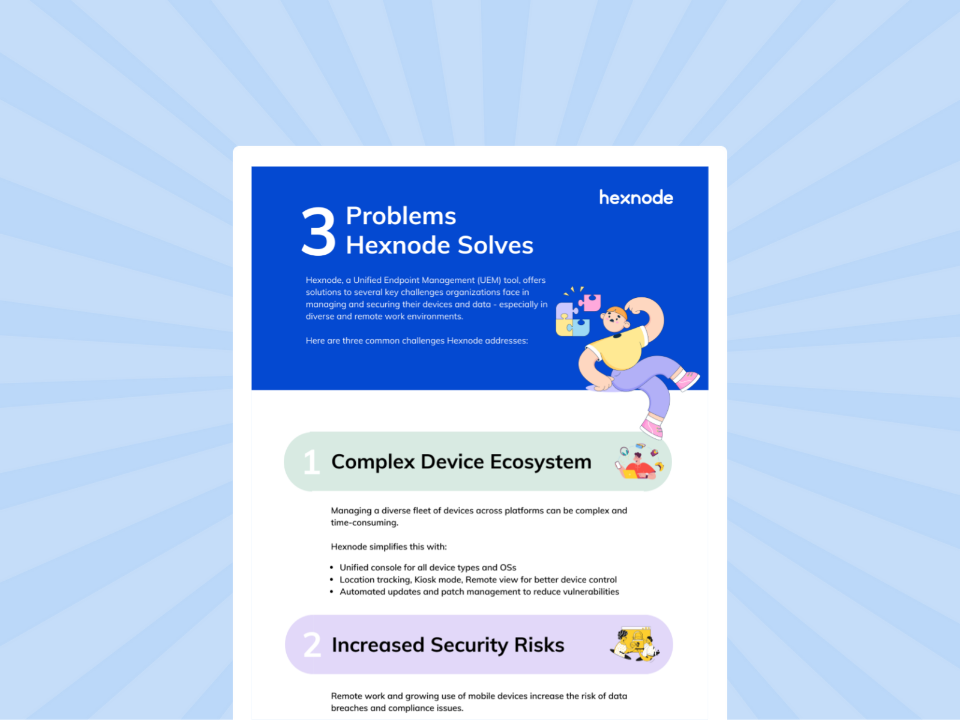
3 Problems Hexnode Solves
Discover how Hexnode streamlines device management and compliance.
JadePuffer and EncForge are not an isolated curiosity. They’re a preview of where ransomware operators are heading now that AI infrastructure represents concentrated, hard-to-reproduce value sitting behind the same weak points enterprises have tolerated for years.
The remediation priorities are not exotic:
Patch Langflow to the current supported release — CVE-2025-3248 was fixed in 1.3.0, but subsequent RCE and authorization-bypass flaws mean version currency needs ongoing attention, not a one-time fix.
Restrict Docker socket access — treat /var/run/docker.sock exposure as equivalent to root access, because it functionally is.
Avoid running containers as root — reduces the blast radius when (not if) a container-level foothold is achieved.
Segment and back up model directories and vector stores separately from standard file-server backup cycles, since these assets have different recovery economics than a database table.
Monitor AI development and orchestration environments for credential-hunting behavior and encryption-pattern activity, not just traditional endpoint indicators.
The uncomfortable takeaway for IT and security leaders: if your AI/ML pipeline isn’t already inside your XDR, patch management, and identity governance programs, it’s currently outside your blast-radius calculations — and attackers have already noticed.
Try Hexnode free for 14 days
See how Hexnode secures every endpoint in your AI pipeline. Start your free trial today.
I’m a technical content writer at Hexnode who loves simplifying tech. I break down complex ideas, remove the fluff, and help readers clearly understand our product for what it actually is: simple, reliable, and built to solve real problems.