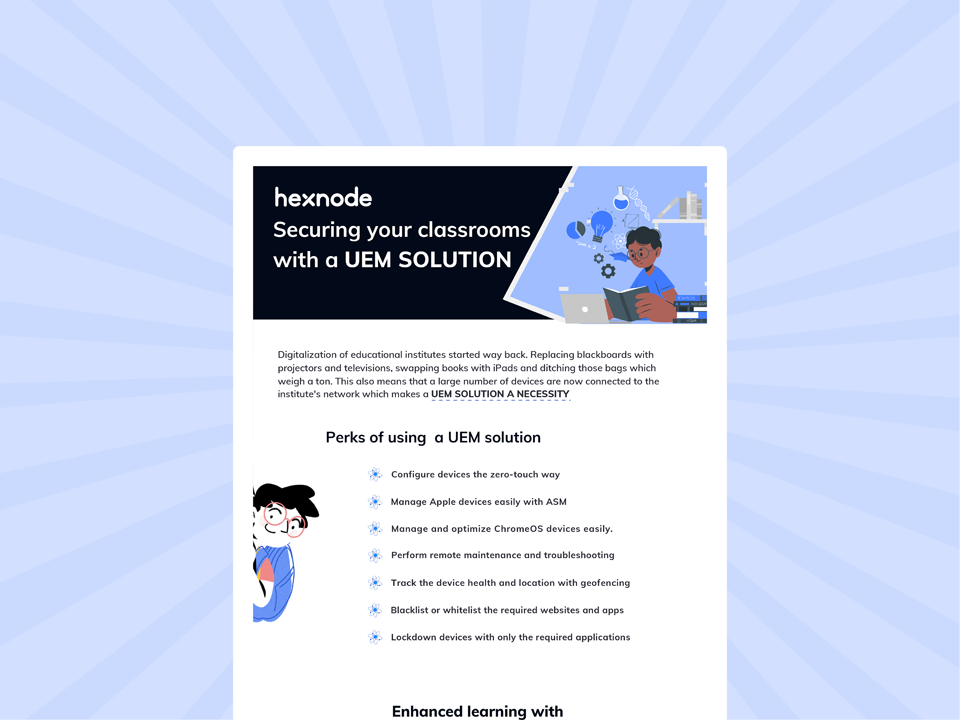
Traditional MDM for schools struggles in shared environments due to weak user isolation and inconsistent policies. Schools need context-aware control, automation, and stronger security. Hexnode enables secure, scalable shared device management with precise policy enforcement and seamless user transitions.
MDM for schools was designed around a simple assumption: one device, one user. That assumption no longer holds. Schools increasingly rely on shared devices across classrooms, labs, and libraries, where multiple students access the same endpoint throughout the day. This shift creates gaps in visibility, security, and control that traditional device management approaches fail to address.
In shared learning environments, devices move between users without clear session boundaries. Data persists unintentionally, policies apply inconsistently, and IT teams lose the ability to enforce accountability at a user level. As a result, education IT security risks increase while operational overhead grows.
Schools need a more advanced approach to education device management that accounts for dynamic usage patterns, enforces strict session control, and maintains consistent device states. This is where modern unified endpoint management solutions like Hexnode step in, enabling IT teams to manage shared devices with precision and confidence.
The Shift to Shared Learning Environments Is Redefining MDM for Schools
Schools are rapidly expanding shared device programs, but most legacy tools still treat devices as single-user endpoints. This mismatch creates operational friction and weakens control. Hexnode approaches MDM for schools with the assumption that devices are dynamic assets used by multiple users throughout the day, not static endpoints tied to one identity.
With Hexnode, IT teams can design shared device workflows that align with real classroom usage. Whether devices rotate across labs, classrooms, or libraries, administrators can enforce consistent configurations while adapting policies to different user contexts. This shifts device management from a rigid, device-centric model to a flexible, usage-aware framework.
Hexnode enables schools to standardize shared device environments without sacrificing control. IT teams can predefine how devices behave during and after each session, ensuring that every student interacts with a secure, clean, and purpose-built interface. Instead of relying on manual resets or inconsistent policies, administrators can automate device readiness at scale.
Single-User MDM Models vs Multi-User Reality
Traditional MDM frameworks struggle to handle rapid user switching and session turnover. Policies remain tied to a single profile, which leads to data persistence and inconsistent enforcement.
Hexnode addresses this gap by enabling:
Session-based device configurations that reset automatically after use
Role-driven policy enforcement for different user groups
Consistent application states across multiple sessions
This approach ensures that each user session starts fresh, with the right permissions and restrictions already in place. By aligning MDM for schools with real-world shared usage patterns, Hexnode allows IT teams to maintain both security and efficiency without added complexity.
Where Traditional Classroom Device Management Falls Short
Most legacy approaches to classroom device management focus on device-level control rather than user-level context. This creates blind spots that become critical in shared environments.
Gaps in Classroom Device Management That Impact Security
Shared devices amplify vulnerabilities that remain hidden in single-user deployments.
Key gaps include:
Lack of session isolation
Limited ability to enforce user-specific restrictions
Weak audit trails for tracking individual activity
These limitations directly undermine education IT security, especially in environments handling sensitive student data.
Operational Inefficiencies in Shared Device Setups
Education IT Security Risks in Shared Environments
Shared devices introduce a broader attack surface compared to dedicated endpoints. Every session represents a potential entry point for misuse, whether intentional or accidental.
Identity and Access Control Challenges
In many schools, authentication mechanisms are either weak or inconsistently enforced. Students may reuse credentials or access devices without proper login controls.
This leads to:
Lack of accountability for device usage
Unauthorized access to applications and data
Difficulty tracing incidents back to individual users
Data Privacy and Session Persistence Risks
When devices do not reset properly between sessions, sensitive information can persist.
Examples include:
Cached login credentials
Browser history and saved sessions
Downloaded files and local storage
These issues directly conflict with student privacy requirements and regulatory expectations.
Application and Content Control Limitations
Shared environments often lack consistent control over applications and content.
Devices may:
Retain previously opened applications
Allow access to unauthorized content
Fail to enforce usage restrictions per user
Without robust controls, schools struggle to maintain a secure and focused learning environment.
What Modern MDM for Schools Must Deliver for Shared Use Cases
To address these challenges, MDM for schools must evolve beyond static device management. It must incorporate user-aware intelligence, automation, and real-time control.
Dynamic User Profiles and Session Management
Modern solutions should enable:
Automatic login and logout workflows
Session-based profile isolation
Immediate cleanup after user activity
This ensures each user interacts with a clean and secure environment.
Granular Policy Enforcement in Classroom Device Management
Policies must adapt based on user context, not just device configuration.
Differentiated policies for students, teachers, and administrators
This level of control strengthens classroom device management while maintaining usability.
Real-Time Monitoring and Remote Actions
IT teams need visibility into active sessions and the ability to respond instantly.
Essential features include:
Live device monitoring
Remote lock, wipe, and reset capabilities
Immediate policy enforcement
These controls help maintain operational continuity while minimizing risks.
Strengthening Education Device Management with Automation and Control
Automation is critical for scaling shared device environments efficiently. Without it, IT teams cannot keep up with the pace of device turnover.
Automated Device Reset and Reprovisioning
Devices should automatically return to a predefined state after each session.
This includes:
Clearing user data
Resetting configurations
Reapplying policies
Automation eliminates manual intervention and ensures consistency across devices.
App and Content Standardization Across Shared Devices
Standardized environments improve both security and usability.
Schools can:
Predefine app availability
Restrict access to approved resources
Ensure consistent learning experiences
This strengthens overall education device management while reducing variability.
How Hexnode Elevates MDM for Schools in Shared Learning Environments
Hexnode addresses the complexities of shared device ecosystems with a comprehensive and flexible management framework. It combines device-level control with user-aware policies, enabling IT teams to enforce security without compromising accessibility.
Single-App Kiosk Mode and Multi-App Kiosk for Controlled Access
Hexnode enforces strict application-level control through its kiosk capabilities, which are critical in shared learning environments where unrestricted access leads to misuse and inconsistency. By locking devices into a single-app or multi-app kiosk configuration, IT administrators can define exactly how a device is used during a session.
In single-app mode, the device operates as a dedicated endpoint for a specific use case such as assessments or guided learning. In multi-app kiosk mode, administrators can curate a controlled workspace with only approved applications, eliminating exposure to non-essential or distracting tools.
This approach ensures:
Defined device behavior regardless of the user
Elimination of unauthorized app access or system-level navigation
Reduced risk of configuration drift across sessions
Hexnode’s kiosk framework operates at the system level, preventing users from bypassing restrictions while maintaining a consistent and purpose-built interface across all shared endpoints.
Single-app vs. Multi-app Kiosk Mode: A Complete Guide to Kiosk Modes
Compare single-app and multi-app kiosk modes to choose the right device lockdown strategy.
Identity-Aware Policies for Secure Access
Hexnode extends policy enforcement beyond the device layer by incorporating user and role-based controls. This is essential in environments where devices serve multiple user groups with different access requirements.
Administrators can define granular policies mapped to user roles such as students, faculty, or administrators. These policies dynamically apply during active sessions, ensuring that each user interacts with the device within predefined boundaries.
This enables:
Context-driven access control based on user identity
Segmentation of permissions without requiring separate device pools
Enforcement of least-privilege principles across shared usage
By aligning policy enforcement with user context, Hexnode ensures that security controls remain consistent even as devices transition between users.
Hexnode provides centralized, real-time visibility into device and user activity, enabling IT teams to maintain control across distributed environments. This is particularly important in shared setups where issues can arise frequently and require immediate intervention.
Through its remote management capabilities, administrators can:
Diagnose and resolve issues without physical access to devices
Execute instant device-level actions such as lock, wipe, or restart
Remotely view and control devices to troubleshoot and resolve technical issues in real time
This level of control reduces dependency on on-site support and allows IT teams to enforce policies and remediate risks in real time. It also ensures continuity in classroom activities by minimizing disruption caused by device failures or misconfigurations.
Automation That Reduces IT Burden
Managing shared devices at scale requires consistent enforcement of configurations without manual intervention. Hexnode addresses this through automation-driven workflows that standardize device behavior across the lifecycle.
IT teams can configure automated actions such as:
Automated user profile deletion and session cleanup upon sign-out
Policy reapplication to maintain baseline configurations
Automated updates to ensure devices remain compliant and secure
Automation ensures that devices return to a known, secure state after each session, eliminating residual data and configuration inconsistencies. It also reduces the operational load on IT teams by removing repetitive tasks, allowing them to focus on strategic initiatives rather than routine maintenance.
Conclusion
Shared learning environments introduce complexities that traditional approaches cannot handle. The limitations of legacy systems create risks in security, efficiency, and user experience.
Schools must move beyond basic MDM for schools and adopt solutions that deliver dynamic control, automation, and user-aware management. By doing so, they can secure shared devices, streamline operations, and create reliable digital learning environments.
Hexnode stands out as a platform built to meet these demands. Its ability to enforce granular policies, automate workflows, and maintain real-time visibility makes it a strong foundation for modern school device management.
Secure Shared Learning Devices Easily
Simplify shared device management and strengthen school security with Hexnode UEM.
How can schools tell if their current MDM is not built for shared devices?
If IT teams rely heavily on manual resets, generic policies, or separate device pools for different users, the MDM may not be flexible enough for shared learning environments.
What should schools define before deploying shared classroom devices?
Schools should define user roles, approved apps, login expectations, privacy rules, and support workflows before rollout to keep device usage secure and consistent.
Content writer at Hexnode. Fueled by good coffee and the occasional cat cuddle, I enjoy crafting content that informs, connects, and resonates. Nothing excites me more than knowing my words have been read, appreciated, and maybe even bookmarked.