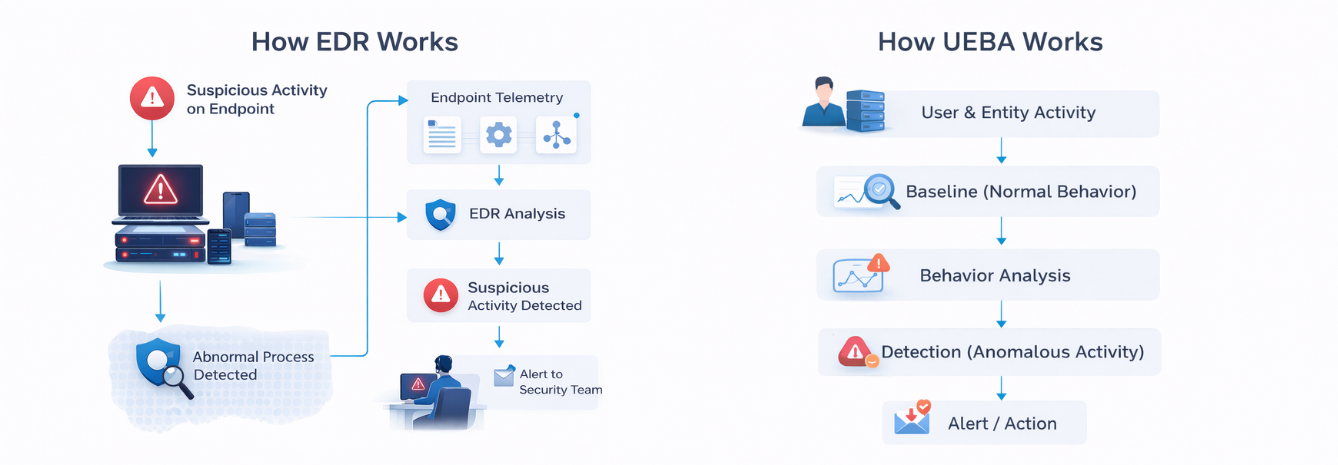
EDR and UEBA address different layers of modern threat detection. EDR monitors endpoint activity to detect threats like malware and ransomware, while UEBA analyzes user and entity behavior to identify anomalies such as insider threats and compromised accounts. Used together, they provide better visibility and context but still operate as separate layers. For most organizations, especially those dealing with credential misuse and complex environments, combining EDR and UEBA helps improve detection accuracy, investigation, and overall security posture.
Most security tools are designed to detect what appears suspicious. But today’s challenge is that many modern attacks do not appear suspicious at all. For example, insider threats and compromised accounts operate using valid credentials and approved access paths. So, whether it is an employee misusing privileges or an attacker logging in with stolen credentials, the activity often appears legitimate on the surface.
This creates a fundamental gap in detection. Traditional endpoint-focused tools can miss these threats because there is no obvious malware or exploit to flag.
This is where the discussion around EDR vs UEBA becomes relevant. While both aim to detect threats, they approach the problem from different angles. Understanding how these two security solutions differ and work together is key to detecting threats early, investigating them accurately, and limiting their impact.
Understanding Endpoint Detection and Response (EDR)
To understand what EDR is and where it fits, it helps to start with how most security teams approach detection today. When a threat reaches a device, it often leaves behind observable signals, even if the initial access looked legitimate.
EDR continuously monitors endpoints such as laptops, servers, and mobile devices to detect suspicious activity. It analyzes telemetry like process execution, file changes, and system events to identify threats such as ransomware, malware, and lateral movement.
In practice, this means EDR can identify when something unusual happens on a device. For instance, if a user unknowingly clicks a phishing link and a script begins executing in the background, EDR can detect the abnormal process behavior, surface it for investigation, and allow administrators to take action.
What is User and Entity Behavior Analytics (UEBA)?
However, not all threats generate obvious signals at the endpoint level. Many modern attacks are designed to blend in by using legitimate access, behaving like normal users. This is where UEBA becomes critical.
User and Entity Behavior Analytics (UEBA) builds a baseline of normal activity for users and systems and identifies deviations from that baseline. It extends to entities such as servers, applications, and devices. By shifting detection from known threat patterns to abnormal activity patterns, UEBA becomes very effective against stealthy attacks that bypass traditional controls.
This approach is especially effective in identifying insider threats and compromised accounts. For example, if a user who typically logs in from one location suddenly accesses sensitive data from a different region at an unusual time, UEBA flags this as anomalous behavior even if no malware is present.
How UEBA relates with SIEM
UEBA is often discussed alongside SIEM, since most implementations build on existing log data. While SIEM focuses on collecting and correlating events using predefined rules, UEBA adds a behavioral layer by analyzing how users and entities act over time. This becomes critical because many insider threats and compromised accounts do not break rules, they only stand out when behavior is examined.
EDR vs UEBA: What’s the Real Difference?
EDR vs UEBA explained
In modern cybersecurity environments, EDR and UEBA are both used for threat detection, but they operate at different layers.
Factor
EDR
UEBA
Focus
Endpoint activity
User and entity behavior
Detects
Malware, ransomware, exploits
Insider threats, anomalies
Data source
Device telemetry
Logs, identity, access patterns
Approach
Signature + behavioral detection
Machine learning and baselining
Key strength
Deep device visibility
Detecting subtle behavioral risks
In simple terms, EDR shows what is happening on a device, while UEBA helps determine whether that activity is expected.
Individually, this distinction is useful. In practice, however, threats rarely stay confined to a single layer. Modern attacks move between users, endpoints, and systems, making it necessary to correlate both behavior and execution.
This is where EDR and UEBA begin to complement each other.
EDR Explained: A Complete Guide to Modern Endpoint Security
Explore how EDR works and why organizations rely on it for endpoint threat detection and response.
How EDR and UEBA Strengthen Threat Detection
Modern threats unfold across users, devices, and systems. This is where EDR and UEBA can provide meaningful visibility. Instead of treating alerts as separate signals, they help security teams understand patterns, intent, and impact in a connected way.
Here are some ways EDR and UEBA can strengthen threat detection and response:
Detecting Insider Misuse Early
Insider threats rarely begin with obvious malicious activity. They often start with subtle deviations such as unusual access patterns or privilege misuse. UEBA identifies these deviations by comparing current activity with established behavioral baselines. EDR adds depth by showing what actions were executed on the endpoint. Together, they help teams identify insider misuse early and validate whether the behavior translates into real risk.
Identifying Compromised Accounts Before Escalation
Credential theft often leads to activity that appears legitimate. UEBA detects early warning signs such as abnormal login behavior, unusual access requests, or inconsistent usage patterns. This allows teams to flag potential compromise before significant actions occur. If the attacker begins interacting with the system, EDR provides visibility into processes and system changes, helping confirm and contain the threat.
Tracking Lateral Movement Across Systems
Once inside, attackers can attempt to expand access across systems. UEBA identifies this through deviations in access patterns across multiple endpoints or accounts. EDR captures the execution layer, such as remote connections or unusual process chains. When viewed together, these signals help teams detect coordinated movement across the environment and respond before the attack spreads further.
Detecting Data Exfiltration in Real Time
Data exfiltration often uses legitimate tools and approved channels, making it difficult to detect through endpoint monitoring alone. UEBA highlights unusual data access or transfer patterns that fall outside normal behavior. EDR supports this by tracking file-level activity and endpoint interactions. This combination ensures that suspicious data movement is both detected and validated with context.
Connecting Behavior with Execution
One of the key advantages of using EDR and UEBA together is the ability to correlate signals across layers. UEBA highlights that something is unusual but does not always explain how it is happening. EDR provides that missing layer by showing the exact processes and actions involved. This connection between behavior and execution helps security teams move from suspicion to confirmed incidents more efficiently.
Reducing Noise and Improving Prioritization
Security teams often deal with high volumes of alerts with limited context. UEBA helps reduce noise by focusing on behavioral anomalies that carry higher risk. EDR provides the technical detail needed to investigate those anomalies. Together, they improve prioritization by ensuring that alerts are not only detected but also understood in context before action is taken.
Featured Resource
The Cybersecurity Blueprint: How to adopt the right cybersecurity strategy for your business
Download the whitepaper to learn how you can adopt the right cybersecurity blueprint for your business.
Do You Need EDR, UEBA, or Both? Here’s How to Decide
The choice between EDR and UEBA is not always straightforward, as each addresses a different layer of threat detection.
Organizations today are dealing with a mix of endpoint-based threats and behavior-driven risks, making it important to understand where each approach fits. Selecting the right combination depends on the type of threats you need to detect, and the level of visibility required across your environment.
EDR is best suited when:
The primary concern is malware, ransomware, or endpoint compromise
Visibility into device-level activity is critical
You need the ability to investigate and respond directly on endpoints
UEBA is more effective when:
The focus is on insider threats or credential misuse
Detecting abnormal user behavior is a priority
Threats may not involve obvious malicious activity
However, most modern environments require both.
Attacks often begin with compromised credentials and evolve into endpoint-level activity. In such cases, relying on a single approach can create blind spots. Combining EDR and UEBA provides both behavioral context and execution visibility, improving overall detection accuracy.
How XDR Extends EDR and UEBA
As security environments become more complex, many organizations are looking for ways to connect endpoint activity, behavioral insights, and response workflows more efficiently. This is where XDR comes in.
XDR builds on EDR by correlating signals across multiple layers and helping security teams investigate and respond from a more unified workflow. Instead of analyzing endpoint activity and behavioral anomalies separately, teams can view related events in context and act faster.
Platforms like Hexnode XDR extend this approach by combining endpoint visibility, incident correlation, and response actions within a single console, helping teams simplify detection and response without adding unnecessary operational complexity.
Frequently Asked Questions (FAQs)
How do EDR and UEBA handle false positives differently?
EDR can generate alerts based on suspicious endpoint activity, which may include benign processes. UEBA reduces this by analyzing behavior over time, helping identify what is truly unusual instead of relying only on predefined rules.
Why are credential-based attacks harder to detect than malware?
Credential-based attacks use valid logins and approved tools, so they often appear normal at the device level. This makes them harder for traditional detection tools to flag without behavioral analysis.
How should teams approach detection in hybrid or remote environments?
In distributed environments, threats can originate from both devices and user behavior. Combining endpoint visibility with behavioral insights helps teams maintain consistent detection across locations and device types.
Strengthen Threat Detection Across Endpoints and Users
Improve visibility into endpoint activity and behavioral risks with a more connected approach to modern threat detection.
Curious, constantly learning, and turning complex tech concepts into meaningful narratives through thoughtful storytelling. Here I write about endpoint security that are grounded in real IT use cases.