Shadow AI involves employees using AI tools without IT approval, increasing risks like data leakage and compliance issues. MSPs can review potential Shadow AI risks by checking application reports, assessing unfamiliar software, and applying app policy controls. Traditional methods can fall short as AI tool adoption continues.
Hexnode centralizes application reports, app management, and application policy controls, helping MSPs review installed applications and apply supported controls to unauthorized applications across client environments through MSP endpoint management capabilities.
Why Shadow AI Is Becoming Every MSP’s Biggest Blind Spot
Understanding how to detect Shadow AI is becoming increasingly relevant for MSPs. Employees increasingly adopt AI-powered applications without IT approval. Additionally, generative AI tools are easy to access through browsers, desktop applications, or standalone clients. This makes them easy to introduce into enterprise environments.
What is Shadow AI?
Shadow AI is the use of AI-powered applications or services without the approval or oversight of an organization’s IT or security team. These tools often process business data through prompts, file uploads, or integrations. As a result, they can increase the risk of data leakage, compliance violations, and reduced organizational visibility.
Common examples of Shadow AI include employees using the following tools without organizational approval:
ChatGPT to summarize customer documents.
Microsoft Copilot to analyze internal reports without organizational approval.
Google Gemini to research business information.
Claude to generate code or documentation.
Perplexity AI to analyze proprietary business data.
However, Shadow AI differs from traditional Shadow IT. While Shadow IT includes any unauthorized hardware, software, or cloud service, Shadow AI directly interacts with business data. Employees may upload customer records, financial documents, source code, or proprietary information into AI tools. Consequently, organizations face higher security and compliance risks.
For many MSPs, the challenge extends beyond identifying a single unauthorized application. They often manage multiple customer environments with different security requirements, compliance obligations, and acceptable use standards. Meanwhile, AI adoption continues. As a result, manual software audits and spreadsheet-based tracking become increasingly difficult to maintain across growing endpoint fleets.
Therefore, MSPs need a scalable way to review installed applications and govern AI-related software across customer environments. Hexnode gives MSPs centralized visibility into installed applications on enrolled devices, allowing administrators to review application reports, compare software against customer policies, and apply supported app controls to unauthorized applications that may introduce security or compliance risks.
Shadow AI vs. Shadow IT
Shadow IT refers to any unauthorized technology used within an organization. Shadow AI, however, specifically involves AI applications that process organizational data. As a result, Shadow AI introduces additional challenges related to data privacy, regulatory compliance, and responsible AI usage.
How to Detect Shadow AI Across Client Environments
Knowing how to detect Shadow AI requires a structured process rather than simply identifying a few AI applications. For MSPs, the goal is to discover unauthorized software, evaluate it against customer policies, and address potential risks before they affect security or compliance. Since every client has different business and regulatory requirements, Shadow AI detection should become part of routine endpoint management.
Can Shadow AI Be Detected?
Yes. MSPs can detect potential Shadow AI by reviewing installed applications, checking unfamiliar software against organizational policies, and separately addressing browser-based AI usage through appropriate web or access controls.
Identify Every Application Running on Managed Endpoints
The first step is reviewing application reports for installed applications across enrolled devices. Without a reliable software baseline, administrators cannot easily distinguish approved AI tools from software introduced without IT oversight.
MSPs should regularly:
Review application reports for installed software.
Identify unfamiliar applications.
Review installed applications within each customer environment.
As a result, administrators can identify unexpected software before it develops into a broader security or compliance issue.
Validate Applications Against Customer Policies
Not every AI application presents the same level of risk. For example, what is acceptable for one organization may violate another’s compliance or security requirements.
When reviewing newly discovered software, MSPs should determine whether the application:
Aligns with customer policies.
Meets security and data handling requirements.
Should be approved, restricted, or investigated further.
Consequently, MSPs can balance business productivity with security and compliance requirements.
Continuously Monitor for New AI Usage
Shadow AI evolves rapidly. Employees often adopt new AI tools before IT teams can assess them. Therefore, periodic software reviews are no longer sufficient.
Instead, MSPs should regularly review application reports to:
Identify unfamiliar or unauthorized AI-related applications.
Investigate unexpected software installations.
Address policy exceptions before they become security incidents.
This proactive approach can help reduce reliance on reactive investigations. Additionally, it helps organizations keep pace with rapidly evolving AI adoption.
Why Traditional Shadow AI Detection Doesn’t Scale for MSPs
As AI adoption continues, many MSPs still rely on software discovery methods designed for less dynamic IT environments. Manual audits, spreadsheet-based tracking, and reactive investigations may work for smaller deployments. However, they become difficult to sustain across hundreds or thousands of endpoints spread across multiple customer environments.
Periodic software audits provide only a snapshot of the software landscape. By the time an assessment is complete, employees may have already adopted new AI applications or browser-based AI services. Similarly, spreadsheet-driven tracking requires constant updates. It is also prone to human error and rarely reflects the current state of an environment.
The operational burden grows with every new client. Each organization has unique software standards, compliance obligations, and security requirements. As a result, administrators often need to:
Switch between multiple management tools.
Reconcile inconsistent software records.
Investigate policy exceptions for each customer.
Spend less time on proactive security initiatives.
Reactive investigations create another challenge. Organizations often identify unauthorized AI applications only after a compliance review, customer inquiry, or security incident. Consequently, MSPs may spend more time responding to problems than preventing them.
Traditional Detection vs. Hexnode Workflow
Traditional Detection
Hexnode Workflow
Periodic manual audits
Application reports for installed applications on enrolled devices
Spreadsheet-based software tracking
Application reports for enrolled devices
Reactive investigations
Application reports for review and supported Windows application compliance checks
Multiple management tools
Centralized endpoint and app management console
Manual policy enforcement
Application policy deployment to targeted devices or groups
Therefore, MSPs need a platform that simplifies software oversight across multiple customers and reduces reliance on manual processes. Hexnode provides that foundation by combining application reports, app management, and application policy controls in a single platform. Consequently, MSPs can reduce manual tracking and support a more structured process for reviewing Shadow AI risks.
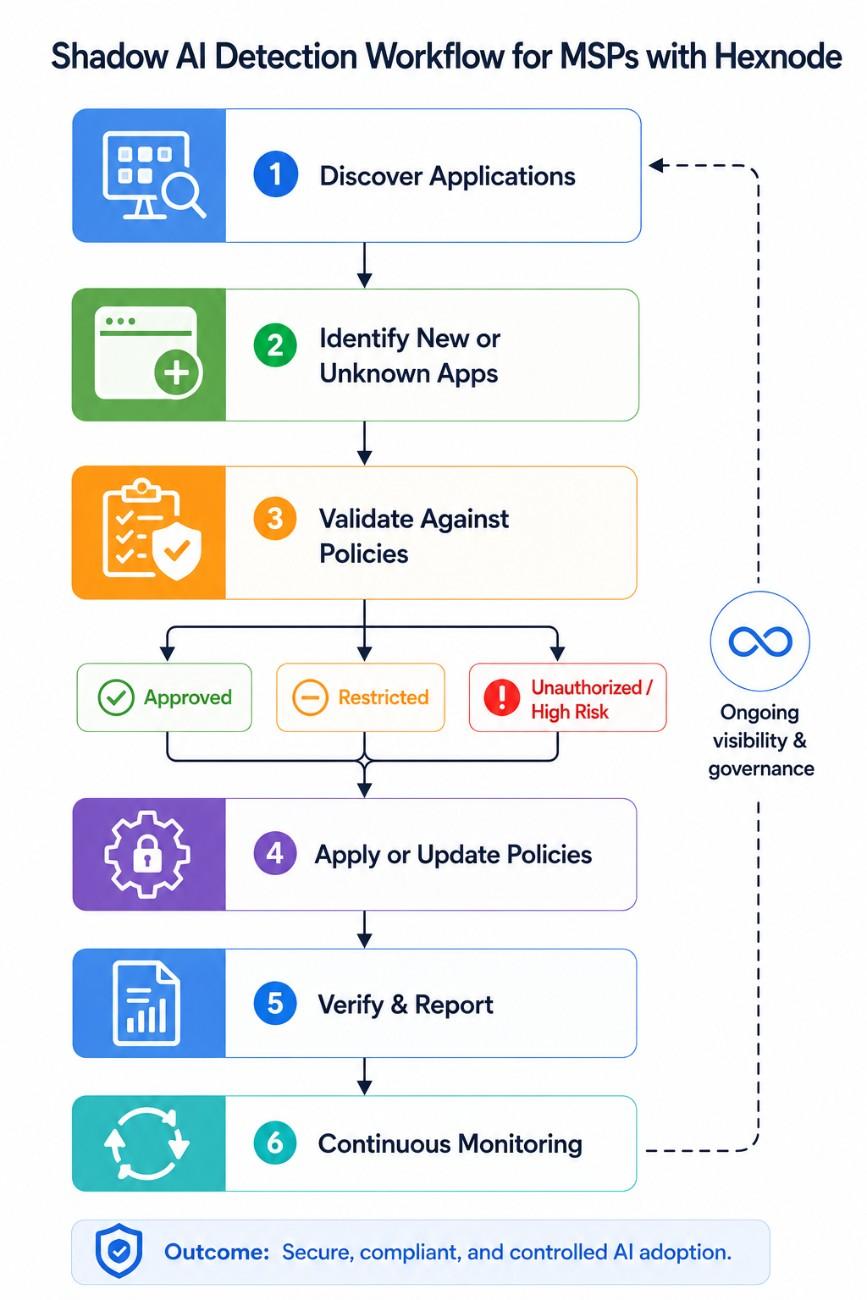
Shadow Al Detection Workflow
How MSPs Use Hexnode to Detect Shadow AI
Detecting Shadow AI is only valuable if MSPs can act on what they discover. Once a detection strategy is in place, the next step is operationalizing it across every client environment. Therefore, MSPs need a repeatable workflow to review installed applications, assess unfamiliar software against customer requirements, and apply consistent controls before unauthorized AI-related tools create security or compliance risks.
Hexnode brings these tasks together in a single platform. As a result, MSPs can manage application reports and application policy controls with fewer disconnected tools and less manual tracking.
Featured resource
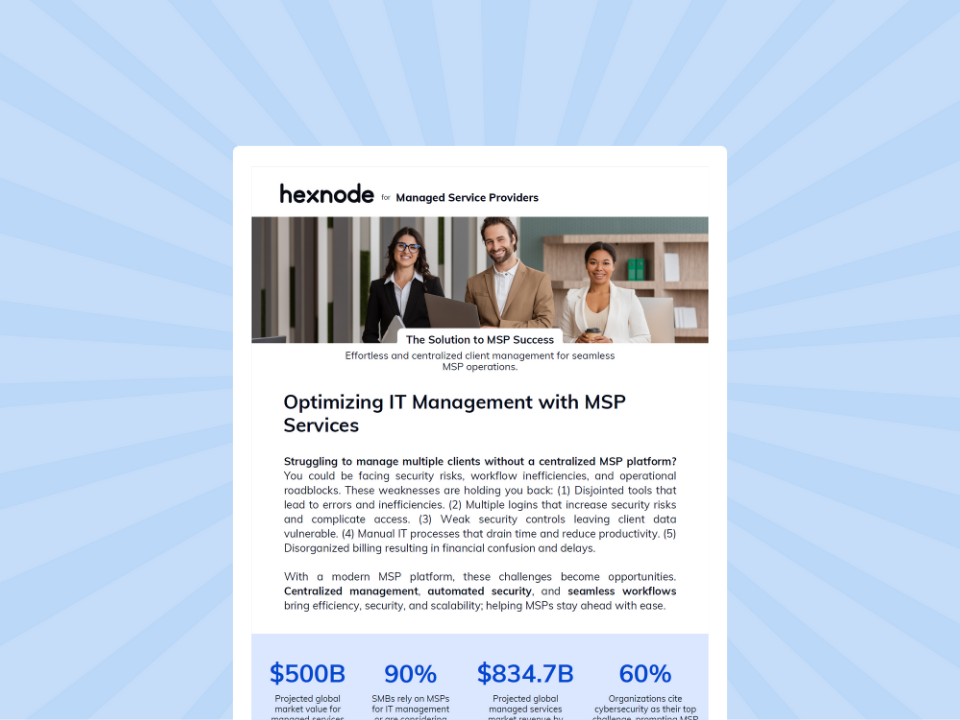
Hexnode UEM for MSPs
See how Hexnode helps MSPs simplify client management, improve operational efficiency, and manage multiple customer environments from a centralized platform.
The first step is understanding what software is installed across managed endpoints. MSPs can use Hexnode’s application reports to review installed applications across enrolled devices from a centralized console.
Administrators can then:
Review installed applications within each customer environment.
Flag unfamiliar software for further investigation.
For example, if an employee installs an AI-powered desktop assistant that is not part of the client’s approved software standards, the MSP can identify it during application report reviews. Consequently, the administrator can investigate it before it develops into a broader security or compliance issue.
Validate Applications Against Customer Requirements
Discovering an application is only the beginning. Next, administrators should determine whether it aligns with the customer’s security, compliance, and operational requirements.
Using Hexnode, MSPs can:
Compare applications found in reports against customer-specific policies.
Determine whether applications should be approved, restricted, or investigated further.
Apply consistent controls while accommodating each customer’s unique requirements.
As a result, MSPs can help support more consistent application management while still accounting for customer-specific requirements.
Apply App Controls Across Managed Devices
After reviewing an application, MSPs need to apply the appropriate controls consistently.
Hexnode allows administrators to deploy application policies across targeted managed devices. Consequently, administrators can reduce per-device configuration when policies are assigned to the appropriate device groups or targets.
This policy-based approach can help reduce per-device policy configuration and support more consistent app control workflows.
Maintain Ongoing Oversight
Shadow AI is not a one-time event. New AI applications continue to emerge as employees look for faster ways to work. Therefore, MSPs should regularly review application reports to help keep customer environments aligned with organizational requirements.
Hexnode helps administrators:
Review application reports and, where supported, verify Windows application compliance status.
Export application reports in CSV or PDF format to help internal governance reviews or customer compliance audits.
A Typical MSP Workflow
A typical Shadow AI review workflow with Hexnode follows these steps:
Review application reports for installed software.
Flag unfamiliar AI-related applications for policy review.
Compare the applications against the customer’s approved software standards.
Apply or update application policies where necessary.
Review application reports and, where supported, verify application compliance status through Hexnode.
By combining application reports, app management, app policy controls, and policy association with devices or groups, Hexnode helps MSPs build a repeatable workflow for reviewing and managing applications that may violate client AI usage policies.
Best Practices for MSPs Managing Shadow AI with Hexnode
Successfully managing Shadow AI requires more than deploying the right technology. MSPs also need clear policies, routine oversight, user education, and automation. Together, these practices help clients adopt AI securely without increasing operational complexity.
Define Clear AI Usage Policies
Every client should establish:
Which AI applications are approved.
What business data employees can share with AI tools.
AI applications evolve rapidly. Therefore, reviewing newly discovered software should become part of regular endpoint management instead of an occasional audit.
Routine reviews help MSPs:
Identify unfamiliar AI-related applications for review.
Review application reports and, where supported, verify Windows application compliance status.
Keep software aligned with customer requirements.
Pair Automation with User Awareness
Application policy controls can support more consistent enforcement of approved app standards. However, technology alone cannot eliminate every Shadow AI risk.
MSPs should also educate employees about:
Approved AI applications.
Acceptable AI usage.
The types of organizational data that should never be shared with external AI services.
When user awareness is combined with Hexnode’s application policy controls, organizations can better support consistent application usage practices. Additionally, administrators can reduce some per-device app control tasks.
MSP Compliance: Policy Staging and Validation for Preventing Breaches
Learn how MSPs can safely stage, validate, and deploy policies across customer environments.
Preparing Clients for the Next Wave of Shadow AI Risks
Shadow AI is becoming a permanent part of enterprise IT as employees continue to adopt AI-powered applications. Therefore, MSPs face a new challenge. They must help clients embrace AI without compromising security, compliance, or operational control.
As AI adoption continues, MSPs need a scalable way to review applications, apply consistent controls, and adapt to evolving customer requirements. Hexnode supports this shift by helping MSPs use application reports, app management, and application policy controls as part of their Shadow AI governance process.
Ultimately, MSPs can better support customers by balancing innovation with effective oversight. As a result, they can help clients adopt AI with confidence while maintaining control over their application environments.
FAQs
What are the biggest risks of Shadow AI for MSPs?
Shadow AI can lead to data leakage, compliance violations, inconsistent security controls, reduced visibility, and increased effort in managing and investigating security risks across client environments.
How can MSPs create a Shadow AI policy for their clients?
MSPs can create a Shadow AI policy by defining approved AI tools, data usage guidelines, review responsibilities, and processes for approval, monitoring, user awareness, and regular policy updates.
Conclusion
Shadow AI is no longer an emerging IT concern. Instead, it has become an operational reality for MSPs managing multiple client environments. As AI adoption continues, MSPs may need stronger review processes than periodic audits or reactive investigations alone. MSPs need a scalable approach to identify and manage unauthorized AI applications as they appear.
Hexnode helps MSPs meet this challenge by combining application reports, app management, application policy controls, and MSP endpoint management capabilities in a single platform. As a result, IT teams can review and manage unauthorized AI-related applications through a repeatable workflow supported by Hexnode’s MSP endpoint management capabilities. They can also support stronger application oversight, compliance workflows, and more structured management of AI-related application risks.
As AI adoption continues, repeatable processes can help MSPs manage related application risks more consistently. This aligns with the NIST AI Risk Management Framework (AI RMF 1.0), which emphasizes continuous governance, risk management, and organizational oversight as AI adoption expands. Therefore, MSPs that operationalize Shadow AI management today will be better positioned to deliver secure, compliant, and scalable IT services tomorrow.
Get Better Visibility into AI-Related Risks
See how Hexnode helps MSPs review installed applications, and strengthen application oversight across customer environments.
I write at the intersection of technology, process, and people, focusing on explaining complex products with clarity. I break down tools, systems, and workflows without any noise, jargon, or the hype.