Agentic IT automation extends scripted automation by enabling context-aware decisions and adaptable workflows instead of relying solely on predefined instructions.
The challenge: Scripted workflows handle predictable tasks but struggle with exceptions, changing conditions, and cross-system coordination.
The approach: AI agents interpret context, select authorized actions, and coordinate multistep workflows while maintaining human oversight and access controls.
The application: Hexnode Synapse introduces agentic orchestration across endpoint management, identity, and security operations, with specialized agents designed to coordinate IT tasks.
Why is traditional IT automation no longer enough?
Traditional IT automation handles repetitive tasks efficiently but struggles with workflows that require contextual decisions, exception handling, and coordination across multiple systems.
Consider an employee unable to access a corporate application. A script can reset credentials or check account status, but determining whether the issue stems from identity permissions, device compliance, or security restrictions may still require manual investigation.
Scripted automation follows predefined instructions. It works well for predictable tasks but becomes restrictive when conditions change, information is incomplete, or an issue falls outside its programmed logic. IT administrators must then interpret results, troubleshoot exceptions, and determine the next action.
Agentic IT automation introduces a different approach. AI agents can interpret operational context, plan actions, and work toward defined outcomes within established permissions and controls.
The distinction is whether automation simply executes predefined steps or can determine the next appropriate action based on the situation.
What happens when IT teams rely entirely on scripted workflows?
Relying exclusively on scripted workflows can create operational bottlenecks when IT processes require decisions beyond predefined conditions. While individual tasks execute automatically, administrators must still handle exceptions, troubleshoot failures, maintain scripts, and coordinate actions across disconnected systems.
These limitations become more apparent as environments change. A script built around specific configurations or system dependencies may fail when those conditions change, requiring manual intervention or updates to its logic.
Security and compliance risks also arise when scripts operate on outdated assumptions, incomplete device information, or insufficient validation. An automated remediation action might modify the wrong configuration or execute before required checks are completed. Delayed remediation and poorly documented manual interventions can further complicate incident investigations and compliance audits.
However, scripted automation is neither inherently ineffective nor insecure. It remains reliable for predictable, well-defined operations with appropriate safeguards.
The challenge emerges when organizations apply fixed workflows to situations requiring contextual decisions, coordination between systems, and responses that must adapt as conditions change.
What is agentic IT automation, and how does it work?
Agentic IT automation uses AI agents to interpret IT requests or events, plan and execute authorized actions, and adapt subsequent steps based on operational context and results. Unlike scripted automation, which executes predefined tasks, agentic automation focuses on achieving a defined outcome by determining which actions are appropriate at each stage.
An agentic workflow combines several components:
AI agents: Interpret requests, evaluate available information, and coordinate actions toward a specified objective.
Contextual information: Device status, system configurations, security policies, and historical events provide the information needed for decisions.
Reasoning and planning: AI models evaluate possible actions and determine the next steps based on the available context.
Approved tools and APIs: Integrations allow agents to retrieve information and perform authorized operations across IT systems.
Execution permissions and feedback: Authorization controls define which actions agents can perform, while execution results provide feedback that agents can use to evaluate progress and adjust subsequent steps.
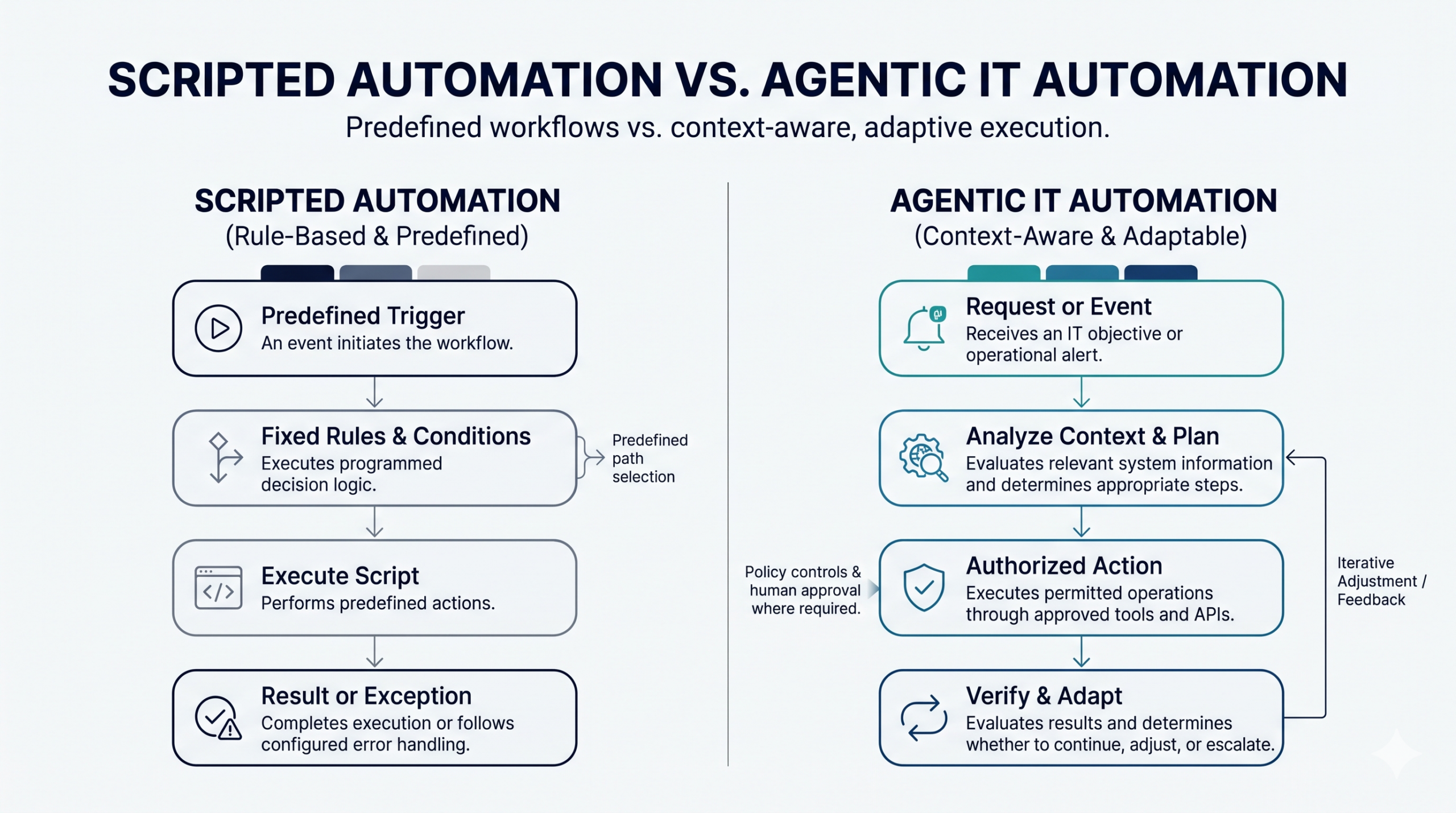
Scripted Automation Vs. Agentic IT Automation
These components enable multistep workflows without requiring administrators to explicitly program every possible execution path.
Consider device compliance remediation. An agentic workflow could:
Detect a device compliance violation.
Retrieve relevant device information and applicable security policies.
Identify the likely cause and determine an appropriate remediation action.
Request administrator approval when required.
Execute the authorized remediation through an approved management tool.
Verify compliance status and escalate unresolved issues.
However, agentic automation does not imply unrestricted autonomy. Organizations must enforce defined permissions, operational policies, approval requirements, and human oversight to ensure agents operate within authorized boundaries..
How is agentic IT automation different from scripted automation?
Scripted automation follows predefined instructions and decision paths, while agentic IT automation evaluates operational context and selects actions to achieve a defined objective. Both can execute tasks without continuous human intervention. The primary difference lies in how they make decisions, handle exceptions, and respond to changing conditions.
Comparison factor
Scripted automation
Agentic IT automation
Execution model
Predefined instructions and workflows
Goal-oriented, context-driven execution
Decision-making
Programmed rules and conditions
AI-supported reasoning and planning
Adaptability
Limited to implemented conditions and error handling
Adjusts actions based on available context
Input requirements
Structured commands, events, or triggers
Interprets requests, events, and contextual data
Exception handling
Defined error paths or escalation
Investigates, replans, or escalates within permitted boundaries
Cross-system workflows
Requires configured scripts, integrations, or orchestration
Coordinates authorized tools and specialized agents
Human involvement
Design, maintenance, and exception management
Goal-setting, governance, approvals, and oversight
Predictability
Generally deterministic under equivalent conditions
Execution paths and outputs may vary with context
Best suited for
Stable, repetitive, predictable tasks
Variable, context-dependent, multistep operations
Featured Resource
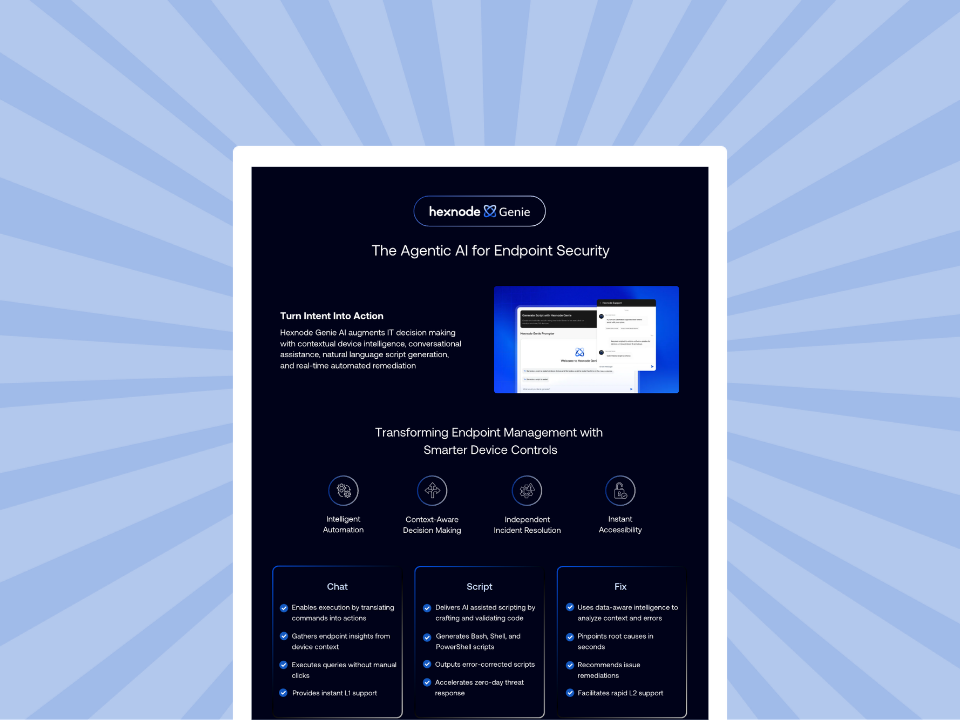
Explore AI-Powered Endpoint Automation
See how Hexnode Genie brings contextual device intelligence, script generation, and AI assistance to IT tasks.
Consider an organization automating employee onboarding across its identity and endpoint management systems.
With scripted automation, an HR system triggers a workflow when a new employee record is created. The script provisions an account, assigns predefined access groups, and applies device configurations based on programmed rules. Missing information or unexpected conditions may interrupt execution or trigger an escalation.
With agentic IT automation, an AI agent could interpret the onboarding request, identify missing prerequisites, determine which approved provisioning tasks are required, and coordinate actions across connected systems. If an access request requires additional authorization, the agent can route it for approval rather than proceeding automatically.
Importantly, agentic automation does not eliminate the need for scripts. AI agents can invoke existing scripts, APIs, and automation workflows as execution mechanisms. The distinction is that the agent can determine which authorized actions to initiate and when, while scripts handle the underlying predefined operations.
Where can agentic automation improve everyday IT operations?
Agentic automation is particularly useful for IT workflows that require contextual analysis, coordination across systems, and decisions beyond predefined rules. Three practical scenarios illustrate how it differs from scripted automation.
Device troubleshooting and compliance remediation
Scripted automation: Executes predefined diagnostic commands or remediation actions when a device reports a specific error or compliance violation.
Agentic automation: An AI agent can examine device configurations, compliance status, and diagnostic results to identify potential causes. It can then select permitted remediation actions and verify whether the issue has been resolved.
Employee onboarding and access management
Scripted automation: Creates user accounts, assigns access groups, and applies device configurations based on predefined onboarding rules.
Agentic automation: An AI agent can interpret onboarding requests, identify missing prerequisites, and coordinate authorized identity and device provisioning tasks. Access requests requiring additional permissions can be routed for approval.
Security alert triage and incident response
Scripted automation: Triggers a predefined response when a security alert matches configured conditions, such as a detection rule or severity threshold.
Agentic automation: An AI agent can gather relevant threat intelligence, identity activity, and endpoint telemetry to investigate an alert. It can evaluate response options and recommend or initiate approved containment actions.
Across these scenarios, agentic automation enables context-aware decision-making, allowing workflows to select and coordinate appropriate actions as conditions change. However, predictable tasks with established execution paths may still be better served by conventional scripts.
How can IT teams introduce agentic automation without disrupting existing workflows?
IT teams can introduce agentic automation incrementally by extending existing workflows rather than replacing established scripts. A phased approach helps organizations evaluate operational benefits while maintaining control over system access, execution, and risk.
Step 1: Identify workflows that require contextual decisions
Review existing automation to identify processes where scripts frequently fail, encounter exceptions, or require manual interpretation.
Prioritize workflows with clear objectives, measurable outcomes, reliable data sources, and manageable operational risks. Device diagnostics and IT ticket triage are potential starting points.
Step 2: Define the agent’s operating boundaries
Establish which systems, APIs, data sources, and actions an AI agent can access.
Implement role-based permissions, least-privilege access, and approval checkpoints. Sensitive operations, including account suspension, permission changes, and device wiping, should require explicit authorization where appropriate.
Define escalation procedures for situations involving insufficient information, failed actions, or decisions outside the agent’s permitted scope.
AI agents do not automatically enforce organizational security policies. Define least-privilege permissions, approval requirements, and escalation boundaries before enabling automated actions. High-impact operations, such as device wiping or privileged access changes, should require appropriate authorization and human oversight.
Step 3: Connect agents to existing tools and workflows
Integrate agents with approved IT service management (ITSM), endpoint management, identity, and security platforms through supported APIs and integrations.
Existing scripts, automation playbooks, and predefined workflows can remain responsible for executing specific operations. The agent determines which authorized tools or workflows to invoke based on operational context.
Step 4: Pilot, monitor, and expand gradually
Begin with low-risk activities such as information retrieval, ticket classification, or diagnostic recommendations before enabling automated remediation.
Test expected outcomes, unexpected inputs, and failure scenarios. Track:
Completion accuracy: Whether workflows achieve their intended outcomes.
Escalation frequency: How often human decisions are required.
Intervention requirements: Where administrators must correct or override agent actions.
Auditability: Whether decisions, approvals, and executed actions are traceable.
Maintain execution logs, human-in-the-loop approvals, and defined escalation paths throughout deployment.
Retain deterministic automation for predictable operations and introduce agentic capabilities where contextual reasoning provides measurable operational value.
How does Hexnode Synapse approach agentic IT automation?
Hexnode Synapse is an agentic AI orchestration layer designed to coordinate IT and security workflows across Hexnode products and connected enterprise systems. Announced at HexCon26 in September 2026, Synapse aims to connect requests, alerts, and system events with the actions required to resolve them.
Its architecture introduces three specialized AI agents:
Device Agent: Supports endpoint diagnostics, compliance-drift remediation, device provisioning, and patch or vulnerability remediation through Hexnode UEM.
Identity Agent: Coordinates access requests, identity lifecycle operations, role changes, and account-related tasks through Hexnode IdP.
Threat Agent: Supports security alert triage, threat investigation, and containment through Hexnode XDR.
Synapse is designed to coordinate these agents across workflows that involve multiple systems. Its announced integrations include ServiceNow, Zendesk, Microsoft Entra ID, and BambooHR, while the product page also identifies connectors for Slack, Microsoft Teams, and Workday.
For example, an employee onboarding request could involve creating a user identity, assigning application licenses, configuring a device, and recording an IT ticket. Hexnode has presented this as an example of how Synapse can coordinate related tasks within a governed workflow.
Human oversight remains central to Synapse’s approach. Hexnode describes administrator-defined guardrails and approval gates for sensitive actions, including device wipes, endpoint isolation, and privileged access changes. Its announced Execution Centre is intended to maintain records of agent decisions, approvals, and executed actions for administrative review.
Synapse is being introduced through invite-only access rather than general availability. Its product roadmap also identifies Custom Agent Creation, Dynamic Agent Chaining, Background & Proactive Agents, and granular Safety Guardrails as upcoming capabilities.
This approach illustrates how agentic orchestration can build on existing IT automation by coordinating decisions and actions across systems while preserving administrative control.
How is Hexnode Synapse different from Hexnode Genie?
Explore how UEM supports email configuration, managed domains, and certificate-based authentication.
FAQs
Does agentic IT automation require replacing existing scripts?
No, agentic IT automation can work alongside existing scripts and automation workflows. AI agents can determine when to invoke predefined scripts or APIs based on operational context, allowing organizations to retain reliable automation while introducing more adaptive decision-making.
What are the main security risks of agentic IT automation?
Agentic IT automation introduces risks such as excessive permissions, unintended system changes, inaccurate decisions, and unauthorized access to sensitive information. Organizations can reduce these risks through least-privilege access, human approval checkpoints, execution logging, and clearly defined operational boundaries.
Can agentic AI agents operate without human approval?
Yes, AI agents can execute authorized, low-risk tasks without requiring approval for every action. However, sensitive operations such as modifying privileged access, suspending accounts, or wiping devices should require appropriate authorization and human oversight based on organizational policies.
How can IT teams measure the effectiveness of agentic automation?
IT teams can evaluate agentic automation using workflow completion accuracy, exception rates, human intervention frequency, and remediation success rates. Monitoring execution logs and approval histories also helps assess reliability, operational efficiency, and compliance with established policies.
What infrastructure is needed to implement agentic IT automation?
Agentic IT automation typically requires access to AI models, relevant operational data, and approved APIs or integrations with existing IT systems. Organizations also need authentication, authorization controls, monitoring, and audit logging to manage agent actions securely.
Can agentic IT automation help reduce IT service desk workload?
Yes, agentic automation can reduce repetitive service desk work by assisting with ticket classification, gathering diagnostic information, and coordinating approved troubleshooting actions. Its effectiveness depends on the quality of available information, integration capabilities, and the complexity of the requests being handled.
Is your IT automation ready for the next step?
Scripted automation remains essential for predictable, repeatable IT tasks. Agentic automation builds on that foundation by introducing contextual reasoning and adaptable execution for workflows that require more than predefined instructions.
The goal isn’t to replace scripts but to combine both approaches under appropriate governance.
Evaluate where manual decisions, disconnected systems, and recurring exceptions continue to interrupt automated processes. These are potential opportunities for introducing agentic capabilities.
Hexnode Synapse represents an emerging approach to governed IT and security orchestration, designed to coordinate actions across endpoint management, identity, and security operations.
Explore Agentic IT Orchestration with Hexnode Synapse
Discover how Synapse is designed to coordinate IT and security workflows through specialized AI agents.
Associate Product Marketer at Hexnode focused on SaaS content marketing. I craft blogs that translate complex device management concepts into content rooted in real IT workflows and product realities.