CVE identifies a vulnerability, while CVSS measures its technical severity; neither determines remediation priority independently.
Treating every CVE equally or relying only on CVSS can create backlogs and misdirect remediation resources.
Prioritize vulnerabilities using applicability, exploit activity, endpoint exposure, asset criticality, compensating controls and available remediation.
Hexnode UEM provides CVE and CVSS visibility for patching, while Hexnode XDR monitors and contains active endpoint threats.
A CVE identifies a publicly disclosed vulnerability, while CVSS measures its technical severity. They describe different aspects of vulnerability data, but security tools often present them as if they were a single measure.
Scanner dashboards, security alerts and vendor advisories commonly display a CVE ID beside a CVSS score. This close pairing can lead teams to treat the identifier as a severity rating or assume that the score alone defines remediation priority.
For SOC and vulnerability-management teams, identifying a flaw is only the starting point. A CVE confirms what the vulnerability is, but it does not reveal how urgently a specific organization should remediate it.
What Happens When Teams Misinterpret CVE and CVSS Data?
Misinterpreting CVE and CVSS data produces inaccurate remediation priorities. Treating every CVE as equally urgent creates oversized backlogs, increases alert fatigue and wastes analyst time on vulnerabilities that may not affect exposed or business-critical systems.
The opposite approach is equally risky. Prioritizing solely by CVSS score can direct resources toward technically severe but unreachable vulnerabilities while actively exploited flaws on critical assets remain unresolved. A lower-scored vulnerability may present greater organizational risk when exploitation is occurring or sensitive systems are exposed.
These prioritization errors delay containment, cause teams to miss patching deadlines and produce inconsistent remediation SLAs. They also weaken audit evidence because remediation decisions cannot be traced to consistent risk-based criteria.
What Is a CVE?
A Common Vulnerabilities and Exposures (CVE) identifier is a standardized alphanumeric label assigned to a publicly disclosed vulnerability. It enables vendors, researchers, security teams and tools to reference the same vulnerability consistently.
Each identifier follows the format CVE-YEAR-NUMBER, such as CVE-2025-12345. This common naming convention lets vendor advisories, vulnerability scanners, patching tools and security platforms correlate data without relying on product-specific descriptions or naming schemes.
A CVE ID identifies a vulnerability; it does not rate it. The identifier alone does not communicate severity, exploitability, affected asset importance or remediation priority. Its associated CVE Record contains structured descriptive data and references that security systems can enrich with severity, threat and environmental context.
What Information Does a CVE Record Contain?
A CVE Record contains structured data that describes and tracks a publicly disclosed vulnerability. Its core elements include the CVE ID, a concise vulnerability description, affected products or versions, supporting references and the record’s publication status.
CVE Numbering Authorities (CNAs) are authorized organizations that assign CVE IDs within defined areas of responsibility. They collect the required vulnerability details, create the corresponding record and publish it to the CVE List. Records can later be updated as vendors or researchers provide more accurate information.
CVE should not be confused with related standards. CVE identifies a specific vulnerability, Common Weakness Enumeration (CWE) classifies the underlying weakness type, and Common Platform Enumeration (CPE) provides standardized identifiers for affected products, operating systems or platforms.
What Is CVSS?
The Common Vulnerability Scoring System (CVSS) is an open framework for describing and scoring the technical severity of software, hardware and firmware vulnerabilities. It provides a standardized way to communicate the characteristics and potential impact of a vulnerability.
CVSS generates a numerical score from 0.0 to 10.0, which maps to a qualitative severity rating:
None: 0.0
Low: 0.1–3.9
Medium: 4.0–6.9
High: 7.0–8.9
Critical: 9.0–10.0
A CVSS assessment includes both the numerical score and a vector string. The score summarizes severity, while the vector records the individual metric values used in the calculation. Analysts can therefore inspect how the score was derived, reproduce the assessment and identify the technical characteristics driving the rating.
How Is a CVSS Score Calculated?
A CVSS score is calculated by assigning defined values to vulnerability characteristics and applying the formula for the specified CVSS version.
In CVSS v3.1, Base metrics describe exploitability through Attack Vector, Attack Complexity, Privileges Required and User Interaction. Scope indicates whether exploitation can affect resources beyond the vulnerable security authority. Impact metrics measure potential loss of Confidentiality, Integrity and Availability.
CVSS v4.0 organizes metrics into Base, Threat, Environmental and Supplemental groups. It removes Scope and separately measures impacts on the vulnerable system and any subsequent system. Threat metrics reflect factors such as active exploitation, Environmental metrics adapt severity to the organization’s environment, and Supplemental metrics add context without changing the score.
Tools and advisories may support different versions. Teams should therefore record the CVSS version and full vector instead of comparing bare scores without context.
How Do CVE and CVSS Work Together?
CVE provides the shared identifier, while CVSS adds severity context that helps teams evaluate the vulnerability.
Suppose a scanner detects CVE-20XX-XXXX on several endpoints and associates it with a CVSS score of 8.8 and its corresponding vector. The CVE ID confirms that every finding refers to the same vulnerability, while the CVSS data explains the technical characteristics behind its High rating. Asset criticality, exposure and current threat activity then determine the actual remediation priority.
This shared identifier also connects otherwise separate workflows. XDR platforms, vulnerability scanners, asset inventories and patch-management tools can correlate detections, affected devices, available patches and remediation status against the same CVE until the exposure is verified as closed.
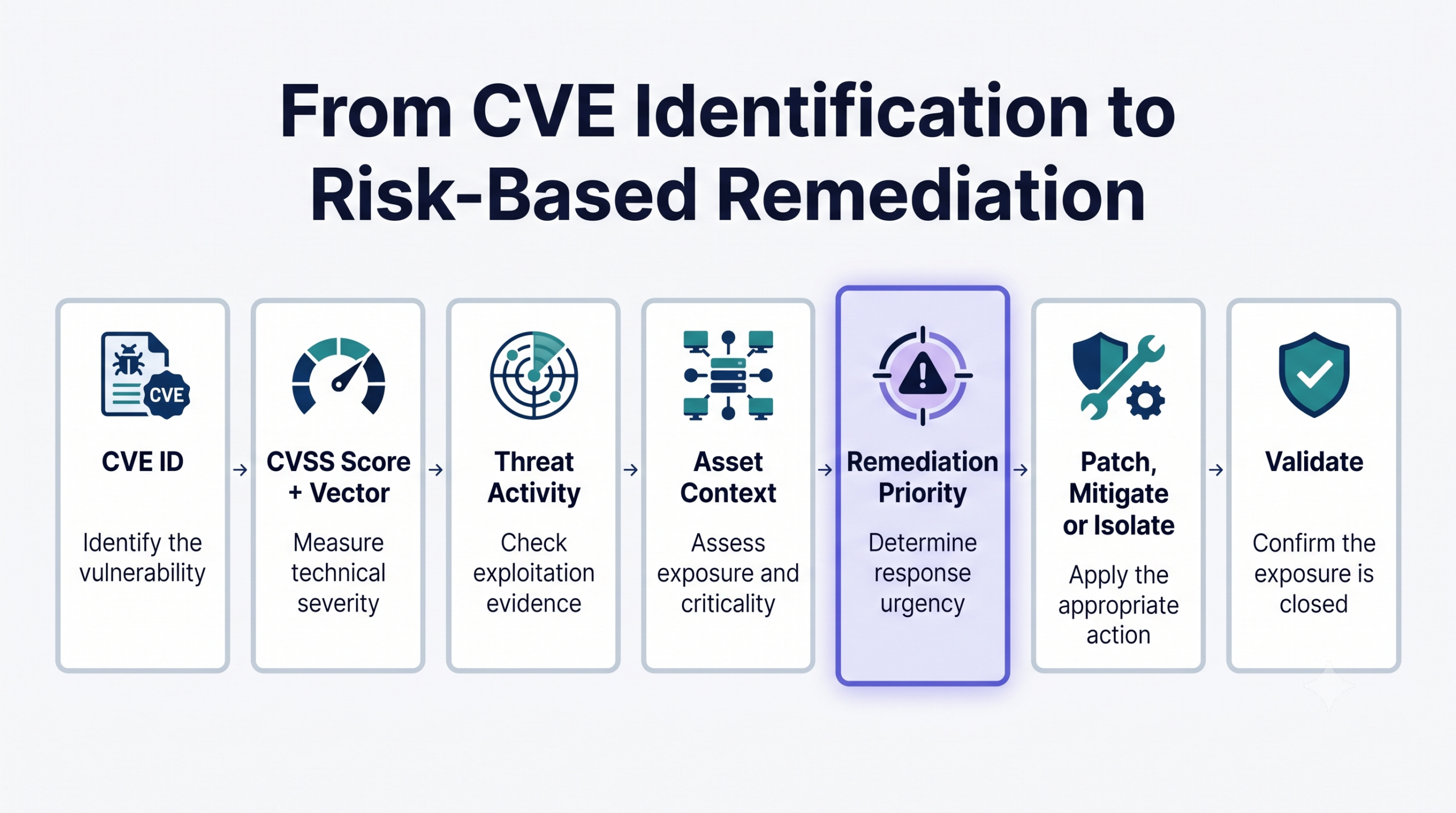
From CVE Identification to Risk-Based Remediation
Is a CVSS Score the Same as a Risk Score?
No. A CVSS Base score measures technical severity, not the organization-specific likelihood or business impact of exploitation. It describes the vulnerability’s intrinsic characteristics under defined assumptions.
The Base score does not automatically establish whether the vulnerable product is deployed in the organization, whether the affected system is internet-exposed or whether effective compensating controls exist. It also does not account for the asset’s business criticality, data sensitivity or connection to essential services.
FIRST recommends supplementing Base metrics with Threat metrics, which reflect conditions such as exploitation activity, and Environmental metrics, which adapt the assessment to the affected environment. CVSS should therefore inform prioritization alongside asset and threat context rather than function as the only remediation rule.
Note
A CVSS Base score measures technical severity, not organizational risk. Add threat activity, asset exposure and business impact before assigning remediation priority.
Risk-Based Patch Management by CVE and Exposure
Learn how to combine CVE data, severity, exploitability and asset exposure to prioritize patching.
How Should Security Teams Use CVE and CVSS Data?
Security teams should use CVE for consistent tracking and correlation, then combine CVSS severity with endpoint exposure, exploit activity, asset criticality and available remediation. Neither data point should determine priority independently.
A repeatable five-step workflow helps SOC, vulnerability-management and endpoint teams apply these factors consistently. It aligns identification, contextual analysis, remediation and verification while giving each team a shared basis for assigning priorities and documenting decisions.
Step 1: Confirm Whether the CVE Affects Your Environment
Compare the affected vendor, product, version and configuration listed in the CVE Record or vendor advisory against a current software and asset inventory. A matching product name alone does not confirm exposure.
Validate the finding by checking patch applicability, endpoint scan freshness and whether the vulnerable component is installed, enabled or reachable. This prevents stale inventory data and configuration differences from creating false positives.
For confirmed exposure, record the affected devices, assigned owners, network accessibility and associated business services. This inventory establishes the scope and context required for accurate remediation prioritization.
Step 2: Interpret the CVSS Score and Vector
Review the CVSS version, numerical score, qualitative rating and complete vector string. A Critical or High label summarizes severity but does not explain the conditions required for exploitation or the resulting impact.
Translate each metric into operational terms. Determine whether exploitation is possible remotely or requires local access, whether the attacker needs privileges, whether user interaction is necessary and how confidentiality, integrity or availability could be affected.
Scores from the software vendor, NVD or another authoritative source may differ because of assessment assumptions or CVSS versions. Compare the supporting vectors, select the assessment appropriate to your workflow and document that decision.
Pro tip
Record the assessment source, CVSS version and complete vector—not just the numerical score. This makes prioritization decisions easier to compare, reproduce and audit.
Step 3: Add Threat and Exploitation Context
Determine whether public exploit code exists, exploitation has been observed in the wild or the CVE appears in trusted threat-intelligence feeds. Review endpoint telemetry for related attack behavior instead of assessing the vulnerability in isolation.
An actively exploited Medium- or High-severity vulnerability may require action before a Critical vulnerability with no reachable attack path. Exploitation evidence changes the likelihood component of risk and therefore the order of remediation.
Correlate the vulnerability with XDR alerts, suspicious process activity, unusual network connections and related incidents. This establishes whether the exposure remains theoretical or is part of an active attack.
Step 4: Apply Asset and Business Context
Evaluate each affected asset’s internet exposure, operational role and connection to sensitive data or critical services. Consider the assigned user’s privileges and the potential consequences of compromise, including service disruption, unauthorized access and data loss.
Document compensating controls such as network segmentation, application control or disabled vulnerable functionality. These controls may reduce immediate exposure, but they should not become permanent substitutes for patching or another complete remediation.
Use the combined technical and business context to assign risk-based remediation tiers and SLAs. Vulnerabilities with the same CVSS rating should not automatically receive identical deadlines.
Step 5: Remediate, Validate and Report
Select the response appropriate to the finding: deploy a patch, change the vulnerable configuration, remove unsupported software, isolate a compromised endpoint or apply a temporary mitigation.
Use staged deployment when patches could disrupt business-critical endpoints. However, accelerate containment and remediation when systems are exposed or exploitation is already occurring.
After remediation, rescan affected endpoints and verify patch installation or mitigation status. Continue monitoring XDR telemetry for exploitation attempts, and preserve scan results, deployment records and validation evidence for operational reporting and audits.
How Hexnode Connects CVE Visibility, CVSS Context and Endpoint Response
Hexnode connects CVE visibility and CVSS context with separate workflows for dormant vulnerabilities and active endpoint threats.
Under Patches and Updates > Vulnerabilities, administrators can review All vulnerabilities, Applicable vulnerabilities and Vulnerable devices. Findings can be filtered by CVSS rating, from None through Critical.
The Applicable Vulnerabilities report includes the CVE ID, CVSS v3.1 Base Score, vector string, rating, CVE.org link and affected devices. The Vulnerable Devices report lists affected device details and provides access to each device’s vulnerabilities. Patch-compliance reports show the percentage of devices on which each applicable patch is installed, while scheduled reports can be emailed to specified administrators or technicians.
Operationally, Hexnode UEM manages applicable patches and dormant exposure remediation. Hexnode XDR monitors endpoint behavior and supports process termination or endpoint isolation when active threats emerge. This division distinguishes recorded severity from exploitation requiring immediate containment across affected endpoints.
Featured Resource
Why XDR Is Stronger With UEM
See how UEM context helps XDR prioritize threats, reduce alert fatigue and coordinate endpoint response.
Yes, a CVE can exist without a CVSS score because the identifier and severity assessment are created through separate processes. A score may be added later by a vendor, the NVD or another assessment provider.
Why do vendors and the NVD sometimes assign different CVSS scores to the same CVE?
CVSS scores can differ when assessors interpret metrics differently, evaluate different affected configurations or use different CVSS versions. Compare the complete vector strings to identify which assumptions produced each score.
Should every vulnerability with a Critical CVSS rating be patched first?
No, a Critical rating should not determine remediation order by itself. Teams should also consider active exploitation, endpoint exposure, asset importance, compensating controls and patch availability.
Can the priority of a CVE change after its initial assessment?
Yes, remediation priority can change when exploit code becomes available, active exploitation is detected or the affected asset’s exposure changes. Teams should reassess vulnerabilities when new threat intelligence or environmental information becomes available.
How can teams verify that a CVE has been fully remediated?
Teams should rescan affected endpoints and confirm that the required patch, configuration change or mitigation is present. They should also verify pending reboots, monitor for continued exploitation attempts and retain remediation evidence.
Can Hexnode show which managed devices are affected by a CVE?
Yes, Hexnode UEM provides Applicable Vulnerabilities and Vulnerable Devices views for identifying affected managed endpoints. Its reports can display CVE details, CVSS v3.1 information, affected devices and patch-compliance status.
Turn Vulnerability Data Into Prioritized Action
Effective vulnerability management requires a connected path from CVE identification and CVSS interpretation to endpoint-level investigation, remediation and verification. This enables teams to prioritize actual exposure instead of relying on identifiers or severity scores alone.
Turn Vulnerability Context Into Action
Use Hexnode XDR to connect vulnerability context with endpoint investigation, remediation and verification.
Associate Product Marketer at Hexnode focused on SaaS content marketing. I craft blogs that translate complex device management concepts into content rooted in real IT workflows and product realities.