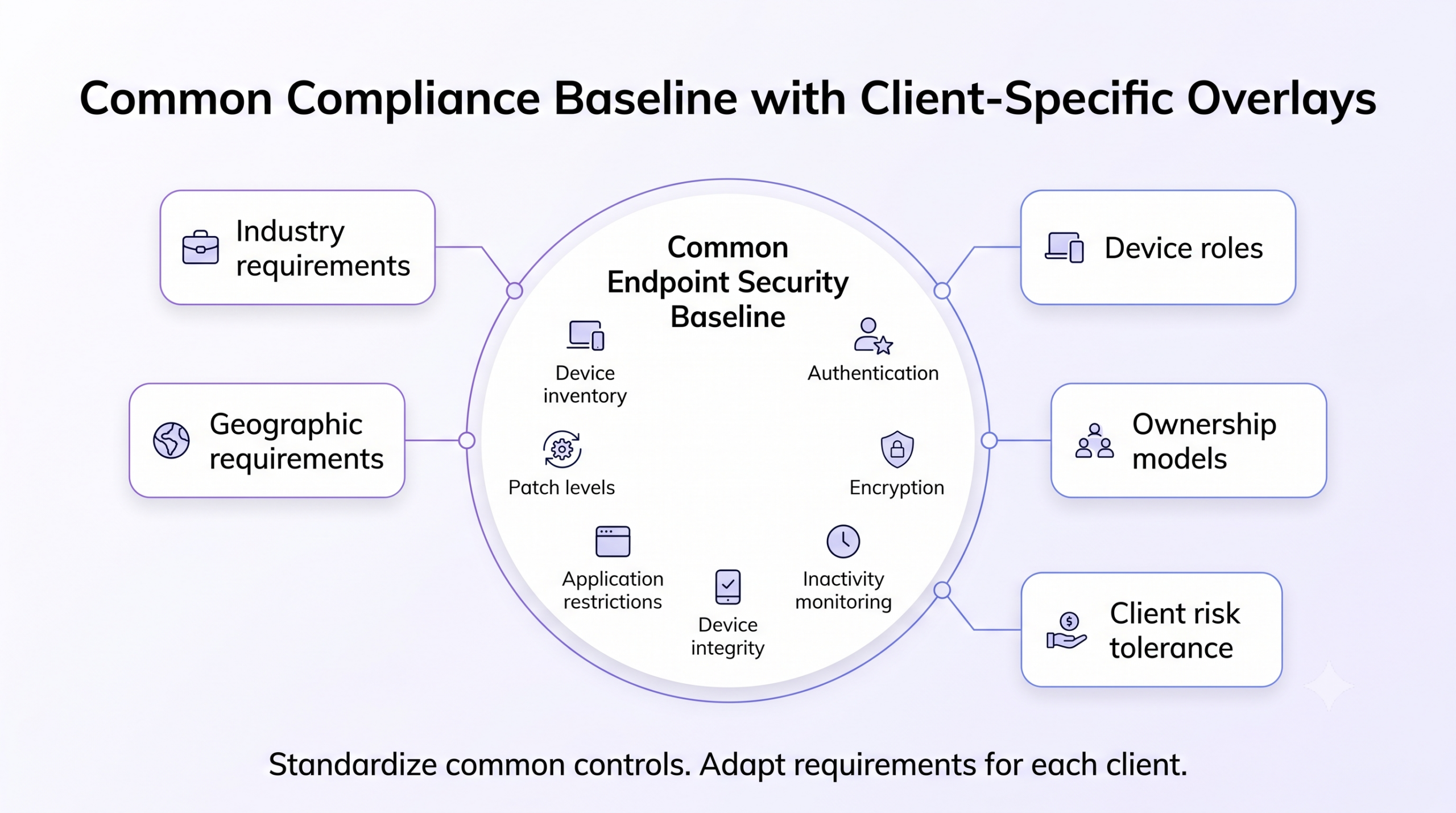
Scalable MSP compliance management combines a shared endpoint-security baseline with client-specific controls, continuous monitoring and documented evidence.
Fragmented processes increase configuration drift, inconsistent enforcement, audit gaps, unresolved vulnerabilities and remediation delays across client environments.
MSPs should map obligations, assign control owners, apply client-specific overlays, test policies, deploy them gradually and maintain evidence throughout the compliance lifecycle.
Hexnode UEM MSP supports separate client portals, configurable compliance policies, role-based administrative access and scheduled device compliance reporting.
Why Is Cross-Industry Compliance Difficult for MSPs?
MSPs must translate different regulatory, contractual and internal requirements into enforceable controls for every client without creating fragmented or unmanageable workflows. Their operating model must support distinct obligations while remaining standardized enough for technicians to execute consistently across multiple client environments.
The variables multiply quickly. Healthcare, financial services and retail clients may require different controls, evidence and remediation timelines. Geographic rules can affect data handling, while corporate-owned, BYOD and shared devices require different management approaches. Mixed Windows, macOS, Android, iOS and ChromeOS estates add further policy and enforcement complexity.
Data sensitivity and risk tolerance also influence how clients respond to non-compliance. One organization may require immediate device restriction, while another permits a remediation window to avoid operational disruption. A universal policy can therefore leave some clients underprotected while imposing unnecessary restrictions on others.
Effective MSP compliance management requires a layered approach: standardize common controls, monitoring methods and evidence formats, then apply client-specific policies and exceptions. The central challenge is preserving each client’s requirements without duplicating every process or making cross-client oversight too complex to scale.
What Happens When MSP Compliance Processes Do Not Scale?
When compliance processes fail to scale, configuration drift, unresolved vulnerabilities, incomplete audit evidence and inconsistent enforcement spread across client environments. MSPs lose a reliable view of whether required controls are active, current and functioning on every managed endpoint.
The operational burden grows with each client. Technicians must repeat manual checks, recreate similar policies and reconcile data from separate tools or spreadsheets. Audit preparation becomes a time-consuming evidence collection exercise instead of a routine reporting process. Teams may also struggle to distinguish a high-risk compliance failure from a lower-priority exception, delaying attention to the clients and devices that need it most.
These gaps can affect both security and service delivery. Missed remediation deadlines or inconsistent controls may contribute to SLA violations, failed audits and contractual disputes. If clients cannot obtain reliable compliance evidence or repeatedly encounter preventable policy failures, confidence in the MSP declines and churn becomes more likely.
Fragmented processes also increase breach exposure by allowing outdated configurations or known vulnerabilities to remain unresolved. Technology can support enforcement and reporting, but no single tool guarantees regulatory compliance. MSPs still need defined ownership, documented procedures, appropriate controls and regular validation across each client environment.
What Does MSP Compliance Management Actually Involve?
MSP compliance management is the continuous process of translating each client’s obligations into measurable technical and administrative controls, monitoring whether those controls remain effective, remediating deviations and retaining evidence of enforcement. It is an ongoing operational discipline, not a one-time assessment completed before an audit.
Those obligations can originate from several sources:
Regulatory requirements: Legally enforceable rules determined by factors such as jurisdiction, industry and the data being processed.
Industry standards: Structured control frameworks or certification requirements that clients adopt or must follow through business relationships.
Contractual obligations: Security, reporting, response and service-level commitments specified in customer, vendor or cyber-insurance agreements.
Internal policies: Requirements established by the client based on its governance model, risk tolerance and operating procedures.
These sources may address similar risks, but they are not interchangeable. A control that supports an industry standard does not automatically satisfy a law or contractual clause. MSPs must map every control to the specific obligation it addresses.
Endpoint compliance forms only one part of this program. A complete compliance model also covers governance, identity and access, networks, applications, data protection, incident response and physical security. Endpoint controls support these wider requirements but cannot replace them.
Which Compliance Controls Can MSPs Standardize?
MSPs can standardize controls that address common endpoint risks across most client environments. Typical baseline controls include:
Maintaining an accurate device inventory
Enforcing storage encryption and passcode requirements
Detecting inactive devices that no longer communicate with management systems
A common control framework turns these recurring requirements into a reusable minimum security baseline. The MSP defines each control once, documents its purpose and maps it to comparable requirements across relevant regulations, standards and client agreements. This reduces duplicate policy design while making gaps easier to identify.
Standardization should also cover operational language. Consistent control names, severity ratings, ownership fields, remediation statuses and evidence formats help technicians interpret findings uniformly across accounts. For example, every critical encryption failure could use the same classification and evidence requirements, even if clients specify different remediation deadlines.
The framework establishes a shared foundation, not a universal configuration. MSPs can adjust thresholds, supported platforms and enforcement actions for each client while retaining a consistent structure for monitoring, escalation and reporting.
Which Requirements Must Remain Client-Specific?
Controls must remain client-specific when they depend on the organization’s industry, location, contracts, data exposure or risk tolerance. A healthcare provider, financial institution, retailer, educational organization and public-sector agency may impose different record-retention rules, device restrictions, audit evidence requirements and remediation timelines, even when they use similar endpoints.
Industry alone does not determine the compliance model. Geography can introduce separate privacy, breach-notification and data-residency obligations. Two clients in the same sector may therefore require different controls because they operate in different jurisdictions, process different categories of data or serve different customer groups.
Frameworks must also be treated according to their actual purpose. HIPAA applies to specified healthcare entities and their business associates in the United States. PCI DSS. applies to entities that store, process or transmit cardholder data or sensitive authentication data, as well as entities that could affect the security of the cardholder data environment. The GDPR applies to personal-data processing connected to an EU establishment and to certain non-EU organizations that offer goods or services to, or monitor the behavior of, individuals in the EU. CIS Controls provide cybersecurity best practices rather than a statutory mandate.
These examples can guide control mapping, but they are neither universally applicable nor equivalent. Each client requires an independently validated compliance scope.
Important:
HIPAA, PCI DSS, GDPR and CIS Controls are not interchangeable. Validate which requirements apply to each client based on its activities, contracts, jurisdiction and data-processing scope.
How Should MSPs Build a Scalable Compliance Program?
MSPs need a repeatable operating model built around discovery, control mapping, policy deployment, monitoring, remediation and evidence collection. The model should provide a consistent operating structure across clients while allowing controls, enforcement thresholds and reporting practices to reflect each client’s requirements.
These activities form a continuous lifecycle rather than a one-time certification exercise. New devices, software updates, contractual changes and emerging vulnerabilities can alter compliance status after an initial assessment. MSPs must therefore reassess controls, validate configurations and update evidence at defined intervals.
Before selecting or configuring technical controls, assign clear accountability for:
Approving policies and exceptions
Monitoring compliance findings
Remediating failed controls
Escalating unresolved risks
Reviewing evidence and reporting to clients
Each responsibility should have a named owner, review frequency and escalation path. This governance layer prevents findings from remaining unassigned and ensures that technical alerts lead to documented action. MSPs can then implement the lifecycle through five structured steps.
Step 1: Inventory Each Client’s Obligations and Environment
Start by defining the compliance scope for each client. Document applicable regulations, industry standards, contractual security clauses, cyber-insurance conditions, internal policies and SLA commitments. Record the jurisdiction, business process and data type that make each obligation relevant rather than assigning requirements based only on industry.
Next, inventory the environment in which those obligations must be enforced. Include:
Users, roles and privileged accounts
Managed and unmanaged devices
Corporate-owned, BYOD and shared-device models
Operating systems, versions and enrollment states
Business-critical and regulated applications
Data categories each endpoint can store, process or access
Reconcile this inventory with identity, asset and service-management records to identify unknown, inactive or incorrectly assigned endpoints.
Use the findings to create a client compliance matrix. For every obligation, identify the accountable owner, required technical or administrative control, affected assets, evidence source and review interval. Where no control or evidence source exists, record the item as a gap requiring remediation. This matrix becomes the reference point for designing policies and evaluating future changes.
Featured Resource
Hexnode UEM for MSPs
See how Hexnode UEM MSP centralizes multi-tenant management, technician access, licensing and reporting.
Step 2: Create a Baseline with Client-Specific Overlays
Use the compliance matrix to establish a minimum endpoint-security baseline that applies wherever technically and contractually appropriate. The baseline should define requirements for storage encryption, authentication, acceptable patch levels, prohibited applications, device integrity and inactivity thresholds. Specify measurable conditions so technicians can determine whether an endpoint passes or fails each control.
Common Endpoint-Security Baseline
Next, add targeted policy overlays instead of building every client configuration from scratch. Overlays can account for:
Industry-specific obligations
Geographic or data-residency requirements
Device roles and access privileges
Corporate-owned, BYOD or shared ownership
Client-defined risk tolerance and remediation periods
For example, an endpoint that accesses regulated records may require stricter authentication and patch deadlines than a device limited to public information.
Define how the MSP will resolve conflicts between the shared baseline and an overlay. The stricter setting may take precedence where requirements can coexist, but business or technical constraints may require a documented exception. Record the affected control, justification, approving authority, compensating measures and expiration date. This preserves consistency while showing why a client-specific configuration differs from the standard baseline.
Step 3: Translate Requirements into Enforceable Controls
Convert each broad requirement into a condition that management and monitoring systems can evaluate. Replace statements such as “devices must be secure” with explicit criteria—for example, storage encryption must be enabled, the OS must meet a defined minimum version and passwords must satisfy specified length and complexity rules.
Document the expected state, supported platforms, evaluation method and remediation action for every control. If a requirement cannot be enforced technically, identify the manual procedure or compensating control used to address it.
Before production deployment, test policies on devices that represent the client’s actual environment. Include different operating systems, OS versions, ownership models and enrollment methods. Validate business-critical workflows such as authentication, network access, application use and data synchronization to detect conflicts before users are affected.
Deploy validated controls in phases, beginning with a limited pilot group. Monitor compliance results and operational impact before expanding the assignment. Define rollback criteria, responsible approvers and recovery procedures in advance so technicians can reverse a faulty configuration without improvising during an incident or disrupting the entire client environment.
MSP Compliance: Policy Staging and Validation for Preventing Breaches
Learn how policy staging and validation reduce configuration errors across managed client environments.
Step 4: Monitor Compliance and Preserve Audit Evidence
Monitor endpoints using consistent definitions for compliant, non-compliant and inactive states. Define what triggers each status, how frequently devices must report and when an inactive endpoint becomes a compliance concern. Keep client inventories, findings and reports logically separated to prevent cross-client access or evidence mix-ups.
For every control, specify the evidence required to demonstrate implementation and ongoing enforcement. Depending on the obligation, this may include:
Policy assignments and configuration details
Device enrollment and compliance status
Encryption state and OS version
Patch or application inventory records
Administrative change logs
Exception approvals and remediation records
Schedule recurring reports according to each client’s review cycle, SLA and audit requirements. Client reviews should examine unresolved findings, recurring failures, expired exceptions and changes to the compliance scope.
Treat automated reports as evidence inputs rather than definitive proof of compliance. Validate timestamps, device coverage, reporting periods and policy scope before submission. Organizational and procedural controls may require additional records, such as approvals, training logs or incident-response documentation.
Step 5: Manage Exceptions, Remediation and Policy Changes
Define severity-based remediation timelines for each type of compliance failure. Assign escalation paths for missed deadlines and specify temporary compensating controls—such as restricted access, network isolation or increased monitoring—when a device cannot immediately meet a requirement.
Maintain a centralized exception register for every approved deviation. Each record should include:
The affected asset and control
Business or technical justification
Risk assessment and compensating controls
Approving authority
Approval and expiration dates
Current review status
💡Pro tip:
Give every compliance exception an owner and expiration date. An exception without a scheduled review can quietly become a permanent security gap.
Exceptions should expire unless they are formally reviewed and renewed. This prevents temporary workarounds from becoming undocumented permanent configurations.
Reassess the control framework whenever regulations, client contracts, supported operating systems, applications or business processes change. Evaluate how each change affects existing policies, evidence requirements and remediation workflows. Record the revision, rationale, approver, implementation date and affected clients so technicians and auditors can trace the policy’s history.
How Does Hexnode UEM MSP Support Client-Specific Compliance?
Hexnode UEM MSP allows providers to create independent UEM Nodes for separate client environments while managing them through an MSP-level structure. Each Node operates as a standalone Hexnode UEM instance, helping isolate client data, policies, applications and administrative access. MSP-level roles and scopes further limit technicians to their assigned responsibilities.
Within each client portal, MSPs can configure Compliance Policies using predefined basic settings or advanced, platform-specific rules. These policies translate requirements—such as encryption, OS version or password criteria—into measurable device conditions. However, a compliant device status supports only endpoint-level control validation; it does not certify the client’s overall regulatory compliance.
Device Compliance Reports identify compliant, non-compliant and inactive devices and can be exported as PDF or CSV files. MSPs can also configure Scheduled Reports for recurring evidence collection. Roles such as Reports Manager restrict technicians or auditors to the dashboard and reporting functions without granting configuration privileges. Together, these controls support client-level monitoring and evidence collection while preserving administrative separation between portals.
What should an MSP include in a client compliance SLA?
A compliance SLA should define control ownership, monitoring frequency, severity levels, remediation deadlines, escalation paths and reporting responsibilities. It should also specify how exceptions, evidence requests and unresolved risks will be handled.
How often should MSPs review client compliance policies?
MSPs should review policies at a defined frequency and whenever regulations, contracts, operating systems or business processes change. High-risk controls and frequently changing endpoint conditions may require more frequent validation than stable configurations.
What is the difference between a compliant device and a compliant organization?
A compliant device meets the technical conditions assigned to it, such as encryption, password or OS-version requirements. Organizational compliance also depends on governance, identity, network, data, incident-response and physical-security controls.
How can MSPs test compliance policies without disrupting client operations?
MSPs should test policies on representative devices before production deployment. A limited pilot, phased rollout and documented rollback procedure help identify conflicts with operating systems, enrollment methods and business-critical applications.
What evidence should MSPs retain for a client compliance audit?
MSPs should preserve policy assignments, device status, encryption and OS information, administrative changes, exceptions and remediation records. Every evidence item should include sufficient scope, timestamps and device coverage to support the relevant control.
Can Hexnode UEM MSP certify that a client is compliant?
No, Hexnode UEM MSP does not certify an organization’s regulatory compliance. Its compliance policies, device reports, scheduled reports and portal separation can support endpoint control monitoring and evidence collection within individual client environments.
Evaluate a Multi-Client Compliance Workflow with Hexnode
Start a Hexnode UEM trial or request a demonstration to evaluate separate client portals, client-specific compliance policies and device compliance reporting. Test the workflow with one representative client, validating technician access, policy behavior, reporting coverage and evidence requirements before expanding it across other accounts.
Standardize Compliance Across Client Portals
Separate client portals, enforce endpoint controls and simplify compliance reporting with Hexnode UEM MSP.
Associate Product Marketer at Hexnode focused on SaaS content marketing. I craft blogs that translate complex device management concepts into content rooted in real IT workflows and product realities.