HexCon26 kicked off in Atlanta on September 9, with the opening keynote bringing together the event’s biggest themes and announcements.
Apu Pavithran, Founder and CEO of Hexnode, took the stage first, followed by Rachana Vijayan, EVP of Global Go-To-Market and CMO. Together, they laid out where enterprise IT is heading, what Hexnode has built over the past year, and why the company believes the industry is moving from managed devices to managed outcomes.
Here’s a recap of everything announced.
Hexnode is moving from device management to managed outcomes
One of the strongest themes of the keynote was that the job of endpoint management has not fundamentally changed over the years.
IT teams still enroll, configure, patch, secure and troubleshoot devices. What has changed is everything happening through those devices: applications, identity, data, security and increasingly AI.
Hexnode’s direction is therefore centered on autonomy: routine work should increasingly happen on its own, while IT retains control over the policies, approvals and outcomes that matter.
The goal is simple: less time spent on enrolling, patching, chasing and ticketing, and more time spent on the work that actually moves the business forward.
Hexnode AI is becoming the intelligence layer across the platform
The keynote moved beyond the idea of AI as just another assistant.
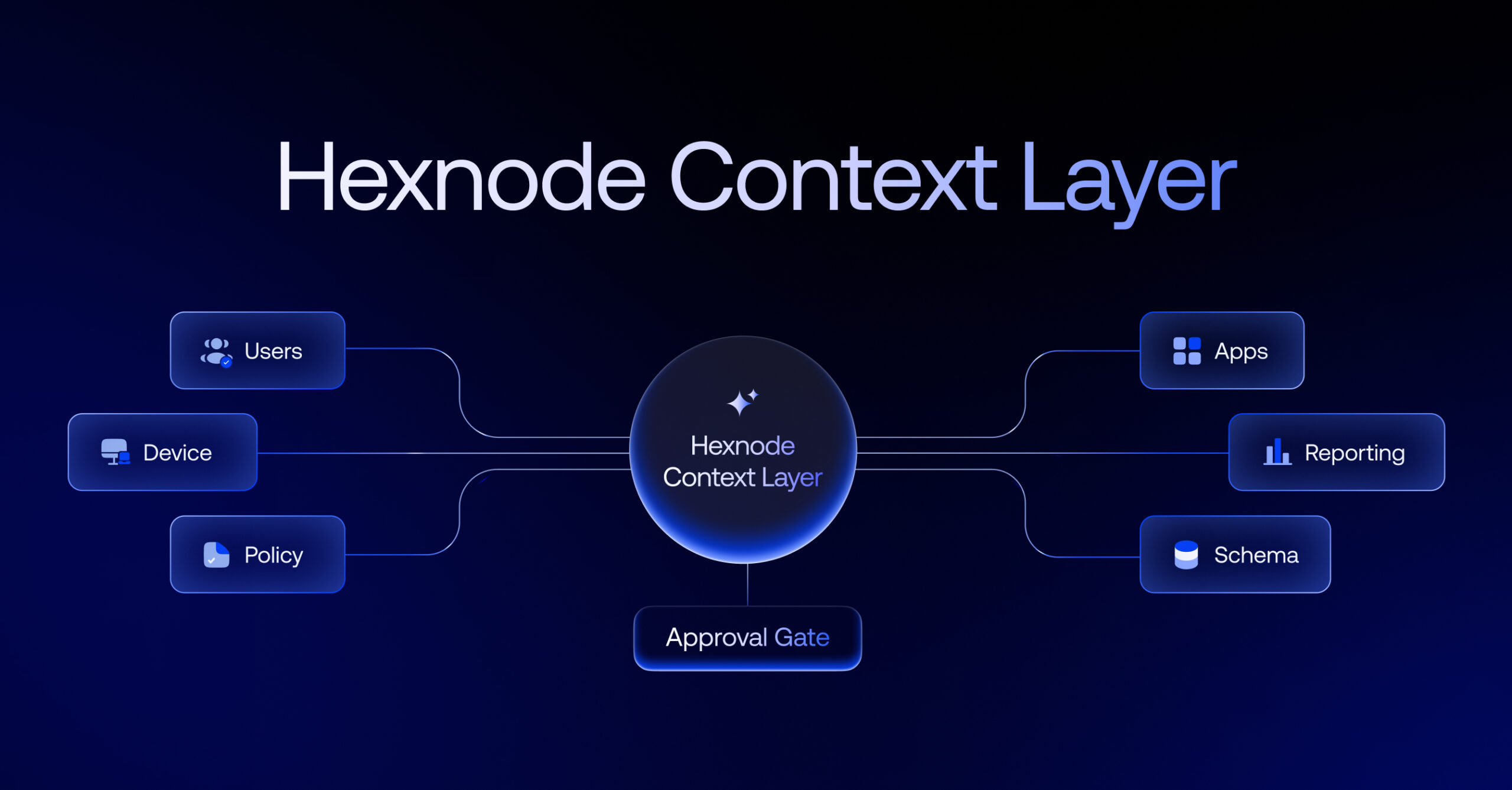
Hexnode Genie can already understand natural-language requests, while the Hexnode Context Layer uses live fleet context to route those requests to specialized agents for device management, users, policies, applications, reporting and schema-related workflows.
The bigger direction is agentic.
Instead of simply answering what an administrator should do, the platform can understand the request, decide which workflow is required and act within defined boundaries. Consequential actions can still wait for human approval.
Underlying that is Hexnode AI, which is being extended across endpoint management, XDR and IdP so that device, identity and incident context can be interpreted as part of one environment.
UEM gets deeper across support, patching and everyday administration
Hexnode UEM received a broad set of updates aimed at reducing everyday administrative effort.
Remote support now includes capabilities such as multi-monitor visibility, session transfer between technicians, and live terminal access with endpoint context available alongside it.
Patching also gets more structured, with deployment rings, n-1 patching and Linux patch management.
The keynote also highlighted BIOS management, eSIM provisioning for Android, Windows Server management, DMG parsing on macOS, offline location tracking, geofencing and improvements across the Manage, Enroll, Automate and Kiosk experiences.
Another addition is the Hexnode UEM Mobile Admin App, designed to give administrators access to fleet information, policies, Genie, incidents, supported remote actions and alerts directly from a phone.
Hexnode XDR focuses on reducing the gap between detection and response
For XDR, the keynote emphasized that more alerts are not the goal.
Hexnode XDR is being shaped around reducing the number of steps between identifying a threat and taking action.
The product includes threat-intelligence checks, sandbox integration, anomaly detection and a consolidated incident view.
Vulnerability management adds a device score from 0-100 based on vulnerability, exposure, configuration and behavior, giving security teams a way to prioritize where to start.
Response capabilities include endpoint network isolation and automated remediation, while SIEM forwarding, APIs, dashboards and incident workflows support investigation and evidence retention.
Genie also appears directly inside incident workflows through Analyse with Genie, using live incident data to explain what happened, what is affected and the recommended response.
Hexnode IdP brings device trust into the access decision
The identity story at HexCon26 was built around a simple gap: valid credentials do not necessarily mean the device itself should be trusted.
Hexnode IdP combines identity and device context so that access decisions can consider whether a device is enrolled, compliant and patched, not just whether the password and MFA are correct.
The keynote also highlighted users and groups, organizational units, templates, Entra and Google federation, OIDC, SAML and OAuth, MFA, conditional access, lifecycle management, RBAC and self-service.
Support also extends to the login experience through Hexnode Access on Linux and Platform SSO on macOS.
Hexnode Synapse extends orchestration beyond Hexnode
The biggest architectural announcement of the keynote was Hexnode Synapse.
The keynote positioned Synapse as the next step beyond intelligence inside the Hexnode platform: one intelligence coordinating work across Hexnode and the other IT systems organizations already use.
That matters because many IT workflows never stay inside one product.
Onboarding touches identity, devices and HR systems. Incident response can involve XDR, endpoint controls, identity and ticketing. Today, administrators are often the ones connecting those systems manually.
Synapse is Hexnode’s answer to that orchestration problem.
Closing the CEO segment: how this gets measured
Apu closed his portion by reiterating that every product shown – UEM, XDR, IdP, DEX, Synapse – works standalone, but behaves as one system because they share the same underlying data and intelligence layer from the start.
Rachana Vijayan: scaling through the ecosystem
Rachana Vijayan, EVP of Global Go-To-Market and CMO, took over to make the case that innovation alone isn’t enough – the platform also has to fit how organizations of very different sizes actually operate, from global enterprises to small IT teams to the MSPs and partners managing technology for hundreds of customers at once.
Her focus was Hexnode UEM MSP, where the pitch is a single unified, multi-tenant platform rather than the patchwork many MSPs run today (RMM plus separate tools for endpoint management, third-party patching, security, and compliance).
Announcements included a new MSP subscription management system, export and import of policies, custom reports and dynamic groups across tenants, and expanded brand customization.
Recognition and community
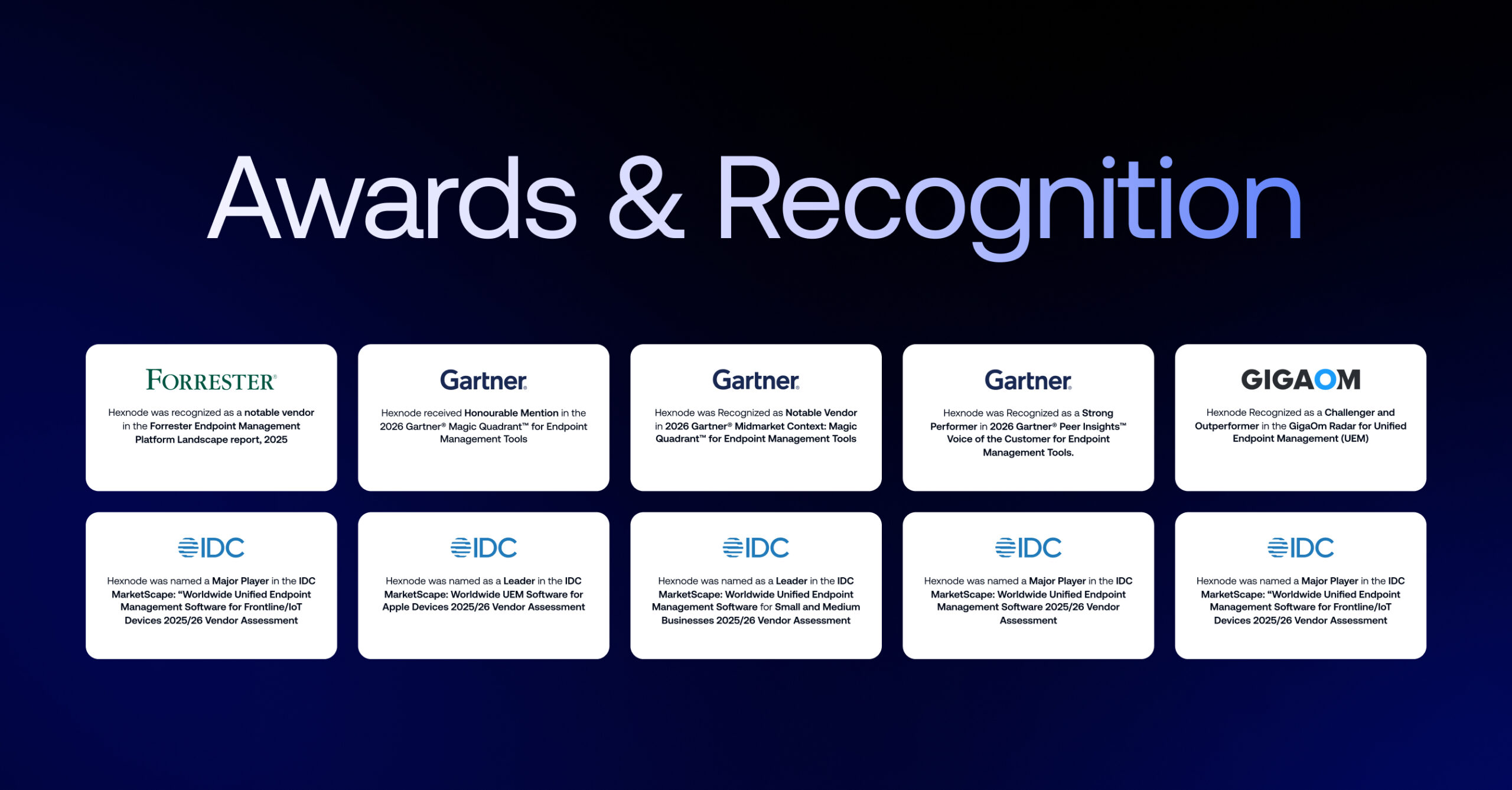
Rachana also highlighted external validation from the past year – recognition from Forrester, IDC, Gartner, and GigaOm across endpoint and UEM categories, along with awards from G2, Info-Tech Research, SoftwareSuggest, and MES Computing.
She was clear, though, that the more meaningful signal is what customers and partners are actually able to do with the platform, and pointed to the customer and partner story montage shared during the session as evidence of that impact across industries and regions.
Rachana closed by framing the conference itself as part of the feedback loop that shapes what Hexnode builds next.
One platform vision, built around connected intelligence
The throughline across both segments of the keynote was consistency: one data model, one intelligence layer, extended across every product Hexnode ships and every partner that resells it.
Whether the audience is an enterprise IT team, a lean IT department, or an MSP managing hundreds of tenants, the goal was the same – less time spent connecting tools manually, and more of the routine work handled automatically, inside boundaries IT controls.