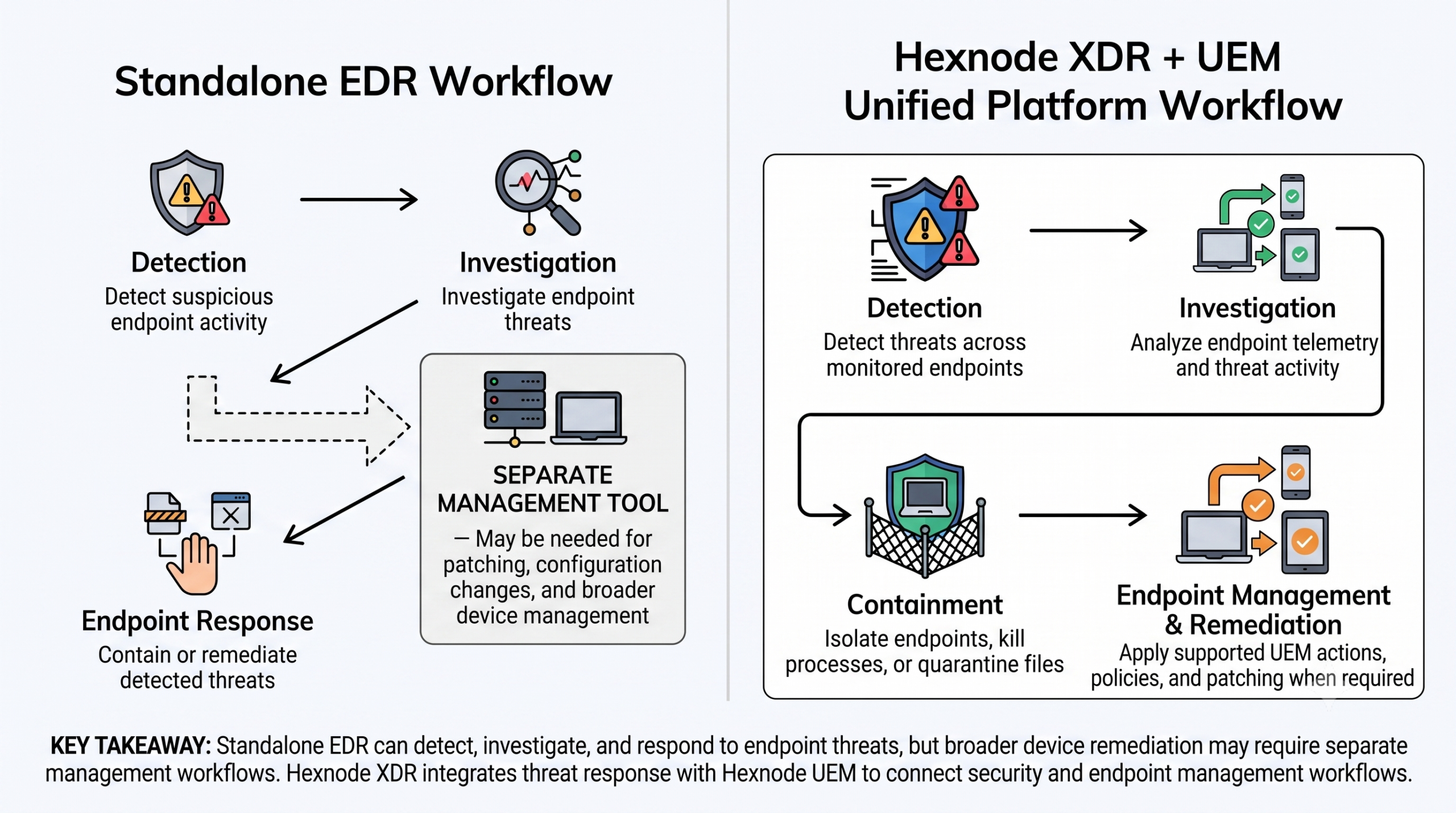
Standalone EDR can detect and contain endpoint threats, but remediation often depends on separate management tools and workflows. Hexnode XDR reduces that gap by combining threat visibility, investigation, response, and UEM-driven remediation in a more unified platform. Its integration with Hexnode UEM also supports follow-up actions such as patching, configuration changes, policy enforcement, and auditability after a threat is identified.
Why Standalone EDR Tools Are Reaching Their Limits
Endpoint detection and response remains a critical layer of enterprise security, but operating EDR as an isolated tool can create friction after a threat is detected. EDR platforms identify suspicious endpoint activity and indicators of compromise. However, full risk remediation requires operational actions beyond the EDR console.
Consider an endpoint running vulnerable software. EDR may surface the resulting malicious activity and provide containment or investigation capabilities, but permanently addressing the exposure could require a software update or configuration change through a separate endpoint management platform. Cross-functional remediation frequently spans multiple IT and security domains. Consequently, administrators must juggle disparate EDR, UEM, patching, and ticketing platforms.
This fragmentation introduces practical challenges:
Context is distributed across security and management tools.
Remediation requires handoffs between consoles, teams, or workflows.
Response times can increase when administrators must manually translate a detection into the appropriate corrective action.
Operational overhead grows as organizations maintain integrations and processes across multiple platforms.
EDR evaluations have moved beyond threat detection capabilities. Leaders now question whether standalone tools ensure operational continuity. Closing the distance between detection, investigation, and remediation may require a more unified approach.
EDR detects and addresses threats at the endpoint level. XDR expands this scope by correlating telemetry and response across the entire enterprise.
The distinction, however, is not simply that XDR collects telemetry from more sources. The “extended” model is intended to reduce the operational separation between security signals and the actions teams take in response. Siloed tools split investigation, context gathering, and remediation across separate consoles. XDR consolidates these steps into a single, coordinated workflow.
In practice, this changes how teams move through an incident:
EDR provides deep endpoint telemetry and endpoint-focused detection, investigation, and response.
XDR correlates signals across supported security domains to provide broader incident context.
A more integrated workflow can reduce the manual handoffs and console switching involved in moving from detection to remediation.
For Hexnode XDR, that extension also includes native integration with Hexnode UEM. Unified platforms combine threat investigation with rich device context. This enables native remediation and patching without requiring a separate UEM product.
The result is a tighter connection between detection and endpoint remediation. Rather than treating security detection and device management as independent workflows, Hexnode XDR and UEM can work together to help teams identify endpoint threats and take corrective action from a unified platform.
The Ultimate Guide to XDR (Extended Detection and Response)
Explore how XDR connects security data, investigation and response across previously siloed security tools.
Hexnode XDR + UEM vs standalone EDR
How Hexnode XDR Closes the Gaps Standalone EDR Leaves Open
The limitations of standalone EDR become most apparent when analysts have to move from understanding a threat to taking action on the affected endpoint. Hexnode XDR brings threat visibility, investigation, containment, and endpoint management closer together, reducing the number of disconnected tools involved in that workflow.
Hexnode XDR provides centralized threat visibility, investigation, and response capabilities for supported Windows endpoints. Security teams can monitor supported Windows endpoints, review incidents, apply security policies, and perform response actions through the centralized Hexnode XDR console.
When an active threat requires containment, one-click threat remediation allows analysts to act from the same platform. Depending on the incident, they can:
Isolate the device to restrict network access and help prevent further spread.
Kill a malicious process directly on the affected endpoint.
Quarantine a suspicious file so it can no longer execute normally.
These actions shorten the path between identifying malicious activity and containing it, without requiring the analyst to escalate the detection to a separate endpoint remediation console.
The Unified Dashboard addresses another common source of operational friction: fragmented context. It provides a real-time, 360-degree view of threats, active incidents, and endpoint health. Analysts can therefore assess a security event alongside the condition of the affected endpoint instead of manually correlating information from separate security and device-health tools.
This unified approach does not come at the expense of investigation depth. Precision Threat Hunting includes an Intuitive Query Builder for constructing and reusing complex searches, while Advanced Investigation Query provides access to seven days of stored, detailed endpoint data. Analysts can investigate indicators, processes, and historical endpoint activity while remaining within the same platform used for detection and response.
The practical difference is workflow continuity: detection, investigation, endpoint context, and containment become parts of a connected operational process rather than separate steps distributed across multiple tools.
Why Hexnode XDR’s Integration Is the Key Differentiator
The key differentiator for Hexnode XDR is its native integration with Hexnode UEM. Detection and device management operate within the same platform, allowing security teams to move from identifying an endpoint threat to applying the required management action without exporting incident data or coordinating remediation through a separate UEM console.
This becomes particularly important when the underlying risk cannot be resolved through containment alone. A vulnerable application, outdated OS, or insecure device configuration may require patching or management-level remediation after the immediate threat has been addressed. With UEM capabilities integrated into the workflow, teams can connect the security event with the endpoint action required to reduce the risk of recurrence.
Integration also provides a more consistent record of administrative activity. Hexnode XDR’s Complete Audit Trail immutably logs technician actions and system events, supporting operational traceability and auditing. For compliance and governance teams, these audit records provide traceability into administrative and security activity performed within the Hexnode XDR portal.
Dynamic Endpoint Groups extend the same integration into ongoing policy enforcement. Dynamic device grouping automatically applies targeted policies as endpoints satisfy defined criteria.
Standalone EDR focuses specifically on threat detection and response rather than comprehensive device lifecycle management. Integrating XDR with UEM extends workflows beyond threat containment. It addresses underlying configuration gaps, patching, and policy compliance.
Featured Resource
Why XDR Is Stronger With UEM
See how integrating UEM and XDR connects endpoint management, threat context and incident response.
Hexnode XDR provides endpoint threat detection, investigation, and response capabilities while also integrating with Hexnode UEM. Whether it replaces an existing EDR depends on an organization’s security requirements, supported environments, and existing tooling.
Why does UEM integration matter after a threat is contained?
Containment may stop immediate malicious activity, but the underlying risk can still require a patch, configuration change, or policy update. UEM integration allows those endpoint-management actions to follow directly from the security workflow.
Does Hexnode XDR still provide detailed threat investigation capabilities?
Yes. The platform includes threat-hunting capabilities such as an Intuitive Query Builder and Advanced Investigation Query, which provides access to seven days of stored endpoint data for deeper investigation.
What remediation actions can security teams perform directly in Hexnode XDR?
Depending on the incident, teams can isolate an affected device, terminate a malicious process, or quarantine a suspicious file. These actions can be initiated without moving the detection into a separate endpoint-remediation tool.
How does Hexnode XDR help reduce tool switching during incident response?
Threat visibility, endpoint context, investigation, containment, and supported device-management actions are brought into a more connected workflow. This reduces the need to manually transfer information between separate security and endpoint-management consoles.
When is an integrated XDR and UEM approach most useful?
It is particularly useful when security incidents regularly require endpoint-management actions after detection, such as patching vulnerable software, changing device configurations, or applying security policies. In those cases, integration can reduce operational handoffs between security and IT teams.
Closing the Gap Between Detection and Remediation
Standalone EDR remains valuable for endpoint-focused detection and response, but the operational challenge often begins after a threat is identified. When investigation, containment, patching, configuration changes, and policy enforcement span separate tools, response workflows become increasingly fragmented.
Hexnode XDR addresses this gap by bringing threat detection and investigation closer to endpoint management through its integration with Hexnode UEM. For enterprises evaluating Hexnode XDR vs standalone EDR, the key consideration is therefore not detection alone, but how efficiently the platform can connect a security finding to the endpoint actions required to resolve the underlying risk.
Connect Endpoint Security and Management
Bring threat detection, investigation, response and endpoint management into a connected workflow.
Associate Product Marketer at Hexnode focused on SaaS content marketing. I craft blogs that translate complex device management concepts into content rooted in real IT workflows and product realities.