Why is Workforce Application Access difficult to secure?
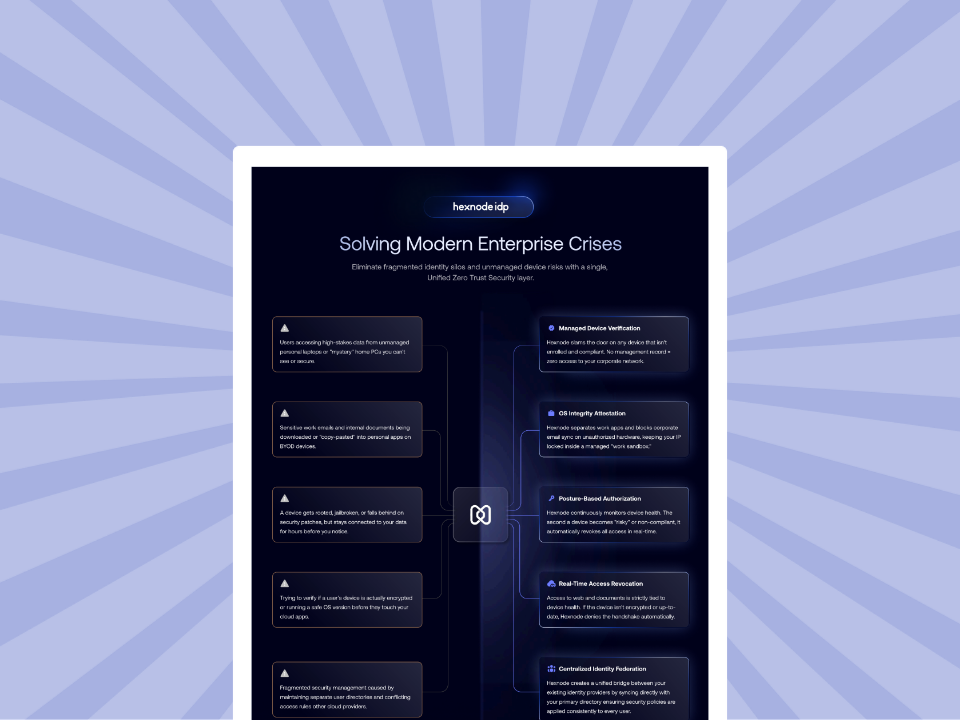
Hexnode IdP workforce access becomes difficult to secure when employees use different identities, devices, and locations to reach distributed web, mobile, and SaaS applications. Authentication may occur in one system while device management and application permissions sit in others, leaving teams without a consistent access decision.
Common gaps include fragmented authentication flows, inconsistent role permissions, unmanaged or non-compliant devices, and delayed removal of access after role changes. These gaps make it harder to verify whether the person, device, and requested application access are appropriate at the same moment.
Hexnode IdP workforce access helps coordinate identity verification, device-aware access decisions, and application controls, allowing IT teams to apply access policies with greater consistency across the workforce.
What are the risks of weak Workforce Access Controls?
Weak Hexnode IdP workforce access controls can lead to compromised accounts, unauthorized application access, excessive privileges, and exposed corporate data. A valid username and password alone do not establish that access is safe.
Risk persists when legitimate credentials are used:
From an unverified or non-compliant device
During a sensitive action that requires stronger authentication
After an employee’s role or responsibilities have changed
Against applications that do not require consistent access policies
Fragmented access management also slows onboarding and offboarding. Teams must update multiple systems manually, increasing the likelihood of:
Stale accounts and delayed access removal
Inconsistent permissions across applications
Audit gaps that complicate access reviews
Greater administrative workload for IT and security teams
5 Reasons to Invest in an Identity Provider in 2026
Unify identity, access, and device trust through Hexnode IdP management.
How does Hexnode IdP secure Workforce Access?
Hexnode IdP secures workforce access by combining identity verification, device compliance, application policies, and contextual controls. This allows organizations to make access decisions using more than a user’s credentials alone.
Effective access security must govern authentication, authorization, session duration, and lifecycle changes together. A user should receive only the appropriate application access, from a device that meets policy requirements, for a defined session period, with access updated when their role or status changes.
Hexnode IdP brings together capabilities that help protect access before sign-in, during application use, and when user status changes.
Featured resource
Hexnode IdP use cases
Hexnode IdP aligns identity, device posture, and access controls to strengthen enterprise security consistently everywhere.
Why choose Hexnode IdP for Workforce Application Access?
Hexnode IdP provides a coordinated control stack for governing access to workforce applications across user identities, devices, and changing access requirements.
Application Access delivers policy-controlled access to approved web, mobile, and SaaS applications.
Conditional Access evaluates user identity, device compliance, and security context before allowing access.
Verified BYOD Access limits company-resource access to verified personal devices.
Access policies also need to control what an authenticated user can do and for how long. Hexnode IdP supports this through:
Contextual Authentication with two-factor MFA for high-risk actions
Session Management policies that define access duration based on session inactivity
For organizations with established identity environments, Federated Identity integrates with providers such as Microsoft Entra ID and Google Workspace. SCIM-Based User Lifecycle Automation automates user access changes, while Activity Reports centralize sign-in logs and provisioning and authentication history across users and applications.
FAQs
What is the difference between authentication and authorization for workforce applications?
Authentication verifies that a user can authenticate with their assigned credentials or authenticator before access is granted.
Why should device compliance be part of an application access decision?
Device compliance helps verify that the endpoint accessing company resources meets defined security requirements. This reduces the risk of granting access from unmanaged or non-compliant devices, even when valid credentials are used.
How does step-up MFA protect high-risk application actions?
Step-up MFA requires an additional authentication factor before a sensitive action can proceed. It adds verification when the context or requested action requires more assurance than a standard sign-in.
Secure Workforce Application Access with Hexnode IdP
Securing workforce applications requires coordinated control over users, devices, applications, permissions, and sessions. Hexnode IdP brings these access decisions into one identity-driven framework, helping teams apply policies consistently as workforce conditions change.
Request a demonstration to evaluate workforce application access controls for your enterprise environment.
Secure every workforce application access point
Start your free trial to evaluate Hexnode IdP access controls.
A storyteller for practical people. Breaks down complicated topics into steps, trade-offs, and clear next actions—without the buzzword fog. Known to replace fluff with facts, sharpen the message, and keep things readable—politely.