Federated identity management lets users authenticate once with a trusted identity provider and access applications across separate domains and organizations—no duplicate credentials, less password fatigue, and centralized security and provisioning. It runs on standards like SAML, OAuth 2.0, and OIDC, and delivers SSO as a byproduct of cross-domain trust. But it concentrates risk at the IdP and, critically, a valid token confirms who the user is—not what device they’re on. Hardening authentication and adding device posture to access decisions is what turns federation from a convenience into a defensible security model.
Federated identity management (FIM) lets users authenticate once with a trusted identity source to access multiple independent domains. Instead of each application verifying the user directly, they agree to trust an authentication decision made elsewhere.
That trust is brokered between two roles:
Identity Provider (IdP): The authoritative source that verifies the user and issues a signed assertion confirming their identity.
Service Provider (SP), or relying party: The application that consumes that assertion and grants access based on it—without ever handling the user’s password itself.
The “federation” is the agreement underneath. Independent systems, and often entirely separate organizations, consent to honor a shared identity assertion from a provider they’ve established trust with. A partner’s application can accept your employees’ identities because it trusts your IdP’s word, not because it manages accounts for them.
Contrast this with the legacy model: siloed, per-application credentials. Every system held its own user store, its own passwords, and its own provisioning lifecycle. That approach expands the attack surface, fragments deprovisioning, and scales poorly across cloud and partner ecosystems—the precise challenge identity federation solves.
At a mechanical level, federation replaces direct authentication with a brokered exchange of signed claims. Three parties and one trust agreement do the work.
The Key Components
Identity Provider (IdP): Verifies the user against its own directory and issues a signed assertion (SAML) or token (OIDC/OAuth) attesting to who they are.
Relying Party (Service Provider): The application the user wants to reach. It doesn’t authenticate the user itself—it validates the assertion and makes an access decision.
User/Principal: The identity requesting access, typically via a browser or client acting on their behalf.
Trust Relationship: The pre-established agreement between IdP and SP, materialized as exchanged metadata and public certificates. Without this configuration, no assertion is honored.
The Authentication Flow (Step by Step)
The user attempts to access the application (the relying party).
The application redirects the request to the trusted IdP.
The user authenticates once at the IdP, which issues a cryptographically signed token or assertion.
The application validates the signature, reads the claims, and grants access—no second login required.
The Role of Trust
The entire model rests on cryptographic trust, not shared secrets. The IdP signs each assertion with its private key; the SP verifies it against the pre-exchanged public certificate. A valid signature is proof enough.
Critically, the application never sees the user’s password—it trusts the assertion instead. That’s a significant security gain, but it also relocates risk. The SP is trusting that a valid token exists, not verifying the conditions under which it was issued.
That distinction matters. A signed token confirms who the user is, but says nothing about the device or session context behind the request—a gap that becomes central as we examine security considerations later.
Federated Identity Management vs. Single Sign-On (SSO)
The two terms get used interchangeably, but they operate at different scopes. SSO is frequently an outcome of federation, not a synonym for it.
SSO solves for convenience within a boundary: one authentication event grants access to multiple applications that share the same trust domain—typically your own organization’s app portfolio. Federation solves for trust across boundaries: it extends a verified identity to applications owned by separate domains or entirely different organizations.
Put simply: you can run SSO without cross-organizational federation, but cross-domain federation almost always delivers SSO as a byproduct.
Dimension
Single Sign-On (SSO)
Federated Identity Management
Scope
Multiple apps, one login
Identity trusted across domains/orgs
Trust Boundary
Single trust domain
Multiple, independent trust domains
Typical Use Case
Internal enterprise app access
B2B, partner, and cross-cloud access
Protocols
SAML, OIDC, Kerberos
SAML, OAuth 2.0, OIDC
The practical takeaway: SSO is about user experience within your walls; federation is about trust management beyond them.
Protocols and Standards That Power Federation
Federation isn’t a single technology—it’s a set of standards that govern how identity claims are formatted, signed, and exchanged. Three dominate enterprise environments, and knowing where each fits prevents costly architectural mismatches.
SAML
Security Assertion Markup Language (SAML 2.0) is the long-standing workhorse of enterprise federation. It uses XML-based assertions to communicate identity and authorization data between an IdP and a service provider.
It remains entrenched in B2B and enterprise web SSO, particularly for established SaaS platforms and internal applications. It’s mature and widely supported—but its XML payloads are heavy and poorly suited to native mobile and API-driven contexts.
OAuth 2.0
OAuth 2.0 is the most misunderstood standard in this stack. It is an authorization framework, not an authentication protocol. It answers “what is this client allowed to do,” not “who is this user.”
Its purpose is delegated access—granting an application scoped permission to resources without sharing credentials.
Using OAuth alone for login is a common design error; it was never built to verify identity on its own.
OpenID Connect (OIDC)
OpenID Connect closes that gap. It’s a thin authentication layer built on top of OAuth 2.0, adding a signed ID token (a JWT) that reliably confirms who the user is.
Lightweight and JSON-based, OIDC has become the default for modern web and mobile applications and API-first architectures.
Which to use when: reach for SAML when integrating legacy or enterprise SaaS that mandates it; standardize on OIDC for new web, mobile, and API-driven builds—with OAuth 2.0 handling authorization beneath it.
Benefits of Federated Identity Management
Federation’s value shows up on both sides of the ledger—user experience and security posture—which is why it earns budget across IT and the C-suite.
Reduced friction, higher productivity: Users authenticate once and move across applications without repeated logins. Fewer credentials to manage means less password fatigue and a measurable drop in password-reset tickets—one of the highest-volume, lowest-value line items in most help desk budgets.
Stronger security posture: Fewer standing credentials means a smaller attack surface to phish or compromise. Centralizing authentication at the IdP also lets you enforce MFA and conditional access policies from a single control point, rather than hoping each application implements them correctly.
Operational efficiency: Centralized provisioning and deprovisioning eliminates the orphaned-account problem. When an employee leaves, revoking access at the IdP cascades everywhere—closing the deprovisioning gaps that drive audit findings and insider risk.
Scalable B2B collaboration: Cross-domain trust lets partners, contractors, and suppliers access resources using their own identities—no shadow accounts, no manual provisioning overhead.
Incorporating device posture into access decisions further strengthens identity lifecycle gains. Through supported integrations, Hexnode can provide device-compliance signals that an identity provider evaluates before granting access.
Challenges and Security Considerations
Federation consolidates identity—and consolidation cuts both ways. The same centralization that streamlines operations also concentrates risk, and a clear-eyed evaluation accounts for the trade-offs.
Concentration of risk at the IdP: When one provider brokers access to everything, it becomes a single point of failure. An IdP outage locks users out across the estate, and a compromised IdP hands an attacker the keys to every federated application at once. Availability and hardening of the provider become board-level concerns.
Token theft and session hijacking: Because the model trusts valid assertions without reverifying the user, attackers can replay stolen tokens or hijacked sessions to impersonate legitimate users. Misconfigured trust relationships—loose certificate validation, overly broad assertion scopes—widen that exposure further.
Limited visibility into access context: A signed token confirms identity but reveals little about where the request originates or what device it comes from. That blind spot matters, because a valid credential on a jailbroken, unpatched, or non-compliant endpoint is still a valid credential. Extending device-level visibility and compliance checks into the access decision closes this gap—so trust reflects not just who the user is, but whether their device is in a state you’d actually approve.
Governance complexity: Managing trust across multiple organizations, protocols, and lifecycles introduces operational and compliance overhead that scales with every new federation partner.
XDR and Zero Trust: Securing Endpoints Together
Identity is only half the picture. See how device trust and Zero Trust close the gaps federation leaves open.
Common Use Cases for Federated Identity
The abstraction becomes concrete once you map it to environments IT teams manage every day. Federation shows up wherever identity needs to cross a boundary.
Enterprise SSO across internal and SaaS applications: Employees reach on-prem tools and dozens of cloud services—Microsoft 365, Salesforce, Workday—through a single authenticated identity, with policy enforced centrally at the IdP.
B2B partner and supply-chain access: Vendors, contractors, and suppliers access shared resources using their own home organization’s credentials. No shadow accounts to provision, maintain, or forget to deprovision when the engagement ends.
Cloud and hybrid environments: Federation stitches identity across multiple cloud providers and on-prem directories, so a workforce spanning AWS, Azure, and legacy systems operates under one consistent trust model.
Education and government systems: Institutions federate identity so students, researchers, and citizens move across separately administered systems—libraries, portals, inter-agency services—without duplicate accounts at each.
The common thread: identity that travels with the user, not the system.
Best Practices for Implementing Federated Identity Management
A sound federation architecture is as much about disciplined operations as it is about protocol selection. The following practices separate resilient deployments from brittle ones.
Enforce strong authentication at the IdP: Since the identity provider is the single point of trust, it must be the strongest link. Mandate phishing-resistant MFA—FIDO2 or certificate-based methods over SMS—for every federated identity. A weak IdP login undermines every downstream application.
Apply least-privilege and conditional access: Grant the minimum scope each user and application requires, and gate access on contextual signals—location, risk score, network. Conditional access policies turn a static “authenticated” decision into a dynamic, risk-aware one.
Continuously monitor tokens, sessions, and access patterns: Treat authentication as ongoing, not one-and-done. Monitor for session anomalies, token replay, and impossible travel while shortening token lifetimes to limit stolen assertion value.
Incorporate device trust into access decisions: Factoring endpoint compliance and posture into access decisions highlights the true value of pairing an IdP with a device management layer like Hexnode.
Govern trust relationships deliberately: Maintain a clear process for onboarding and offboarding federation partners, rotating certificates, and auditing trust configurations. Stale or over-scoped trust relationships are a standing liability.
Adding Device-Level Assurance to Federated Access
Federation answers who the user is. It says nothing about what they’re connecting from. Closing that gap means feeding device context into the access decision—and that’s where Hexnode fits alongside your identity stack.
Compliance-aware access: With Microsoft Entra ID Conditional Access, Hexnode can report the compliance state of supported enrolled devices for access evaluation. Hexnode deploys Okta Verify and management attestation for Okta Device Trust evaluations. Through Microsoft Entra Conditional Access, non-compliant devices are blocked until Hexnode policies trigger remediation.
Visibility across access points: Most federation deployments leave a critical blind spot: tracking which endpoints actually access corporate resources. Hexnode provides administrators with full visibility into managed devices and their latest compliance status, while enabling teams to inspect, schedule, and export compliance reports for audits.
Automated enforcement and provisioning: Manual device vetting doesn’t scale to a distributed workforce. Hexnode supports automated enrollment and policy enforcement, and administrators can configure dynamic groups and remediation policies to automate responses to selected compliance violations.
The result is an access decision that combines identity verification by the connected identity provider with device-management or compliance signals supplied through the supported Hexnode integration.
Featured Resource
Secure Your Digital Perimeter with Hexnode IdP
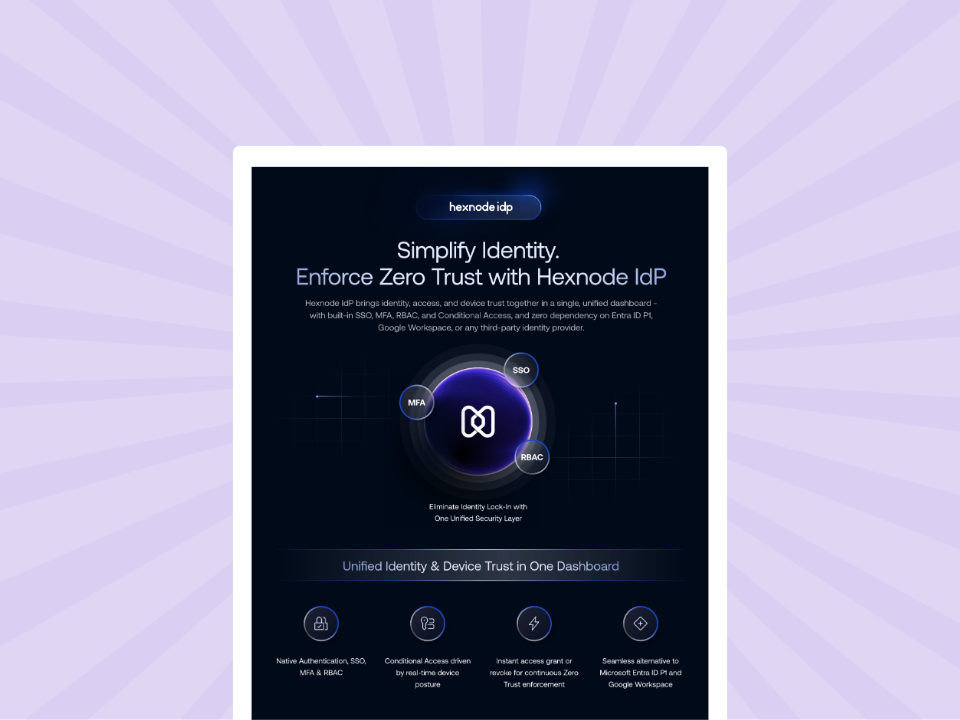
See how Hexnode IdP unifies identity and device trust into a single Zero Trust path for secure access.
Do I need to replace my existing identity provider to adopt federated identity management?
Not usually. Federation works by establishing trust relationships between your existing identity provider and the applications or partners you want to connect. In most cases you extend and configure what you already run rather than rip it out and replace it.
Is federated identity management the same as Zero Trust?
No, but they’re complementary. Federation handles how identity is verified and trusted across domains, while Zero Trust is a broader security model that assumes no request is trusted by default. Federation supports a Zero Trust approach, especially when access decisions also factor in signals like device posture and context.
How does federated identity relate to IAM?
Federation is one capability within the wider field of identity and access management (IAM). IAM covers the full lifecycle of identities and permissions, while federation specifically handles extending trusted identities across separate systems or organizations. You can think of federation as the cross-boundary layer of a broader IAM strategy.
What happens to federated access when the identity provider goes down?
Because the identity provider is the single point of trust, an outage can block sign-ins across every connected application at once. This is why provider availability, redundancy, and hardening are treated as high-priority concerns. Planning for IdP resilience is part of any serious federation deployment.
Can federated identity management verify the device a user is signing in from?
On its own, no. A federated token confirms who the user is, not what device the request comes from. To close that gap, organizations pair their identity provider with a device-management layer—such as Hexnode—so access decisions also account for whether the endpoint meets compliance requirements.
Which protocol should we standardize on for new applications?
For new web, mobile, and API-driven builds, OpenID Connect (OIDC) is generally the practical default because it’s lightweight and purpose-built for authentication. SAML still makes sense when integrating legacy or enterprise SaaS platforms that require it. Many environments run both, matching the protocol to each application’s needs.
Conclusion
Federated identity management does one thing exceptionally well: it turns a sprawl of fragmented logins into a single trusted identity that moves cleanly across domains and organizations. That consolidation is what delivers the payoff—less password fatigue for users, a single control point for security policy, and provisioning that scales without multiplying orphaned accounts.
But the payoff isn’t automatic. It holds only when the identity provider is hardened with strong authentication and when access decisions
account for more than a valid token. This is the distinction worth carrying forward: identity confirms who is asking, while device context confirms what they’re asking from. A defensible access decision in a distributed, cloud-heavy estate needs both—one without the other leaves exactly the kind of gap attackers look for.
The practical next step is to audit where device trust currently sits in your federation strategy. If access today rests on identity alone, that’s the gap to close—and reviewing how conditional access and endpoint posture fit into your model is the logical place to start.
Bring device trust to every login
Pair your identity provider with Hexnode so access reflects who the user is and whether the device is safe.
Associate Product Marketer at Hexnode focused on SaaS content marketing. I craft blogs that translate complex device management concepts into content rooted in real IT workflows and product realities.