Linux patch management is a core endpoint security practice that closes known vulnerabilities through timely, risk-based remediation—not just software updates. A mature patching program combines visibility, prioritization, testing, phased deployment, verification, and reporting to reduce exposure while supporting compliance and operational stability. Centralized management helps organizations standardize Linux patching across distributed environments and maintain consistent security control.
Linux is no longer confined to server rooms and backend infrastructure. It now runs across developer workstations, production systems, edge devices, kiosks, and specialized enterprise endpoints that often sit outside traditional patch governance.
That makes Linux patch management a security execution issue, not a routine maintenance task. Security tools can detect vulnerabilities, flag risky assets, and surface exposure, but the risk remains until fixes are deployed, verified, and documented.
This article breaks down why Linux patching is often the missing link in endpoint security, covering operational risks, patch lifecycle design, prioritization, best practices, measurable outcomes, and enterprise control considerations.
Why Linux patch management belongs in enterprise endpoint security
From system maintenance to security control
Linux patching is not just an administrative hygiene task. It is a direct risk reduction control that closes known vulnerabilities before they become viable attack paths. Once a flaw is disclosed, the security value comes from how quickly the organization can identify affected systems, deploy the fix, and verify remediation.
Detection alone does not reduce exposure. Vulnerability scanners, EDR alerts, asset inventories, and policy checks can surface risk, but they do not eliminate it. When patch deployment is slow, inconsistent, or undocumented, the organization carries avoidable exposure across systems that may already be part of critical business workflows.
Why Linux endpoints cannot sit outside patch workflows
Enterprise Linux devices need to be part of the same endpoint security discipline as any other managed asset. That means defined ownership, patch SLAs, exception handling, reboot tracking, and audit-ready evidence.
Strong Linux patch management supports:
Endpoint hygiene by reducing outdated packages and vulnerable OS components.
Compliance readiness through documented remediation activity.
Operational resilience by preventing known issues from escalating into outages or incidents.
Exploit-driven prioritization, using sources like CISA’s Known Exploited Vulnerabilities catalog to focus on vulnerabilities already exploited in the wild.
Understanding Patch Management: Why it Matters?
Learn patch management fundamentals, lifecycle, best practices, and strategies to reduce security risk.
What Linux patch management actually covers
OS updates vs. security patches vs. package updates
Linux patch management is the structured process of discovering, prioritizing, testing, deploying, verifying, and documenting updates across Linux systems. It goes beyond running an update command on a device. At enterprise scale, patching must account for risk, compatibility, downtime, ownership, and proof of remediation.
A mature Linux patching program typically covers:
Kernel patches that may require reboots or staged rollout.
OS security updates that address known vulnerabilities.
Critical fixes for stability, performance, or exposed services.
Package updates from approved repositories.
Third-party application updates where business tools depend on Linux packages.
Deployment of vendor-supplied patch packages that resolve default security misconfigurations.
Why package managers are not a complete patch strategy
Tools like APT, DNF, YUM, and Zypper are essential for executing updates, but they are not a complete governance model. They do not automatically answer enterprise-level questions such as which devices are missing patches, which updates failed, which systems still need a reboot, or whether remediation met internal SLAs.
Effective Linux patch management requires centralized visibility, controlled execution, deployment validation, and audit-ready reporting across every managed Linux endpoint.
Why enterprise Linux patching gets messy fast
Distro diversity and version drift
Linux environments rarely stay uniform for long. One team may standardize on Ubuntu, another may use RHEL or Fedora, while developer groups introduce Debian-based workstations or specialized Linux builds for specific workloads. Each distribution brings its own release cadence, package repositories, dependency behavior, and support lifecycle.
That diversity creates version drift. Two devices may both be “Linux endpoints,” but require different patch commands, maintenance windows, reboot handling, and compatibility checks. Without standardization, patching becomes difficult to govern consistently.
The risk of script-based patching at scale
Many teams start with SSH, cron jobs, shell scripts, or admin-specific routines. These methods can work for small environments, but they become fragile at scale.
Common failure points include:
No centralized record of which systems were updated.
Inconsistent execution across teams, locations, or device groups.
Limited failure visibility when updates break, hang, or require manual intervention.
Spreadsheet-based tracking that quickly becomes outdated.
The issue is not that scripts are inherently bad. The issue is that scripts alone rarely provide the control, validation, and reporting required for enterprise patch governance.
Reboots, dependencies, and change windows
Linux patching also carries operational risk. Kernel updates may require reboots. Service updates may restart critical processes. Dependency changes may affect applications running on the endpoint.
This is where centralized device visibility becomes important. Security teams need to know which Linux endpoints exist, which ones are outdated, which failed to update, and who owns remediation. Without clear ownership across infrastructure, security, DevOps, and local IT teams, patching gaps become accountability gaps.
The Linux patch management lifecycle enterprises should follow
Inventory and exposure mapping
A reliable Linux patching program starts with discovery. IT and security teams need a current inventory of Linux endpoints, including OS distribution, version, installed packages, ownership, location, business function, and criticality. Without this baseline, patching becomes reactive and incomplete.
The next step is assessment. Teams must identify missing updates and map them against severity, exploit activity, system exposure, and business impact. A vulnerable package on an isolated test machine does not carry the same risk as the same package on an internet-facing production system.
A practical lifecycle should include:
Discover: Identify Linux endpoints, OS versions, installed software, and asset owners.
Assess: Determine which systems are missing updates and how exposed they are.
Prioritize: Separate emergency security fixes from routine maintenance updates.
Test: Validate updates before broad deployment.
Deploy: Roll out patches in controlled phases.
Verify: Confirm installation success, reboot completion, and remaining exposure.
Document: Preserve evidence for audits, incidents, and compliance reviews.
Testing and phased rollout
Prioritization should account for known exploited vulnerabilities, remote code execution risks, privilege escalation issues, and internet-facing assets. These updates should move faster than routine package updates or low-risk maintenance patches.
Testing is still essential. Kernel updates, driver changes, dependency-heavy packages, and updates affecting production workflows should be validated against a pilot group before wider rollout. Phased deployment by device group, department, risk tier, or maintenance window reduces business disruption while keeping remediation moving.
Verification and audit evidence
Patch deployment is not complete when the command runs. Teams must confirm whether updates installed successfully, whether a reboot is pending, and whether any devices failed or fell out of policy.
This final verification layer turns patching into a measurable security control, with evidence that supports audit readiness, incident reviews, and executive-level risk reporting.
How to prioritize Linux patches without breaking production
Risk-based patch prioritization
Not every Linux patch should move through the same queue. Prioritization should be based on severity, exploit activity, asset exposure, system criticality, and available compensating controls. A critical vulnerability on an internet-facing Linux endpoint requires a different response than a low-risk package update on an isolated lab machine.
High-priority patches typically include:
Known exploited vulnerabilities with active attacker use.
Remote code execution flaws that can expand initial access.
Privilege escalation issues that increase post-compromise impact.
Updates affecting internet-facing systems or business-critical workloads.
Patch rings and maintenance windows
A risk-based model does not mean pushing every update everywhere at once. Enterprises should separate patch queues into emergency fixes, scheduled security updates, routine OS updates, and deferred compatibility updates.
Patch rings help reduce disruption:
Start with test devices or controlled pilot groups.
Expand to low-risk endpoints.
Move to department or business-unit groups.
Schedule critical systems during approved maintenance windows.
For managed Linux endpoints, Hexnode can support this kind of targeted update execution by helping admins apply update actions to specific devices or groups.
Managing reboot debt
Linux patching also requires tracking reboot debt. Some kernel and system updates are not fully effective until the device restarts. Uninstalled patches and pending reboots should both be treated as unresolved exposure, especially on high-risk systems.
Linux patch management best practices for endpoint security teams
Standardize what gets patched and when
Effective Linux patch management starts with a current endpoint inventory. Every Linux device should have a known owner, OS version, business function, exposure level, and support status. Untracked Linux systems should be treated as unmanaged risk, not operational noise.
Patch timelines should be based on severity and exposure, not a flat monthly cadence. A practical model should define separate SLAs for:
Critical exploited vulnerabilities on exposed systems.
High-severity security updates on business-critical endpoints.
Teams should also standardize approved repositories and package sources. This reduces dependency conflicts, limits unauthorized software drift, and lowers supply chain exposure.
Automate carefully, not blindly
Automation is valuable when the risk profile is predictable. IT teams can automate routine updates on low-risk devices to reduce manual effort and drive consistency. High-impact updates, including kernel changes, driver updates, and major version upgrades, should still pass through testing and approval workflows.
Use pilot groups before broad deployment. Start with representative Linux endpoints, monitor for failures, then expand rollout by department, device group, or risk tier.
For managed Linux endpoints, Hexnode can support centralized visibility, remote update actions, and update tracking without relying entirely on manual SSH-based workflows.
Keep evidence for audits and incident response
Patching is not complete until outcomes are verified. Endpoint security teams should track:
Pending reboots.
Failed updates.
Unsupported Linux versions.
Out-of-policy devices.
Exceptions and deferred patches.
Critical systems should also have rollback and recovery plans. Documented patch outcomes give security leaders evidence for compliance reviews, incident investigations, and executive risk reporting.
Metrics that show whether Linux patching is actually reducing risk
Operational metrics
Patch programs should not be measured only by how many updates were pushed. The better question is whether exposure is shrinking across the Linux estate.
Track operational indicators such as:
Patch compliance rate by device group, department, location, and OS version.
Failed update rate and recurring failure causes.
Pending reboot count and average reboot delay.
Stale check-ins from Linux devices that have not reported recently.
Security risk metrics
Security teams should focus on how quickly high-risk exposure is removed. Key metrics include mean time to remediate critical vulnerabilities, the number of devices missing security updates or critical fixes, and the percentage of Linux endpoints running unsupported or end-of-life versions.
Unknown ownership should also be treated as a risk signal. If no team owns the device, no team owns the remediation.
Compliance metrics
Audits and internal reviews require clear evidence showing when teams deployed updates, where installations succeeded or failed, and which Linux endpoints remain exposed. Visibility and reporting are what turn patching from an IT activity into a measurable security control.
Quick answers to common Linux patch management questions
What is Linux patch management? Linux patch management is the process of identifying, prioritizing, testing, deploying, verifying, and documenting updates across Linux systems. It is not limited to running package manager commands.
How often should teams patch Linux systems? While routine updates can follow a defined maintenance cadence, critical or actively exploited vulnerabilities require an expedited emergency path based on risk and exposure.
What is the difference between general Linux upgrades and security updates? General upgrades introduce feature enhancements, performance improvements, or routine software changes. Security updates—commonly called patches—deliver package upgrades that directly remediate known vulnerabilities, security flaws, and critical bugs.
Can Linux patching be automated? Yes, but automation should be controlled. Mature programs still require testing, prioritization, approval workflows, rollback planning, and reporting.
Why is Linux patching important for compliance? It proves that teams consistently remediate known vulnerabilities across managed Linux systems.
Bringing Linux update control into Hexnode-managed workflows
Linux patch management breaks down when remediation depends on isolated admin routines. Hexnode gives teams a single operational plane for managed Linux devices, including devices running distributions derived from Fedora and Debian, helping reduce blind spots across distributed fleets.
For OS-level remediation, Hexnode’s Update OS remote action lets admins deploy system patches, security updates, and critical fixes to managed Linux endpoints. The workflow supports options to install all updates (which includes security, critical, and general patches) or install only security updates, giving teams a practical way to separate routine maintenance from higher-priority remediation.
In practice, this helps endpoint teams improve:
Visibility: Confirm which Linux devices are enrolled, reporting, and in scope.
Control: Target updates to specific devices or groups instead of relying on manual SSH sessions.
Consistency: Apply repeatable update actions across distributed endpoints.
Compliance evidence: Track device status, compliance, and endpoint insights from a centralized view.
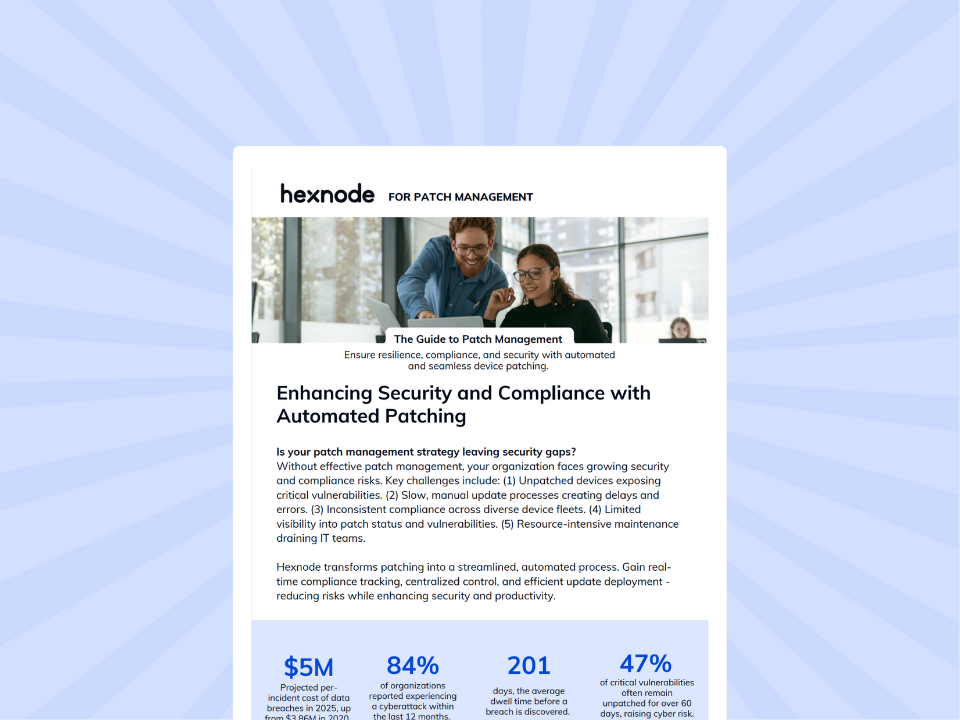
Featured Resource
Hexnode UEM for Patch Management
Discover how centralized patch management simplifies deployment, compliance, and update visibility across endpoints.
Is a package manager enough for enterprise Linux patch management?
No, enterprise patch management also requires visibility, prioritization, testing, verification, and reporting.
What should happen if a Linux patch cannot be deployed immediately?
Security teams must document the issue as an exception, assign a clear owner, and continuously track and review it until they remediate the risk.
Why is reboot tracking important after Linux updates?
Some updates are not fully applied until the system restarts, making pending reboots a security risk.
Should every Linux patch be deployed immediately?
No, patches should be prioritized based on risk, tested when necessary, and deployed in controlled phases.
What is the biggest challenge in enterprise Linux patch management?
Maintaining consistent visibility, ownership, and patch governance across diverse Linux environments.
What makes Linux patch management audit-ready?
Maintaining records of deployments, outcomes, failures, exceptions, and remaining exposure provides audit-ready evidence.
Conclusion
Linux patch management is not back-office maintenance. This core endpoint security control determines how quickly teams reduce known exposure across enterprise Linux systems.
The missing link is execution. Security teams need more than vulnerability detection; they need visibility, prioritization, controlled deployment, verification, and evidence that remediation actually happened.
A mature Linux patching program reduces attack surface while supporting system stability, compliance readiness, and operational continuity. Organizations should bring Linux endpoints into the same disciplined patch workflow as every other managed environment. Hexnode can help add visibility and control to that process.
Simplify Linux patch management at scale
See how centralized patching helps reduce security risk, improve compliance, and streamline Linux updates.
Associate Product Marketer at Hexnode focused on SaaS content marketing. I craft blogs that translate complex device management concepts into content rooted in real IT workflows and product realities.