Measuring ROI involves tracking operational, security, and business metrics, such as patch compliance, deployment success rates, downtime, and IT productivity.
When evaluating a solution, prioritize capabilities like policy-based deployments, centralized reporting, deployment monitoring, and scalability.
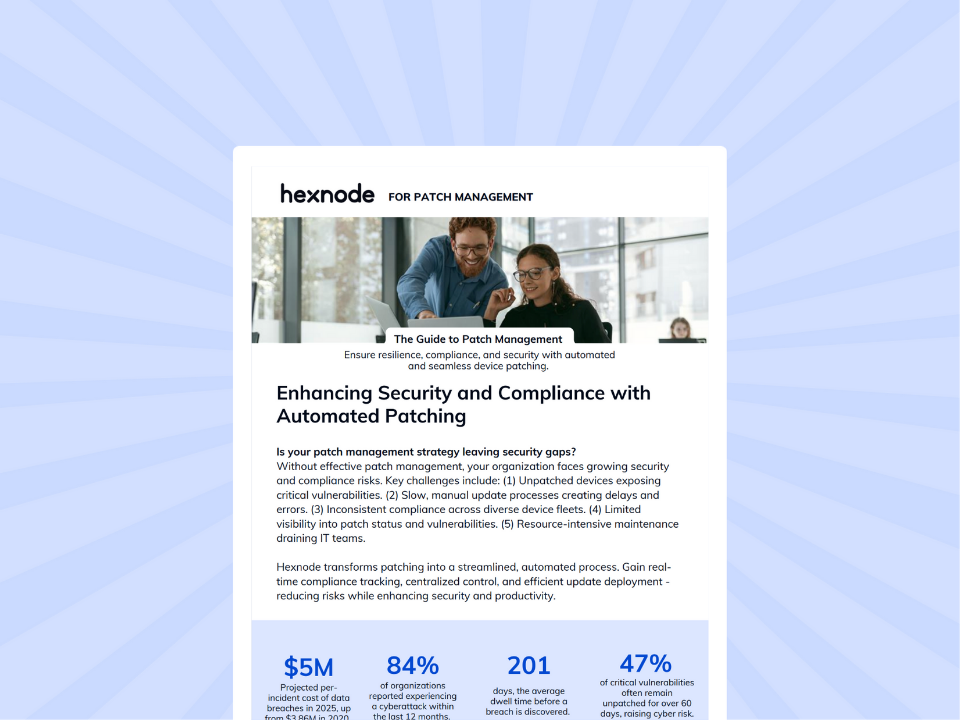
Solutions like Hexnode help IT teams automate patch management, maintain centralized visibility, and manage software updates more efficiently across growing device environments.
Keeping software up to date has always been a core IT responsibility, but the scale and complexity of modern IT environments have transformed patch management into a strategic business priority. As organizations manage hundreds or even thousands of endpoints across on-site, remote, and hybrid work environments, understanding the ROI of automated patch management has become just as important as keeping every device up to date. At the same time, software vendors continue to release security updates at a rapid pace to address newly discovered vulnerabilities.
For many IT teams, manual patch management is no longer practical. It is time-consuming, difficult to scale, and increases the risk of missed or delayed updates. Automated patch management streamlines software updates by helping IT teams identify, deploy, monitor, and report on patches more efficiently.
Understanding the ROI of automated patch management is therefore essential for organizations looking to reduce operational overhead while maintaining a secure and resilient IT environment. In this article, we’ll explore what drives patch management ROI, how to measure it, and the key capabilities to consider when evaluating an automated patch management solution.
What is the ROI of automated patch management?
The ROI of automated patch management comes from automating repetitive patching tasks to reduce IT effort, improve patch compliance, minimize downtime, and strengthen security. By streamlining software update management, organizations can lower operational costs, reduce risk, and enable IT teams to focus on higher-value initiatives instead of routine maintenance.
Why Patch Management Has Become a Business Priority
Patch management has evolved beyond routine IT maintenance because it directly impacts an organization’s security, business continuity, and ability to keep systems running smoothly.
Cybercriminals increasingly exploit known vulnerabilities for which patches are already available. In many cases, successful attacks occur not because fixes are unavailable, but because updates are delayed or deployed inconsistently.
At the same time, modern IT environments have become more complex. IT teams are responsible for managing operating systems, business applications, browsers, and remote devices across distributed environments. As software updates become more frequent and device fleets continue to grow, patching has shifted from a periodic task to an ongoing operational process.
Today, effective patch management is essential for:
Reducing security risks
Supporting business continuity
Meeting compliance requirements
Maintaining employee productivity
Managing growing IT environments efficiently
Organizations that rely on manual patch management often struggle to keep pace, increasing operational overhead and the risk of missed or delayed updates.
The Hidden Costs of Manual Patch Management
Manual patch management involves far more than installing software updates. As device fleets grow, repetitive patching tasks consume valuable IT resources, increase the risk of errors, and make it difficult to maintain consistent update practices.
Administrative Overhead
Manual patch management requires IT teams to:
Monitor vendor releases
Identify applicable updates
Test compatibility
Schedule deployments
Track installation progress
Resolve failed deployments
Managing these tasks across hundreds of devices consumes valuable time that could be spent on strategic initiatives.
Increased Security Risk
Delayed or missed patches leave systems exposed to known vulnerabilities, while inconsistent deployments make it difficult to maintain a uniform security baseline across the organization.
Downtime and Productivity Loss
Reactive patching, failed deployments, and poorly planned updates can disrupt end users, delay business operations, and increase support requests.
Compliance Challenges
Many regulations require organizations to prove that systems are regularly updated. Without centralized reporting, preparing for audits becomes a time-consuming process that involves manually tracking deployments, verifying compliance, and documenting patch status.
Manual vs. Automated Patch Management
Manual Patch Management
Automated Patch Management
Requires continuous manual effort
Automates routine patching tasks
Higher risk of missed or delayed updates
Consistent and timely patch deployment
Time-consuming reporting and tracking
Centralized reporting and visibility
Difficult to scale across growing device fleets
Scales efficiently across distributed environments
Greater risk of downtime from reactive patching
Minimizes disruption with scheduled deployments
Reactive approach to patching
Proactive patch management
Limited visibility into patch status
Centralized visibility into patch status and compliance
Automated Patch Management: Save Hours & Secure Endpoints
Learn practical strategies for building an automated patch management process and reducing security risks.
How Automated Patch Management Delivers ROI
Automated patch management uses predefined policies and workflows to identify, deploy, monitor, and report software updates across managed devices. By automating routine patching tasks while giving administrators control over approvals, deployment schedules, and maintenance windows, it helps organizations maintain consistent software updates with less manual effort.
A typical automated patch management workflow includes:
Detecting missing patches
Identifying devices that require updates
Scheduling deployments
Deploying patches based on predefined policies
Monitoring installation status
Generating deployment reports
These capabilities translate into measurable business value in several ways.
Lower Operational Costs
Automating routine patch management reduces the time and effort required to deploy and monitor updates, helping organizations lower:
Administrative labor
Overtime during maintenance cycles
Emergency remediation efforts
Time spent on routine patching
This allows IT teams to focus on higher-value initiatives instead of repetitive maintenance.
Improved IT Productivity
Automation reduces repetitive workloads, enabling IT teams to spend more time on infrastructure improvements, security initiatives, and end-user support while managing larger device fleets more efficiently.
Reduced Security Risk
Faster patch deployment reduces the window during which attackers can exploit known vulnerabilities. Consistent update practices also minimize the risk of devices remaining unpatched because of manual oversight.
Better Compliance Readiness
Centralized reporting simplifies compliance by providing visibility into:
Patch deployment status
Missing updates
Deployment history
Compliance levels
This makes audit preparation faster and reduces the effort required to maintain compliance.
Reduced Downtime
Scheduled maintenance windows and phased deployments help minimize user disruption, reduce deployment failures, and maintain business continuity during software updates.
How to Measure the ROI of Automated Patch Management
Measuring the ROI of automated patch management involves evaluating the operational, security, and business improvements achieved through automation, not just the cost of the solution.
Key Metrics to Measure ROI
Operational
Track the efficiency of your patch management process by measuring:
Hours spent managing patches before and after automation
Percentage of successful patch deployments
Reduction in failed installations
Time required to complete deployment cycles
Security
Measure improvements in your security posture by tracking:
Mean time to patch critical vulnerabilities
Patch compliance percentage
Number of devices missing critical updates
Reduction in vulnerability exposure
Business
Evaluate the broader business impact through:
Reduced downtime
Lower support costs
Faster audit preparation
Increased IT productivity
A Simple ROI Formula
A practical way to estimate the ROI of automated patch management is:
Although some benefits, such as reduced business risk, are difficult to quantify, improvements in productivity, operational efficiency, and downtime can provide a clear picture of the return on investment.
Features That Have the Greatest Impact on Patch Management ROI
The ROI of automated patch management depends on choosing a solution that combines automation with the visibility, control, and scalability needed to manage software updates efficiently.
Together, these capabilities help IT teams deploy updates consistently, monitor patch status, identify failed deployments, and simplify compliance reporting.
Built to Scale with Growing IT Environments
As organizations grow, patch management becomes more complex due to distributed workforces, diverse operating systems, and expanding device fleets. A scalable solution should enable administrators to:
Apply consistent deployment policies across device groups
Prioritize high-risk systems
Monitor deployment progress
Maintain patch compliance as the environment grows
By combining automation with centralized management and visibility, organizations can scale patch management without significantly increasing IT workload.
Featured resource
Hexnode UEM for Patch Management
Automate software updates, streamline patch deployments, and maintain visibility into patch status with Hexnode.
How Hexnode Helps Maximize the ROI of Automated Patch Management
Hexnode supports automated patch management by simplifying software update deployment while giving IT teams centralized control over the patching process.
For supported platforms, IT teams can automate patch deployments based on predefined criteria and maintenance-window settings, helping apply updates consistently while reducing disruption to end users. Support for device grouping also makes it easier to manage deployments across distributed and growing IT environments.
Centralized reporting provides visibility into patch status, deployment progress, and devices that require attention, enabling administrators to monitor compliance and respond to issues more efficiently.
By combining automated deployments with centralized management, Hexnode helps organizations reduce manual effort, maintain patch consistency, and simplify patch management at scale.
FAQs
How often should organizations deploy software patches?
Critical security patches should be deployed as soon as possible after testing, while routine updates can follow a scheduled patch cycle. The ideal frequency depends on your organization’s risk tolerance, compliance requirements, and change management process.
What’s the difference between patch management and vulnerability management?
Patch management focuses on deploying software updates to fix known issues, while vulnerability management identifies, prioritizes, and tracks security weaknesses across the IT environment. Patch management is one of the key remediation activities within a broader vulnerability management strategy.
Automated Patch Management Is an Investment, Not Just an IT Expense
The ROI of automated patch management is measured not only by reduced IT effort but also by the long-term value it delivers to the organization. By streamlining software updates and reducing operational complexity, automation helps IT teams work more efficiently while supporting a stronger security posture.
As IT environments continue to grow, manual patch management becomes increasingly difficult to sustain. Investing in an automated solution enables organizations to keep pace with software updates, improve patch consistency, and support business continuity without increasing administrative overhead.
When evaluating patch management solutions, focus on their ability to simplify operations, provide centralized visibility, and scale with your organization’s needs. Over time, these capabilities make automated patch management a strategic investment that supports a more secure, resilient, and efficient IT environment.
Simplify Patch Management with Hexnode
See how Hexnode helps automate software updates, improve patch visibility, and simplify patch management across your organization.
I write at the intersection of technology, process, and people, focusing on explaining complex products with clarity. I break down tools, systems, and workflows without any noise, jargon, or the hype.