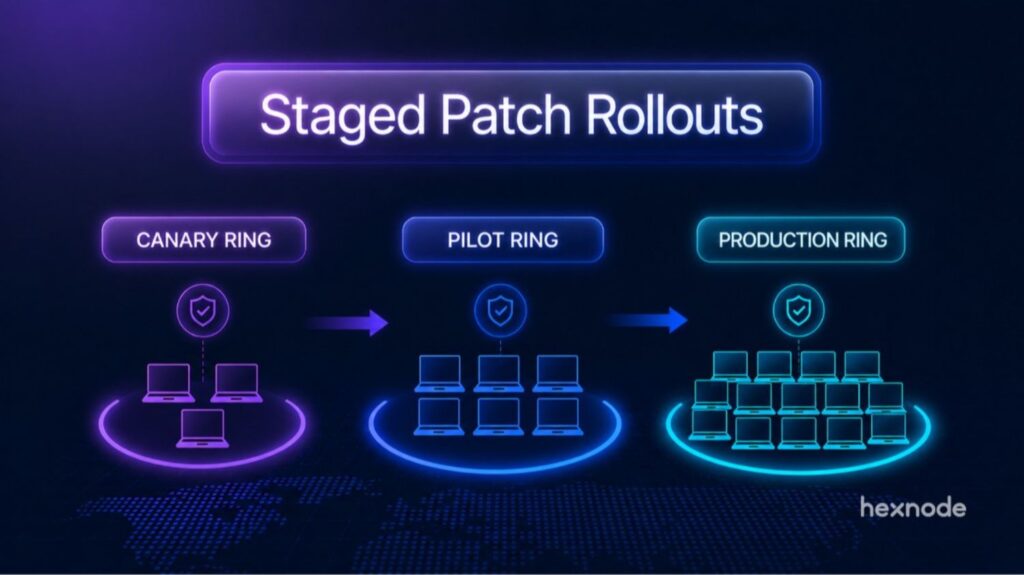
Staged patch rollouts help enterprises reduce deployment risk by validating updates progressively through canary, pilot, and production rings. Instead of deploying patches organization-wide at once, IT teams can control rollout timing, monitor deployment status, and minimize disruption. Hexnode UEM supports phased patch management through device grouping, deployment scheduling, centralized monitoring, and policy-driven rollout controls.
A single faulty patch can disrupt thousands of endpoints in minutes. That is why enterprises increasingly rely on staged patch rollouts using canary, pilot, and production rings to validate updates progressively before full-scale deployment. With Hexnode UEM, IT teams can implement controlled, policy-driven patch deployment workflows for Windows devices using the Patch Management module and manage macOS updates through dedicated Software Update policies.
Large-scale patch deployment failures often create operational and security challenges such as:
System instability across business-critical endpoints
Application crashes caused by compatibility conflicts
Organization-wide downtime that impacts productivity and service availability
At enterprise scale, even a minor patching issue can escalate quickly. A failed update deployed across thousands of devices increases helpdesk volume, delays remediation efforts, and disrupts business continuity.
As a result, organizations are shifting toward phased patch management models that reduce deployment risk while maintaining patch compliance. Through structured device groups and centralized patch management, Hexnode UEM helps IT teams deploy updates incrementally, monitor automation status, and manage patch rollout workflows for supported Windows and macOS devices.
Staged patch rollouts are a phased patch management approach where updates are deployed incrementally across predefined groups of endpoints instead of the entire environment at once. The goal is to identify compatibility issues, deployment failures, or performance instability before patches reach production-wide systems.
Most enterprises structure this rollout model using three deployment stages:
Canary ring for initial validation on a limited set of low-risk devices
Pilot ring for broader testing across departments or user groups
Production ring for enterprise-wide deployment after successful validation
This controlled patch deployment strategy helps IT teams reduce operational risk while maintaining deployment velocity. With Hexnode UEM, administrators can use device groups to represent deployment rings, configure separate patch automations or deployment settings, and monitor patch automation status centrally.
Understanding Deployment Rings in Patch Management
Canary Ring
The canary ring represents the first stage in a staged patch rollout strategy. It typically includes a small group of controlled test devices used for initial patch validation before broader deployment. Organizations often assign IT-managed systems, test devices, or low-risk endpoints to this ring.
The primary objective is early issue detection. IT teams use canary deployments to identify:
Failed installations
Driver conflicts
System instability
Immediate application compatibility issues
Because deployment scope remains limited, administrators can contain failures quickly without disrupting broader business operations.
Pilot Ring
The pilot ring expands patch deployment to a broader and more representative group of endpoints. This stage typically includes users across departments, hardware profiles, and operational environments.
Pilot deployments help organizations validate:
Business-critical application compatibility
User workflow stability
Hardware-specific behavior
Real-world deployment performance
At this stage, IT teams assess how updates behave under normal production conditions before approving organization-wide rollout.
Production Ring
The production ring is the final deployment stage where patches are rolled out across the broader enterprise environment. Organizations initiate production deployment only after successful validation in earlier rings.
This phase focuses on:
Operational continuity
Enterprise-wide patch compliance
Controlled rollout execution
Minimizing user disruption during deployment
With Hexnode UEM, administrators can manage device groups that represent rollout stages, configure separate patch automations or deployment settings, and monitor patch automation status from the console.
Featured resource
Hexnode UEM for Patch Management
Discover how Hexnode simplifies patch management and strengthens device security.
Operational Challenges of Traditional Patch Deployment
Simultaneous Rollouts Increase Deployment Risk
Traditional patch deployment models often rely on pushing updates across large groups of endpoints simultaneously. While this approach may accelerate deployment timelines, it significantly increases operational risk when patches contain compatibility issues or installation failures.
Without staged validation, IT teams often detect issues only after patches impact production systems at scale.
Limited Visibility Delays Issue Detection
Traditional patching workflows frequently lack granular rollout visibility. IT teams may struggle to identify which devices failed updates, experienced reboot issues, or became non-compliant after deployment.
This creates challenges such as:
Delayed remediation efforts
Inconsistent patch compliance tracking
Limited insight into rollout progress across endpoint groups
As endpoint environments grow larger and more distributed, centralized visibility becomes critical for maintaining deployment control.
Inconsistent Policies Create Operational Gaps
Different endpoint groups often require different deployment schedules, reboot rules, and maintenance windows. Traditional patching approaches make it difficult to apply these controls consistently across the environment.
As a result, organizations may face:
Unplanned system restarts
Patch deployment conflicts during business hours
Inconsistent rollout behavior across teams and locations
Manual Coordination Slows IT Operations
Many organizations still rely on manual coordination for patch scheduling, device grouping, and deployment tracking. This increases administrative overhead and makes large-scale patch management difficult to scale efficiently.
Without structured deployment rings and centralized policy management, IT teams struggle to maintain a reliable and repeatable enterprise patch rollout strategy.
IT Admin’s Guide to Patch Management with Hexnode
Learn using Hexnode to automate, test, and deploy software patches across your fleet without disrupting productivity.
How Hexnode UEM Supports Staged Patch Rollouts
Modern enterprises require more than basic patch deployment capabilities. They need centralized control, deployment visibility, and policy-driven automation to execute reliable staged patch rollouts across distributed endpoint environments. Hexnode UEM helps organizations operationalize phased patch management for supported Windows and macOS devices through patch automation rules, scheduling, approvals, target filters, and centralized monitoring.
Create Structured Deployment Rings
Hexnode UEM enables administrators to organize devices into dynamic or custom device groups that can represent canary, pilot, and production rollout stages.
IT teams can segment devices using:
Operating system versions
Departments or business units
Device ownership models
Hardware profiles
Custom attributes or groups that represent business criticality
This allows organizations to build targeted canary, pilot, and production deployment rings for progressive patch validation.
Apply Ring-Specific Patch Policies
Different deployment stages require different rollout controls. Hexnode UEM allows administrators to configure separate patch automations or deployment settings for different device groups to support phased rollout cycles.
Teams can define:
Independent deployment schedules
Maintenance windows
Restart and reboot behavior
Deferred deployment configurations
This helps organizations maintain greater control over patch rollout timing and user impact.
Monitor Rollout Progress Centrally
Hexnode UEM provides centralized visibility into patch automation activities, including automation status, platform, version, created time, and last status update.
IT teams can monitor:
Deployment completion status
Failed or pending installations
Patch management metrics and patch automation status
This visibility enables faster issue identification and more informed rollout decisions.
Automate Controlled Patch Deployment
Manual patch coordination becomes difficult at enterprise scale. Hexnode UEM helps reduce operational overhead by enabling more consistent and controlled rollout workflows across endpoint groups.
Organizations can implement:
Separate device groups and patch automations to support gradual rollout expansion
Separate deployment schedules for different device groups
Policy-driven rollout scheduling and maintenance windows
Controlled patch deployment for production device groups using target filters and approval settings
The effectiveness of a canary patch deployment depends on limiting the initial blast radius. Organizations should use a small group of low-risk or IT-managed devices for early validation.
Best practices include:
Avoiding business-critical systems in the first rollout phase
Selecting devices with representative configurations
Monitoring deployment behavior closely before expansion
Build Representative Pilot Groups
A pilot deployment ring should reflect real production conditions as closely as possible. Incomplete pilot coverage often causes issues to surface only during enterprise-wide rollout.
Organizations should include:
Multiple departments or user groups
Critical business applications
Diverse hardware and OS configurations
Define Rollout Timelines Clearly
Structured rollout timelines help balance deployment speed with operational stability. Rushed deployments increase failure risk, while excessive delays extend vulnerability exposure windows.
Critical infrastructure and sensitive workloads should follow stricter deployment schedules than standard user endpoints.
Organizations should:
Use dedicated maintenance windows
Avoid simultaneous updates across critical systems
Apply additional validation before production rollout
Monitor Deployment Metrics Continuously
Continuous monitoring helps IT teams identify deployment failures before they escalate across larger endpoint groups.
Key metrics include:
Failed installations
Reboot-related issues
Patch compliance status
Deployment completion rates
Hexnode UEM provides centralized visibility into patch automation status and related deployment activity.
Continuously Refine Ring Membership
Deployment rings should evolve alongside the endpoint environment. Static device groups eventually reduce validation accuracy.
Organizations should regularly:
Remove inactive devices
Update device categorization policies
Reassess canary and pilot group composition
Enterprises adopting staged patch rollouts should also align deployment timelines and validation processes with established vendor guidance for phased update management, such as Microsoft’s deployment ring recommendations.
Key Considerations
Even well-structured staged patch rollouts cannot eliminate deployment risk entirely. Some compatibility issues only emerge at production scale or within highly specific environments.
Organizations should also consider that:
Extended validation cycles may delay full patch adoption
Deployment rings require ongoing maintenance
Patch policies should be reviewed periodically as infrastructure changes
A successful enterprise patch rollout strategy requires balancing deployment speed, operational stability, and ongoing endpoint patch management.
Conclusion
As enterprise environments grow more distributed and complex, organizations can no longer rely on broad, simultaneous patch deployments without increasing operational risk. Staged patch rollouts provide a more controlled and scalable approach by allowing IT teams to validate updates progressively before enterprise-wide deployment.
Structured deployment models built around canary, pilot, and production rings help organizations:
Reduce large-scale deployment failures
Improve rollout visibility and control
Minimize business disruption during patch cycles
Maintain more consistent patch compliance across endpoints
A well-defined enterprise patch rollout strategy also strengthens change management processes by introducing predictable validation stages and controlled deployment timelines.
However, effective phased patch management requires centralized visibility, accurate device grouping, and policy-driven deployment controls. Hexnode UEM helps organizations implement these workflows through dynamic device grouping, separate patch automations or deployment settings, patch automation monitoring, and patch management metrics.
By combining controlled deployment practices with centralized endpoint management, enterprises can execute patch rollouts more reliably while maintaining operational continuity across increasingly diverse endpoint environments.
Looking to implement controlled and reliable patch deployment workflows?
Explore how Hexnode UEM helps enterprises manage staged patch rollouts with greater patch visibility, management metrics, and operational control.
Staged patch rollouts are a phased deployment approach where updates are gradually released across predefined endpoint groups before enterprise-wide deployment. This helps IT teams identify compatibility or stability issues early and reduce operational risk during patch deployment.
What is the purpose of canary, pilot, and production rings?
Deployment rings help organizations validate patches progressively across different endpoint groups.
Canary ring: Initial testing on a small set of low-risk devices
Pilot ring: Broader validation across departments or user groups
Production ring: Enterprise-wide deployment after successful testing
This structured approach improves deployment reliability and minimizes large-scale failures.
How does Hexnode UEM support staged patch rollouts?
Hexnode UEM supports staged patch rollout workflows through dynamic or custom device groups, separate patch automations or deployment settings, deployment scheduling, automation monitoring, and patch management metrics.
Why are phased patch deployments important for enterprises?
Enterprise environments often contain diverse operating systems, hardware configurations, and business-critical applications. Phased patch deployments help organizations reduce deployment risk, maintain operational continuity, and prevent organization-wide disruptions caused by faulty updates.
I write at the intersection of technology, process, and people, focusing on explaining complex products with clarity. I break down tools, systems, and workflows without any noise, jargon, or the hype.