Ensure Software Supply Chain Security with Hexnode UEM
Learn how Hexnode UEM strengthens software supply chain security through endpoint management and policy enforcement.

Get fresh insights, pro tips, and thought starters–only the best of posts for you.

A WordPress supply chain attack occurs when attackers compromise trusted plugins or updates to distribute malicious code. As a result, websites install backdoors through legitimate update mechanisms, often without detection.
In this case, attackers compromised multiple plugins in the EssentialPlugin suite, exposing thousands of WordPress sites to unauthorized access and manipulation.
At first glance, this WordPress supply chain attack appears limited to web infrastructure. However, it directly impacts endpoint security.
Employees routinely access internal portals, support systems, and public-facing sites from managed devices. Therefore, when these sites become compromised, they act as trusted entry points for malicious activity.
As a result, organizations must address two critical areas simultaneously:
This is where Hexnode plays a defined role.
Attackers inserted malicious code into plugin updates distributed through legitimate channels. As a result, websites installed the backdoor during routine updates.
The affected plugins exposed an unauthenticated endpoint. Therefore, they could retrieve malicious payloads from an external domain without proper validation.
The payload enabled file creation and modification. For example:
Therefore, affected sites must be treated as compromised until verified clean.
In many organizations, WordPress instances operate outside centralized IT control. As a result, they often miss consistent monitoring and governance.
However, the bigger issue is not just the compromised site itself. Instead, the risk expands when managed devices continue to access these sites.
Therefore, organizations must control:
First, audit all WordPress instances and identify any EssentialPlugin components.
Next, apply official cleanup updates. However, do not rely solely on automated fixes.
Then, check for:
Finally, treat all affected systems as potentially compromised until validated.
Hexnode does not remediate compromised websites. However, it provides endpoint-level controls that reduce exposure while remediation is in progress.
Hexnode enables administrators to:
As a result, IT teams can detect and control unauthorized or risky software across managed devices.
Hexnode supports Web Filtering with platform-specific conditions. Therefore, administrators can:
Additionally, filtering works at the device level, not just within corporate networks. As a result, protection continues across home networks and public connections.
Hexnode provides browser and web access controls on supported platforms:
These controls allow administrators to limit access to specified or potentially risky websites on managed devices.
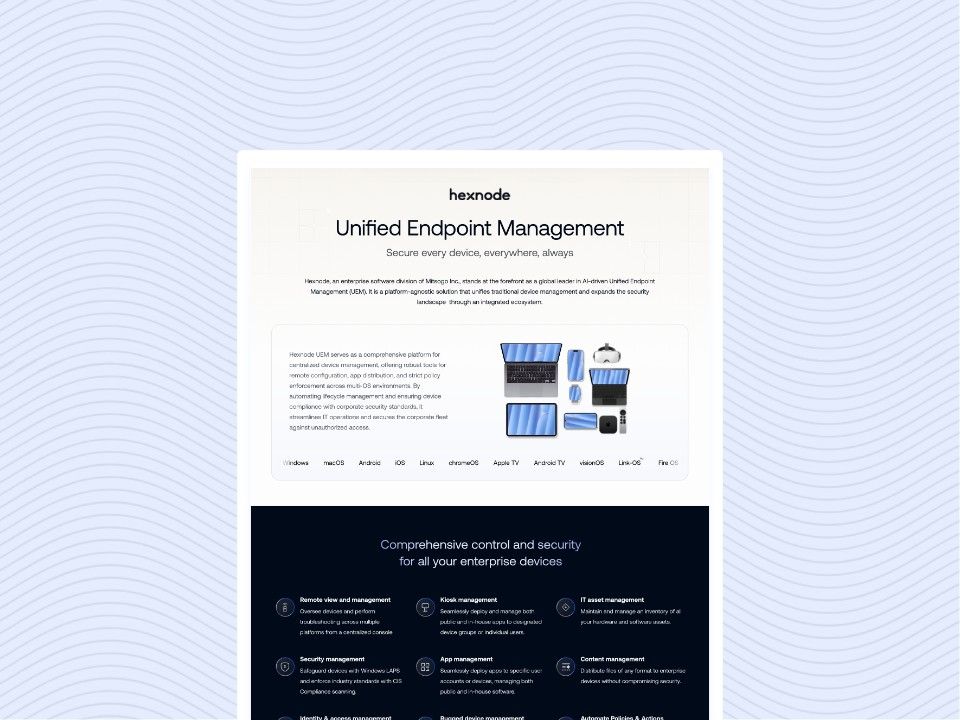
Explore Hexnode UEM capabilities for unified endpoint management, automation, security, and cross-platform device control.
Featured resource
Hexnode UEM Capability Statement
The WordPress supply chain attack highlights a critical shift. Attackers increasingly target trusted software distribution channels instead of exploiting endpoints directly.
However, endpoint exposure remains the final attack vector.
Therefore:
Hexnode supports this by enforcing device-level restrictions, application control, and web filtering based on documented capabilities.
This WordPress supply chain attack demonstrates how trusted plugins can become attack vectors. Therefore, organizations must act quickly and strategically.
They must:
Hexnode supports this approach by enabling:
As a result, organizations can limit risk while remediation efforts are underway.
Get expert insights, threat alerts, and endpoint security best practices.
Try Hexnode Now