How Companies Boost Productivity with IT Automation Using Hexnode
Discover how to scale your IT operations and reduce human error by automating repetitive device management tasks.

Get fresh insights, pro tips, and thought starters–only the best of posts for you.
Mar 18, 2026
8 min read
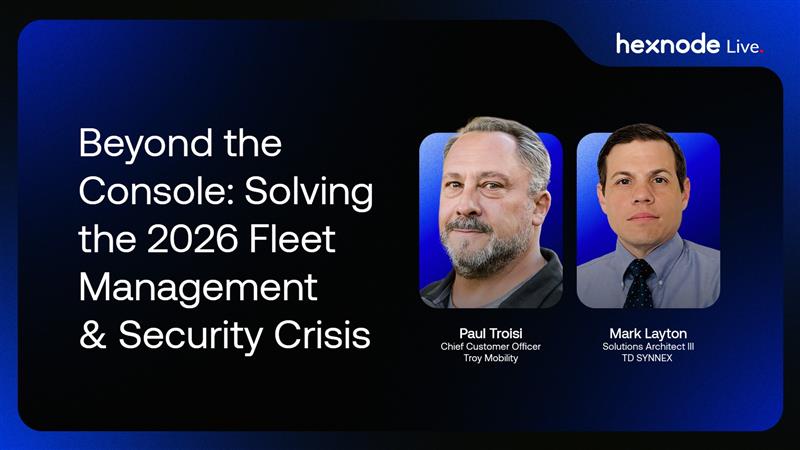
In the enterprise IT outlook of 2026, legacy playbooks are no longer holding up. Organizations are operating in a complex world of multi-OS environments, ruggedized IoT, and unattended endpoints—all while security expectations and privacy risks are at an all-time high. To navigate this, IT teams must look beyond the traditional management console.
Deep diving into the current fleet management crisis, industry experts Paul Troisi (Chief Customer Officer, Troy Mobility) and Mark Layton (Solutions Architect III, TD SYNNEX), recently joined the Hexnode Live series to explore why traditional strategies are failing and how to build a resilient future.
For years, the standard response to new technology was to add a specialized tool for every new challenge. However, this fragmentation has become a primary source of failure for modern fleet management. Troisi identifies this as the “Multiple Panes of Glass” paradox.
“Trying to manage multiple operating systems under multiple panes of glass equals multiple levels of pain. We do like to say too many panes equals too much pain.” — Paul Troisi
Consolidation is no longer a luxury; it is a mandate. Layton emphasized that this “pain” is precisely why the industry is gravitating toward unified platforms like Hexnode, as they eliminate the friction of toggling between disparate systems.
When an IT organization is stretched thin across separate consoles, context is lost, and the “self-healing” capabilities of autonomous endpoint security are neutralized.
The goal for 2026 is a unified strategy that simplifies management experience while strengthening the defensive perimeter.
A significant portion of modern fleets consists of unattended endpoints that often fall into a management “black hole.” Because these devices lack a human interface to initiate manual updates, they frequently become the weakest link in the security chain.
Addressing these blind spots requires a fundamental departure from traditional update management.
Layton emphasized that by integrating automation into standard workflows, IT teams can move beyond reactive patching. Leveraging Hexnode’s automated querying and remediation features provides the critical visibility needed to secure these otherwise “invisible” assets—a necessary step in mitigating systemic risks that often go undetected.
The danger of ignoring these automated systems is significant. As Troisi explained, “Apple, Google, and Microsoft are putting out updates. If we’re just taking those patches and shoving them under the rug, at the end of the day, everybody ends up being impacted by that rug-shoving.”
Without a strategic pivot toward automation, these unpatched gateways remain a constant threat to enterprise resilience. By automating the “handshake” between the OS update and the device, organizations ensure that no endpoint is left behind in the dark.
In 2026, the most dangerous misconception stalling enterprise resilience is what Troisi calls the “Ronco Oven” mentality—the flawed belief that IT can simply “set and forget” their security infrastructure. In a hyper-evolving threat landscape, a static security policy isn’t just stagnant; it’s decaying.
Troisi argues that maintaining a robust defensive posture requires dynamic orchestration because business objectives, application suites, and device configurations are in a constant state of flux.
This volatility is exactly why security can no longer exist in an administrative vacuum. Layton reinforces this, noting that the intricacies of modern mandates like the Cybersecurity Maturity Model Certification (CMMC) have effectively ended the era of the “siloed administrator.”
Because today’s digital environment is too multifaceted for any single person to manage, success now requires a cross-functional approach. By aligning specialized teams with automated systems, organizations lift the operational burden from individual admins. This shift allows them to stop simply managing tools and start driving the strategic outcomes required for long-term growth.
As the enterprise fleet expands beyond traditional office walls, the concept of a physical “perimeter” has vanished. In a hybrid or BYOD environment, device health acts as the essential foundation upon which all identity-based security is built. While identity verification is critical, it cannot happen in isolation; it requires environmental context to be truly meaningful.
Layton correctly emphasizes that “there needs to be a force of an MFA because IT must be able to prove that this user is who they say they are.” This authentication serves as the vital first step of modern security. However, to operate effectively in 2026, we must build upon this foundation by layering in Contextual Trust.
This approach moves beyond simple passwords or tokens. It requires real-time validation of both the user and their operating environment. Authenticated users on jailbroken or unpatched devices still pose critical risks. Identity verification alone cannot detect these device-level threats.
By establishing this high standard of Device Trust, organizations can confidently lean into BYOD policies to support a flexible, hybrid workforce. This strategic shift finally dismantles the “Big Brother” myth that Troisi has noted in BYOD circles for over fifteen years.
Historically, the hurdle has been a pervasive fear—rather than a technical reality—that management tools allow employers to surveil personal data such as private photos or messages.
This strategic shift resolves the “Big Brother” anxiety Troisi has noted in BYOD circles for over fifteen years. Historically, the hurdle has been the pervasive fear that management tools allow employers to monitor private data like photos or messages.
However, as Layton points out, “modern unified endpoint management (UEM) tools like Hexnode deliver true privacy by design,” providing a technical solution to these psychological barriers.
This architecture secures corporate silos by verifying external health markers, such as encryption status and patch levels, without ever overstepping into a user’s personal life. The result is a robust security posture that remains firmly aligned with the strict privacy expectations of today’s workforce.
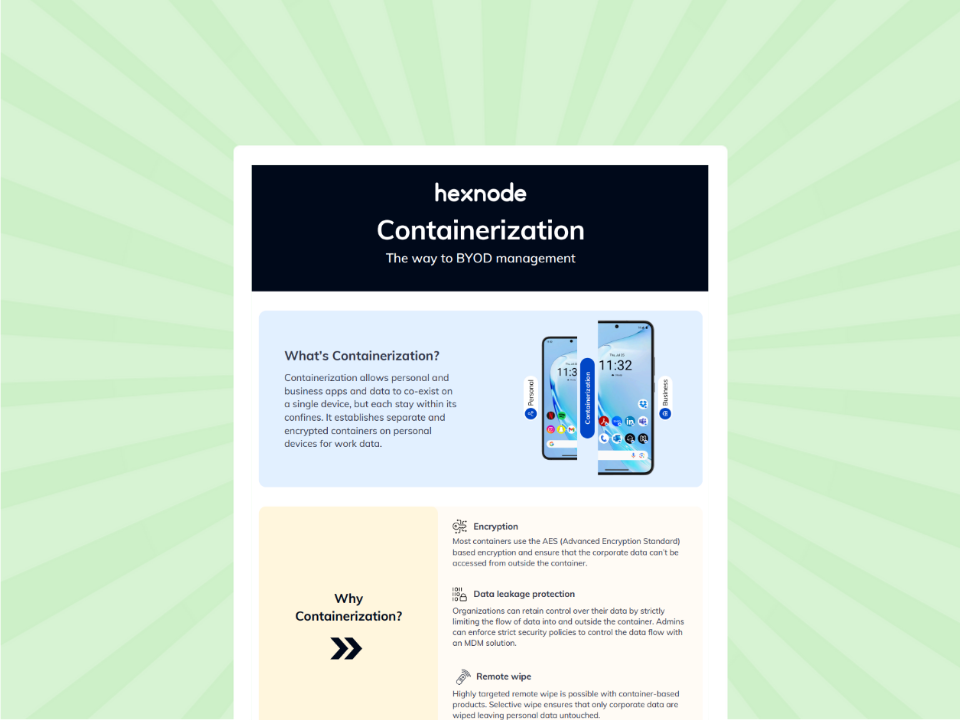
Learn how to use selective wipe and data leakage protection to manage BYOD fleets across Android and iOS effectively.
Get the InfographicThe ultimate goal of autonomous endpoint management (AEM) isn’t to replace the IT professional, but to liberate them.
Layton shared a glimpse into his own workflow. He uses AI to handle the “low-task work” of manual querying. This approach shifted his daily focus. As an administrator, he noted, “I’m not doing as much clicking as I am doing more thinking.”
This is the hallmark of a truly resilient fleet. Troisi believes that “we are at the edge of a major transition where technologies will start moving towards more of an autonomous response to handle threats.”
The result is a platform that is not just managed but is self-healing and self-remediating. The most successful organizations in the transformational years ahead won’t just have the best tools. Instead, they will move beyond the console to embrace a smarter, more automated future.
1.Does autonomous endpoint security mean losing control over the fleet?
No. Moving to Autonomous Endpoint Management shifts your role from micro- management to strategic orchestration. In a traditional “reactive” model, IT manually intervenes to fix individual alerts—a process that cannot scale.
An autonomous fleet operates on a Desired State model. You define the security baseline, including encryption, patch levels, and applications. The system then uses continuous, non-linear remediation to keep every device glued to that state. If a device drifts, it self-heals in real time.
This transforms the IT role from a firefighter into an architect. IT professionals define high-level security outcomes rather than clicking through repetitive tasks.
2. What is the most effective way to solve tool fragmentation?
Tool fragmentation is effectively solved by shifting from a “best-of-breed” point-solution strategy to a Unified Platform Architecture. This involves two critical moves: