TL;DR:
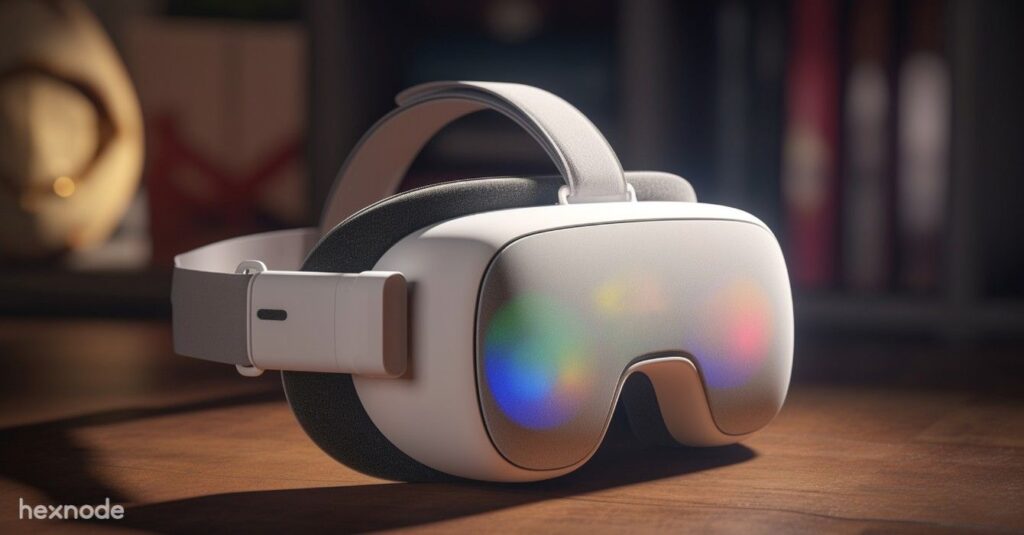
As XR moves from pilots to enterprise-scale deployments, headsets must be managed as primary endpoints rather than isolated devices outside the core security stack.
- Production XR introduces the same identity, application, compliance, and lifecycle-management requirements as other enterprise endpoints.
- A unified endpoint strategy brings enrollment, app delivery, restrictions, access controls, and device lifecycle management into the existing IT architecture.
- Hexnode UEM brings Apple Vision Pro and Meta Quest management alongside mobile and desktop fleets, reducing fragmented XR management.
In 2026, the transition from experimental pilots to industrial-scale fleets signaled the maturity of extended reality applications in business. What began as a handful of Meta Quest 3 and Apple Vision Pro units managed via spreadsheets has evolved into massive deployments across global construction, healthcare, and logistics sectors. However, this rapid scaling has exposed a critical “Spatial Computing Gap,” where organizations often treat these $3,500 devices as isolated guest hardware or manage them through niche, siloed platforms that exist outside the core security stack.
To eliminate this fragmentation, CISOs must shift from a siloed “XR Strategy” to a unified endpoint philosophy. Rather than viewing spatial computers as peripheral gadgets, they must be architected as primary enterprise endpoints integrated directly into your security infrastructure. This guide details how to leverage Hexnode UEM to secure visionOS and Meta Quest devices, ensuring that your spatial workforce is governed by the same rigorous compliance and identity standards as your mobile and desktop fleets.
Effortlessly manage and secure your visionOS devices
Extended Reality in Business: From VR to Spatial Computing
Extended reality is not a single device category. It is the umbrella that connects virtual reality (VR), augmented reality (AR), and mixed reality (MR)—three technologies that place digital information at different points on the spectrum between physical and virtual environments. Competitor content consistently establishes this foundation before moving into enterprise applications.
VR replaces the user’s physical surroundings with an immersive digital environment. In business, that makes it particularly valuable for simulations, safety training, and scenarios where practicing in the real world would be expensive, disruptive, or dangerous.
AR takes the opposite approach. It keeps the physical environment visible while overlaying digital instructions, data, or 3D objects. Think technicians viewing repair instructions over a machine or warehouse workers receiving contextual information without leaving the task.
MR and spatial computing push the model further by allowing digital objects to behave as persistent elements within the physical environment. That opens the door to collaborative design reviews, immersive visualization, and workflows built around spatial rather than conventional 2D interfaces.
For IT, however, the distinction matters less than the endpoint underneath it. Once XR becomes part of a production workflow, the headset stops being an experiment and becomes another device accessing enterprise identities, applications, networks, and data.
Where Extended Reality Applications Deliver Business Value
The business case for XR extends well beyond immersive training. Across enterprise environments, the technology is moving into workflows where visualization, spatial context, and hands-free access to information can reduce the distance between digital data and physical work. Training, design, and remote collaboration are among the most established workplace application areas.
Training and simulation: VR can recreate hazardous, expensive, or difficult-to-reproduce scenarios without exposing employees or physical equipment to the same operational risk.
Product design and engineering: Spatial visualization allows teams to inspect 3D concepts at scale, review designs collaboratively, and identify potential issues before committing to physical prototypes.
Field service and maintenance: AR can place instructions and contextual information directly within a technician’s field of view, while remote collaboration can connect on-site workers with specialists elsewhere.
Healthcare: Immersive environments can support training and other specialized clinical workflows where spatial understanding matters. Healthcare is also a recurring enterprise XR application area across competing coverage.
Logistics and operations: AR-guided workflows can give workers contextual information while they remain focused on the physical task.
Different application, same IT problem: every production headset introduces another endpoint that must be deployed, governed, updated, and secured at scale.
The Gap: Why Proprietary Device Subscriptions Create a Silo
Standard marketing for high-end headsets often suggests that managing an enterprise fleet requires specific, manufacturer-branded subscriptions. These programs frequently steer organizations toward a restricted ecosystem of “official” partners, creating a fragmented management experience that can become a strategic trap.
This approach introduces three primary challenges for the enterprise:
- The Cost: It adds a recurring subscription layer on top of your existing hardware investment for features that should be standard.
- The Silo: It forces administrators to manage spatial policies in a dedicated, standalone portal that is disconnected from the rest of the mobile and desktop fleet.
- The “OS” Reality: Under the hood, these devices are built on familiar foundations—visionOS is an evolution of iOS, and Meta Quest runs on a fork of Android.
The Hexnode Perspective: Because these headsets share a common DNA with smartphones and tablets, Hexnode manages them using our core Apple and Android Enterprise engines. You do not need a specialized, high-cost portal to push a 3D application or enforce a security passcode; you simply need a UEM that understands the underlying architecture at a root level. By bringing both Meta Quest and Apple Vision Pro into Hexnode, you achieve Single Pane of Glass visibility—ensuring your spatial devices appear alongside your laptops, subject to the same compliance rules and identity governance.
Before You Scale XR: Build the Management Layer First
A successful XR pilot proves that an immersive workflow works. It does not prove that the organization can operate 50, 500, or 5,000 headsets securely.
That distinction matters. Research into enterprise XR adoption repeatedly points to factors beyond the headset itself, including compatibility with existing information systems, organizational readiness, cost, technical limitations, and the availability of skills needed to support the technology.
Before expanding an XR deployment, IT should ask the same questions it would ask before introducing any new endpoint class:
- How will devices be enrolled and assigned?
- How will business applications reach the headset?
- Which device capabilities should users be allowed to access?
- How will identities and access policies follow the user?
- How will IT maintain application and OS versions across the fleet?
- What happens when a headset is lost, reassigned, or retired?
The objective is not simply to manage XR hardware. It is to prevent XR from becoming a parallel IT estate.
That is why endpoint management should be part of the architecture before the pilot becomes a fleet. Enrollment, configuration, application delivery, access controls, and lifecycle management need to scale with the deployment—not arrive as an emergency retrofit after hundreds of headsets are already in circulation.
Strategy 1: Securing Apple Vision Pro (The “Super-iPad” Approach)
Apple has made enterprise adoption easy by building visionOS on the foundation of iOS. If you can secure an iPad, you can secure a Vision Pro—if you understand the nuances.
The Enrollment Path:
- Automated Device Enrollment (ADE): Just like a MacBook, you can purchase Vision Pros via Apple Business Manager. When the user puts on the headset for the first time, they are greeted not by a “Hello” screen, but by a “Remote Management” prompt.
Streamlining Device Management with Apple’s Automated Device Enrollment (ADE)
Streamline large-scale Apple device deployment using Automated Device Enrollment and Hexnode.
The Hexnode Security Layer: The Vision Pro introduces new privacy risks. It has cameras that constantly record the user’s room.
Actionable Policy: Use Hexnode to enforce a “Spatial Flow” Restriction.
- Config: Disable “AirPlay Receiver” to prevent unauthorized casting of sensitive 3D models to external screens.
- Config: Enable “Process voice to talk only on device” to ensure voice commands (which might contain sensitive patient data) are processed locally, not sent to Siri servers.
Apple Vision Pro is not a toy; it is a laptop on your face. Secure it with the same rigor you apply to a MacBook Pro—Encrypted, Supervised, and Managed.
Strategy 2: Taming the Meta Quest (The “Kiosk” Approach)
The primary use case for Meta Quest in the enterprise is Training. You don’t want an employee playing Beat Saber when they should be learning Forklift Safety. This is where Hexnode’s Android Kiosk Mode becomes your “Spatial Strategy.”
The Workflow:
- The Content: You have a proprietary VR Training App (.apk file) that is 2GB in size.
- The Deployment: Upload the APK to the Hexnode Enterprise App Inventory.
- The Lockdown: Create a Single App Kiosk Policy.
- Target: “Warehouse VR Headsets” Group.
- App: com.yourcompany.safetytraining.
- The Result: When the employee puts on the headset, they don’t see the Meta Store. They don’t see the Browser. They launch directly into your training environment.
Addressing the “File Size” Challenge: VR apps are massive. Pushing a 4GB update to 500 headsets can kill your Wi-Fi.
Hexnode Fix: Utilize our Local Content Distribution (or integrate with a local caching server). Hexnode can schedule these heavy downloads for 2:00 AM, ensuring the headsets are updated and ready for the 8:00 AM shift.
Strategy 3: Identity-Bound Spatial Computing
The biggest security risk in VR is “The Shared Headset.” In a design studio, five engineers might share one Vision Pro. If Engineer A logs in and leaves their Slack open, Engineer B has access to it.
The Solution: Hexnode + Identity Provider (IdP) Integration.
We treat the headset as a “Zero Trust” endpoint.
- Enrollment: Authenticate enrollment via Microsoft Entra ID (Azure AD) or Okta. This binds the device to a specific corporate identity.
- Session Management: For Apple Vision Pro, we enforce a strict “Auto-Lock” policy (e.g., 2 minutes of inactivity). Because the device uses Optic ID (Iris scanning), it re-authenticates the user instantly. If a different user puts it on, it stays locked.
For Meta Quest shared devices, use Hexnode to push a “Reset on Idle” script or policy (where supported) to clear app data between shifts, ensuring a sterile environment for the next trainee.
The “Spatial Asset” Challenge: Tracking the Hardware
VR headsets have a high “walk-away” rate. They are expensive, portable, and desirable.
The Hexnode Geofence: You cannot physically chain a VR headset to a desk. But you can digitally chain it.
- Action: Create a Geofence Policy around your R&D Lab or Training Center.
- Trigger: If a Meta Quest 3 leaves the designated “Safe Zone” (detected via Wi-Fi SSID or GPS signal on paired devices), Hexnode triggers a “Lock Down” action.
- The Message: The user inside the headset sees a black screen with the text: “Device Outside Authorized Zone. Return to IT immediately.
Conclusion: Unify Your Reality
The mistake enterprises make is treating “Spatial Computing” as a separate discipline. It is not. It is just another screen. Whether that screen is in your pocket (iOS), on your desk (Windows), or strapped to your face (visionOS), the requirements are the same:
- Who is using it? (Identity)
- What are they accessing? (Content)
- Is it secure? (Compliance)
By managing your Apple Vision Pro and Meta Quest fleets via Hexnode UEM, you dismantle the “XR Silo.” You bring the Spatial Workplace into the fold, ensuring that your innovation doesn’t outpace your security.Don’t buy a separate tool. Extend your perimeter.
Ready to Secure Your Spatial Fleet?
Learn how to enroll and configure VR headsets in Hexnode.
Sign Up NowFAQ
What should IT teams consider before scaling an enterprise XR deployment?
IT teams should plan how to enroll, assign, configure, update, secure, and eventually retire XR devices. Establish identity, app delivery, access controls, and lifecycle management before scaling XR deployments.
Why should XR headsets be included in an organization’s UEM strategy?
Production XR headsets access enterprise applications, identities, networks, and data, making them part of the endpoint environment. Including them in UEM helps IT avoid creating a separate management silo alongside existing mobile and desktop fleets.
How can IT manage applications on enterprise VR headsets?
Application management should cover deployment, updates, and controls that determine which apps users can access. Hexnode can deploy enterprise APKs and restrict Meta Quest devices to approved apps using kiosk policies.
How does identity management fit into enterprise XR security?
Identity management helps connect device enrollment and access with a corporate user identity. The draft describes authenticating enrollment through identity providers such as Microsoft Entra ID or Okta and applying session controls to reduce unauthorized access on shared headsets.
How can organizations prevent XR devices from becoming a separate IT silo?
Organizations can manage XR devices through the same endpoint-management architecture used for other enterprise devices. This brings enrollment, application delivery, restrictions, identity controls, compliance, and lifecycle management into a unified operational model.
What security controls should IT prioritize for enterprise XR headsets?
IT should prioritize controls around device access, applications, identity, data exposure, and device lifecycle. The draft specifically covers restrictions, kiosk lockdown, authentication, auto-lock policies, geofencing, and centralized endpoint management for XR deployments.