How Companies Boost Productivity with IT Automation.
Discover how leading enterprises use Hexnode automation to slash manual labor costs and maximize hardware efficiency.

Get fresh insights, pro tips, and thought starters–only the best of posts for you.
In the Enterprise IT playbook, there is a “Golden Rule” that has gone unquestioned for two decades: The 3-Year Refresh Cycle.
The logic dictates that after 36 months, a laptop’s warranty expires, its battery degrades, and its processor struggles to run the latest bloated version of Microsoft Teams or Adobe Creative Cloud. So, the CFO signs a check for $2 million, 5,000 perfectly functional laptops are sent to a recycler (or a landfill), and 5,000 new units are unboxed.
In 2026, this model is economically and environmentally defenseless, especially when repurposing old laptops as kiosks offers a more sustainable alternative.
A 3-year-old Intel Core i5 laptop is indeed too slow for a Power User multitasking across three 4K monitors. But it is overpowered for a Digital Signage player. It is a supercomputer for a Visitor Check-In Kiosk. It is a Ferrari for a Warehouse Inventory Terminal.
The future of hardware management isn’t “Replace.” It is “Repurpose.”
This guide details how to use Hexnode UEM to break the 3-year cycle. We will explore the technical workflow to strip down aging Windows and macOS devices, lock them into high-performance Kiosk Mode, and extend their useful life from 3 years to 5, 6, or even 7 years.
Before we get to the How, we must address the Why. Repurposing isn’t just about being frugal; it’s about two critical Enterprise KPIs: CapEx Efficiency and Scope 3 Emissions.
Replacing a fleet of 1,000 visitor kiosks with dedicated hardware (e.g., iPads or specialized touchscreens) costs roughly $500,000. Repurposing 1,000 retired employee laptops costs $0 in hardware. You only pay for the software license.
The uncomfortable truth of Green IT is that 80% of a laptop’s carbon footprint is generated during manufacturing. Using the device consumes relatively little power compared to the energy required to mine the lithium, cobalt, and gold to build it.
For companies reporting under the EU CSRD or California Climate Laws, extending hardware life is the single most effective way to lower Scope 3 (Supply Chain) emissions.
Why does a laptop feel “slow” after 3 years? It isn’t usually hardware failure. It is software bloat. The accumulation of background agents (Antivirus, DLP, Updater services, Teams helpers) consumes the CPU cycles.
The Strategy: We don’t try to fix the slowness. We eliminate the multitasking. By converting the device into a Hexnode Kiosk, we strip away the Windows Explorer shell or the Mac Finder. The OS boots directly into a Single Application (e.g., a Chrome Browser or a Citrix Receiver).
The Result: A laptop that struggled to run Windows 11 with 50 apps open will fly when it only has to run one. You aren’t just extending the life; you are effectively upgrading the performance for that specific use case.
The importance of workplace automation: Empowering enterprises for the future
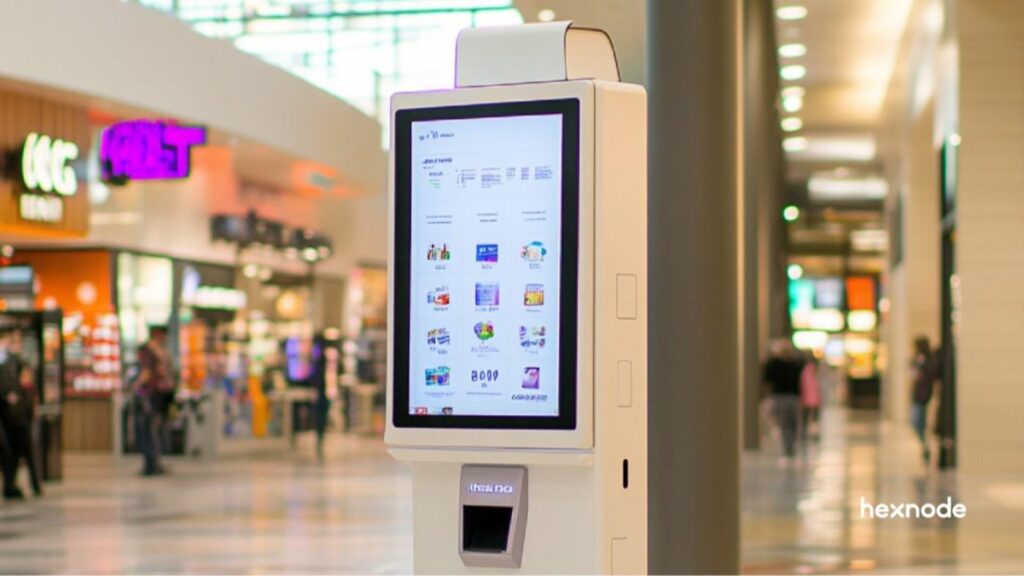
The Use Case: You need screens in the cafeteria to display menus, or in the lobby to play corporate videos. The “Old” Way: Buy a $800 Digital Signage Player. The Hexnode Way: Take a retired Dell Latitude (missing keys? broken trackpad? doesn’t matter), hide it behind the TV, and control it remotely.
Result: A zero-cost 4K media player that can be managed alongside your mobile fleet.
The Use Case: Warehouse staff need a terminal to look up inventory on a web-based ERP (SAP/Oracle).
The “Old” Way: Buy ruggedized tablets or Thin Clients.
The Hexnode Way: Repurpose retired MacBook Airs. Even with a degraded battery, if they are bolted to a desk and plugged in, they are perfect Thin Clients.
Result: A secure, high-resolution terminal that costs nothing and is immune to “distraction browsing” (no YouTube, no Facebook).
The Use Case: Front desk visitor registration.
The “Old” Way: Expensive specialized kiosks.
The Hexnode Way: Retired Sales Chromebooks or Tablets.
A common objection from the CISO is: “Old devices are security risks. They don’t have the latest TPM chips or might stop getting OS updates.”
This is a valid concern for a general-purpose device. It is less relevant for a Kiosk.
The “Reduced Attack Surface” Defense: When you lock a device in Kiosk Mode with Hexnode, you effectively brick the attack vectors.
Even if the device is running an older OS patch level, the mitigating controls of the Kiosk container make it secure enough for low-sensitivity tasks (like displaying a menu or entering a visitor name).
A Kiosk is the ultimate ‘Least Privilege’ environment. The device is allowed to do exactly one thing, and the OS ignores any request to do anything else.

From security best practices to advanced UX configurations, learn everything your business needs to know about managing a high-performance kiosk fleet.
Download White paperThe risk of repurposing is perception. If you put a beat-up laptop on the reception desk, it looks like the company is struggling.
The Fix: Hide the hardware.
Don’t just throw retired laptops in a pile. Build a process.

Don’t touch every device. The biggest hurdle to repurposing hardware is the labor cost of “wiping and reloading.” If IT has to spend two hours per laptop, the CapEx savings vanish.
Hexnode bridges this gap by integrating with Windows Autopilot and Apple Business Manager (DEP) to enable a Zero-Touch transition:
The Result: You can transform a stack of 50 laptops in the time it takes to click a button. IT never has to touch the keyboard.
Can I turn an old laptop into a Kiosk?
Yes. Using a UEM solution like Hexnode, you can configure old Windows or Mac laptops into Kiosk Mode. This strips away the standard desktop interface and locks the device into a single application (like a web browser), allowing older hardware to run smoothly as digital signage or check-in terminals without the performance overhead of a full OS.
Is it secure to use outdated hardware for Kiosks?
Generally, yes, if properly locked down. While older hardware may lack the latest OS features, Kiosk Mode drastically reduces the attack surface by blocking access to the file system, USB ports, and unauthorized websites. This “Least Privilege” configuration mitigates many risks associated with older operating systems.
How does repurposing hardware help with ESG goals?
Repurposing hardware directly impacts Scope 3 Emissions (Supply Chain). Approximately 80% of a laptop’s lifetime carbon footprint is generated during manufacturing. By extending a device’s life from 3 years to 6 years, you effectively halve its annualized carbon impact, improving your company’s sustainability reporting metrics.
Can Hexnode run kiosks on laptops that don’t support Windows 11?
Yes. While these devices may not meet Windows 11’s TPM requirements for general use, they can remain functional and secure as single-purpose kiosks on Windows 10 with Hexnode’s lockdown policies and Microsoft’s ESU program.
Every time you repurpose a laptop using Hexnode, you are saving ~$1,000 in CapEx and preventing ~300kg of Carbon emissions.
You are transforming a “Cost Center” (E-Waste disposal) into a “Resource Center” (Free Hardware Inventory). This is the kind of strategic thinking that gets IT Leaders invited to the boardroom.
Don’t retire your hardware. Re-imagine it.
Turn your retired hardware into high-value kiosks in minutes. No credit card required.
Start your 14-day free trial today!