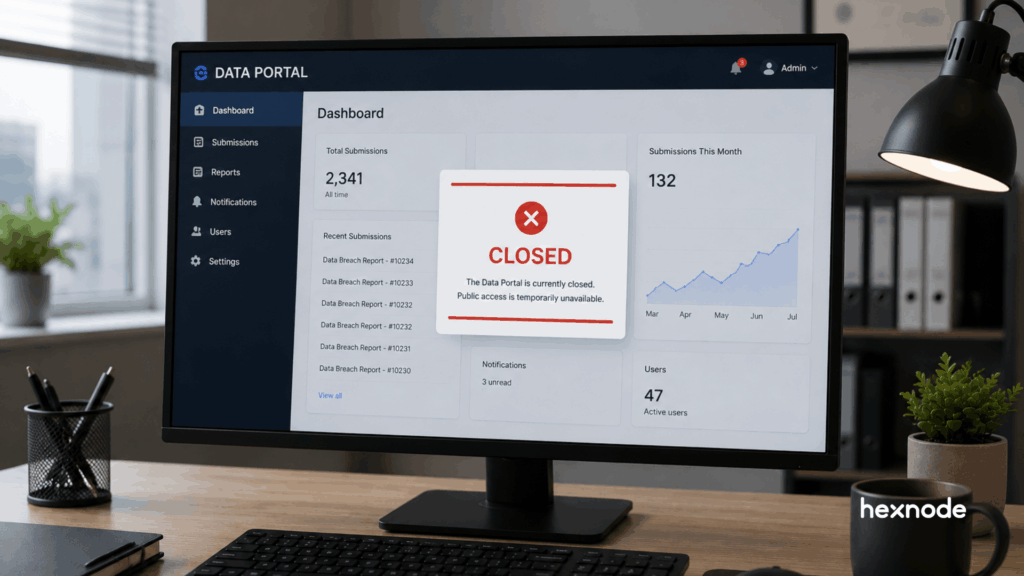
The Maine data breach portal was temporarily taken offline after fraudulent breach disclosures impersonating Discord and VRChat were published on an official government website. The incident was not a network intrusion or confirmed data breach. Instead, it exposed weaknesses in a security reporting workflow that allowed unverified submissions to be automatically published. For enterprises, the case highlights how trust-based systems can be abused to spread misinformation, create reputational risk, and complicate incident response efforts.
Maine temporarily disabled public access to its data breach notification database after an unknown entity submitted fake breach disclosures through the state’s reporting system. The false filings impersonated Discord and VRChat and appeared on an official government website before their legitimacy was verified.
The Maine data breach portal incident stands out because publicly available information does not indicate malware, ransomware, or a confirmed compromise of the affected companies.
Because the filings appeared on an official state platform, they carried a level of credibility that could have led customers, journalists, researchers, and security teams to treat the claims as legitimate before verification occurred.
For organizations that rely on public breach disclosures as authoritative sources of security information, the incident serves as a reminder that trust mechanisms themselves can become targets.
What Happened in the Maine Data Breach Portal Incident?
The issue emerged when fraudulent breach notifications were submitted through Maine’s public reporting process.
One filing falsely claimed that VRChat had experienced a security incident affecting more than 2.4 million individuals. The submission reportedly included fabricated details and referenced a fictitious employee. VRChat later confirmed that it had not submitted the disclosure and stated that it had no reason to believe its systems had been compromised.
A separate suspicious filing allegedly impersonated Discord. Maine officials later stated that they had no knowledge of any recent legitimate breach reports from either organization.
Following the discovery of the false submissions, the Maine Attorney General’s Office removed the fraudulent reports and suspended public access to the breach notification database while reviewing its procedures. Companies can still submit notifications, but public access to disclosures has been restricted during the review process.
Why the Incident Was a Workflow Failure Rather Than a Cyber Intrusion
Publicly available information does not indicate that anyone breached Maine’s systems or gained unauthorized access to government infrastructure. Instead, the incident appears to have stemmed from the design of the reporting process itself. Before Maine shut down the portal, the reporting system automatically published breach notices to the public database without verifying that authorized representatives submitted the reports.
This distinction is important.
Traditional cybersecurity incidents typically involve unauthorized access to systems, exploitation of vulnerabilities, or theft of data. In this case, the apparent abuse occurred through a legitimate submission channel.
The effectiveness of the scheme depended on a lack of identity verification rather than technical compromise.
Once published, the disclosures gained credibility simply because they appeared on an official government website.
Featured resource
Hexnode XDR Info Sheet
Discover how Hexnode XDR helps security teams investigate endpoint activity, gain visibility into security events, and respond to threats.
Although no confirmed breach occurred at the impersonated organizations, the impact of a fraudulent disclosure can still be significant.
Reputational Risk
Organizations may face public scrutiny, customer concern, and media attention before they have an opportunity to deny false claims.
Incident Response Disruption
A fabricated incident can force security, legal, communications, and executive teams to divert resources toward investigation and response efforts.
Regulatory and Stakeholder Confusion
False disclosures can complicate communication with regulators, partners, customers, and stakeholders who rely on official reporting channels.
Phishing and Social Engineering Opportunities
Fraudulent breach claims may create favorable conditions for phishing campaigns and other social engineering efforts. Threat actors could attempt to exploit confusion by sending fake breach notifications, password reset messages, or support communications to concerned users.
Threat Intelligence Contamination
Threat intelligence teams, researchers, and journalists frequently monitor breach notification databases for newly reported incidents. As they ingest and share new reports, unverified information can quickly spread across monitoring systems and reporting channels before organizations can verify and correct it.
The Maine case demonstrates that breach notification abuse can create operational consequences even when no actual cyberattack has occurred.
What Remains Unknown About the Maine Data Breach Portal Incident
Several aspects of the incident have not been publicly confirmed.
At the time of reporting:
The identity of the individual or group responsible for the submissions remains unknown.
No motive has been publicly established.
It is unclear whether additional fraudulent filings were submitted before public access was suspended.
There is no public evidence linking the activity to a broader threat campaign.
No confirmed compromise of Discord, VRChat, or Maine government systems has been reported.
Organizations should view this incident primarily as an abuse of a reporting process rather than a confirmed data breach event. Regardless of who submitted the false reports, the incident highlights a broader challenge for public disclosure systems: ensuring that only authorized representatives can submit breach notices and trigger public disclosures.
Strengthening Identity Verification in Security Reporting Workflows
The incident highlights the importance of validating both information and identity before publication. Organizations that operate disclosure portals, reporting systems, or public-facing security workflows should consider safeguards such as:
Verifying the identity of authorized submitters
Confirming organizational ownership before publication
Implementing approval workflows for sensitive disclosures
Maintaining audit trails for submissions and modifications
Monitoring for suspicious or anomalous filing activity
Establishing rapid review procedures for disputed reports
Security reporting systems are often designed to encourage timely disclosure. However, reducing friction should not come at the expense of trust and authenticity.
The challenge is balancing accessibility with adequate verification controls.
UEM Incident Management: From Monitoring to Remediation with the New Incidents Tab
Learn how effective incident management processes help organizations investigate suspicious activity.
How Hexnode Supports Incident Response Readiness
While this incident did not involve endpoint compromise, it highlights the operational challenges organizations face when responding to misinformation, impersonation, and security-related communications.
Hexnode UEM
Hexnode UEM can help organizations enforce device compliance policies for teams involved in incident response, legal review, and communications processes. By managing and securing endpoints used to access sensitive workflows, organizations can maintain greater control over devices participating in disclosure and response activities.
Hexnode IdP
Hexnode IdP supports multi-factor authentication, role-based access control, Microsoft Entra ID integration, device compliance checks, and conditional access capabilities. These controls can help organizations strengthen identity verification around internal approval and disclosure workflows.
Hexnode XDR
If a false disclosure triggers suspicious activity on employee endpoints, Hexnode XDR enables security teams to investigate affected devices using historical endpoint data, query-based investigation, and endpoint visibility.
Security teams can also take response actions such as device isolation, process termination, and file quarantine when warranted by endpoint findings.
These capabilities do not prevent fraudulent third-party filings, but they can help organizations maintain stronger operational control during incident response activities.
Key Lessons from the Maine Data Breach Portal Incident
The Maine portal incident shows that cybersecurity risks do not always stem from malware, exploits, or unauthorized access.
Sometimes the target is trust itself.
By abusing a public reporting workflow, an unknown individual or group was able to publish false breach claims on an official government platform, creating the potential for reputational risk, public confusion, and unnecessary response activity.
As organizations increasingly rely on public disclosure systems and digital reporting channels, they must treat identity verification and submission validation as critical security controls rather than administrative afterthoughts.
This incident highlights a clear lesson: organizations should protect the integrity of security reporting workflows with the same rigor they use to secure the networks those workflows support.
Strengthen Security Beyond the Network
See how Hexnode helps secure devices, strengthen access controls, and support incident response readiness.
I write at the intersection of technology, process, and people, focusing on explaining complex products with clarity. I break down tools, systems, and workflows without any noise, jargon, or the hype.