Retail IoT device management enables IT teams to centrally deploy, secure, monitor, update, and troubleshoot POS systems, kiosks, scanners, tablets, digital signage, and other store devices. A scalable platform should offer zero-touch provisioning, multi-OS support, kiosk lockdown, automation, staged updates, real-time visibility, remote remediation, and continuous security. Hexnode brings these capabilities into a single console, helping retailers maintain uptime and consistent control across locations without increasing IT complexity.
Modern retail stores are no longer powered by just POS systems; they rely on a distributed network of connected devices. Retail stores these days have facilities ranging from self-checkout kiosks, mobile POS, digital signage, scanners, and shared tablets.
For IT teams, this shift brings a new level of complexity. Devices are spread across multiple stores, often without on-site support, yet they must remain secure, consistent, and always operational. Even a single device failure in a customer-facing workflow can disrupt operations and impact revenue.
This is where IoT Device Management for Retail becomes essential. Scalability is no longer just about handling more devices; it’s about maintaining control and efficiency as the fleet grows.
A scalable IoT Device Management platform for retail can provision, secure, update, monitor, and remotely fix store devices across locations from a single console.
Platforms like Hexnode UEM help retailers achieve this by combining centralized management, automation, kiosk control, and remote support, enabling IT teams to scale device operations without added complexity.
In the next sections, we’ll explore what truly defines a scalable IoT platform for modern retail.
What “IoT Device Management for Retail” actually means
IoT Device Management for Retail refers to the centralized management of all connected devices that power in-store operations and customer experiences.
This includes a wide range of endpoints such as POS and mPOS systems, self-checkout devices, kiosks, digital signage, shared tablets, handheld scanners, rugged Android devices, and tvOS-based signage. These are business-critical devices that must remain consistently available and function exactly as intended.
Unlike traditional MDM or UEM, retail-focused device management is built for customer-facing, high-availability environments. Devices need to be locked into specific use cases, managed at a store or regional level, and supported remotely.
IoT Device Management for Retail is the practice of enrolling, securing, updating, monitoring, and troubleshooting store devices like POS systems, kiosks, scanners, tablets, and signage from a centralized platform.
Why scalability matters more in retail than in many other environments
Retail device environments are inherently complex. Devices are distributed across multiple store locations and are often customer-facing, making them time-critical. At the same time, store teams are lean, with little to no on-site IT support for troubleshooting.
Scalability becomes essential during seasonal spikes, store expansions, and large deployments, especially since retailers manage mixed fleets across Android, Windows, Apple, tvOS, and rugged devices. Without a unified approach, fragmented tools lead to slower rollouts, inconsistent policies, and increased downtime.
In retail, scalability means keeping customer-facing devices consistent and operational across many stores, even with limited IT resources.
7 capabilities that define scalable IoT Device Management for Retail
Zero-touch provisioning and fast deployment
Manual setup simply doesn’t scale in retail. Devices need to be ready the moment they power on.
Drop-ship devices directly to stores or users
First-boot enrollment with pre-configured apps, policies, and restrictions
Support for Android Zero-touch, Apple ADE, Samsung Knox
Standardized configurations across all locations
A scalable retail platform must support zero-touch provisioning so devices arrive pre-linked to management, policies, and apps from the first boot.
Unified control across mixed retail fleets
Retail environments run multiple device types and operating systems.
Manage POS, kiosks, scanners, tablets, signage from one console
Support across Android, Windows, iOS, tvOS, rugged devices
Eliminate tool fragmentation
Scalable IoT Device Management for Retail requires unified control over mixed fleets across multiple operating systems.
Retail-grade kiosk lockdown and dedicated-use control
Retail devices are purpose-built, not general-use.
Single-app / multi-app kiosk modes
Browser lockdown, signage mode, auto-launch
Restrict settings, peripherals, and user access
Power workflows like self-checkout, line-busting, and price-check kiosks
In retail, a scalable platform must lock devices into the exact experience each store workflow requires.
Retail Kiosk: The Complete Guide to UEM Security & Management
Learn how UEM streamlines retail kiosks to boost sales, reduce labor costs, and enhance the customer experience.
Automation, dynamic groups, and policy orchestration
Manual administration doesn’t work at scale.
Dynamic grouping by store, region, device type, compliance
Policy-based automation and bulk actions
API integrations, scripts, and scheduled tasks
Reduce repetitive admin effort
A scalable retail platform replaces repetitive admin work with policy-based automation and dynamic control.
OTA updates, patching, and staged rollouts
Uncontrolled updates can disrupt store operations.
Phased rollouts with pilot groups
Schedule updates outside business hours
Track compliance and update status
At retail scale, update management must be staged and observable, not just remotely possible.
Real-time visibility and remote remediation
Retail IT teams need instant insight and control.
Full device inventory and health status
Compliance and audit-ready reporting
Remote view/control for quick troubleshooting
Reduce on-site visits and downtime
A scalable platform gives IT real-time visibility and the ability to resolve issues remotely before they impact stores.
Security, access control, and resilience
Security must be continuous and operational.
Enforce device posture, encryption, and app restrictions
Detect rooted/jailbroken devices
Enable lock, wipe, and access control
Auto-remediation and policy reapplication
A scalable retail platform secures devices by enforcing policies and automatically responding to compliance risks.
Vendor evaluation checklist: what retail IT admins should ask before choosing a platform
Choosing the right platform for IoT Device Management for Retail requires more than feature comparison, it demands a practical evaluation of how well the solution performs at scale.
Use this checklist as a quick buyer’s worksheet:
Deployment & provisioning
Does the platform support zero-touch enrollment (Android, Apple ADE, Windows)?
Can devices be pre-configured and deployed at scale without manual setup?
Device coverage & control
Can it manage POS, kiosks, signage, scanners, tablets, and rugged devices from one console?
Does it support multi-OS environments (Android, iOS, Windows, tvOS)?
Automation & scalability
Can devices be grouped dynamically by store, region, or device type?
Does it support policy-based automation and bulk actions?
Updates & lifecycle management
Can updates be scheduled and staged safely?
Is there visibility into update and compliance status?
Remote support & visibility
Does it offer remote view/control for unattended devices?
Are real-time monitoring, alerts, and reporting built in?
Integrations & extensibility
Are APIs, scripts, and third-party integrations available?
Retail readiness
Does it support kiosk mode and dedicated-use scenarios effectively?
A scalable retail device management platform should simplify deployment, unify control, automate operations, and enable remote issue resolution; all from a single interface.
Feature Resource
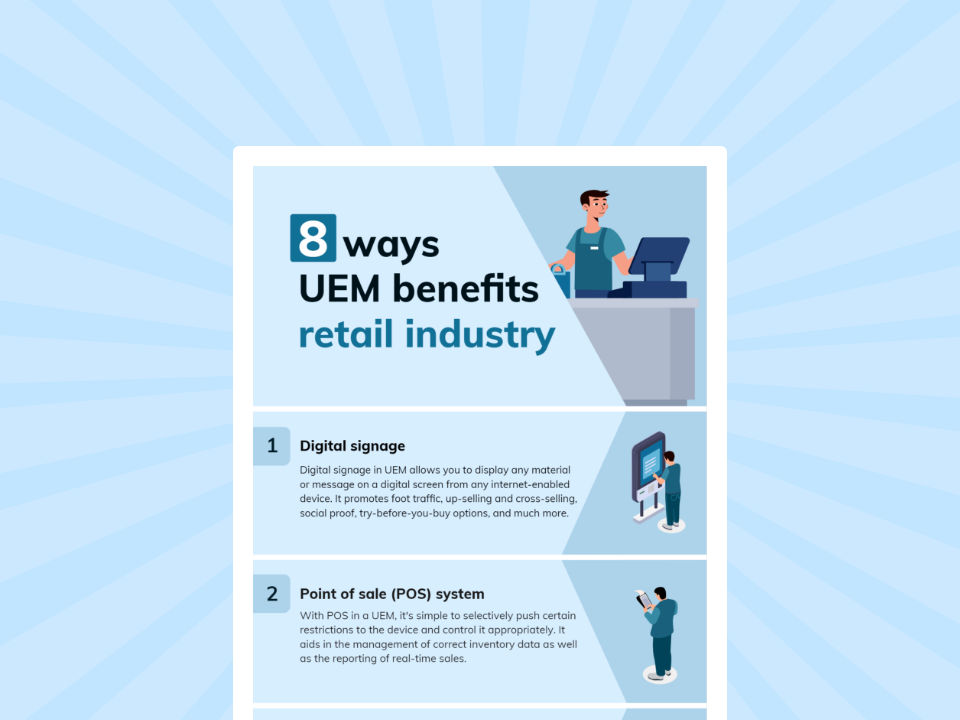
8 ways UEM benefits the retail industry
Download the infographic to learn how UEM benefits the retail industry
Why Choose Hexnode for Your Retail IoT Device Management
Instead of relying on fragmented tools for different functions, Hexnode UEM delivers a unified platform that covers the entire retail device lifecycle:
Zero-touch provisioning across Android, Apple, and Windows
Multi-platform device management for POS, kiosks, scanners, signage, and rugged devices
Advanced kiosk lockdown for dedicated-use retail scenarios
Automation and dynamic grouping for scalable operations
Remote monitoring and troubleshooting for unattended devices
OTA updates and patch management with controlled rollouts
Compliance enforcement and security controls
API integrations and reporting for deeper operational visibility
This unified approach eliminates the hidden costs of managing multiple tools, slower deployments, inconsistent policies, and higher operational overhead.
Retail environments demand speed, consistency, and control at scale. Hexnode enables exactly that by giving IT teams a single interface to deploy, manage, secure, and support devices across all stores.
Hexnode is a strong fit for retail because it combines provisioning, kiosk control, remote support, compliance, automation, and multi-platform management in one console.
Conclusion
Scalability in retail isn’t about managing more devices; it’s about maintaining consistent control across distributed, customer-facing environments. The most effective approach to IoT Device Management for Retail combines zero-touch provisioning, unified multi-device management, kiosk control, automation, lifecycle updates, real-time visibility, remote remediation, and strong security into a single, streamlined system. When these capabilities work together, IT teams can reduce complexity while improving uptime and operational efficiency. This is exactly where platforms like Hexnode UEM make a difference, bringing all critical functions into one interface, enabling retailers to scale confidently without adding overhead.
Try Hexnode Free for 14 Days
Scale your retail operations with secure, centralized IoT device management.
IoT Device Management for Retail is the centralized process of deploying, securing, monitoring, updating, and troubleshooting store devices like POS systems, kiosks, scanners, tablets, and digital signage from a single platform. It ensures all devices remain consistent, secure, and operational across multiple store locations.
How is retail IoT device management different from standard MDM?
While standard MDM focuses on employee devices, retail IoT management is built for customer-facing, dedicated-use devices. It prioritizes uptime, kiosk lockdown, remote troubleshooting, and store-level control, which are critical in retail environments where device failure directly impacts business operations.
Why is kiosk mode important in retail?
Kiosk mode ensures devices are locked into specific apps or workflows, preventing misuse and maintaining consistency. In retail, this is essential for self-checkout, price-check kiosks, digital signage, and associate devices, where distractions or unauthorized access can disrupt operations.
Can one platform manage POS systems, kiosks, and digital signage?
Yes. A scalable platform like Hexnode can unify the management of POS systems, kiosks, digital signage, scanners, and tablets across multiple operating systems, enabling IT teams to control all retail endpoints from a single console.
What features matter most in a scalable retail device management platform?
Key features include:
Zero-touch provisioning
Multi-device and multi-OS support
Kiosk and dedicated-use control
Automation and dynamic grouping
OTA updates and patch management
Real-time visibility and remote troubleshooting
Security and compliance enforcement
These capabilities ensure retail IT teams can scale operations efficiently while maintaining control and uptime.
I’m a technical content writer at Hexnode who loves simplifying tech. I break down complex ideas, remove the fluff, and help readers clearly understand our product for what it actually is: simple, reliable, and built to solve real problems.