Identity Providers (IdPs) verify users and manage identities, while Service Providers (SPs) deliver the applications and resources users access. Together, they enable secure Single Sign-On (SSO), simplify access management, and strengthen security across cloud and hybrid environments.
Modern businesses rely on dozens, sometimes hundreds, of cloud applications, making secure and seamless access management more important than ever. That’s where Identity Providers (IdPs) vs Service Providers (SPs) come in. While these two components work closely together in authentication systems like Single Sign-On (SSO), they serve very different purposes.
An Identity Provider verifies who a user is, while a Service Provider delivers the application or service the user wants to access. Understanding the difference between IdPs and SPs is essential for IT administrators, security professionals, and organizations building secure digital workplaces.
In this guide, we’ll break down how IdPs and SPs work, their key differences, how they interact in federated authentication systems, and why both are critical to modern identity and access management (IAM) strategies.
Introduction to Identity and Access Management (IAM)
As organizations increasingly adopt cloud applications, remote work models, and SaaS platforms, managing user access securely has become a critical business priority. Identity and Access Management (IAM) refers to the framework of policies, technologies, and processes used to ensure the right users can access the right resources at the right time. Modern IAM systems help organizations strengthen security while simplifying the login experience for employees and customers alike.
Technologies such as Single Sign-On (SSO), federated authentication, and Zero Trust security models are now central to modern IT environments. At the core of these systems are two essential components: Identity Providers (IdPs) and Service Providers (SPs). While they work together to enable secure authentication and seamless access, their roles are fundamentally different. Understanding how IdPs and SPs function is key to building secure, scalable, and user-friendly authentication systems.
What Is an Identity Provider (IdP)?
An Identity Provider (IdP) is a system or service responsible for verifying a user’s identity and managing their login credentials. In modern Identity and Access Management (IAM) environments, the IdP acts as the central authority for authentication, ensuring users are who they claim to be before granting access to applications or services. Because it stores and manages user identities, the IdP is often considered the “source of truth” for authentication data within an organization.
Definition of an IdP
At its core, an Identity Provider authenticates users and maintains digital identity information such as usernames, passwords, roles, and permissions. Instead of each application managing its own separate login system, organizations can use a centralized IdP to streamline authentication and improve security across multiple services.
How an Identity Provider Works
When a user attempts to log in to an application, the request is typically redirected to the Identity Provider. The IdP verifies the user’s credentials using authentication methods such as passwords, biometrics, or multi-factor authentication (MFA). Once the identity is confirmed, the IdP generates an authentication token or assertion and sends it back to the application. The application then grants the user access without requiring another login.
This process is commonly enabled through protocols like Security Assertion Markup Language (SAML), OAuth 2.0, and OpenID Connect (OIDC).
Common Features of an IdP
Most Identity Providers include features designed to improve both security and user experience, including:
Single Sign-On (SSO)
Multi-factor authentication (MFA)
User directory and identity management
Conditional access and adaptive authentication
Identity federation across multiple platforms
Examples of Popular Identity Providers
Several widely used Identity Providers support enterprise authentication and cloud identity management, including:
Okta
Microsoft Entra ID (formerly Azure AD)
Google Identity
Ping Identity
Auth0
These platforms help organizations centralize authentication, simplify access management, and strengthen overall cybersecurity.
What Is a Service Provider (SP)?
A Service Provider (SP) is an application, platform, or system that delivers services or resources to users after confirming their identity. In Identity and Access Management (IAM) environments, the SP relies on an Identity Provider (IdP) to authenticate users instead of managing login credentials directly. This approach simplifies authentication while improving security and user experience across multiple applications.
Definition of an SP
A Service Provider can be any cloud application, enterprise platform, or web service that users need to access. Its primary role is to provide functionality, resources, or data, such as email, collaboration tools, storage, or business applications. Rather than storing and validating usernames and passwords itself, the SP trusts the Identity Provider to verify user identities securely.
This trust relationship is a key component of federated authentication systems and Single Sign-On (SSO) environments.
How a Service Provider Works
When a user attempts to access an application, the Service Provider first checks whether the user is already authenticated. If not, the SP redirects the user to the Identity Provider for verification. The IdP then authenticates the user through methods such as passwords or multi-factor authentication (MFA).
Once the user’s identity is confirmed, the IdP sends an authentication assertion or token back to the Service Provider using protocols such as SAML, OAuth 2.0, or OpenID Connect (OIDC). The SP validates this token and grants the user access to the requested application or resource.
While the IdP focuses on authentication, the SP is primarily responsible for authorization and resource access management.
Examples of Service Providers
Many commonly used business applications act as Service Providers, including:
Salesforce
Slack
Zoom
Dropbox
AWS Management Console
These platforms depend on trusted Identity Providers to streamline secure access while reducing the need for multiple passwords and separate login systems.
Identity Provider vs. Service Provider: Core Differences
Feature
Identity Provider (IdP)
Service Provider (SP)
Primary Role
Authenticates and verifies user identities
Delivers applications, services, or resources
Core Responsibility
Manages user credentials and authentication policies
Grants users access to requested services
Data Managed
User identities, passwords, MFA settings, directory information
Application data, user sessions, and access permissions
Authentication Function
Confirms user identity and issues authentication tokens/assertions
Accepts and validates authentication assertions from the IdP
User Interaction
Handles login and identity verification process
Provides the application or platform users want to access
Focus Area
Authentication and identity management
Authorization and service delivery
Protocols Commonly Used
SAML, OAuth 2.0, OpenID Connect (OIDC)
SAML, OAuth 2.0, OpenID Connect (OIDC)
Examples
Okta, Microsoft Entra ID, Google Identity, Auth0
Salesforce, Slack, Zoom, Dropbox, AWS
Trust Relationship
Trusted authority that validates identities
Trusts the IdP to authenticate users securely
Simple Analogy
Airport security checking your identity
Boarding gate allowing access to the plane
Feature Resource
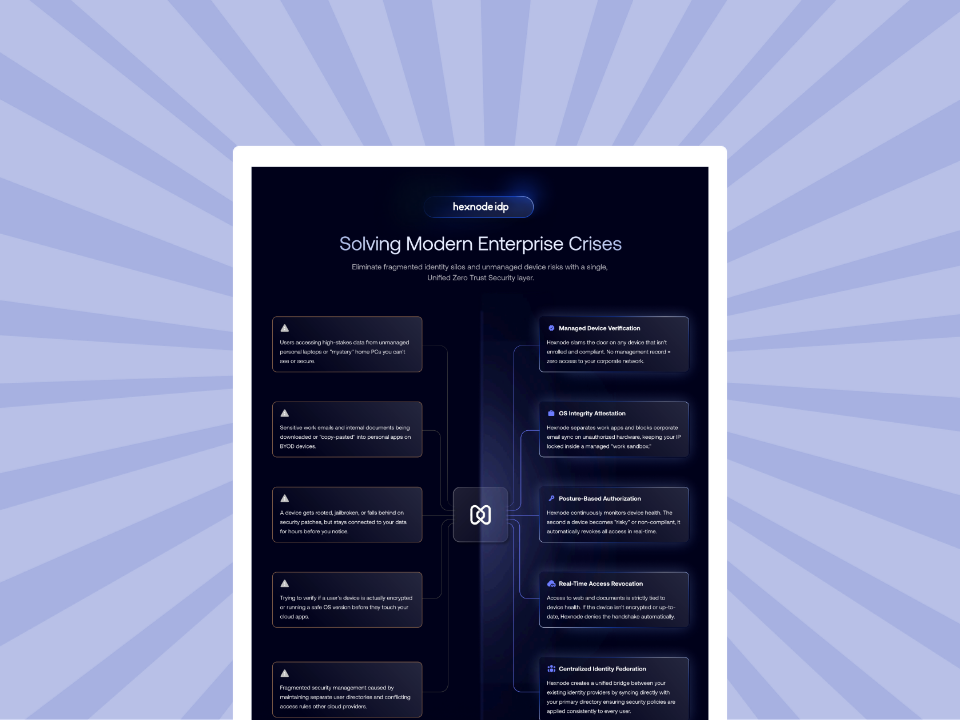
Hexnode IdP use cases
Check out this document for a quick glance into Hexnode IdP's capabilities.
Identity Providers (IdPs) and Service Providers (SPs) work together to enable Single Sign-On (SSO), allowing users to access multiple applications with a single set of credentials. Instead of logging in separately to every application, users authenticate once through an Identity Provider, which securely verifies their identity and grants access across connected services.
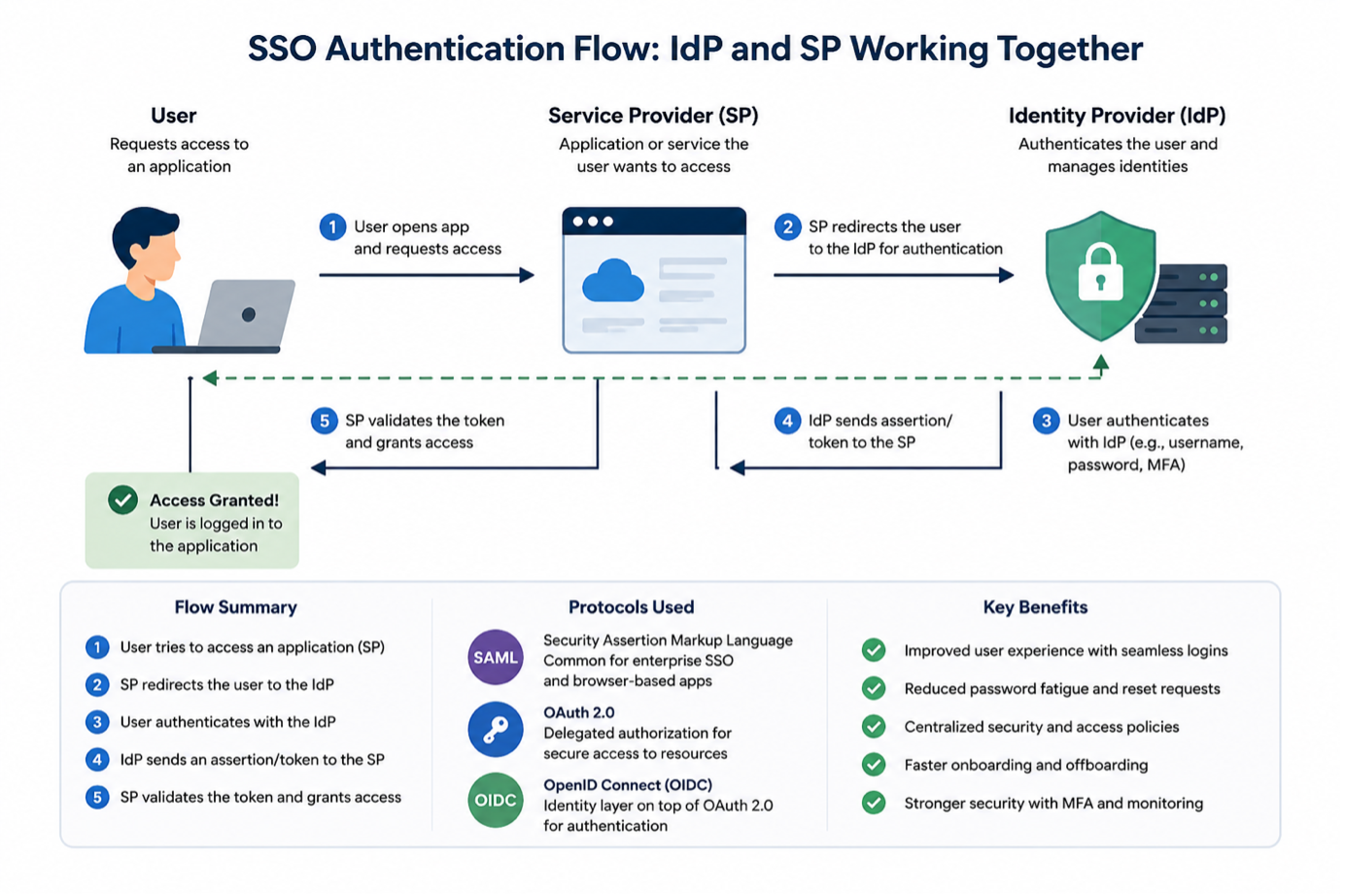
Step-by-Step SSO Authentication Flow
The SSO process begins when a user attempts to open an application such as Slack, Salesforce, or Zoom.
Since the application acts as the Service Provider, it first checks whether the user is already authenticated.
If the user is not authenticated, the SP redirects the user to the Identity Provider for login verification.
The user authenticates through the IdP using credentials, multi-factor authentication (MFA), or other verification methods.
Once authentication is successful, the Identity Provider generates a secure authentication assertion or token and sends it back to the Service Provider.
The SP validates the token to confirm the user’s identity and grants access to the requested application or resource without requiring another login.
Protocols That Enable Communication
Several authentication protocols enable secure communication between IdPs and SPs, including:
SAML (Security Assertion Markup Language): Commonly used for enterprise SSO and browser-based applications
OAuth 2.0: Focuses on delegated access and authorization
OpenID Connect (OIDC): An identity layer built on OAuth 2.0 for modern authentication
Benefits of This Integration
Integrating IdPs and SPs through SSO provides several advantages for organizations and users alike:
Improved user experience with seamless logins
Reduced password fatigue and fewer password reset requests
Centralized security and access control policies
Faster employee onboarding and offboarding processes
Enhanced security through MFA and centralized authentication monitoring
SSO Authentication Flow
Common Use Cases for IdPs and SPs
Identity Providers (IdPs) and Service Providers (SPs) are widely used across modern organizations to simplify authentication, improve security, and streamline access management. As businesses adopt more cloud applications and distributed work environments, these technologies play a central role in managing digital identities at scale.
Enterprise SSO
One of the most common use cases is Enterprise Single Sign-On (SSO). Employees can log in once through an Identity Provider and gain secure access to multiple SaaS applications such as Slack, Salesforce, Microsoft 365, and Zoom without needing separate passwords for each platform. This improves productivity while reducing password fatigue and IT support requests.
Workforce Identity Management
Organizations also use IdPs and SPs for workforce identity management and employee access provisioning. IT teams can centrally manage user accounts, assign permissions, and revoke access when employees leave the organization. This ensures consistent security policies across all connected applications and reduces the risk of unauthorized access.
Customer Identity and Access Management (CIAM)
In customer-facing applications, IdPs support Customer Identity and Access Management (CIAM) by enabling secure customer authentication and social logins through providers like Google or Facebook. This simplifies the login experience while helping businesses maintain secure user authentication.
Hybrid and Multi-Cloud Environments
In hybrid and multi-cloud environments, IdPs and SPs help organizations manage identities across on-premises systems, cloud platforms, and third-party services. This centralized approach improves scalability, strengthens security, and ensures seamless access across complex IT ecosystems.
Hexnode UEM MSP: All you need to know
Hexnode UEM MSP simplifies multi-client management with centralized control, licensing, and built-in security.
Challenges and Security Considerations
While Identity Providers (IdPs) and Service Providers (SPs) improve authentication and access management, improper implementation can introduce security risks. Common challenges include misconfigured SAML or OpenID Connect (OIDC) settings, token vulnerabilities, identity sprawl across multiple platforms, and difficulties integrating legacy applications into modern SSO environments.
To reduce these risks, organizations should follow strong security best practices. Enforcing multi-factor authentication (MFA), applying least privilege access controls, and regularly rotating certificates can significantly strengthen authentication security. Continuous monitoring of authentication logs also helps detect suspicious login attempts and unauthorized access activity. Additionally, adopting Zero Trust principles ensures that every access request is continuously verified, regardless of user location or device.
Choosing the Right Identity Provider
Selecting the right Identity Provider (IdP) is essential for building a secure and scalable Identity and Access Management (IAM) strategy. Organizations should evaluate factors such as scalability, support for authentication protocols like SAML and OpenID Connect (OIDC), integration capabilities with existing applications, user experience, compliance certifications, and deployment flexibility. A well-designed IdP solution not only strengthens security but also simplifies access management across growing cloud and hybrid environments.
Understanding the difference between Identity Providers (IdPs) and Service Providers (SPs) is equally important. While the IdP authenticates users and manages digital identities, the SP delivers the applications and resources users need to access. Together, they form the foundation of modern Single Sign-On (SSO) and federated authentication systems. As organizations continue adopting cloud-first and Zero Trust security models, implementing the right IdP-SP architecture will play a critical role in improving both cybersecurity and user experience.
Try Hexnode Free for 14 Days
Sign up for Hexnode to simplify secure access and enable seamless SSO across your organization.
What is the main difference between an Identity Provider (IdP) and a Service Provider (SP)?
An Identity Provider (IdP) verifies and authenticates a user’s identity, while a Service Provider (SP) delivers the application, platform, or resource the user wants to access.
How do IdPs and SPs work together in Single Sign-On (SSO)?
In an SSO setup, the Service Provider redirects the user to the Identity Provider for authentication. After the user is verified, the IdP sends a secure token or assertion back to the SP, which then grants access without requiring another login.
What authentication protocols are commonly used between IdPs and SPs?
The most common protocols are SAML, OAuth 2.0, and OpenID Connect (OIDC). These protocols allow secure communication and identity verification between systems.
Can a company use multiple Service Providers with one Identity Provider?
Yes. Organizations commonly use one Identity Provider to manage authentication for multiple Service Providers such as Slack, Salesforce, Zoom, and Microsoft 365.
Why are IdPs and SPs important for cybersecurity?
IdPs and SPs help centralize authentication, enforce security policies like multi-factor authentication (MFA), reduce password-related risks, and improve visibility into user access activity.
What are some common challenges when implementing IdPs and SPs?
Common challenges include misconfigured SAML or OIDC settings, token security vulnerabilities, identity sprawl, and integrating legacy applications into modern authentication systems.
I’m a technical content writer at Hexnode who loves simplifying tech. I break down complex ideas, remove the fluff, and help readers clearly understand our product for what it actually is: simple, reliable, and built to solve real problems.