The Hola Browser supply chain attack exposed how trusted software distribution channels can be abused to deliver unauthorized code. A compromise affecting the Windows version of Hola Browser resulted in some users receiving an undeclared executable that appeared to function as a Monero miner.
The malware established persistence, modified Microsoft Defender settings, and ran during idle periods. Although Hola reported that only about 0.1% of users were affected and found no evidence of data theft, the incident demonstrates why organizations should combine application governance, behavioral monitoring, and endpoint investigation capabilities to reduce software supply-chain risk.
Most users trust that software downloaded from an official source is safe to install. The Hola Browser supply chain attack, disclosed in June 2026, challenged that assumption after investigators discovered that some Windows installations of Hola Browser included an undeclared executable that appeared to be a cryptocurrency miner.
A compromise in Hola Browser’s Windows software delivery process caused the issue, rather than the browser’s intended functionality.
The incident highlights a broader concern: trusted software distribution channels can provide a pathway into otherwise well-protected environments.
One of the most concerning aspects of the Hola Browser supply chain attack is that software users expected to trust delivered the malicious activity. Rather than targeting individual users through phishing emails or exploiting vulnerabilities on specific devices, the compromise affected the software delivery process itself.
This approach can make malicious activity harder to identify because the software originates from a legitimate vendor and appears to be a normal installation.
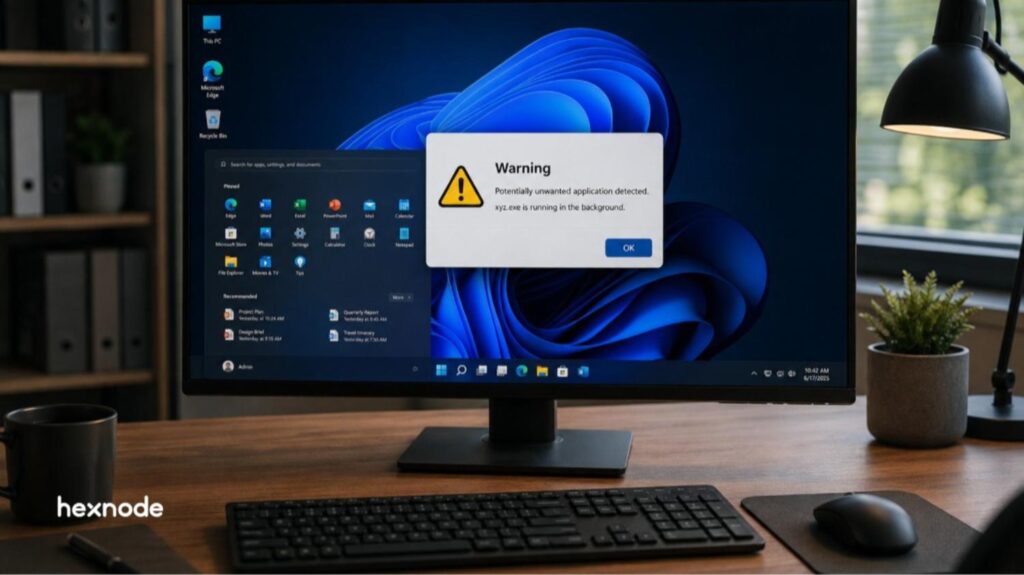
In this case, some Windows installations of Hola Browser reportedly included an undeclared executable that was not part of the expected software package. The file was later associated with cryptocurrency mining activity and persistence mechanisms on affected systems.
The incident serves as a reminder that software trust should not end at installation. Even when applications come from legitimate sources, organizations benefit from monitoring application behavior, validating software integrity, and investigating unexpected changes on endpoints. This layered approach can help security teams identify suspicious activity when trusted software behaves in unexpected ways.
How the Hola Browser supply chain attack works
Category
Details
Disclosure date
June 2026
Threat actor
Not publicly identified
Initial access method
Not publicly confirmed
Delivery mechanism
Undeclared executable delivered through affected Hola Browser for Windows installations
Social engineering
None reported
Target platforms
Windows
Infrastructure
Hola Browser Windows software delivery pipeline
User action required
Installation of an affected Hola Browser for Windows build
Data at risk
No evidence of user data access, theft, or compromise has been reported
Confirmed impact
Delivery of an undeclared executable identified as a cryptocurrency miner; creation of persistence mechanisms; Microsoft Defender exclusion modification
Unconfirmed impact
Credential theft, remote access, lateral movement, ransomware deployment, and data exfiltration have not been reported or confirmed
Key Findings from the Investigation
Investigators identified an undeclared executable named me.exe in the Hola installation directory on some Windows systems.
Analysis revealed several suspicious characteristics:
The file was not digitally signed.
It lacked a timestamp.
It contained obfuscated code.
It was not part of the browser’s declared software package.
The file could write to memory.
The binary also exhibited behavior commonly associated with cryptomining malware:
Creating a Defender exclusion.
Copying itself as HolaMonitorService.exe.
Registering an auto-starting service named hola_monitor_svc.
Running primarily when the device was idle.
Investigators observed indicators suggesting the executable was based on XMRig-related mining functionality and operated as a Monero miner.
What Remains Unclear in the Hola Browser supply chain attack
Several important details have not been publicly confirmed:
The identity of the attackers.
How access to the distribution pipeline was obtained.
The exact duration of the compromise.
Whether additional payloads were tested or distributed.
Whether specific geographic regions were disproportionately affected.
Hola reported that approximately 0.1% of users were impacted and stated that there was no evidence of user data access, theft, or compromise.
Featured resource
Hexnode Windows Management Solution
See how organizations can leverage Hexnode's Windows management capabilities to efficiently manage their corporate Windows devices.
This incident apparently resulted in unauthorized cryptocurrency mining. However, the larger concern is the attack path itself.
Organizations often place significant trust in software obtained directly from vendors. When attackers gain access to a trusted distribution mechanism, traditional allowlisting and reputation-based controls may be less effective because the software appears legitimate at the point of installation.
The incident also demonstrates why Windows endpoint security programs increasingly rely on behavioral monitoring rather than signatures alone. Activities such as unauthorized service creation, suspicious persistence mechanisms, unsigned executable deployment, and Defender exclusion changes can reveal malicious behavior even when it originates from trusted software.
As software ecosystems continue to grow more interconnected, maintaining visibility into application behavior becomes just as important as validating the source of the software itself.
Ensure Software Supply Chain Security with Hexnode UEM
Learn how organizations can use Hexnode UEM to ensure real-time software supply chain security.
How Hexnode Can Help Reduce Risk
Hexnode UEM: Improve Application Governance and Device Compliance
The Hola Browser supply chain attack demonstrates why organizations need visibility and control over the software running on managed endpoints.
Manage software deployment across Windows devices.
Control unauthorized applications through blocklisting/allowlisting and compliance enforcement.
Validate device compliance against organizational policies.
Remotely remove managed applications from Windows devices when required.
While no device management platform can guarantee prevention of a supply-chain compromise, strong application control and UEM compliance practices can help reduce exposure and simplify response efforts when trusted software contains unexpected components.
Supply-chain attacks often become visible through the behavior of the delivered payload rather than the initial installation process.
Hexnode XDR helps security teams investigate suspicious endpoint activity and support response actions, such as device isolation and process termination, when they identify malicious activity.
Closing the Gaps Exposed by This Attack
The Hola Browser supply chain attack is a reminder that trusted software distribution channels remain attractive targets for attackers.
Although the payload focused on cryptocurrency mining and users have not reported any data compromise, the incident illustrates how compromising software distribution infrastructure can turn a legitimate application into a delivery mechanism for unauthorized code.
Organizations should review software governance processes, validate application inventories, monitor for unexpected endpoint behavior, and ensure they can rapidly investigate suspicious activity across managed devices.
Combining application management, compliance enforcement, endpoint investigation, and supported response actions can help reduce exposure to software supply chain compromises.
As attackers continue to target trusted delivery mechanisms, organizations should focus not only on where software comes from but also on how that software behaves after installation.
Stay Ahead of Emerging Endpoint Threats
Get practical threat intelligence, endpoint security insights, and incident analysis delivered directly to your inbox.
I write at the intersection of technology, process, and people, focusing on explaining complex products with clarity. I break down tools, systems, and workflows without any noise, jargon, or the hype.