FERPA compliance in digital education requires schools to protect student data across devices, applications, remote environments, and third-party services.
Growing BYOD, cloud adoption, and endpoint diversity increase the risks of unauthorized access, data exposure, and inconsistent security controls.
UEM strengthens FERPA-aligned security through centralized policies, encryption, app controls, authentication, remote actions, monitoring, and reporting.
Hexnode helps schools centrally manage diverse endpoints, enforce security policies, control applications, and respond to device-related risks while supporting modern learning environments.
The digital transformation of education has accelerated rapidly in recent years. From online learning platforms and smart classrooms to Bring Your Own Device (BYOD) initiatives and 1:1 device programs, technology is now deeply embedded in the learning experience.
While these innovations have unlocked new opportunities for personalized and accessible education, they’ve also introduced significant challenges – chief among them, the protection of student data.
Educational institutions are now custodians of vast amounts of sensitive student information, including academic records, health data, and personally identifiable information (PII). This has placed immense pressure on IT administrators and decision-makers to ensure that every device and application used within their ecosystem complies with stringent privacy regulations.
One of the most critical regulations in this space is the Family Educational Rights and Privacy Act (FERPA). Enacted in 1974, FERPA governs access to student education records and mandates strict controls to safeguard student privacy in U.S. educational institutions.
With increasing scrutiny from regulators, parents, and advocacy groups, compliance with FERPA is no longer optional – it’s essential.
This is where Unified Endpoint Management (UEM) solutions come into play. Cross-platform UEM tools like Hexnode offer a centralized approach to managing and securing all endpoints – whether they’re school-owned or student-owned – across diverse operating systems.
By enabling granular control over device usage, application access, and data sharing, Hexnode UEM empowers educational institutions to meet FERPA requirements while supporting modern learning environments.
What is FERPA Compliance and Why It’s Crucial for Educational Institutions?
The Family Educational Rights and Privacy Act (FERPA) is a foundational U.S. federal law enacted in 1974 to protect the privacy of student education records.
Often referred to as the Buckley Amendment, FERPA grants parents and eligible students (those over 18 or attending post-secondary institutions) specific rights regarding access to and control over their educational data.
Key Components of FERPA
FERPA outlines several core rights and responsibilities:
Right to Access: Parents and eligible students can inspect, and review education records maintained by the school.
Right to Request Amendments: If records are believed to be inaccurate or misleading, they can request corrections.
Consent for Disclosure: Schools must obtain written permission before releasing personally identifiable information (PII) from education records, except under certain permitted conditions.
Right to File Complaints: Individuals can file complaints with the U.S. Department of Education if they believe their rights under FERPA have been violated.
Directory Information and FERPA Disclosure Exceptions
FERPA does not require written consent for every disclosure of information from education records. Certain exceptions allow schools to disclose protected information under defined circumstances, making it important for IT and compliance teams to understand where those boundaries lie.
One commonly misunderstood category is directory information. Schools may designate information such as a student’s name or enrollment status as directory information, but parents and eligible students must first be notified and given an opportunity to opt out of such disclosures.
FERPA also permits certain disclosures to school officials with legitimate educational interests and, under specific conditions, to external parties performing institutional services or functions.
These exceptions do not eliminate the need for access controls. Schools still need mechanisms that restrict access to the minimum information necessary for an individual’s role or educational purpose.
From an endpoint-management perspective, policies governing managed apps, authentication, device configurations, and data sharing can help reinforce these institutional controls by reducing unnecessary exposure of student information.
What Qualifies as “Student Education Records” under FERPA?
FERPA defines education records broadly to include any records that are:
– Directly related to a student, and
– Maintained by an educational agency or institution.
This includes not only traditional records like transcripts and report cards but also emails, cloud-stored documents, device usage logs, attendance data, disciplinary records, and even metadata from learning apps.
Relevance of FERPA in the Digital Learning Era
As education increasingly shifts to digital platforms, FERPA compliance has extended far beyond physical records and traditional classroom settings. Today’s learning environments rely heavily on cloud-based applications and virtual classrooms, both of which introduce new risks related to data exposure and privacy.
Tools like learning management systems (LMS), video conferencing platforms, and educational apps routinely collect and store personally identifiable information (PII) – ranging from student names and grades to behavioral data and login credentials. Without proper oversight, this information can be accessed, shared, or stored in ways that violate FERPA’s strict privacy standards.
This evolving landscape makes it essential for schools to implement robust data governance and access control mechanisms to ensure student data remains protected – regardless of where or how it is accessed.
Managing Third-Party EdTech Vendors Under FERPA
Modern schools rarely manage student data within a single system. Learning management platforms, assessment tools, cloud applications, communication services, and other EdTech vendors may all receive or process information from education records.
This makes third-party risk management an important part of FERPA compliance. Before granting a service provider access to protected student information, institutions should understand what data the vendor collects, why it needs that data, where the information is stored, and whether it can be redisclosed.
Schools should also document the vendor’s legitimate educational purpose and review contracts for appropriate privacy, security, data-retention, and deletion provisions.
UEM adds an important endpoint-level control to this process. IT teams can maintain tighter control over which applications are installed, restrict unapproved apps, configure managed accounts, and apply policies that reduce unauthorized movement of institutional data.
However, device management should complement—not replace—a broader vendor-vetting process. FERPA compliance ultimately depends on controlling both the endpoints accessing student records and the third-party services receiving them.
Who Must Comply?
FERPA applies to all educational institutions and agencies that receive funding from the U.S. Department of Education. This includes:
– Public and private K-12 schools
– Colleges and universities
– State and local education agencies
Consequences of Non-Compliance
Violating FERPA can have serious consequences:
Loss of federal funding: The Department of Education can withhold funds from non-compliant institutions.
Removal of Accreditation: In extreme cases, non-compliance could lead to the loss of accreditation.
Reputational damage: Breaches of student data can erode trust among parents, students, and the broader community.
Challenges Schools Face in Maintaining FERPA Compliance
As educational institutions embrace digital transformation, maintaining FERPA compliance has become increasingly complex. The modern learning environment is no longer confined to classrooms and computer labs – it now spans personal devices, cloud platforms, and remote networks.
This shift introduces a host of challenges that Unified Endpoint Management (UEM) solutions like Hexnode are uniquely positioned to address.
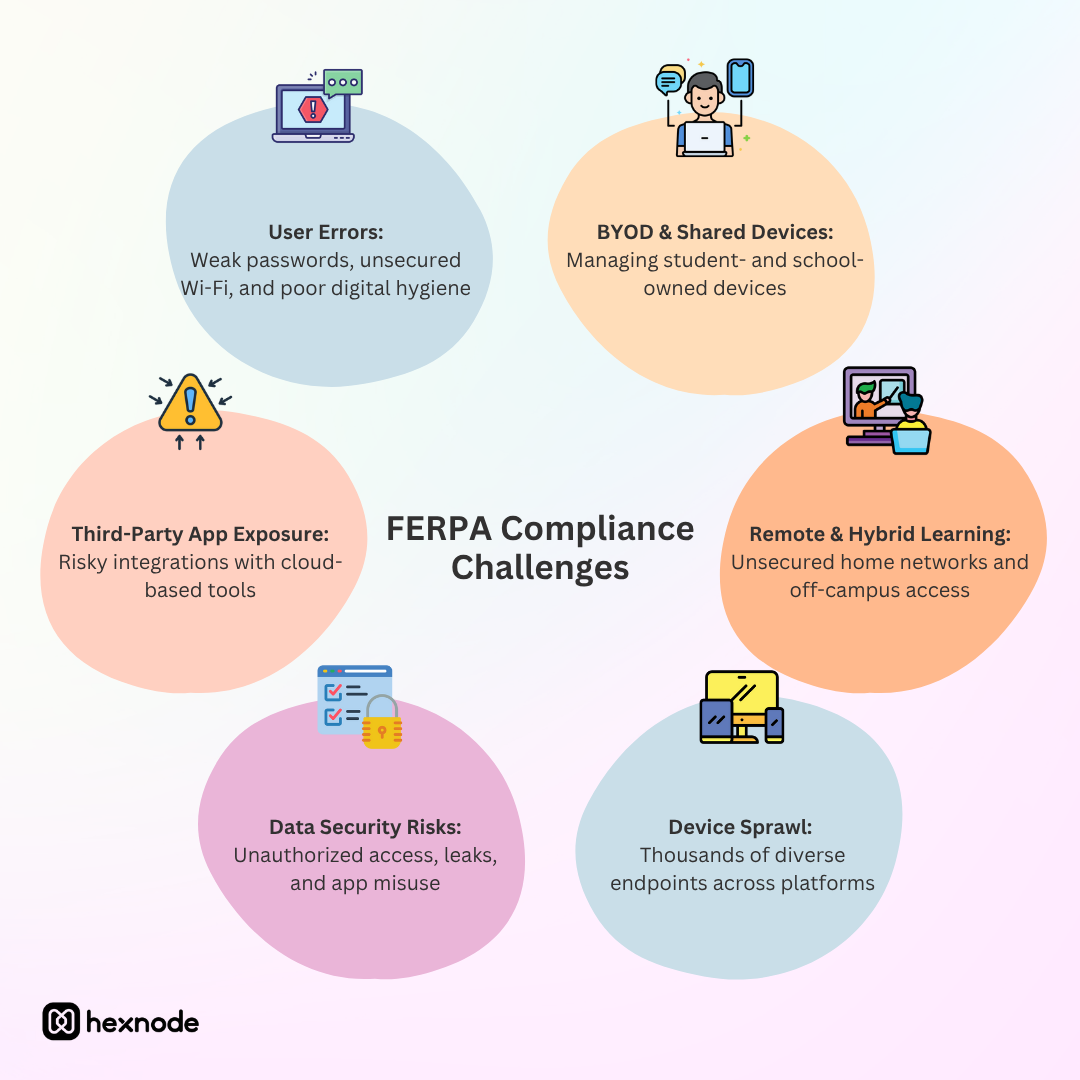
FERPA Compliance Challenges for Schools
1. Proliferation of Personal and Shared Devices
With the rise of BYOD (Bring Your Own Device) and 1:1 device program, schools must manage a mix of student-owned and institution-owned devices. These devices often operate outside the school’s secure network, increasing the risk of unauthorized access to student data.
2. Remote and Hybrid Learning Environments
The shift to remote and hybrid learning has extended the classroom into homes and public spaces, where devices connect to unmanaged and potentially insecure networks. This decentralization makes it harder for IT teams to enforce consistent security policies and monitor data access.
3. Device Sprawl and Endpoint Diversity
Educational institutions now manage thousands of endpoints across multiple platforms – Chromebooks, iPads, Windows laptops, Android tablets, and more. Without a centralized system, maintaining visibility and control over these devices becomes nearly impossible.
4. Data Security Risks
Unsecured devices and apps can lead to:
– Unauthorized access to sensitive student records
– Data leaks through unmonitored file sharing or cloud sync
– App misuse, including the use of non-compliant or unvetted third-party tools
– Lost or stolen devices that contain unencrypted student data
Each of these scenarios poses a direct threat to FERPA compliance.
5. Human Error and Poor Security Hygiene
Simple mistakes – like using weak passwords, connecting to unsecured Wi-Fi, or failing to log out of shared devices – can lead to data breaches. These user-level vulnerabilities are often overlooked but are among the most common causes of FERPA violations.
What is Unified Endpoint Management (UEM)?
Unified Endpoint Management (UEM) is a comprehensive solution that enables organizations to manage, secure, and monitor all endpoints – such as laptops, tablets, smartphones, and desktops – from a single platform.
In the context of education, UEM plays a critical role in ensuring that every device accessing student data is compliant with privacy regulations like FERPA.
Core Capabilities of UEM
A robust UEM solution like Hexnode offers:
Device Management: Enroll, configure, and monitor devices across platforms.
Data Protection: Enforce encryption, secure containers, and data loss prevention (DLP) policies.
Access Control: Integrate with identity providers like Microsoft Entra ID and Google Workspace for user enrollment and authentication, while using technician roles to enforce role-based access within the Hexnode portal.
Remote Actions: Lock, wipe, or locate lost/stolen devices instantly.
Content Filtering: Block inappropriate or non-educational content to ensure safe browsing.
Benefits for Educational Institutions
UEM brings significant advantages to schools and universities:
Multi-Platform Support: Seamlessly manage Windows, macOS, iOS, Android, and ChromeOS devices from a single dashboard.
Centralized Compliance Enforcement: Apply consistent security and privacy policies across all endpoints.
App and Identity Integration: Sync with learning management systems (LMS), cloud storage, and identity providers to streamline access and reduce risk.
Scalability: Easily scale to manage thousands of devices across campuses, classrooms, and remote learners.
How UEMs Help Schools Achieve FERPA Compliance
Unified Endpoint Management (UEM) platforms like Hexnode are instrumental in helping educational institutions meet the stringent requirements of FERPA.
By offering centralized control, real-time visibility, and robust security features, UEMs address many of the compliance challenges schools face in today’s digital learning environments.
1. Centralized Device Management
UEM enables IT teams to define and enforce consistent usage policies across all devices – whether they’re school-issued or part of a BYOD program.
Policy Enforcement: Push security and usage policies to thousands of devices from a single console.
2. Device Encryption and Data Security
FERPA requires institutions to protect student data from unauthorized access. UEMs help enforce encryption and secure data at rest and in transit.
Device Encryption: Enforce native encryption tools like BitLocker on Windows and FileVault on macOS, while using passcode policies on iOS/iPadOS, where device data is automatically encrypted when a passcode is set.
Lost Device Protection: Ensure that even if a device is lost or stolen, student data remains inaccessible.
Secure Connectivity: Configure VPNs and enforce secure browsing rules to protect data on public or home networks.
3. Remote Wipe and Lock Capabilities
In the event of a breach or device loss, UEMs provide immediate response tools to prevent data exposure.
Remote Lock: Instantly lock devices to prevent misuse.
Remote Wipe: Erase sensitive student data from lost, stolen, or decommissioned devices to maintain FERPA compliance.
Locate Devices: Location tracking feature allows us to pinpoint the real-time location of school-issued or student-enrolled devices using GPS, Wi-Fi, mobile networks, or device sensors. This is especially useful in scenarios where devices are lost, stolen, or misplaced.
4. App and Content Management
Unvetted apps can pose serious FERPA risks. UEMs help schools control what apps are installed and how data is shared.
App Whitelisting/Blacklisting: Allow only FERPA-compliant apps and block those that misuse or share data.
Data Isolation: Prevent data sharing between apps to avoid accidental leaks.
Secure Content Delivery: Push educational content directly to devices in a controlled and secure manner.
5. Identity and Access Management
Controlling who accesses student data is a core FERPA requirement. UEMs integrate with identity providers to enforce secure access.
User Authentication: Integrate with Google Workspace, Microsoft Entra ID, and other identity platforms.
Role-Based Access: Ensure only authorized IT technicians can access specific Hexnode portal functions and managed scopes based on their assigned roles.
6. Secure Remote Learning Setup
Even when students learn from home, UEMs ensure that devices remain compliant and secure.
Pre-Configured Devices: Ship devices with preloaded policies and apps for immediate use.
Remote Monitoring: Maintain visibility and control over devices without needing physical access.
Consistent Policy Enforcement: Apply the same security standards across on-campus and remote environments.
7. Audit Trails and Reporting
FERPA compliance requires documentation and accountability. UEMs provide detailed logs and reports to support audits.
Activity Logs: Automatically track and log activities within the Hexnode management console, including technician actions, policy associations, device synchronizations, and system events – ensuring a clear audit trail for administrative activity.
Compliance Reports: Generate detailed reports on device status, policy compliance, and user behavior. These reports are essential for internal reviews and external FERPA audits.
Anomaly Detection: Identify unusual patterns or unauthorized access attempts early through usage reports and security alerts, helping prevent potential data breaches before they escalate.
Featured resource
Hexnode UEM Kit for Schools
Get started with Hexnode’s UEM Kit for Schools to build a secure, efficient, and FERPA-compliant learning environment.
Building a FERPA-Aligned Data Breach Response Plan
Preventive security controls are essential, but schools also need a defined response process for situations where student information may have been exposed.
A FERPA-aligned incident response plan should establish clear procedures to contain the incident, identify affected records or personally identifiable information, determine who gained access, document corrective actions, and escalate the incident to the appropriate privacy or compliance personnel.
Technical response should begin as quickly as possible. If someone loses, steals, or compromises a managed endpoint, or accesses it without authorization, IT teams can use UEM controls to lock the device, remove managed data where supported, restrict applications, or revoke access while they investigate the incident.
Schools should preserve relevant administrative logs and device information to support the investigation and maintain a documented record of the actions taken.
Just as importantly, every incident should feed back into the institution’s security program. Reviewing what happened can reveal gaps in device policies, application controls, staff training, access permissions, or vendor governance—allowing the school to strengthen its FERPA safeguards before another incident occurs.
Hexnode UEM: Tailored for Education Environments
Hexnode UEM is designed with the unique needs of educational institutions in mind.
From managing diverse device ecosystems to enforcing strict privacy controls, Hexnode offers a suite of features that align perfectly with the demands of modern learning environments and FERPA compliance.
Education-Specific UEM Features
Hexnode provides tools that simplify device management while enhancing student safety and learning outcomes:
Zero-touch deployment: IT teams can pre-configure devices before they reach students, ensuring instant compliance and readiness.
Single Sign-On (SSO): Enable secure technician sign-in through identity providers like Google, Microsoft, or Okta, with assigned roles determining access within the Hexnode portal.
Content restrictions: Block inappropriate websites and apps to maintain a safe digital learning environment.
Multi-Platform Support
Hexnode supports all major operating systems used in education:
– iOS and macOS for Apple-centric schools
– Windows for traditional desktop environments
– Android for affordable mobile learning
– ChromeOS for Chromebook-heavy classrooms
This cross-platform flexibility allows schools to manage mixed-device environments from a single dashboard.
Seamless Integration with Educational Tools
Hexnode integrates seamlessly with Apple School Manager (ASM) to automate device enrollment, app distribution, and user management for Apple devices.
In addition, Hexnode supports Apple Classroom, a powerful teaching assistant tool that allows educators to manage student devices during class.
With Hexnode, IT admins can configure devices to be Classroom-ready, enabling teachers to view student screens, launch apps, lock devices into specific activities, and guide learning in real time – all while maintaining student privacy and FERPA compliance.
These integrations help schools deliver a secure, structured, and engaging learning experience, whether in physical classrooms or remote settings.
Specialized Modes for Learning and Assessment
Kiosk Mode: Lock devices into a single app or a set of apps – ideal for standardized testing or focused learning sessions.
Autonomous Single App Mode (ASAM): Allow an autonomous app to lock an iPhone or iPad into single-app mode when launched and automatically exit after serving its purpose, making it useful for assessments or digital exams.
Best Practices for FERPA Compliance with Hexnode UEM
While deploying a UEM solution like Hexnode is a powerful step toward FERPA compliance, maintaining compliance requires ongoing effort. Here are some best practices educational institutions should follow to ensure student data remains protected:
1. Regularly Audit and Update Device Configurations
Ensure that all devices – whether school-owned or BYOD – are regularly reviewed for compliance. Update configurations to reflect the latest security standards and educational needs.
2. Train Teachers and Students on Safe Device Usage
Awareness is key. Provide regular training sessions on secure device practices, such as recognizing phishing attempts, using strong passwords, and avoiding unapproved apps.
3. Maintain Regular Reporting and Backups
Use Hexnode’s reporting tools to generate compliance logs and monitor device activity. Schedule regular backups of critical data to prevent loss in case of device failure or breach.
4. Keep UEM Policies Aligned with FERPA Updates
FERPA guidelines may evolve. Stay informed and adjust your UEM policies accordingly to ensure continued compliance.
5. Limit App Access to Vetted Tools
Only allow apps that have been reviewed for FERPA compliance. Use Hexnode to allowlist approved apps and block those that pose privacy risks.
6. Encrypt All Devices and Monitor Usage
Enforce device encryption across supported platforms and monitor device usage for anomalies. This ensures that data remains protected even if a device is lost or stolen.
7. Segment Users by Role and Apply Group Policies
Use Hexnode’s user groups and policy targets to apply different policies for students, teachers, and administrators. This minimizes unnecessary access to sensitive data.
Frequently Asked Questions (FAQs)
Can schools use UEM to support FERPA compliance on BYOD devices?
Yes, UEM can help schools apply security and usage policies to enrolled BYOD devices that access student information. Controls such as managed apps, authentication, encryption, and restrictions can reduce the risk of unauthorized data access or sharing.
Does using a UEM solution automatically make a school FERPA compliant?
No, UEM supports FERPA compliance but does not replace an institution’s broader privacy and governance responsibilities. Schools still need appropriate access controls, vendor oversight, staff training, data-handling procedures, and incident response processes.
How should schools evaluate third-party EdTech apps for FERPA compliance?
Schools should determine what student information an EdTech provider collects, why it needs the data, where the information is stored, and whether it can be redisclosed. They should also review relevant privacy, security, retention, and deletion provisions before granting access to protected student information.
What should IT teams do if a device containing student data is lost or stolen?
IT teams should quickly contain the potential exposure and identify any affected student information. For managed endpoints, IT teams can use UEM controls to lock the device, remove managed data where supported, restrict applications, or revoke access while they investigate the incident.
How can schools maintain FERPA controls across remote and hybrid learning environments?
Schools can use UEM to enforce consistent device, application, authentication, and security policies without requiring physical access to endpoints. This helps maintain centralized visibility and control when students use devices outside the campus network.
Can Hexnode manage different policies for students, teachers, and administrators?
Yes, Hexnode can use user groups and policy targets to apply different device policies to groups such as students, teachers, and administrators. This allows IT teams to tailor endpoint configurations and restrictions to different user requirements.
Conclusion
In today’s digital-first education landscape, protecting student data is more than a legal obligation – it’s a shared responsibility. As schools adopt new technologies to enhance learning, they must also ensure that these tools do not compromise student privacy.
Unified Endpoint Management (UEM) is no longer just a technical convenience – it’s a strategic enabler of compliance. With the right UEM solution in place, educational institutions can confidently navigate the complexities of FERPA, even in remote and hybrid learning environments.
Hexnode UEM empowers schools to stay compliant without sacrificing the quality of education. Its cross-platform support, privacy-first features, and education-specific capabilities make it an ideal partner for institutions looking to modernize securely.
Now is the time for schools to rethink device management as a privacy-first strategy. By adopting proactive solutions like Hexnode, they can protect student data, streamline IT operations, and create a safer, more focused learning environment for all.
Protect Student Data with Confidence
Ready to simplify FERPA compliance? Explore how Hexnode can secure your educational devices.
I write about endpoint management. As a content writer at Hexnode, I translate complex IT concepts into clear, actionable insights. My goal is to help organizations navigate endpoint management with confidence and clarity.