DEX, ITIL, and ITSM are related but serve different purposes. DEX measures and improves digital employee experience, ITSM manages IT service delivery, and ITIL provides the best-practice framework that guides ITSM. Understanding these differences helps organizations choose the right tools and processes for their IT strategy.
Confusing DEX, ITIL, and ITSM can lead to mismatched tools, recurring user issues, and unnecessary compliance risks.
DEX provides proactive visibility into employee experience, while ITSM focuses on service delivery and ITIL establishes governance and best practices.
Hexnode UEM integrates with ITSM platforms and supports incident management workflows, helping IT teams streamline endpoint management and service operations.
DEX vs ITIL vs ITSM is a comparison that helps organizations understand how digital employee experience, IT service management, and ITIL work together. While these terms are closely related, they serve different purposes. Understanding this helps organizations choose the right tools, processes, and frameworks for their IT strategy.
DEX (Digital Employee Experience) focuses on device health, application performance, employee sentiment, and the overall digital workplace experience.
ITSM (IT Service Management) is the practice of planning, delivering, managing, and continually improving IT services.
ITIL (Information Technology Infrastructure Library) is a widely adopted best-practice framework that helps organizations standardize ITSM practices, including incident management, problem management, and change enablement.
Why Are DEX, ITIL, and ITSM Often Confused?
Although DEX, ITIL, and ITSM serve different purposes, IT teams, decision-makers, and technology vendors often use the terms interchangeably. Vendor messaging, RFPs, and even internal IT discussions frequently blur the distinctions between them.
As a result, organizations may invest in tools that solve the wrong problem or overlook critical gaps in their IT strategy.
The impact extends beyond tool selection. Confusing DEX vs ITIL vs ITSM can lead to recurring employee issues, inefficient IT operations, duplicated investments, and avoidable compliance risks.
Understanding how these concepts work together helps organizations choose the right technologies, improve IT service delivery, and create a better digital employee experience.
The comparison below summarizes the key differences between DEX vs ITIL vs ITSM at a glance.
Feature
DEX
ITSM
ITIL
Primary purpose
Improve digital employee experience
Deliver and manage IT services
Provide best-practice guidance for ITSM
Primary focus
Employee experience, endpoint health, and application performance
Service delivery and operational efficiency
IT service governance and process improvement
Approach
Primarily proactive
Primarily reactive (with proactive capabilities)
Governance and continual improvement
Category
Technology category and operational discipline
IT management practice
Best-practice framework
Typical outcomes
Higher productivity, reduced employee friction, improved digital experience
Faster incident resolution, improved service quality, and SLA compliance
Standardized processes, stronger governance, and continual service improvement
Why Mixing Up DEX, ITIL, and ITSM Costs IT Teams Time and Money
Misunderstanding the difference between DEX, ITIL, and ITSM creates more than semantic confusion. It leads to inefficient IT operations, recurring employee issues, and unnecessary compliance risks. Each addresses a different aspect of IT management, so using the wrong tool or process often results in problems that remain unresolved.
Operational Costs of Confusing DEX with ITSM
When IT teams route a device performance issue through a traditional ITSM ticketing process, they treat a DEX problem as a service desk issue. While the ticket may be resolved within its service-level agreement (SLA), the underlying employee experience problem often persists. As a result, the same issue can resurface days or weeks later.
This disconnect also affects employee productivity and satisfaction. A slow laptop, a crashing application, or an unreliable VPN creates daily friction, even if the ITSM team successfully closes the ticket. In other words, meeting an SLA does not always translate into a positive digital employee experience.
Governance Risks of Treating ITIL as Documentation
Confusing ITIL with documentation rather than an operational framework creates a different set of challenges. Organizations that fail to embed ITIL practices into day-to-day workflows may skip consistent change enablement, approval, and governance processes.
As a result, security reviews and compliance audits often reveal gaps between documented procedures and actual execution. These inconsistencies increase operational risk and make it more difficult to demonstrate compliance during internal or external audits.
The impact extends beyond operational efficiency. Gartner’s 2026 Magic Quadrant for Digital Employee Experience Management Tools highlights that poor digital employee experience can negatively affect workforce productivity, operational resilience, and the value organizations realize from their technology investments.
When DEX issues remain invisible because organizations rely solely on traditional ITSM workflows, these broader business outcomes, not just longer ticket resolution times, are ultimately affected.
DEX vs ITIL vs ITSM: Core Definitions and How They Relate
What Is ITIL?
ITIL (Information Technology Infrastructure Library) is a globally recognized framework of best practices for IT service management (ITSM). Currently in its ITIL 4 edition, it is not a tool or software platform. Instead, ITIL provides structured guidance that organizations can adapt to improve IT service delivery, governance, and continual improvement.
At the core of ITIL 4 is the Service Value System (SVS), which connects guiding principles, governance, continual improvement, and the Service Value Chain to help organizations create value through IT services.
The framework includes 34 management practices, covering areas such as incident management, change enablement, problem management, and service request management. Because these practices are modular, organizations can adopt the ones that best align with their business objectives and operational maturity.
What Is ITSM?
ITSM (IT Service Management) is the practice of designing, delivering, managing, and continually improving IT services to meet business and employee needs. While ITIL provides guidance on how to implement ITSM effectively, ITSM itself defines what an organization’s IT service delivery should achieve.
Although ITIL is the most widely adopted ITSM framework, organizations can also align their service management practices with approaches such as COBIT, DevOps, or Lean IT, depending on their operational and governance requirements.
In practice, ITSM is implemented through technologies such as service desks, Configuration Management Databases (CMDBs), ticketing systems, knowledge bases, and IT asset management tools. As a result, two organizations can both practice ITSM while following different frameworks and operational processes.
What Is DEX (Digital Employee Experience)?
DEX (Digital Employee Experience) measures and improves how employees interact with technology. It focuses on the devices, applications, and digital services used every day. Traditional ITSM typically responds only after users report an issue.
In contrast, DEX continuously monitors endpoint performance, application health, and employee sentiment. This identifies problems before they disrupt daily productivity.
This proactive approach gives IT teams greater visibility into the employee experience. Rather than relying solely on service tickets, DEX helps identify recurring performance issues, application instability, or declining user satisfaction before they affect larger groups of employees.
How Do ITIL, ITSM, and DEX Work Together?
Understanding the relationship between ITIL, ITSM, and DEX is easier when you think of them as complementary layers rather than competing approaches.
ITIL provides the best-practice framework for managing IT services.
ITSM applies those practices through service delivery, support, and operational processes.
DEX adds continuous visibility into employees’ digital experiences, helping IT teams identify and address issues proactively.
For example, a DEX platform can detect a degrading application experience and automatically trigger an incident within an ITSM platform before users submit support tickets. This integration helps organizations resolve issues faster while improving employee productivity and service quality.
This layered approach also reflects broader industry trends. Gartner identifies ITSM integration as a core capability of Digital Employee Experience Management (DEXM) tools, highlighting the growing convergence of endpoint experience monitoring, IT service management, and endpoint management platforms.
MDM Integrations: Unify Your IT Tech Stack with Hexnode
Learn how Hexnode integrates with ITSM, identity providers, and enterprise tools to simplify endpoint management.
How to Decide Which Framework Applies to Your Problem
Choosing between DEX vs ITIL vs ITSM starts with identifying the problem you’re trying to solve. Understanding the differences helps you match the right framework or discipline to your organization’s needs. The following framework can help you identify the right starting point.
Audit Your Current IT Challenges
Review your IT issues from the past 30 to 60 days and group them into three categories.
Process and governance gaps, such as inconsistent change approvals, incomplete documentation, or audit findings, typically point to an ITIL challenge.
Service delivery issues, including rising ticket volumes, missed SLAs, or slow response and resolution times, generally indicate an ITSM gap.
Recurring device, application, or network performance issues that don’t fit neatly into a ticket category often signal a DEX gap rather than a service management problem.
Classifying issues this way helps prevent organizations from investing in tools that solve the wrong problem.
Evaluate Your Existing Tools and Processes
Next, assess what your current technology stack actually supports.
If your service desk only logs, prioritizes, and routes tickets, it likely provides ITSM capabilities without proactive DEX insights such as endpoint telemetry, application performance monitoring, or employee sentiment. As a result, many experience-related issues remain invisible until users report them.
It’s equally important to evaluate how ITIL is implemented. If governance practices exist only in documentation or internal wikis instead of being embedded within approval workflows, change enablement processes, and operational procedures, they are unlikely to be applied consistently. This often creates gaps between documented policies and day-to-day execution, increasing compliance and audit risk.
Prioritize Based on Business Goals
Once you’ve identified the gaps, prioritize improvements based on the outcomes that matter most to your organization.
If compliance, governance, or audit readiness is your primary concern, strengthen ITIL practices by embedding them into operational workflows.
If your biggest challenge is ticket backlogs, missed SLAs, or inefficient service delivery, focus on improving your ITSM processes and tooling.
If employee productivity, recurring endpoint issues, or poor digital experiences are driving support requests, prioritize DEX capabilities to gain proactive visibility into user experience.
Matching your investment to your most pressing business objective helps improve operational efficiency, reduce unnecessary spending, and deliver measurable improvements across IT services and the digital workplace.
Featured resource
Mastering Endpoint Management with Hexnode
Discover how centralized endpoint management supports efficient IT operations and service delivery.
Where Hexnode Fits into Your DEX, ITIL, and ITSM Strategy
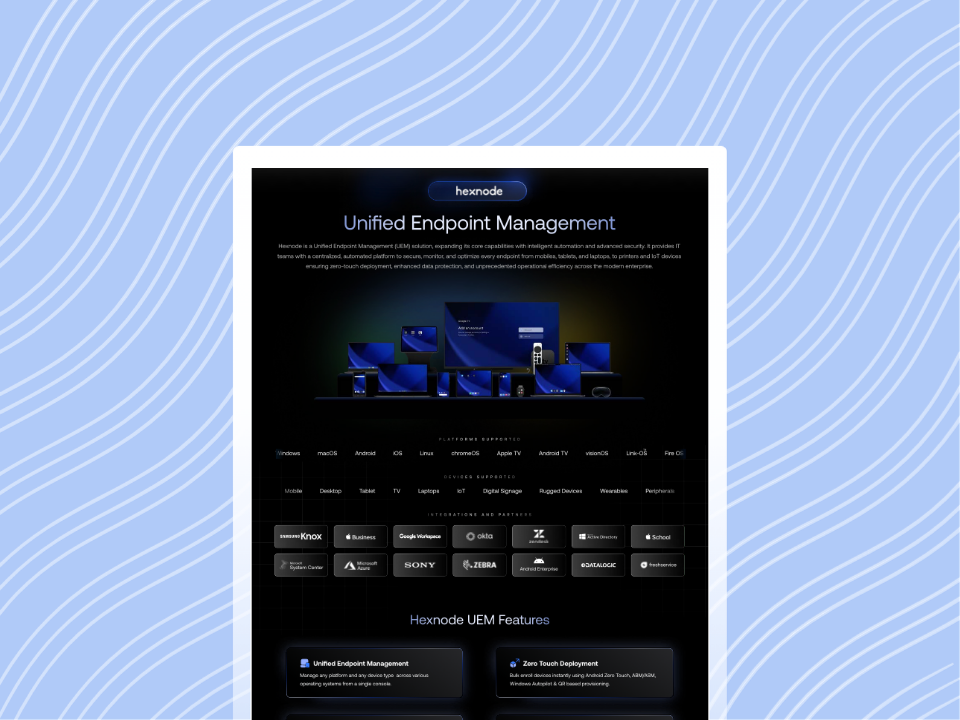
Hexnode UEM helps organizations strengthen IT operations through centralized endpoint management, automation, and integrations with enterprise ITSM platforms such as ServiceNow.
Through its ServiceNow integration and Incidents module, IT teams can view synchronized incident information, access device context, and perform supported remote actions to streamline incident management.
While ITIL defines best practices for IT service management, Hexnode UEM helps organizations put many of those practices into action through policy enforcement, endpoint compliance, automation, and operational visibility.
By integrating endpoint data with existing ITSM workflows, IT teams can improve service delivery without introducing disconnected management processes.
As organizations continue to prioritize digital employee experience (DEX), endpoint management platforms and ITSM tools increasingly work together to provide a more complete view of IT operations.
Combining endpoint visibility with structured service management enables IT teams to reduce recurring issues, improve employee productivity, and make more informed operational decisions.
FAQs
Can DEX, ITIL, and ITSM be implemented at the same time, or should they be rolled out in stages?
Organizations can implement DEX, ITIL, and ITSM together, but many adopt them in stages based on IT maturity, business priorities, and operational needs. A phased approach often makes implementation easier and reduces disruption.
Does adopting DEX mean an organization can retire its existing ITSM tools?
No. DEX complements ITSM rather than replacing it. ITSM manages service delivery and support workflows, while DEX provides proactive visibility into endpoint performance and employee experience.
How do you measure whether a DEX initiative is working?
Many DEX platforms provide a DEX score based on metrics such as endpoint performance, application experience, and employee sentiment. Organizations should also track trends like improved endpoint health, fewer recurring incidents, and higher employee satisfaction.
Who typically owns DEX and ITSM within an organization?
ITSM is usually managed by the IT service desk or service management team. DEX is commonly owned by endpoint management or IT operations teams responsible for device performance and digital employee experience.
Is ITIL required to practice ITSM?
No. Organizations can implement ITSM without ITIL by using other frameworks or methodologies such as COBIT, DevOps, or Lean IT.
What is the first sign that an organization needs a dedicated DEX solution?
Recurring device, application, or network issues despite consistently meeting ITSM SLAs often indicate a DEX gap. This suggests underlying employee experience problems that traditional ITSM processes may not detect proactively.
Bring DEX, ITIL, and ITSM Together for Better IT Outcomes
DEX, ITIL, and ITSM are complementary, not competing, approaches to modern IT management. ITIL provides the best-practice framework, ITSM delivers and supports IT services, and DEX adds the real-time visibility needed to improve digital employee experience. Together, they help organizations strengthen governance, improve service delivery, and resolve issues before they affect productivity.
Understanding the difference between DEX, ITIL, and ITSM enables IT teams to choose the right tools. It helps close operational gaps and drives maximum business impact. Your goal may be improving compliance, reducing support tickets, or enhancing the digital workplace. Aligning these three disciplines creates a more efficient and resilient IT strategy.
Modernize Your IT Operations with Hexnode
See how Hexnode helps IT teams automate endpoint management, simplify operations, and integrate with existing ITSM workflows from a single platform.
I write at the intersection of technology, process, and people, focusing on explaining complex products with clarity. I break down tools, systems, and workflows without any noise, jargon, or the hype.