A strong business case for Hexnode XDR must translate security gaps into measurable costs, risks, and improvements that stakeholders can evaluate.
Establish a baseline using MTTR, analyst effort, tool costs, alert volume, investigation complexity, and existing security exposure.
Map each operational problem to specific Hexnode XDR capabilities, then validate expected improvements through a controlled proof of concept.
Audit trails, MITRE ATT&CK insights, threat hunting, one-click remediation, and agent management strengthen the case around compliance, investigation costs, response, and administration.
Why Getting Budget Approval for a New XDR Platform Is So Difficult
Getting approval for a new XDR platform requires more than proving that the current security stack has technical limitations. Leadership needs a clear explanation of what those limitations cost the business, which risks they create, and whether replacing the platform is financially justified.
Security teams often see the problems first. Analysts may be dealing with excessive alerts, fragmented telemetry, repetitive investigations, or slow response workflows. Separate endpoint and security tools can also force teams to move between consoles before they can understand the scope of an incident.
However, these operational problems do not automatically translate into an approved budget.
Arguments such as “our tools are outdated” or “the SOC is overwhelmed” describe legitimate concerns, but they rarely give finance or executive stakeholders enough information to make an investment decision. Decision-makers need to understand how those problems affect measurable outcomes such as analyst capacity, mean time to respond (MTTR), security-tool spending, operational disruption, and breach exposure.
That changes the conversation from a technical preference to a business decision.
A strong business case for Hexnode XDR, or any proposed XDR investment, therefore needs to establish several things clearly:
What is inadequate about the current security environment?
What operational and financial costs result from those gaps?
Which risks remain difficult to detect or contain?
How would the proposed platform improve measurable security outcomes?
What will the organization spend to deploy and operate it?
How does that investment compare with maintaining the existing approach?
The core challenge is not simply proving that a better platform exists. Security and IT leaders must show why changing platforms makes financial and risk-management sense now.
What It Costs to Delay Replacing Inadequate Tooling
Maintaining inadequate security tooling carries its own cost. When organizations continue relying on fragmented systems and high-volume alert queues, the operational burden compounds across every investigation.
Analysts spend more time correlating information between tools, validating alerts, and performing repetitive response tasks. Persistent alert fatigue can reduce analyst capacity and contribute to burnout. Complex investigation workflows can also extend MTTR, increasing the period during which malicious activity may remain active inside the environment.
The larger concern is accumulated risk.
Every quarter spent operating with known visibility or response gaps means accepting additional exposure while continuing to pay for the existing tooling and the human effort required to compensate for its limitations. A serious security incident can then introduce costs far beyond the proposed platform investment, including business interruption, recovery work, incident-response expenses, and potential data exposure.
Yet organizations frequently remain with the existing stack even when security teams recognize these weaknesses.
That does not necessarily mean leadership believes the current tools are sufficient. Often, the status quo continues because nobody has translated the technical problem into an explicit cost-versus-risk decision.
Without that comparison, delaying investment appears financially neutral. A credible business case must demonstrate that maintaining the current environment is itself an investment decision, with measurable operational costs and security consequences.
What a Strong XDR Business Case Needs to Include
A strong XDR business case should connect current operational costs, security risk, and measurable improvement. Stakeholders need to see what the existing environment costs today, what risk remains unresolved, and what changes after adopting the proposed platform.
Start by establishing the current-state cost. Include overlapping security-tool licenses, analyst hours spent investigating alerts, average MTTR, and the number of systems analysts must use during an investigation. These figures establish a financial baseline rather than treating the existing stack as a zero-cost option.
Next, quantify risk exposure. Document detection blind spots, containment delays, limited endpoint context, and gaps that make investigation or audit preparation more difficult. The goal is not to assign an arbitrary monetary value to every threat. It is to show where the existing environment increases the likelihood or potential impact of an incident.
Finally, define the expected outcome. Relevant measures can include reduced dwell time, faster containment, fewer consoles, lower tool-management overhead, and greater analyst efficiency.
This is where the business case for Hexnode XDR can make a specific consolidation argument. Hexnode positions UEM and XDR within an integrated environment where teams can combine threat visibility and response with endpoint-management workflows. Hexnode UEM also supports automated remediation workflows and patch deployment on supported endpoints, reducing the operational separation between security response and device management.
That integration can also form part of the licensing discussion. Organizations should compare the cost and administrative effort of separate detection, response, endpoint-management, and patching tools against the functions they can consolidate through Hexnode.
MTTR provides an especially useful benchmark. Record the current time from detection to containment, then compare it with response workflows using Hexnode XDR’s One-Click Threat Remediation actions: Isolate Device, Kill Process, and Quarantine File. These administrator-initiated actions provide a concrete before-and-after metric instead of relying on assumptions about faster response.
XDR Use Cases: Real-World Applications in Threat Detection
Explore real-world XDR use cases for faster threat detection, investigation, and incident response.
How to Structure and Present the Business Case
The strongest proposal follows a simple progression: prove the current problem, map it to specific capabilities, validate the improvement, and present the financial tradeoff.
Step 1: Document current-state pain points
Avoid broad statements about SOC workload. Capture measurable operational data instead.
Useful baselines include:
Average alerts handled per analyst
Current MTTR for common incident types
Number of consoles or tools used during a typical investigation
Analyst hours spent correlating endpoint information
Previous incidents where delayed detection or containment caused measurable downtime, recovery work, or business disruption
These figures create the baseline against which Hexnode XDR can be evaluated.
Step 2: Map each problem to a specific Hexnode XDR capability
Do not present a generic feature list. Connect each capability directly to an identified operational weakness.
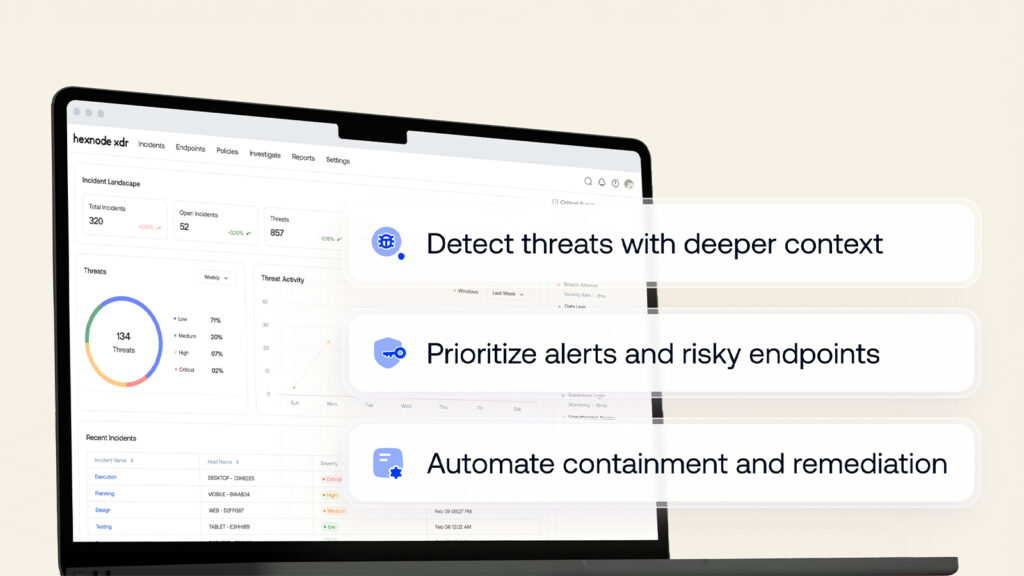
For example, Custom Alert Profiles can address excessive alert noise, while Contextualized Alerts add endpoint context to security signals. For fragmented visibility, Hexnode XDR provides Cross-Platform Visibility for Windows and macOS environments alongside a Unified Dashboard covering threats, incidents, and endpoint health. Slow containment can be mapped directly to One-Click Threat Remediation through device isolation, process termination, and file quarantine.
The mapping should make the proposed investment easy to evaluate: pain point → capability → expected measurable outcome.
Step 3: Validate the assumptions with a proof of concept
Use Hexnode XDR’s 14-day free trial to test the platform against a controlled subset of representative endpoints.
Capture the same metrics established during the baseline assessment. Compare alert volume, investigation effort, containment time, and the number of tools required to complete common workflows. This converts projected benefits into environment-specific evidence.
A proof of concept is particularly valuable when discussing MTTR. Leadership can evaluate observed response times rather than relying solely on vendor positioning or theoretical efficiency gains.
Step 4: Present a risk-adjusted cost comparison
Finish with two comparable operating models.
For the current environment, include existing licensing, administration effort, analyst overhead, and documented exposure created by slow or fragmented response. For the proposed environment, include Hexnode XDR licensing together with any efficiencies gained by integrating XDR, UEM, endpoint remediation, and patch-management workflows. Hexnode documents centralized patch-management capabilities alongside broader endpoint-management operations, including automated patch deployment for supported Windows and macOS environments.
The objective is not to claim that a new platform eliminates breach risk. It is to show leadership the risk-adjusted cost of both choices. Once the existing stack carries an explicit operational and risk cost, Hexnode XDR is no longer presented as another security expense. It becomes an investment that can be evaluated against the measurable cost of maintaining the status quo.
Featured Resource
Introduction to Hexnode XDR
Explore Hexnode XDR and learn how it strengthens threat detection, investigation, and response.
Hexnode XDR strengthens the business case by addressing costs that extend beyond detection and containment. Auditability, investigation effort, and ongoing agent maintenance all affect the total cost of operating an endpoint security platform.
Start with compliance. Hexnode XDR’s Complete Audit Trail immutably logs technician actions and system events, providing traceability across administrative and security activity. Hexnode XDR’s Complete Audit Trail immutably logs technician actions and system events, while Hexnode UEM’s Audit History and Action Reports provide records of portal events and remote commands. This gives security leaders stronger evidence when positioning the platform against requirements for audit readiness, accountability, and regulatory reporting.
Investigation efficiency provides another measurable argument. MITRE ATT&CK® Insights maps detected threats to established adversary techniques, helping analysts understand attacker behavior without reconstructing every stage manually. Precision Threat Hunting extends that visibility through investigation queries and endpoint telemetry. Hexnode’s Advanced Investigation Query can search seven days of stored raw process and endpoint-event data, giving analysts historical context for tracing suspicious activity.
For the business case, this can support a reduced investigation cost line item. Teams can compare analyst hours currently spent collecting telemetry, correlating events, and rebuilding attack timelines against the effort required during a Hexnode XDR proof of concept.
Ongoing administration should also factor into the calculation. Hexnode XDR’s Seamless Agent Management keeps agents updated and automatically enables tamper protection. Reducing routine agent-maintenance work can lower the operational overhead that is often missed when organizations calculate the true cost of their current security stack.
FAQs
What metrics should organizations use to build a business case for XDR?
Organizations should establish baselines for MTTR, analyst hours, alert volume, investigation complexity, security-tool costs and administrative effort. These metrics provide measurable points for comparing the existing security stack with a proposed XDR platform.
How can an organization measure the ROI of switching to an XDR platform?
Organizations can compare current licensing, analyst workload, administration costs and response performance against the proposed operating model. A controlled proof of concept can then measure changes in containment time, investigation effort, alert volume and the number of tools required for common workflows.
How can XDR help reduce security investigation costs?
XDR can reduce investigation effort by giving analysts consolidated telemetry and contextual information for tracing suspicious activity. Hexnode XDR provides MITRE ATT&CK Insights and threat-hunting capabilities that can reduce time spent manually correlating events and reconstructing attack activity.
Take the Next Step Toward Approval
A persuasive business case for Hexnode XDR should combine current-state cost and risk data with a direct capability-to-outcome comparison. Instead of arguing that the SOC simply needs better tooling, show stakeholders how specific problems map to measurable improvements in investigation, containment, visibility, compliance, and administration.
Use your existing alert volume, MTTR, analyst effort, licensing costs, and incident history as the baseline. Then evaluate those same metrics against Hexnode XDR’s threat hunting, MITRE ATT&CK insights, one-click remediation, audit trail, and integrated endpoint-security workflows.
A controlled proof of concept makes that comparison considerably stronger. Start Hexnode XDR’s 14-day free trial with no credit card required and capture evidence from representative endpoints. Alternatively, request a demo to evaluate the relevant capabilities and gather supporting information for your internal business case.
Give decision-makers evidence they can evaluate, not another security-tool pitch.
Build Your XDR Business Case
Reduce security complexity, accelerate threat response, and strengthen endpoint protection with Hexnode XDR.
Content writer at Hexnode. Fueled by good coffee and the occasional cat cuddle, I enjoy crafting content that informs, connects, and resonates. Nothing excites me more than knowing my words have been read, appreciated, and maybe even bookmarked.