The hidden costs of separate client portals come from fragmented tools, repeated administration, and operational overhead that increase an MSP’s cost-to-serve.
Portal sprawl consumes technician capacity through repeated logins, context switching, training, reporting, and overlapping tools.
MSPs can quantify this overhead, establish a cost baseline, and evaluate where consolidation can simplify administration.
Hexnode UEM MSP supports consolidation through Multi-Tenant Management, Universal Login, Role-Based Access Control, and Secure Centralized Billing.
What Does It Really Cost to Manage Client Portals Separately?
The hidden costs of separate client portals start when technicians need different logins, licenses, and dashboards for each client. Some MSPs add another layer of fragmentation by using separate management tools for different operating systems.
Portal sprawl occurs when an MSP manages client environments through multiple disconnected portals, accounts, or tools. Tool fragmentation creates the same problem across platforms. Technicians must repeatedly switch systems, rebuild workflows, and learn different interfaces to complete similar tasks.
Consider a routine policy change across several customer environments. A technician may need to authenticate separately, locate each client’s devices, configure the change, verify deployment, and document the result. Then, they repeat that workflow for the next client.
Consequently, fragmented administration consumes technician capacity without increasing the value delivered to customers. Separate tools can also introduce overlapping licensing costs and additional operational overhead.
The cost extends beyond time spent switching browser tabs. MSPs must account for several sources of operational expense:
Tool licensing: Multiple management platforms can create overlapping software expenses.
Training: Technicians must learn and maintain proficiency across different consoles and workflows.
Process overhead: Teams must maintain separate procedures, documentation, and operational practices across tools.
As a result, portal sprawl becomes a cost-to-serve problem. At scale, this administrative overhead consumes technician hours that MSPs could allocate to higher-value work. Those hours and overlapping expenses directly affect service delivery economics.
What Do Fragmented Client Portals Actually Cost an MSP?
Fragmented client portals create a “swivel-chair tax” every time technicians move between dashboards, logins, and disconnected systems.
For MSPs, those lost minutes become a direct service-delivery cost. Moreover, the expense grows as the technology stack expands across more clients and services.
MSPs commonly operate across numerous vendor tools, and fragmented stacks can increase licensing, integration, training, and context-switching overhead. Those costs accumulate through several forms of tool-stack friction:
License stacking from overlapping capabilities
Integration overhead between disconnected platforms
Training time across different interfaces and workflows
Context switching during routine technician tasks
Reporting complexity when teams must reconcile data manually
Because MSP margins depend on pricing, service mix, labor efficiency, and tooling costs, unnecessary operational overhead can directly weaken profitability.
The same fragmentation pattern appears in enterprise security operations. The Splunk State of Security 2025 report surveyed 2,058 security leaders across nine countries and 16 industries. It found that 59% said tool maintenance was their main source of inefficiency, while 78% said their security tools were dispersed and disconnected.
For MSPs, fragmented tools can similarly add operational friction through portal switching, manual reconciliation, and disconnected workflows.
MSP Tech Stack Sprawl: The Profit Killer Behind Shrinking Margins
Explore how fragmented MSP tool stacks increase licensing costs, operational complexity, and management overhead.
What Does a Consolidated MSP Management Model Look Like?
A consolidated MSP management model brings multi-client administration and cross-platform device management into a unified operational layer. Instead of rebuilding workflows across disconnected tools, technicians can manage client environments through a consistent administrative model.
The Single-Console Model
Hexnode UEM MSP provides Multi-Tenant Management for managing multiple Hexnode UEM instances across clients from a single console.
It’s Polycentric Dashboard provides administrators with a consolidated view of client UEM portals in a single interface. Technicians can use Universal Login to access client UEM portals with one login.
Multi-Tenant, Cross-Platform Management
Hexnode UEM MSP supports multiple endpoint platforms, including iOS, Android, Windows, macOS, Linux, ChromeOS, visionOS, tvOS, Android TV, and Fire OS.
It also supports cross-platform management, while available Hexnode UEM capabilities depend on the supported platform and applicable feature requirements.
This model combines single-console management of multiple Hexnode UEM portals with cross-platform endpoint management. MSPs should compare Hexnode’s platform-specific capabilities with their existing tools before consolidating their management stack.
Featured resource
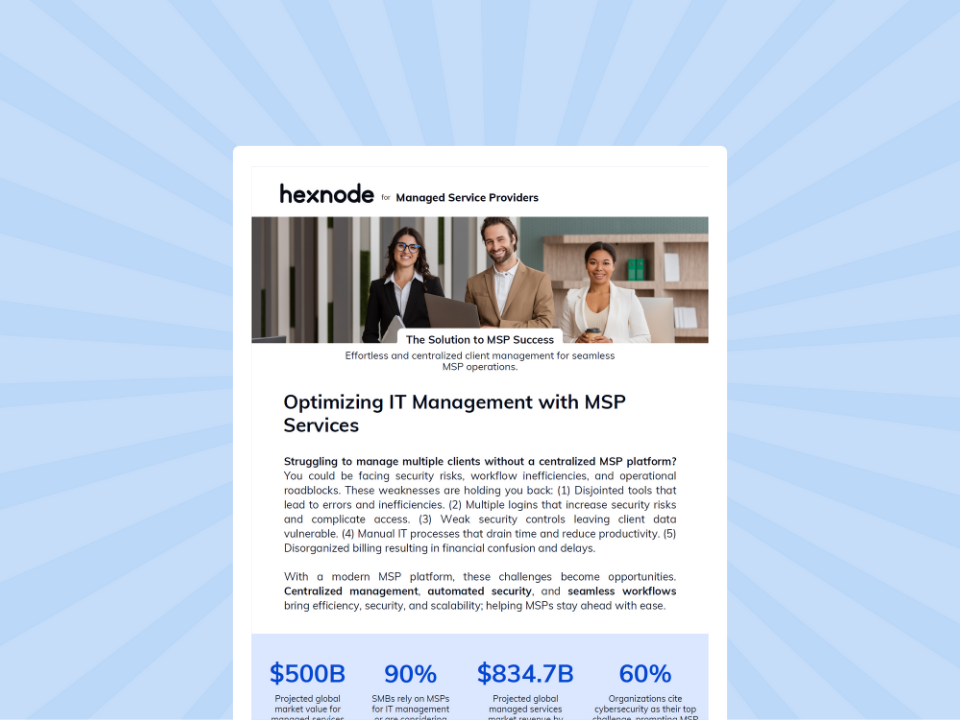
Hexnode UEM for MSPs
See how Hexnode UEM MSP brings multi-client endpoint management into a centralized platform for MSPs.
How Can MSPs Migrate from Separate Portals to a Consolidated Model?
MSPs evaluating consolidation can audit existing costs, then use Hexnode UEM MSP capabilities for centralized multi-client management, technician access, and billing. This phased approach establishes a measurable baseline before changing established client-management workflows.
The goal should not simply involve replacing portals. Instead, MSPs should identify where consolidation can reduce duplicated administration and the hidden costs of separate client portals.
Step
Action
Hexnode capability
1. Audit current tooling costs
Establish the current cost baseline
Current tooling inventory
2. Consolidate technician access
Standardize access by technician role
Role-Based Access Control
3. Centralize billing
Bring billing into the MSP management model
Secure Centralized Billing
Step 1 – Audit Current Per-Client Tooling Costs
Start with a complete cost inventory. For each customer, document management platforms, license quantities, renewal costs, integrations, and technician access requirements.
Next, include operational costs that invoices cannot show directly. Technician hours spent navigating portals, maintaining credentials, and assembling reports all contribute to cost-to-serve.
Portal-sprawl cost = software licensing + technician administration + training + integration maintenance + reporting and billing overhead.
This baseline gives MSPs a consistent reference point for evaluating consolidation.
Step 2 – Consolidate Technician Access with Role-Based Access Control
After establishing the baseline, standardize technician access around job responsibilities. Hexnode UEM MSP provides Role-Based Access Control for assigning specific roles to technicians.
Step 3 – Centralize Billing Administration
Finally, centralize billing administration across client environments.
Together, these steps give MSPs a baseline for comparing fragmented administration with a consolidated management model.
How Does Hexnode UEM MSP Eliminate These Hidden Costs?
Hexnode UEM MSP addresses portal sprawl across three administrative areas: multi-client management, billing, and technician access.
1. Replace Portal Hopping with Multi-Client Management
Hexnode UEM MSP provides the Polycentric Dashboard for a consolidated view of client UEM portals. Meanwhile, Universal Login allows technicians to access client portals with one login.
2. Centralize Billing Administration
Hexnode UEM MSP provides Secure Centralized Billing for managing billing within the MSP environment.
3. Control Technician Access with Role-Based Access Control
Hexnode UEM MSP provides Role-Based Access Control for assigning roles to technicians. This separates technician access management from the portal-access workflow handled through Universal Login.
FAQs
How can an MSP calculate the cost of portal sprawl?
Start by totaling management licenses, technician time, training, integrations, reporting, and billing administration across each client portal. Include repetitive tasks such as authentication, navigation, and invoice reconciliation because they contribute to the MSP’s cost-to-serve.
Can an MSP manage multiple client environments from one console?
Yes. Hexnode UEM MSP lets MSPs manage multiple Hexnode UEM instances across clients from a single console.
Can MSPs manage different operating systems without using separate UEM tools?
Hexnode UEM supports management across Windows, macOS, Android, iOS/iPadOS, Linux, ChromeOS, visionOS, and other supported platforms. However, management capabilities vary by platform, so MSPs should verify their required workflows before consolidating existing tools.
How can MSPs control technician access after consolidating client management?
Hexnode UEM MSP provides Role-Based Access Control for managing technician access.
Does an MSP automatically save money by moving to a single management console?
No, consolidation does not automatically eliminate every existing software cost. Actual savings depend on the overlapping tools, licenses, and administrative workflows the MSP can retire or simplify.
Ready to Stop Paying for Portal Sprawl?
The hidden costs of separate client portals become easier to address once MSPs can compare their current stack against a consolidated model.
Book a personalized Hexnode UEM MSP demo to see the Polycentric Dashboard, Universal Login, Role-Based Access Control, Multi-Tenant Management, and Secure Centralized Billing in action.
Consolidate Endpoint Management Across Client Environments
Explore Hexnode UEM and evaluate whether a unified management model fits your MSP's endpoint operations.
I write at the intersection of technology, process, and people, focusing on explaining complex products with clarity. I break down tools, systems, and workflows without any noise, jargon, or the hype.