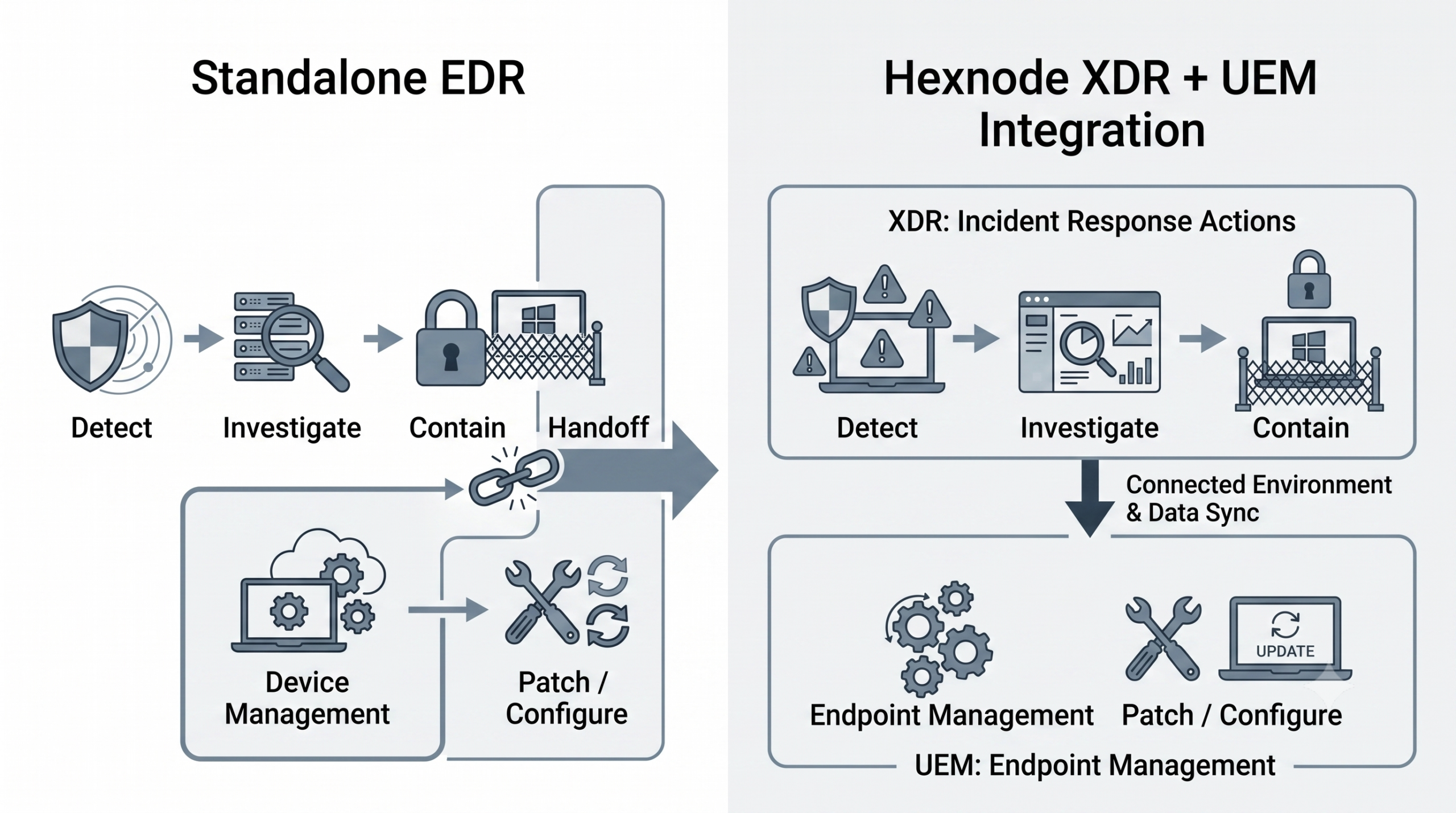
Standalone EDR can detect and contain endpoint threats, but remediation often extends into separate management workflows. Hexnode XDR combines threat detection, investigation, and response with Hexnode UEM integration, helping teams connect containment with endpoint management actions such as patching and policy enforcement. Centralized threat visibility, threat hunting, audit reporting, and coordinated endpoint management reduce manual handoffs and help close the operational gap between detecting a threat and addressing the underlying endpoint risk.
Why Standalone EDR Tools Are Reaching Their Limits
EDR remains a critical layer of endpoint security, but the operational challenge increasingly begins after a threat is detected. Standalone EDR tools identify behavioral anomalies and threat indicators. However, remediating underlying risk requires actions outside the EDR console.
Consider a compromised endpoint running a vulnerable application. EDR platforms detect threats and isolate compromised endpoints. However, full remediation requires switching between separate patching, configuration, and ticketing systems. Each handoff adds another console, workflow, and potentially another team to the response process.
At enterprise scale, this fragmentation can create practical problems:
Slower remediation as detection and corrective actions occur across separate workflows.
Limited operational context when security telemetry and device configuration data reside in different systems.
Higher administrative overhead from maintaining integrations and coordinating actions across multiple tools.
Inconsistent remediation when response depends on manual handoffs between security and IT teams.
The issue, therefore, is not whether EDR can detect endpoint threats effectively. It is whether detection in isolation is enough. For decision-makers, the more important question is whether closing the gap between detection and remediation now requires a more unified approach to endpoint security and management.
EDR (Endpoint Detection and Response) focuses on detecting, investigating, and responding to threats at the endpoint level, while XDR (Extended Detection and Response) extends that approach by bringing broader security context and response capabilities into a more coordinated workflow.
The distinction is not simply that XDR collects data from more sources. Extended detection correlates security signals across detection, investigation, and response workflows. This eliminates the need to navigate disconnected tools for isolated alerts. XDR correlates this activity to expose the entire attack lifecycle.
This changes the operational workflow. Rather than treating detection, investigation, and remediation as separate stages handled by separate systems, an XDR approach can connect them more closely. That can help teams reduce manual handoffs, prioritize related signals, and move from identifying a threat to containing it more efficiently.
Hexnode XDR integrates with Hexnode UEM for silent agent deployment and continuous endpoint synchronization. Teams leverage XDR for threat containment while executing patching and configuration enforcement through UEM.
The practical difference, then, is not merely EDR versus more telemetry. It is endpoint-focused detection versus a broader, more integrated model designed to close the operational gap between detection and remediation.
Standalone EDR vs Hexnode XDR+UEM
Featured Resource
Introduction to Hexnode XDR
See how Hexnode connects threat detection, investigation, response, and endpoint management.
How Hexnode XDR Closes the Gaps Standalone EDR Leaves Open
Standalone EDR provides clear threat visibility. However, its limitations emerge when teams must transition to active remediation. Hexnode XDR addresses this by bringing endpoint visibility, investigation, threat response, and device management into a more unified operational workflow.
Hexnode XDR currently provides threat detection, investigation, and response capabilities for supported Windows endpoints. This reduces the fragmentation that can make enterprise endpoint security harder to operate consistently across heterogeneous fleets.
When a threat requires immediate containment, One-Click Threat Remediation allows analysts to act directly from the platform. Available response actions include:
Isolate Device to restrict a compromised endpoint from communicating with the wider environment.
Kill Process to terminate a malicious or suspicious process.
Quarantine File to contain a detected malicious file.
Consolidated workflows unify threat detection and containment. This eliminates the friction of escalating incidents across separate systems.
The Hexnode XDR dashboard provides a centralized view of the threat landscape, active threats, recent incidents, MITRE ATT&CK events, endpoint remediation, incident allocation, critical events, and console activity. Analysts can assess what is happening and which endpoints require attention without manually correlating security alerts with information from a separate endpoint health or management console. This consolidated context can help teams prioritize incidents and determine the appropriate response faster.
Hexnode XDR also retains the investigative depth expected from endpoint detection tooling. Precision Threat Hunting provides an Intuitive Query Builder for rapid search. Additionally, Advanced Investigation Query enables deeper analysis using seven days of stored endpoint telemetry. Historical telemetry allows analysts to investigate suspicious endpoint behavior directly. This eliminates the need to pivot to a separate EDR platform.
Hexnode UEM integration extends threat workflows into active endpoint management. This closes the operational gap standalone EDR leaves between threat identification and risk resolution.
How XDR Platforms Unify Endpoint, Network, and Cloud Security
See how XDR connects security telemetry, investigation, and response across the enterprise environment.
Why Hexnode XDR’s Integration Is the Key Differentiator
The key differentiator for Hexnode XDR is its native integration with Hexnode UEM. Rather than treating threat detection and endpoint management as separate workflows, the two operate within the same platform. The Hexnode UEM integration allows selected UEM-managed endpoints to be synchronized with Hexnode XDR and enables silent deployment of the XDR agent for continuous security monitoring.
That integration matters when the detected threat exposes a broader endpoint problem. Containing malicious activity may address the immediate incident, but if the root cause is an unpatched application or an inadequate device configuration, the endpoint still requires corrective action. With XDR and UEM connected, teams can address both the security event and the underlying device state through a unified workflow.
Hexnode XDR audit reports log critical system events and configuration changes. They also capture technician portal activity and remote terminal sessions for complete accountability.
Dynamic Endpoint Groups extend this integration into ongoing policy enforcement. Devices can be grouped automatically according to defined criteria, allowing relevant policies to be assigned as endpoint conditions change. This connects security visibility with broader device management controls that a standalone EDR product may not provide natively.
The result is a tighter operational loop: detect the threat, contain it, address the endpoint condition, and maintain the appropriate policy posture within the same integrated platform.
FAQs
Does adopting XDR mean an organization no longer needs EDR capabilities?
Not necessarily. XDR builds on endpoint detection and response capabilities while connecting them with broader security context and response workflows. The key consideration is whether the organization needs endpoint detection alone or a more integrated path from investigation to remediation.
When does a standalone EDR tool become an operational bottleneck?
The bottleneck typically appears when responding to a detected threat requires separate systems for patching, configuration changes, device management, or ticketing. Multiple handoffs can increase administrative overhead and make remediation less direct.
Why does UEM integration matter for threat remediation?
UEM integration allows teams to address the device condition associated with a security incident, not just contain the immediate threat. For example, after detecting malicious activity, teams may also need to patch vulnerable software or apply appropriate endpoint policies.
Can Hexnode XDR investigate threats without a separate EDR console?
Hexnode XDR includes threat-hunting capabilities such as an Intuitive Query Builder and Advanced Investigation Query. The latter can use up to seven days of stored endpoint data, allowing analysts to investigate endpoint activity within the same platform.
How does combining XDR and UEM affect security and IT workflows?
It reduces the separation between security operations and endpoint management. Security teams can detect and contain threats while relevant device-management actions can be handled within the integrated platform, reducing reliance on manual cross-tool handoffs.
What should enterprises evaluate when comparing Hexnode XDR with a standalone EDR tool?
Look beyond detection capabilities and assess the complete response workflow. Consider whether the platform supports the required operating systems, investigation depth, containment actions, endpoint remediation, patching, policy enforcement, and audit visibility without depending on multiple disconnected tools.
Rethinking the Role of Standalone EDR
The case for moving beyond standalone EDR is ultimately an operational one. Detecting and containing threats remains essential, but endpoint risk can persist when patching, configuration enforcement, and device management sit in disconnected workflows. By connecting Hexnode XDR with Hexnode UEM, security and IT teams can bring threat investigation and containment closer to the endpoint-management actions needed to address the underlying device condition. For CISOs evaluating XDR, that ability to reduce fragmented workflows and connect security response with endpoint management is where the broader value lies.
Move beyond standalone endpoint detection
Bring threat detection, response, and endpoint management into a more connected security workflow.
Associate Product Marketer at Hexnode focused on SaaS content marketing. I craft blogs that translate complex device management concepts into content rooted in real IT workflows and product realities.