NIS2 makes cybersecurity a continuous operational and board-level responsibility. Hexnode helps organizations support compliance through centralized endpoint management, automated patching, device-aware access, threat response, and audit-ready reporting.
With the NIS2 Directive, cybersecurity is no longer just a periodic compliance task handled by leadership or legal teams. It has become an ongoing operational responsibility that directly affects how IT admins manage endpoints, identities, patching, access controls, and incident response across the organization. As enterprises face stricter expectations around cybersecurity risk management and reporting, endpoint environments have become a key area for implementing and proving security controls.
From maintaining accurate device inventories to enforcing encryption, automating patch management, and responding to threats quickly, IT teams now play an important role in supporting NIS2 compliance.
This blog explores what NIS2 means from an endpoint-security perspective, where Hexnode UEM Security Suite fits into a broader compliance strategy, and how UEM, XDR, and device-aware access can help enterprises strengthen security, improve visibility, and maintain audit-ready operations.
Why NIS2 compliance is now a board-level cybersecurity priority
NIS2 compliance requires enterprises to prove that cybersecurity risks are actively governed, monitored, and managed, not simply documented in policy files. The Directive raises the standard for how organizations approach cybersecurity resilience, incident response, and operational accountability across the EU.
NIS2 expands cybersecurity obligations
The NIS2 Directive replaces the earlier NIS1 framework and significantly broadens the EU’s cybersecurity expectations through clearer requirements, stronger enforcement, and wider sector coverage. It applies across 18 critical sectors, including energy, healthcare, banking, manufacturing, transport, digital infrastructure, and public administration.
The Directive also expands the number of organizations that fall within scope, particularly medium and large entities operating in sectors considered essential to economic and societal stability. These organizations are broadly categorized as “essential” or “important” entities based on their sector, size, and criticality.
Management accountability changes the tone
Unlike earlier compliance models, NIS2 places direct responsibility on management bodies to approve and oversee cybersecurity risk-management measures. This shifts cybersecurity from being only an IT concern to a board-level governance issue.
For IT and security teams, that means leadership increasingly needs evidence that controls are not only defined, but also actively implemented, monitored and enforced across the organization.
Non-compliance has real consequences
NIS2 also introduces stricter supervision and enforcement measures. Under Article 34, organizations may face administrative fines for failures related to cybersecurity risk management and incident-reporting obligations under Articles 21 and 23, with higher maximum penalties for essential entities.
What NIS2 compliance means for enterprise endpoint security
For IT teams, NIS2 compliance translates into practical security controls that must be implemented and continuously maintained across enterprise devices. In operational terms, this includes asset visibility, secure configuration, patch management, encryption, access control, incident response and compliance reporting.
Article 21 in IT-admin terms
Article 21 of the NIS2 Directive requires organizations to implement “appropriate and proportionate” cybersecurity measures based on their risk exposure and operational needs. For IT admins, this means maintaining layered controls that support prevention, monitoring, and response.
Key areas include:
Risk analysis and information-system security.
Incident handling and business continuity.
Vulnerability management and secure maintenance.
Cryptography and encryption.
Access control and asset management.
MFA or continuous authentication where appropriate.
NIS2 also expects organizations to continuously assess and improve the effectiveness of these controls over time.
Why endpoints are central to NIS2 execution
Endpoints are where users access corporate apps, data, and networks, making them a critical part of NIS2 risk management. Unmanaged or under-patched devices can weaken security, incident response, and audit readiness.
This is why UEM and endpoint security platforms are important for operationalizing NIS2 requirements. They help IT teams enforce policies consistently, reduce compliance gaps, and maintain visibility across the device environment.
Where Hexnode Security Suite fits in a NIS2 compliance program
Hexnode Security Suite supports NIS2 compliance by helping enterprises implement, enforce, and monitor endpoint-security controls across their environment. Rather than acting as a standalone compliance solution, Hexnode serves as a practical control and evidence layer within a broader cybersecurity and governance program.
The product-layer view
Hexnode’s approach can be viewed through a “manage, secure, detect, respond, and prove” model that connects endpoint management, identity, and threat response capabilities.
Hexnode UEM helps organizations manage endpoints, enforce security policies, maintain device compliance, control apps and content, and generate compliance reports.
Hexnode XDR supports threat detection, investigation, and response with endpoint visibility, remediation actions, and audit trails.
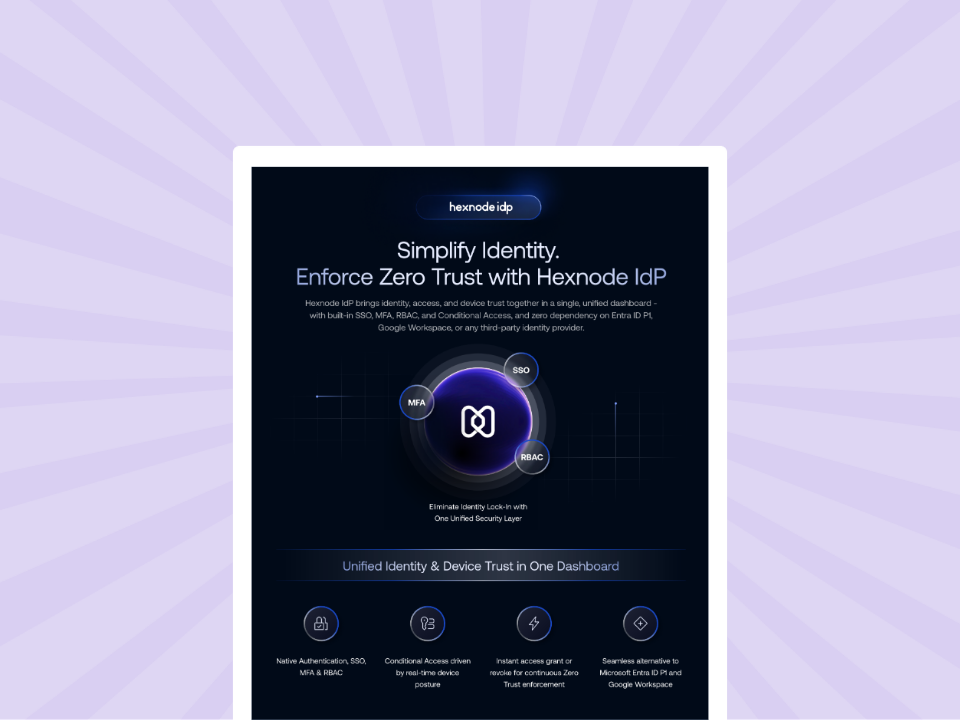
Hexnode IdP and access capabilities help organizations apply device-aware access controls through identity verification, device posture checks, MFA, and role-based access control (RBAC).
Hexnode also offers bundled approaches such as UEM + IdP and UEM + XDR to help organizations unify endpoint management and security operations.
While Hexnode can help operationalize and document many technical controls related to NIS2, compliance ultimately depends on the organization’s risk assessment, governance processes, sector-specific obligations and national implementation requirements.
Build a reliable endpoint inventory and enforce policies centrally
Centralized endpoint visibility helps enterprises support NIS2 requirements around asset management, access control, and security governance across distributed environments.
Unified visibility across device types
Hexnode UEM helps IT teams manage laptops, desktops, smartphones, tablets, kiosks, rugged devices, and remote endpoints from a single console. The platform supports major operating systems, including Windows, macOS, Android, iOS, tvOS, Fire OS, ChromeOS, Linux, and visionOS.
Maintaining a complete device inventory is important because unknown or unmanaged devices can introduce security and compliance risks.
Policy deployment at scale
With capabilities such as zero-touch enrollment, centralized policy management, dynamic groups, and automation, IT admins can apply consistent security controls across large device fleets.
Compliance drift and remediation
Devices can fall out of compliance due to outdated OS versions, disabled passcodes, or missing security configurations. Hexnode helps teams detect compliance drift and automate remediation actions such as reapplying policies, restricting access, locking devices, or notifying administrators.
Reduce risk with security baselines, encryption, app controls, and web filtering
Security baselines help IT teams translate NIS2 risk-management requirements into consistent endpoint-security policies across the organization. With Hexnode UEM, admins can standardize device posture using controls such as passcode policies, device encryption, secure configurations, Wi-Fi and VPN settings, web filtering, app allowlisting/blocklisting, and mandatory app deployment.
Hexnode also supports BYOD management through work-data separation and controlled access policies, helping organizations secure enterprise data without fully managing personal content.
These controls align closely with Article 21 requirements around cryptography, information-system security, access control, and cyber hygiene. By enforcing consistent configurations and restricting risky device behavior, organizations can reduce exposure while improving compliance visibility.
Recommended endpoint baseline for NIS2 readiness
Enforce strong passcodes and MFA
Enable full-device encryption
Restrict unapproved apps and websites
Configure secure Wi-Fi and VPN access
Maintain approved app catalogs
Separate work and personal data for BYOD devices
Monitor device compliance continuously
Automate patch and vulnerability remediation across enterprise endpoints
Automated patch management plays an important role in supporting NIS2 compliance by helping organizations reduce exposure to known vulnerabilities and maintain secure systems over time. Article 21 specifically highlights vulnerability handling and secure maintenance as part of an organization’s cybersecurity risk-management responsibilities.
Delayed or inconsistent patching can increase the likelihood of security incidents while also making it harder for organizations to demonstrate that reasonable security measures were actively maintained. For IT teams, patch management is no longer just an operational task; it is also part of compliance readiness and audit evidence.
Why patching matters for NIS2
NIS2 expects organizations to identify, assess, and remediate vulnerabilities in a timely and structured manner. This includes maintaining visibility into outdated systems, prioritizing critical updates, and ensuring security fixes are deployed consistently across endpoint environments.
Hexnode patch lifecycle
Hexnode helps IT admins streamline the patch-management lifecycle by enabling them to:
Identify missing patches and outdated devices.
Prioritize vulnerabilities based on severity and risk.
Pre-approve or defer updates where needed.
Assign patches to specific devices or groups.
Schedule deployments during maintenance windows.
Track and report patch status for compliance and audits.
By automating patch workflows and maintaining deployment records, organizations can improve operational resilience while strengthening their overall NIS2 security posture.
Enforce device-aware identity and access control with Hexnode IdP
Device-aware access control helps enterprises ensure that only trusted users on compliant devices can access corporate applications and data. Under NIS2, identity alone is no longer enough if the accessing device is compromised, outdated or unmanaged.
Hexnode IdP combines user identity with device posture to help organizations apply access decisions based on both who the user is and the security state of their device. This helps strengthen access governance across enterprise environments.
Access controls to highlight
Organizations can enforce:
Conditional access based on user identity and device compliance.
MFA for high-risk sign-ins or sensitive actions.
Role-based access control (RBAC) for admin privilege management.
Session controls to reduce risks from unattended devices.
Activity logs and authentication reports for audit evidence.
These capabilities align with Article 21 requirements around access control, asset management, and MFA or continuous authentication where appropriate.
Feature Resource
Simplify Identity & Device Trust with Hexnode IdP Hexnode IdP Info sheet
Secure Your Digital Perimeter with Hexnode IdP—The Unified Path to Zero Trust.
Detect, investigate, and respond faster with Hexnode XDR
Hexnode XDR helps support these requirements by providing endpoint visibility, threat detection, and response capabilities across enterprise environments.
Hexnode XDR uses endpoint telemetry, contextualized alerts, and automated correlation to help security teams identify suspicious activity faster. Unified visibility across devices also helps teams investigate threats with better context and prioritization.
Response actions
IT and security teams can take response actions such as:
Isolating compromised endpoints.
Killing malicious processes.
Quarantining suspicious files.
Running deep scans after remediation.
Maintaining detailed audit trails for investigations.
NIS2 incident reporting readiness
XDR findings and response records can help organizations gather the evidence needed for NIS2 incident reporting timelines, including 24-hour early warnings, 72-hour notifications and final reporting requirements.
While Hexnode supports incident investigation and response workflows, the organization remains responsible for official reporting to the relevant CSIRT or regulatory authority.
Maintain audit-ready evidence and continuous compliance reporting
NIS2 expects organizations to demonstrate that cybersecurity controls are actively implemented, monitored, and reviewed over time. For IT admins, this means maintaining clear evidence around device inventory, policy status, patching, encryption, access activity, and incident response.
Hexnode supports audit readiness through real-time device insights, compliance dashboards, automated reports, and exportable reporting formats that help teams track and review security posture continuously.
NIS2 control area
Hexnode capability
Evidence example
Asset management
UEM inventory and dashboards
Device ownership and OS status
Access control
IdP, RBAC, conditional access
Sign-in logs and policy decisions
Encryption
Security policies
Encryption compliance reports
Vulnerability handling
Patch management
Patch status and exceptions
Incident handling
XDR detection and response
Alert timelines and remediation history
Effectiveness review
Reports and dashboards
Compliance trend reports
Cybersecurity Best Practices for Businesses to Adopt in 2026
Cybersecurity best practices for 2026: tackle human error, AI threats, and disconnected security tools.
A practical NIS2 compliance workflow for IT admins using Hexnode
A practical NIS2 endpoint-security workflow should combine visibility, policy enforcement, patch management, access control, and incident response into a continuous operational process.
Suggested workflow
Scope devices, users, ownership models, and operating locations.
Identify devices that support essential or important business services.
Enroll endpoints into Hexnode UEM for centralized management.
Apply baseline security and compliance policies.
Enforce encryption, passcodes, app controls, and web restrictions.
Configure automated patch rules and patch SLAs.
Connect identity and access policies to device posture.
Enable Hexnode XDR visibility and response workflows.
Schedule recurring compliance and security reports.
Conduct incident-response drills aligned with NIS2 reporting timelines, including 24-hour warnings, 72-hour notifications, and final reporting requirements.
Conclusion
NIS2 compliance requires organizations to move beyond static security checklists and adopt a continuous, risk-based approach to cybersecurity. By combining unified endpoint management, device-aware access, patch automation, threat response, and compliance reporting, Hexnode Security Suite helps enterprises strengthen operational resilience and support ongoing security governance.
Try Hexnode Free for 14 Days
Support your NIS2 compliance strategy with unified endpoint visibility and control.
NIS2 compliance refers to meeting the cybersecurity risk-management, incident-reporting, and governance requirements defined under the EU’s NIS2 Directive.
Who needs to comply with NIS2?
NIS2 applies to medium and large entities operating in critical sectors such as healthcare, energy, banking, manufacturing, transport, and digital infrastructure.
Can Hexnode make my organization NIS2 compliant?
No. Hexnode supports NIS2 compliance by helping organizations implement and monitor technical controls, but compliance also depends on governance, legal interpretation, and organizational processes.
I’m a technical content writer at Hexnode who loves simplifying tech. I break down complex ideas, remove the fluff, and help readers clearly understand our product for what it actually is: simple, reliable, and built to solve real problems.