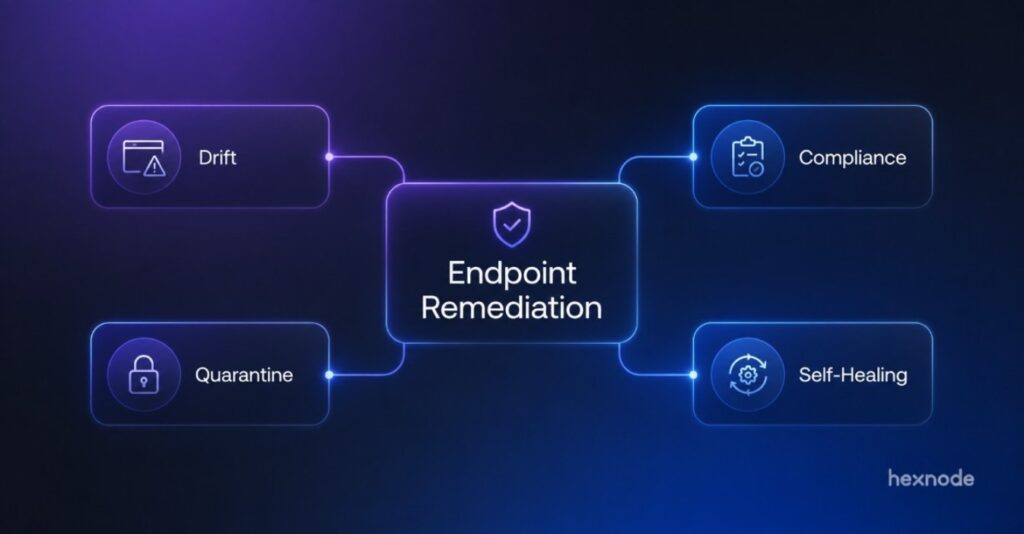
AI-assisted endpoint remediation helps organizations reduce manual effort, accelerate incident response, and improve operational efficiency. Its ROI extends beyond faster remediation to include reduced downtime, stronger compliance, better resource utilization, and improved business continuity. Measuring outcomes with the right KPIs and implementing automation with proper governance are key to realizing long-term value.
Endpoint remediation is the process of identifying and correcting issues on managed devices that affect security, compliance, or operational stability. Remediation may involve removing malicious files, installing missing patches, isolating compromised devices, or enforcing security policies. It may also include restoring devices to a compliant state after a security incident.
AI-assisted endpoint remediation builds on these workflows. It helps IT and security teams analyze endpoint data, prioritize risks, and recommend appropriate remediation actions. Where organizational policies allow, it can also automate routine responses. Unlike traditional automation, which follows predefined if-then rules, AI-assisted systems evaluate context from multiple signals. This supports more informed decisions while allowing human oversight for higher-risk actions.
Common remediation actions include isolating affected devices, deploying patches, terminating malicious processes, and enforcing security policies. They may also include removing unauthorized software or, on supported platforms, rolling back specific changes. The goal is to reduce response times, minimize manual effort, and restore endpoints to a secure, compliant state.
Why Traditional Endpoint Remediation Doesn’t Scale
Modern IT environments are far more complex than they were a decade ago. Organizations now manage a mix of corporate-owned and personal devices across multiple operating systems, alongside remote and hybrid workforces. This expanded endpoint landscape increases the volume of security events and operational issues that IT teams must investigate and resolve.
Traditional endpoint remediation often relies on manual investigation and predefined workflows. As security alerts accumulate, analysts must determine which incidents require immediate attention, identify affected devices, and decide on appropriate remediation actions. This process can become time-consuming, particularly when teams are managing thousands of endpoints.
Longer investigation and response times may extend an organization’s exposure to security risks and increase operational costs. At the same time, repetitive manual tasks contribute to alert fatigue, making it more difficult for teams to focus on higher-priority incidents.
Hidden Costs of Manual Response
Beyond slower incident response, manual remediation can have broader business consequences. Employees may experience longer periods of downtime while issues are investigated, reducing productivity. Security teams can become overwhelmed by repetitive investigations and alert triage, increasing the risk of burnout.
Delayed remediation may also prolong the window during which attackers can exploit compromised endpoints and make it more difficult for organizations to consistently meet internal security policies or regulatory compliance requirements.
These challenges are driving many organizations toward AI-assisted remediation, which helps prioritize incidents, automate routine actions, and improve operational efficiency without removing human oversight from higher-risk decisions.
Where the ROI Comes From
The ROI of AI-assisted endpoint remediation isn’t limited to faster incident response. Its value comes from reducing operational overhead, minimizing business disruption, and allowing IT teams to spend more time on strategic work instead of repetitive tasks.
Key areas where organizations typically see returns include:
Faster incident response and containment
Lower operational costs through automation
Fewer help desk interventions
Reduced endpoint downtime
More consistent endpoint compliance
Lower business impact from security incidents
Better utilization of IT and security staff
Rather than measuring success solely by technical metrics, organizations should evaluate how AI-assisted remediation improves efficiency, productivity, and overall business resilience.
Direct Financial Benefits
AI-assisted remediation can help reduce day-to-day operational costs by automating routine response activities and shortening investigation times.
Some of the most tangible financial benefits include:
Reduced labor hours: Analysts spend less time on repetitive investigations and manual remediation.
Lower remediation costs: Standardized workflows reduce the effort required to resolve common endpoint issues.
Less endpoint downtime: Devices can be restored to a secure, operational state more quickly, minimizing disruptions to employees.
Fewer help desk requests: Faster resolution of endpoint issues can reduce support tickets and repeat incidents.
These efficiencies allow organizations to manage a growing number of endpoints without proportionally increasing IT resources.
Strategic Business Benefits
The long-term value extends beyond direct cost savings.
AI-assisted remediation can help organizations:
Improve employee productivity by reducing device-related interruptions.
Strengthen business continuity through faster recovery from endpoint issues.
Apply security policies more consistently across managed devices.
Reduce operational risk by identifying and addressing issues before they escalate.
Enable security teams to focus on threat hunting, investigations, and security improvements instead of repetitive administrative work.
While AI accelerates routine remediation, human oversight remains important for high-risk or complex incidents, ensuring that automation complements—not replaces—security professionals
Metrics That Actually Measure AI Remediation ROI
To determine whether AI-assisted endpoint remediation is delivering value, organizations should track measurable operational and business outcomes rather than relying on anecdotal improvements.
Some of the most useful metrics include:
Mean Time to Detect (MTTD): How quickly potential endpoint issues are identified.
Mean Time to Respond (MTTR): The time taken to acknowledge, investigate, and begin responding to an incident.
Mean Time to Remediate: The time required to fully resolve the issue and restore the endpoint to a secure state.
Incident containment time: How quickly affected devices are isolated or controlled to prevent further impact.
Number of automated remediations: The percentage or volume of incidents resolved through automated workflows.
Help desk ticket reduction: Changes in endpoint-related support requests over time.
Endpoint compliance rate: The percentage of devices that meet organizational security and configuration policies.
Device downtime: The amount of time endpoints remain unavailable because of security or operational issues.
Security analyst hours saved: Time that can be redirected from repetitive remediation tasks to higher-value activities such as threat hunting, investigations, and security planning.
Tracking these metrics over time helps organizations quantify improvements in operational efficiency, user productivity, and security performance.
Featured Resource
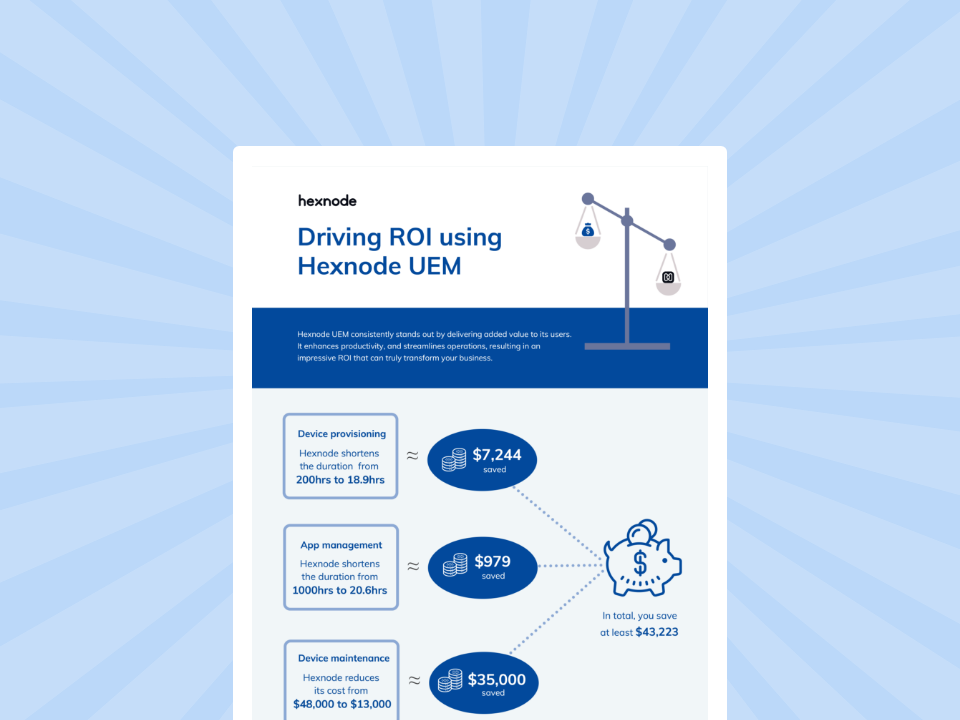
Driving ROI with Hexnode
Download the infographic to check out how Hexnode UEM drives ROI for organizations.
Organizations using similar AI-assisted remediation tools can achieve very different results. The difference often comes down to how well the technology is implemented, managed, and integrated into existing IT operations.
Some of the biggest factors that influence ROI include:
Endpoint visibility: Complete visibility helps teams identify affected devices quickly and prioritize remediation efforts.
AI recommendation accuracy: Reliable recommendations help teams respond more efficiently while reducing unnecessary investigations.
Integration with existing workflows: Remediation processes work best when they fit naturally into existing IT and security operations.
Accurate device inventory: Up-to-date endpoint information enables faster and more targeted remediation.
Operational adoption: IT teams are more likely to realize value when they consistently use automation for routine tasks while reserving manual intervention for complex incidents.
Continuous policy optimization: Regularly reviewing and refining remediation policies helps improve efficiency as environments evolve.
Common ROI Killers
Several operational challenges can significantly reduce the value of AI-assisted remediation:
Incomplete or outdated endpoint inventory
Excessive manual approvals for routine remediation tasks
Automation without clear governance or oversight
Limited reporting that makes it difficult to measure business outcomes
Outdated remediation policies that no longer reflect the organization’s environment
Addressing these issues helps organizations maximize the long-term value of AI-assisted remediation initiatives.
Common Mistakes When Evaluating AI Remediation Platforms
When evaluating AI-assisted endpoint remediation platforms, it’s easy to focus on advanced AI capabilities while overlooking the operational factors that determine long-term success. A platform that fits existing workflows and provides measurable outcomes is often more valuable than one with the most sophisticated AI features.
Common evaluation mistakes include:
Prioritizing AI over workflows: Assess how well the platform supports your existing incident response and remediation processes, not just its AI capabilities.
Ignoring reporting and analytics: Look for reporting that helps measure remediation performance, operational efficiency, and business outcomes over time.
Skipping baseline measurements: Record key metrics such as MTTR, device downtime, and help desk ticket volume before implementation so improvements can be measured accurately.
Underestimating change management: Ensure IT teams receive the training and governance needed to adopt automation effectively.
Focusing only on licensing costs: Consider the total operational impact, including implementation effort, ongoing management, productivity gains, and potential cost savings from faster remediation.
A well-informed evaluation should balance AI capabilities with usability, governance, integration, and measurable business value. These factors are ultimately what determine whether an organization realizes a meaningful return on its investment.
AI-Powered Endpoint Automation with Hexnode Genie
AI-powered endpoint automation with Hexnode Genie simplifies scripting, troubleshooting, and faster IT remediation.
Turning AI-Assisted Remediation Into Measurable Operational Gains
AI-assisted remediation delivers the greatest value when organizations pair intelligent decision-making with centralized endpoint management and consistent operational workflows. While AI can help prioritize and accelerate response, organizations also need the visibility and controls to execute remediation actions efficiently across distributed devices.
Hexnode supports these operational goals by helping IT teams manage endpoint remediation from a centralized console and apply standardized policies across managed devices. Rather than relying on manual intervention for every issue, administrators can use centralized management to improve consistency and reduce repetitive administrative work.
Key capabilities that contribute to measurable operational gains include:
Centralized endpoint visibility: Hexnode provides a unified view of managed devices, helping IT teams quickly identify affected or non-compliant endpoints.
Policy-based management: Administrators can apply and enforce security and configuration policies across devices, promoting consistent remediation workflows.
Remote management actions: Hexnode enables administrators to perform supported remote actions without requiring physical access to managed devices, helping reduce response times for common operational issues.
Compliance monitoring: Compliance policies and reports help IT teams verify whether devices have returned to the organization’s required security posture after remediation activities.
Reporting and audit trails: Action Reports and Audit Reports provide visibility into administrative activities and remote actions, supporting operational reviews and compliance requirements.
By combining centralized visibility, policy enforcement, remote management, and compliance reporting, Hexnode helps organizations reduce manual effort and maintain greater control over endpoint operations. These capabilities support more efficient remediation workflows and improve operational consistency. They also allow IT teams to focus on higher-value initiatives instead of repetitive endpoint administration.
Conclusion
AI-assisted endpoint remediation is ultimately about delivering measurable business value, not just resolving technical issues more quickly. While faster response times are important, organizations should evaluate ROI more holistically by considering improvements in operational efficiency, security posture, compliance, and employee productivity.
To accurately measure success, establish baseline metrics before implementing AI-assisted remediation and track key performance indicators such as response times, endpoint compliance, downtime, and administrative effort over time. The greatest returns come from combining intelligent automation with strong endpoint visibility, well-defined governance, and continuous performance measurement.
Rather than choosing a platform based solely on its AI capabilities, focus on how effectively it supports your existing workflows, scales with your environment, and delivers measurable business outcomes. That approach will provide a clearer picture of long-term value and help maximize the return on your investment.
Try Hexnode Free for 14 Days
Automate endpoint management and respond faster to security risks with Hexnode. Start your free trial today.
Can small and mid-sized businesses benefit from AI-assisted endpoint remediation?
Yes. While large enterprises often manage more endpoints, small and mid-sized businesses can also benefit by automating routine remediation tasks, reducing the burden on lean IT teams, and improving response times without significantly increasing staffing.
Does AI-assisted endpoint remediation replace security analysts?
No. AI is designed to assist security and IT teams by prioritizing incidents, recommending actions, and automating repetitive tasks. Human oversight remains essential for investigating complex threats, validating high-risk actions, and making strategic security decisions.
How long does it typically take to see ROI from AI-assisted endpoint remediation?
The timeline varies depending on factors such as deployment size, existing workflows, and automation maturity. Organizations often begin seeing operational improvements soon after implementation, while broader ROI becomes clearer as they collect and compare performance metrics over time.
Which endpoints can benefit from AI-assisted remediation?
AI-assisted remediation can be applied across a wide range of managed endpoints, including laptops, desktops, mobile devices, and other enterprise-managed endpoints, provided they support the required management and security controls.
What should organizations evaluate before adopting an AI-assisted remediation solution?
Beyond AI capabilities, organizations should assess how well the solution integrates with existing IT workflows, supports policy enforcement, provides visibility into endpoint health, offers actionable reporting, and scales as the endpoint environment grows.
I’m a technical content writer at Hexnode who loves simplifying tech. I break down complex ideas, remove the fluff, and help readers clearly understand our product for what it actually is: simple, reliable, and built to solve real problems.