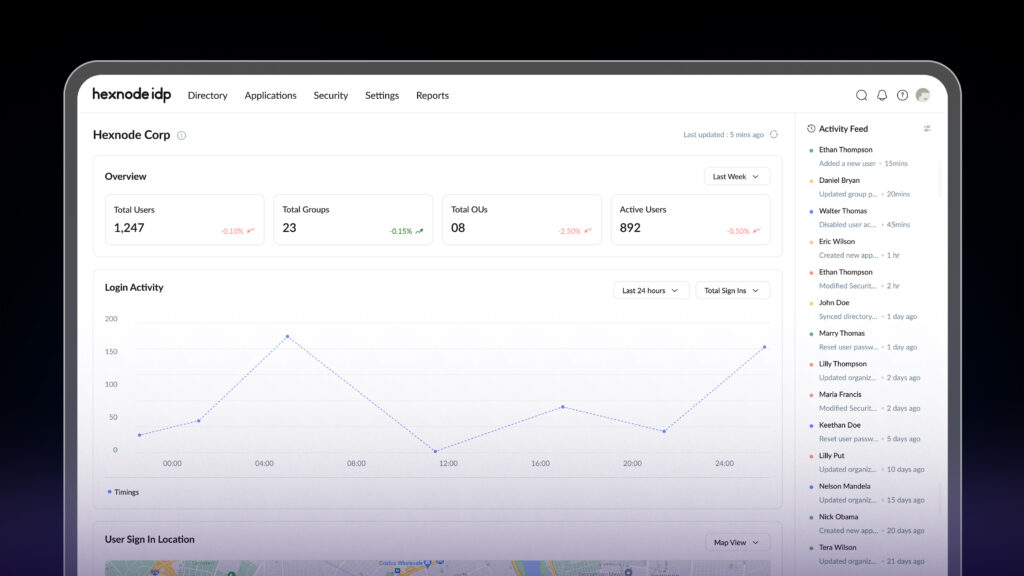
Enterprise identity management has become the foundation of modern security. The right IdP should simplify identity lifecycle management, strengthen access controls, and scale with business growth. Hexnode IDP helps organizations unify user identity and device posture, secure workforce access, automate user access changes through SCIM-based lifecycle management, and enforce access rules based on user identity, device compliance, and security context.
Enterprise identity management has become a critical challenge for modern IT teams. As organizations adopt more cloud applications, support hybrid workforces, and manage access across multiple devices, maintaining visibility and control over user identities becomes increasingly difficult. Fragmented identity systems, inconsistent access policies, and manual processes often lead to security gaps and operational inefficiencies.
When organizations lack centralized identity controls, users can accumulate excessive permissions, dormant accounts may remain active, and administrators spend valuable time managing access requests manually. At the same time, attackers increasingly target user credentials, making identity a primary security concern.
As a result, enterprise identity management has evolved from a back-office IT function into a strategic business priority. The right identity provider (IdP) helps organizations centralize authentication, automate access management, strengthen security, and simplify compliance. Choosing the right identity management solution is therefore essential for building a secure and scalable identity strategy.
Why Enterprise Identity Management Has Become a Strategic Priority
Modern enterprises operate in environments where users, applications, and devices constantly interact across multiple locations and networks. Understanding the factors driving this complexity helps explain why identity has become a critical business and security concern.
The growing complexity of enterprise identities
The average enterprise manages a rapidly expanding digital ecosystem. Employees access SaaS applications, cloud services, internal systems, collaboration platforms, and business-critical tools from multiple devices and locations. Each new application introduces another identity layer that IT teams must manage and secure.
Several factors are making identity management increasingly difficult:
Expanding SaaS portfolios
Hybrid and remote work environments
Multi-device access requirements
Third-party contractor and vendor access
Cloud and on-premises infrastructure coexistence
At the same time, organizations increasingly rely on contractors, temporary workers, vendors, and third-party partners. Managing access for these users manually becomes difficult as the business grows and user populations become more dynamic.
The shift to hybrid work has added another layer of complexity. Users now access corporate resources from home networks, public Wi-Fi, and personal devices, making traditional perimeter-based security models far less effective.
Identity is the new security perimeter
Modern attackers understand that credentials often provide the easiest path into enterprise environments. Rather than targeting infrastructure directly, they increasingly focus on identity-based attacks such as phishing, credential theft, and account takeover attempts.
As organizations adopt Zero Trust security models, identity becomes the primary mechanism for verifying users and controlling access. Every authentication request must be evaluated against security policies before access is granted.
Today, identity systems play a central role in:
Verifying user legitimacy
Enforcing access policies
Detecting suspicious login behavior
Supporting Zero Trust initiatives
Reducing credential-related security risks
Organizations that fail to modernize identity controls often struggle to detect unauthorized access, enforce consistent policies, and respond quickly to security incidents.
The business impact of poor identity management
Weak identity practices affect more than security. Manual user provisioning slows onboarding, excessive permissions increase compliance risks, and disconnected systems create administrative burdens for IT teams.
The operational consequences often include:
Challenge
Business Impact
Manual provisioning
Delayed employee onboarding
Dormant accounts
Increased security exposure
Excessive permissions
Compliance and audit risks
Password-related issues
Higher help desk workload
Disconnected identity systems
Reduced visibility and control
Help desk teams frequently spend significant time handling password resets and access requests. Auditors struggle to verify access controls across multiple systems, while business leaders face increased risk from privilege creep and unmanaged accounts.
An effective identity management solution addresses these challenges while improving both security and operational efficiency.
What Is an Identity Provider (IdP)?
An identity provider serves as the foundation of modern identity architecture, but its role extends well beyond authentication. Understanding how an IdP functions within a broader identity strategy is essential when evaluating enterprise solutions.
What is an Identity Provider (IdP)?
Learn what an identity provider is and how it enables secure, seamless access management.
Understanding the role of an IdP
An identity provider acts as the central authority responsible for authenticating users and granting access to applications and resources. Instead of requiring separate credentials for every application, users authenticate through the IdP, which then verifies their identity and facilitates access.
This centralized approach simplifies authentication while allowing organizations to enforce consistent security policies across their environment. Administrators gain greater visibility into user activity and can manage access from a single platform.
At a high level, an IdP helps organizations:
Centralize user authentication
Simplify application access
Enforce consistent security policies
Reduce password-related risks
Improve visibility into user activity
Modern IdPs also support industry-standard authentication protocols such as SAML, OAuth, and OpenID Connect, enabling seamless integration with cloud and on-premises applications.
How an IdP supports enterprise identity management
An IdP forms the backbone of enterprise identity management by consolidating user identities, authentication policies, and access controls into a centralized framework.
Beyond authentication, modern platforms support identity lifecycle management, automated provisioning, access governance, and compliance reporting. These capabilities help organizations maintain control over user access throughout the entire employee lifecycle.
Core functions typically include:
Capability
Business Value
Authentication
Verifies user identity
Access management
Controls resource access
User provisioning
Automates account creation
Identity lifecycle management
Simplifies onboarding and offboarding
Compliance reporting
Supports audits and governance
Access governance
Reduces excessive permissions
Rather than treating identity as a standalone function, enterprises can use an IdP to establish a unified identity strategy that aligns security, compliance, and operational objectives.
Key Features to Look for in an Enterprise Identity Provider
Not all identity platforms are built to support enterprise-scale requirements. The following capabilities separate basic authentication tools from comprehensive identity management solutions.
Comprehensive identity lifecycle management
One of the most important capabilities in any enterprise IdP is identity lifecycle management. User access requirements constantly change as employees join the organization, switch roles, receive promotions, or leave the company.
Without automation, these changes often result in delayed access provisioning, inconsistent permissions, and lingering accounts that increase security risk. Manual processes also place unnecessary burdens on IT teams.
A mature lifecycle management framework should support:
Automated onboarding workflows
Role-based access assignments
Department and role transitions
Automated deprovisioning
Temporary and contractor access management
Organizations that automate lifecycle processes reduce administrative overhead while maintaining stronger security and compliance controls.
Single Sign-On (SSO) across enterprise applications
As application portfolios expand, managing separate credentials for every platform becomes increasingly difficult. Employees often resort to weak passwords or password reuse, creating avoidable security vulnerabilities.
Single Sign-On allows users to authenticate once and securely access multiple applications without repeated login prompts. This improves user experience while reducing password-related support requests.
When evaluating SSO capabilities, organizations should verify support for:
SaaS applications
Legacy business applications
Cloud-native services
Hybrid environments
Industry-standard authentication protocols
Broad compatibility ensures organizations can maintain consistent authentication experiences regardless of where applications reside.
Strong authentication and adaptive security
Authentication requirements continue to evolve as threats become more sophisticated. Passwords alone no longer provide sufficient protection for enterprise environments.
Modern IdPs should support multi-factor authentication, passwordless authentication, adaptive authentication, and risk-based access policies. These controls enable organizations to evaluate contextual factors such as location, device posture, and user behavior before granting access.
Key security capabilities to prioritize include:
Security Feature
Why It Matters
Multi-factor authentication
Reduces credential-based attacks
Passwordless authentication
Improves security and user experience
Adaptive authentication
Applies controls based on risk
Conditional access
Restricts access based on context
Risk scoring
Identifies suspicious activity
Adaptive security measures help organizations balance user convenience with security requirements.
Automated provisioning and access governance
Provisioning user accounts manually introduces delays, inconsistencies, and human error. As organizations grow, these issues become increasingly difficult to manage.
Automated provisioning enables organizations to assign applications, permissions, and resources based on predefined roles and policies. This ensures users receive the access they need without excessive privileges.
Together, these controls improve accountability and reduce unnecessary risk.
Directory integration and synchronization
Most enterprises operate within complex identity ecosystems that include Active Directory, LDAP directories, HR systems, and cloud platforms. An IdP must integrate seamlessly with these existing systems.
Synchronization capabilities help ensure identity information remains accurate and consistent across environments. Changes made in one system can automatically propagate throughout the organization.
Organizations should prioritize platforms that support flexible integration options while minimizing deployment complexity and ongoing maintenance requirements.
Scalability for enterprise growth
Identity infrastructure should support long-term business growth rather than creating future limitations. Organizations frequently expand through acquisitions, geographic growth, and digital transformation initiatives.
An enterprise IdP should support large user populations, multiple business units, and distributed environments without compromising performance or reliability.
Questions to consider include:
Can the platform support future workforce growth?
Does it support multi-region deployments?
Can it accommodate mergers and acquisitions?
Will performance remain consistent at scale?
Scalability becomes especially important for global organizations that require consistent access experiences across regions and time zones.
Reporting, auditing, and compliance capabilities
Identity systems generate valuable security and compliance data. Organizations need visibility into authentication activity, access changes, and administrative actions.
Comprehensive reporting capabilities help IT and security teams identify unusual behavior, investigate incidents, and demonstrate compliance during audits.
Reporting should ideally provide visibility into:
Authentication events
User activity
Administrative changes
Access reviews
Policy violations
Compliance status
Detailed audit trails also support regulatory frameworks that require organizations to document access controls and user activities.
Open integration ecosystem
Identity management does not operate in isolation. Enterprises depend on security tools, endpoint management platforms, productivity applications, and business systems that all require identity integration.
An effective IdP should provide robust APIs, integration frameworks, and support for security ecosystems. This enables organizations to build unified workflows that connect identity decisions with broader security and operational processes.
A strong integration ecosystem should support connections with:
Endpoint management platforms
Security information and event management (SIEM) tools
HR systems
IT service management platforms
Collaboration suites
Cloud infrastructure providers
The easier it is to integrate identity data across the enterprise, the more value organizations can derive from their identity strategy.
Featured Resource
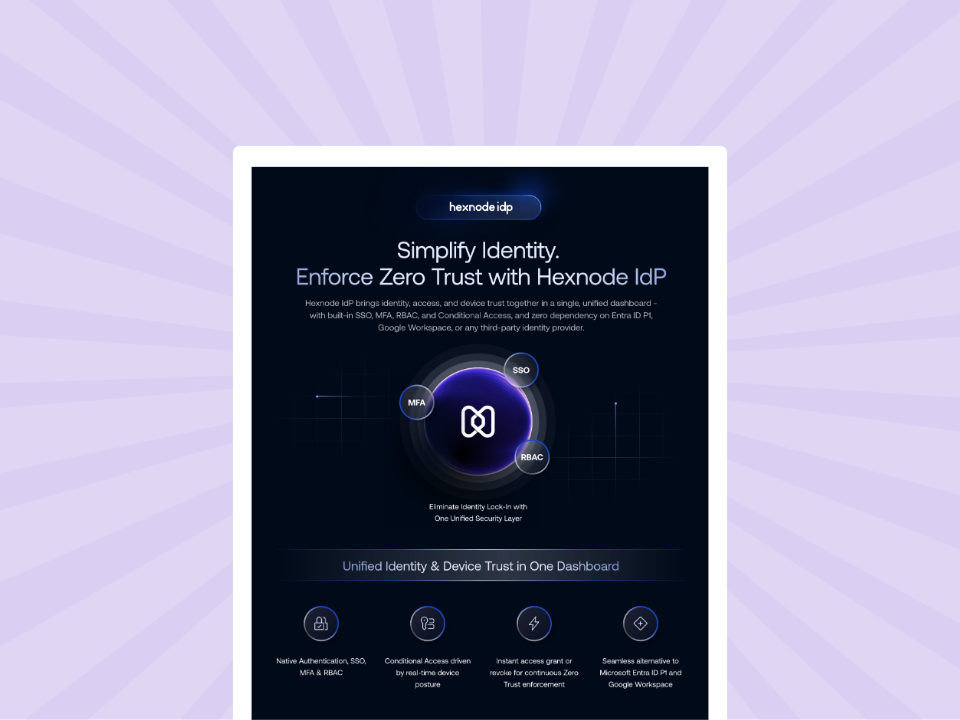
Hexnode IdP Info sheet
Discover how Hexnode IdP unifies identity, device trust, and Zero Trust access management.
Strengthening Enterprise Identity Management with Hexnode IDP
Organizations need more than a standalone authentication platform. They need a solution that simplifies identity operations while supporting broader security initiatives.
Hexnode IDP helps organizations centralize authentication, simplify access management, and improve visibility across their identity ecosystem. By consolidating identity controls within a unified platform, IT teams can reduce complexity while strengthening security.
The platform supports User Lifecycle Automation by making user access changes automated through SCIM-based lifecycle management. These capabilities help organizations automate user access changes through SCIM-based lifecycle management and manage access rights and permissions based on defined user roles.
Hexnode IDP also supports secure authentication experiences through centralized identity controls and policy-driven access management. Organizations can provide secure, policy-controlled access to approved web, mobile, and SaaS applications.
When combined with Hexnode UEM, organizations can extend identity decisions beyond authentication and incorporate device trust into access policies. This integration enables IT teams to verify both user identity and device compliance before granting access to sensitive resources.
For enterprises pursuing Zero Trust initiatives, Hexnode IDP unifies user identity and device posture to secure access across devices and applications.
Conclusion
Enterprise identity management has become a foundational component of modern cybersecurity, compliance, and IT operations. As organizations navigate increasingly complex digital environments, the right IdP can simplify access management, automate identity lifecycle management, and strengthen security across the enterprise.
When evaluating an identity management solution, organizations should look beyond basic authentication capabilities. Scalability, automation, governance, integration, and device-aware security controls all play a critical role in long-term success.
Hexnode IDP helps organizations address these challenges with enterprise-grade authentication, identity management, conditional access, role-based access control, contextual authentication, session management, application access, and activity reports.
Simplify Enterprise Identity Management
Centralize identities, automate access, and strengthen security with Hexnode Identity and UEM.
How does an identity management solution support Zero Trust?
An identity management solution supports Zero Trust by continuously verifying users, enforcing authentication policies, and enabling context-aware access decisions based on risk factors such as user behavior and device status.
Can identity management improve compliance?
Yes. Identity management platforms provide audit trails, access controls, reporting capabilities, and governance features that help organizations meet regulatory and compliance requirements.
Content writer at Hexnode. Fueled by good coffee and the occasional cat cuddle, I enjoy crafting content that informs, connects, and resonates. Nothing excites me more than knowing my words have been read, appreciated, and maybe even bookmarked.