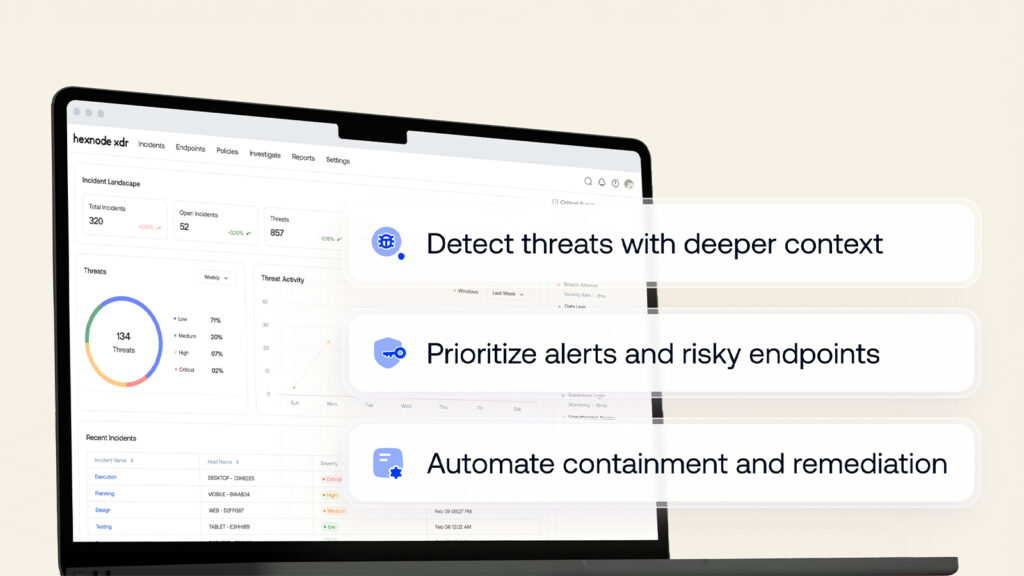
A managed XDR service combines 24/7 expert-led threat monitoring, investigation, and response with extended visibility across endpoints, identities, cloud environments, and networks. By correlating security data from multiple sources, it helps organizations detect sophisticated attacks faster, reduce alert fatigue, accelerate incident response, and strengthen overall security posture without the cost and complexity of running a full in-house SOC.
A managed XDR service combines advanced threat detection, investigation, and response capabilities with the expertise of dedicated security professionals. Rather than relying solely on internal teams to monitor and respond to threats, organizations can leverage a managed service that continuously analyzes security signals, investigates suspicious activity, and coordinates response actions across the environment.
As cyberattacks become more sophisticated and attack surfaces continue to expand, traditional security monitoring approaches often struggle to provide the visibility and speed required to contain modern threats. A managed XDR service addresses this challenge by correlating data from multiple security layers, helping organizations detect attacks that might otherwise go unnoticed when viewed in isolation.
The value of a managed XDR service comes from three key components:
Managed security expertise: Security analysts and threat hunters provide around-the-clock monitoring, investigation, and response support.
Extended visibility across environments: Security telemetry is collected and analyzed across endpoints, identities, cloud services, networks, and other critical assets.
Response-driven security operations: The focus extends beyond alert generation to threat validation, containment, remediation, and recovery.
Unlike conventional monitoring solutions that often leave organizations responsible for investigating alerts, managed XDR services provide operational support throughout the incident lifecycle.
Why Managed XDR Has Gained Popularity
Several factors have accelerated the adoption of managed XDR services in recent years.
First, organizations are managing a significantly larger and more distributed attack surface due to cloud adoption, remote work, and increasing device diversity. Second, the ongoing cybersecurity skills shortage makes it difficult for many businesses to staff and operate a mature security operations center internally.
At the same time, threat actors are using increasingly sophisticated techniques that can bypass traditional detection methods. As a result, organizations are turning to managed XDR services to improve threat visibility, reduce mean time to detect (MTTD), and accelerate incident response without the cost and complexity of building a full-scale security operations capability in-house.
How Does a Managed XDR Service Work?
A managed XDR service operates as a continuous security operations function that collects telemetry from multiple sources, identifies suspicious activity, investigates potential threats, and coordinates response actions. Its effectiveness comes from combining advanced analytics with the expertise of security analysts who can separate genuine threats from routine noise.
Instead of treating alerts as isolated events, managed XDR services analyze security data in context, enabling faster and more accurate threat detection.
Data Collection and Visibility
The process begins with comprehensive data collection across the organization’s environment. Security telemetry is continuously gathered from sources such as:
Endpoints including laptops, desktops, servers, and mobile devices
Users and identities to monitor authentication activity and access patterns
Cloud workloads and SaaS applications
Network activity to identify unusual connections, communications, or traffic flows
This broader visibility helps uncover attack patterns that may not be apparent when monitoring individual systems independently.
Threat Detection and Investigation
Once data is collected, the managed XDR service applies advanced analytics, machine learning models, behavioral analysis, and threat intelligence to identify indicators of compromise.
Key activities include:
Correlating events across multiple environments
Detecting abnormal user, device, or application behavior
Enriching alerts with threat intelligence context
Validating incidents to eliminate false positives
Rather than overwhelming internal teams with large volumes of alerts, security analysts prioritize incidents based on risk, business impact, and likelihood of compromise.
Response and Remediation
When a threat is confirmed, the managed XDR service initiates response actions to contain and mitigate risk.
Depending on the provider’s operating model, response activities may include:
Isolating affected devices or user accounts
Blocking malicious processes or network connections
Performing root-cause analysis to determine how the attack occurred
Providing remediation guidance and post-incident recommendations
The speed of response often depends on how quickly affected assets can be identified and controlled. Strong endpoint visibility and policy enforcement capabilities can significantly improve response effectiveness by helping IT teams locate impacted devices, assess their security posture, and take corrective action before threats spread further across the environment.
Key Capabilities Included in a Managed XDR Service
Organizations evaluating a managed XDR service should look beyond alert monitoring and focus on the operational capabilities that directly improve security outcomes. The value of managed XDR lies in its ability to continuously detect, investigate, and respond to threats while reducing the burden on internal security teams.
While capabilities vary between providers, several core functions are typically expected from a mature managed XDR service.
24/7 Threat Monitoring
Cyber threats do not operate on business hours, which is why continuous monitoring is a foundational capability of managed XDR services.
Key functions include:
Continuous collection and analysis of security telemetry
Monitoring for indicators of compromise and suspicious behavior
Alert triage to identify high-priority threats
Ongoing threat hunting to uncover activity that may evade automated detections
This around-the-clock coverage helps organizations identify potential incidents before they escalate into larger security events.
Advanced Threat Detection
Modern attacks often involve multiple stages and techniques designed to evade traditional security controls. Managed XDR services use analytics and event correlation to identify threats across different parts of the environment.
Detection capabilities may include:
Behavioral analysis to identify anomalous activity
Cross-environment event correlation
Detection of suspicious user, device, and application activity
Identification of attack patterns that may indicate a broader compromise
By analyzing activity in context, security teams can prioritize genuine threats over isolated alerts.
Managed Incident Response
Detection alone does not reduce risk unless it is followed by effective response.
Managed XDR services typically support:
Incident validation and investigation
Threat containment recommendations or actions
Escalation based on severity and business impact
Root-cause analysis to understand how the incident occurred
The objective is to reduce the time between detection and remediation while minimizing operational disruption.
Threat Intelligence and Context
Threat intelligence helps analysts understand whether an alert is associated with known malicious activity.
Managed XDR providers often enrich investigations with:
Information on known threat actors and tactics
Indicators of compromise (IOCs)
Context about emerging threats and attack techniques
Additional evidence to support incident prioritization
This added context helps security teams make more informed response decisions.
Reporting and Security Insights
Managed XDR services also provide visibility into an organization’s security posture through reporting and operational insights.
Common reporting capabilities include:
Incident summaries and response timelines
Threat trend analysis
Security posture assessments
Compliance and audit-support reporting
During investigations, device compliance status and security posture information can provide valuable context when assessing risk, determining the potential impact of an incident, and prioritizing remediation efforts across affected systems.
Vulnerability Assessment with Hexnode UEM + XDR
Move beyond scans with Hexnode UEM + XDR—detect threats in real time, automate response, and shrink exposure.
Benefits of Using a Managed XDR Service
By combining continuous monitoring with expert-led investigation and response, managed XDR services help organizations strengthen their security posture without significantly expanding internal resources.
Improved Security Visibility
Modern IT environments span endpoints, identities, cloud services, and networks. Managed XDR services consolidate and analyze data from these sources, helping security teams gain broader visibility into potential threats and suspicious activity.
Faster Mean Time to Detect (MTTD)
Early detection is critical for limiting the impact of cyber incidents. Managed XDR services continuously monitor security events and correlate activity across multiple sources, enabling security teams to identify threats more quickly than isolated monitoring approaches.
Faster Mean Time to Respond (MTTR)
Reducing response times can help contain threats before they affect additional systems or users. Managed XDR services support incident investigation, prioritization, and response workflows, helping organizations take corrective action more efficiently.
Better Use of Internal IT Resources
Building and operating an internal security operations center requires significant investments in personnel, technology, and ongoing training. A managed XDR service allows internal IT and security teams to focus on strategic initiatives while external specialists handle continuous monitoring and threat analysis.
Managed XDR vs MDR vs Traditional Security Operations
Organizations evaluating security operations models often encounter overlapping terms such as MDR, managed XDR, and traditional SOC services. While all three focus on threat detection and response, they differ in visibility, operational scope, and resource requirements.
Managed XDR vs MDR
Managed Detection and Response (MDR) typically focuses on detecting and responding to threats using a defined set of security data sources, often centered on endpoint telemetry.
A managed XDR service extends visibility across multiple domains, such as endpoints, identities, cloud environments, and networks. By correlating activity across these sources, managed XDR can provide broader context during investigations and incident response.
Managed XDR vs Traditional SOC Services
Traditional security operations centers (SOCs) are often built and managed internally, requiring dedicated personnel, tools, and operational processes. Managed XDR delivers many of the same security monitoring and response capabilities through an external service model, reducing the need to build and maintain a full in-house operation.
Which Approach Is Right for Your Organization?
The right approach depends on factors such as security maturity, available resources, compliance requirements, and the complexity of the IT environment. Organizations seeking broader visibility and operational support without the overhead of running a dedicated SOC often consider managed XDR as part of their security strategy.
Featured Resource
Making XDR Accessible for Every Team
Learn about accessible XDR for IT admins by transforming your team into a proactive security force.
Managed XDR services help identify complex attacks such as ransomware and advanced persistent threats (APTs) by correlating activity across multiple systems. This enables security teams to detect attack progression before significant damage occurs.
Identifying Suspicious User Behavior
Credential theft, account compromise, and insider threats often manifest through unusual authentication or access patterns. Managed XDR services analyze user activity to help identify potentially malicious behavior and prioritize investigation.
Limiting Lateral Movement
Once attackers gain access, they frequently attempt to move across the environment. Managed XDR services support early detection and containment efforts. Maintaining secure and compliant devices can further reduce the attack surface and limit opportunities for attackers to establish footholds or spread within the organization.
Who Should Consider a Managed XDR Service?
A managed XDR service is particularly valuable for organizations that need stronger threat detection and response capabilities but lack the resources to operate a fully staffed security operations center.
Small and Mid-Sized Businesses
Many SMBs face the same cyber threats as larger enterprises but often have limited security personnel and budgets. A managed XDR service provides access to specialized security expertise and continuous monitoring without the overhead of building an in-house SOC.
Distributed Workforces
Organizations supporting remote and hybrid work environments must secure users, devices, and applications across multiple locations. Managed XDR services help maintain visibility across these distributed environments and identify threats that may otherwise be difficult to detect.
Compliance-Driven Industries
Organizations in sectors such as healthcare, finance, and government often face strict security and compliance requirements. Managed XDR services can support security monitoring, incident investigation, and reporting efforts that contribute to broader risk management and compliance objectives.
Enterprises seeking 24/7 threat monitoring and organizations managing large numbers of endpoints may benefit from combining continuous security monitoring with centralized device oversight. This approach can improve visibility, simplify operational management, and help security teams respond more effectively to potential threats across the environment.
Strengthening Threat Response Through Better Endpoint Visibility with Hexnode
A managed XDR service is most effective when security teams have accurate visibility into the devices operating across the environment. During an investigation, understanding which devices are affected, their security status, and their compliance posture can significantly improve response efficiency.
While managed XDR focuses on detection and response, solutions like Hexnode can complement these efforts by providing centralized visibility and control over managed devices.
Identifying Affected Devices Faster
Hexnode helps IT teams maintain visibility across managed devices through centralized device inventory and monitoring capabilities. This allows administrators to quickly access device information and assess device status when investigating potential security incidents.
Security and compliance data can also provide additional context when determining the scope and potential impact of a threat.
Enforcing Security Policies at Scale
With centralized policy management and compliance monitoring, organizations can apply security configurations across device fleets and identify systems that do not meet defined requirements. This helps maintain a stronger security posture and reduces gaps that attackers may exploit.
Supporting Faster Incident Response
Hexnode supports a range of remote management actions that can help administrators respond more efficiently when devices require intervention. Organizations can also leverage automation capabilities to streamline repetitive device management tasks and support operational efficiency.
By combining managed XDR services with centralized endpoint oversight, organizations can improve visibility, maintain policy consistency, and strengthen their overall response readiness without increasing operational complexity.
Conclusion
As cyber threats continue to evolve, managed XDR services are becoming an increasingly important part of modern security strategies. By combining comprehensive visibility, threat detection, investigation, and response capabilities with expert oversight, organizations can strengthen their ability to manage security risks more effectively.
However, technology alone is not enough. Effective security operations require the right combination of people, processes, and tools. Organizations should also consider how endpoint visibility, policy enforcement, and security controls contribute to faster and more informed response efforts.
Evaluating current security maturity, operational gaps, and resource constraints can help determine whether a managed XDR service aligns with the organization’s security and business objectives.
Frequently Asked Questions
Can a managed XDR service replace an internal security team?
Not entirely. A managed XDR service supplements internal security resources by providing continuous monitoring, investigation, and response expertise. Most organizations still require internal stakeholders to handle security governance, business risk decisions, and remediation activities.
How long does it typically take to see value from a managed XDR service?
Organizations often begin seeing value once monitoring, alert validation, and incident response workflows are operational. The timeline depends on factors such as the complexity of the environment, the number of data sources being monitored, and existing security maturity.
Is a managed XDR service only suitable for large enterprises?
No. While large enterprises benefit from managed XDR services, they can also be valuable for small and mid-sized organizations that lack the resources to build and operate a dedicated security operations center.
What should organizations evaluate before selecting a managed XDR provider?
Key considerations include monitoring coverage, incident response capabilities, analyst expertise, reporting features, and how well the service integrates with the organization’s existing security and IT operations.
How does endpoint visibility improve threat investigations?
Endpoint visibility helps security teams quickly identify affected devices, assess their status, and understand the potential impact of an incident. This context can improve investigation accuracy and support faster response decisions.
Can managed XDR help organizations with compliance requirements?
While a managed XDR service is not a compliance solution by itself, it can support broader compliance efforts through continuous monitoring, incident investigation, security reporting, and improved visibility into security events.
Try Hexnode Free for 14 Days
Gain better device visibility and control to strengthen security operations and respond to threats faster.
I’m a technical content writer at Hexnode who loves simplifying tech. I break down complex ideas, remove the fluff, and help readers clearly understand our product for what it actually is: simple, reliable, and built to solve real problems.