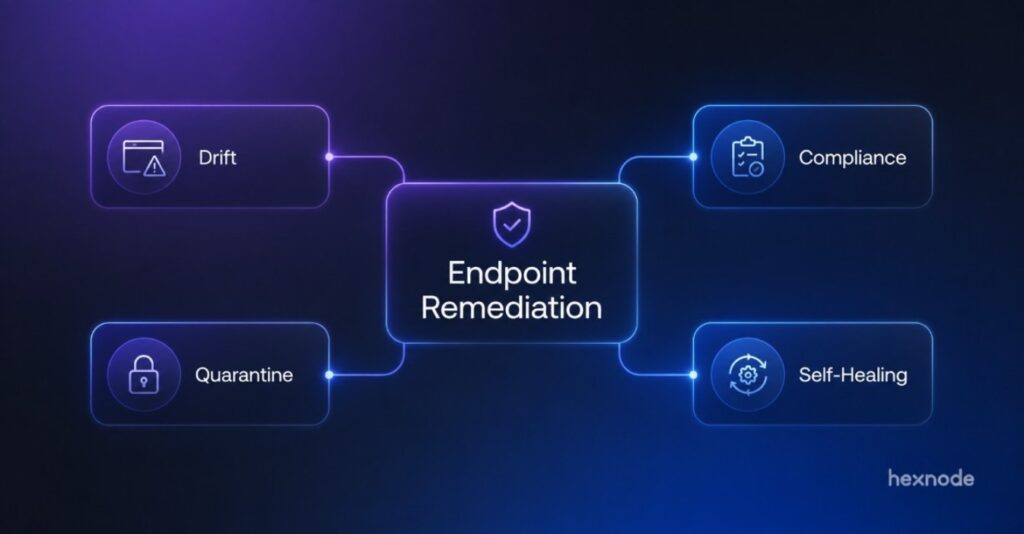
Endpoint remediation is a continuous discipline for keeping devices secure, compliant, and operationally stable. Drift, compliance, quarantine, and self-healing work together as stages of the remediation lifecycle: detect deviations, assess risk, contain high-risk devices, and restore trusted configurations. As endpoint environments become more distributed, automation helps organizations maintain endpoint health at scale.
Endpoint remediation is the process of identifying and correcting issues on managed devices that affect security, compliance, performance, or operational consistency. It goes beyond visibility by restoring endpoints to an approved and secure state.
Organizations often use detection, monitoring, and remediation interchangeably, but each serves a distinct purpose:
Detection identifies a problem or deviation.
Monitoring tracks device status and behavior over time.
Remediation applies corrective actions to resolve the issue.
Remediation may be triggered by:
Security risks, such as malware or unauthorized access attempts
Policy violations, including disabled security controls or unapproved applications
Configuration issues that deviate from established baselines
Software problems, such as missing patches, failed updates, or application failures
As endpoint environments become more distributed, organizations need the ability to identify issues and apply corrective actions quickly. Effective endpoint remediation helps reduce risk, maintain compliance, and ensure consistent device performance across the enterprise.
Why Endpoint Remediation Matters in Modern IT Environments
Modern endpoint environments are increasingly diverse, spanning multiple operating systems, ownership models, and work locations. As a result, unmanaged changes such as missing updates, unauthorized applications, or misconfigured settings can introduce security and compliance risks that are difficult to detect manually.
Delayed remediation increases both risk and cost. Unresolved issues can lead to security incidents, audit failures, service disruptions, and greater administrative overhead.
Configuration Drift: When Endpoints Slowly Move Away from Policy
Configuration drift occurs when an endpoint deviates from its approved configuration baseline. While individual changes may appear insignificant, they can accumulate over time and create security, compliance, and operational risks.
Common causes of drift include:
User-initiated configuration changes
Unauthorized software installations
Misconfigured applications or security controls
Operating system updates that alter existing settings
The common examples include disabled encryption, modified security settings, outdated software, and excessive user privileges.
Common Types of Endpoint Drift
Organizations typically encounter several forms of drift:
Security configuration drift: Changes that weaken security controls.
Application drift: Software installed, removed, or modified outside approved standards.
Without ongoing oversight, configuration drifts may only become visible during audits, security incidents, or troubleshooting efforts, often after it has already introduced risk.
Featured resource
Simplifying Compliance: An Actionable Guide for IT
Learn practical strategies for maintaining compliance, reducing policy violations, and streamlining enforcement across your endpoint environment.
Endpoint Compliance: Keeping Devices Aligned with Organizational Requirements
Endpoint compliance refers to the state in which a device meets the security, operational, and regulatory requirements defined by an organization.
While compliance and security are closely related, they are not the same. A compliant device meets established requirements, while a secure device is protected against threats. Compliance supports security but does not guarantee it.
Common endpoint compliance requirements include:
Encryption enabled
Approved software installed
Password and authentication policies enforced
Latest operating system and application patches applied
Required security configurations maintained
Compliance monitoring identifies devices that fall out of alignment with these requirements. Compliance remediation corrects those deviations and restores devices to an approved state.
What Causes Non-Compliance?
Endpoints commonly become non-compliant due to:
User-initiated configuration changes
Delayed or failed software updates
Deployment or maintenance misconfigurations
Unauthorized applications or tools
Even small deviations can accumulate over time and increase operational and compliance risk.
Compliance Enforcement vs Compliance Reporting
Compliance reporting helps organizations identify policy violations and assess audit readiness. However, identifying issues is only the first step.
Reporting identifies issues.
Enforcement corrects issues.
As organizations move toward continuous compliance, automated policy enforcement plays an increasingly important role in reducing compliance gaps and maintaining consistent policy adherence across endpoint environments.
Endpoint Quarantine: Isolating Risk Before It Spreads
Endpoint quarantine is a containment measure that restricts a device’s access to corporate resources when it is identified as a potential security or compliance risk. Its purpose is to limit exposure while the underlying issue is investigated and resolved.
Do not confuse quarantine with remediation. Quarantine isolates the compromised device from the network.
In contrast, remediation fixes the root cause of the threat. This process safely restores the endpoint to a trusted state.
What Happens During Quarantine?
Depending on organizational policies, a quarantined device may experience:
Restricted network access
Limited access to applications and corporate resources
Administrative review and investigation
Remediation actions to resolve identified issues
This allows security and IT teams to contain risk without removing the device from management.
Benefits and Considerations
Quarantine helps contain threats, reduce the attack surface, and prevent issues from spreading across the environment. However, because access restrictions can affect productivity, organizations should establish clear remediation and recovery procedures to return devices to a trusted state as quickly as possible.
Self-Healing Endpoints: Automated Recovery and Correction
Self-healing endpoints use automation to detect and correct common device issues without direct administrator intervention. Rather than relying on manual troubleshooting, self-healing mechanisms help maintain devices in their intended operational state.
Common self-healing actions include:
Reapplying approved configurations when settings drift from policy
Restarting critical services
Reinstalling missing or corrupted software components
Restoring security and compliance settings
By automating routine corrective actions, self-healing reduces administrative effort and minimizes endpoint downtime.
Self-healing typically relies on continuous monitoring, policy baselines, and automated remediation triggers that identify and correct issues as they occur.
Where Self-Healing Delivers the Most Value
Self-healing is particularly effective in environments where manual remediation is difficult to scale:
Large device fleets
Remote and hybrid work environments
Compliance-sensitive industries
Resource-constrained IT teams
By automating routine recovery tasks, organizations can accelerate issue resolution and maintain more consistent endpoint performance across their environment.
UEM for Endpoint Drift Management: How to Detect and Fix Endpoint Drift Automatically
Learn how organizations can detect configuration drift early, and maintain policy compliance across distributed endpoints.
How Drift, Compliance, Quarantine, and Self-Healing Work Together
Drift, compliance, quarantine, and self-healing are interconnected stages of the endpoint remediation lifecycle.
The process typically begins when configuration drift causes an endpoint to deviate from an approved baseline. Compliance checks identify the deviation and determine whether the device meets organizational requirements.
If the issue presents a significant risk, quarantine can contain the device while it is investigated. Finally, self-healing or remediation workflows restore the device to its intended state.
Together, these processes create a continuous cycle of detection, assessment, correction, and validation.
A Typical Endpoint Remediation Workflow
A typical remediation workflow follows four key steps:
Drift occurs and the endpoint deviates from policy.
Compliance checks identify the issue and assess its impact.
Quarantine may be applied if the device presents elevated risk.
Remediation restores the device to a compliant state.
Effective endpoint remediation depends on the ability to identify deviations, apply corrective actions, and maintain policy alignment over time.
Building Automated Endpoint Remediation Workflows with Hexnode
Effective endpoint remediation requires a consistent process for identifying, prioritizing, and correcting issues at scale. Hexnode helps organizations operationalize remediation through policy enforcement, compliance monitoring, remote actions, and automation workflows.
Organizations can use Hexnode to:
Automatically deploy, associate, and manage policies across supported managed devices
Monitor compliance status and identify policy deviations
Execute supported remote actions to address configuration or operational issues, depending on the device platform and available management controls
These capabilities help IT teams reduce manual effort while maintaining greater consistency across their endpoint environment.
The benefits extend beyond operational efficiency:
Improved security posture through consistent policy enforcement
Reduced compliance gaps and stronger audit readiness
Faster remediation response to endpoint issues
Greater administrative control across diverse device fleets
Lower operational overhead through automation-driven management
As endpoint environments grow in complexity, automation plays an increasingly important role in maintaining device health, compliance, and operational consistency.
Key Takeaways from the Endpoint Remediation Glossary
The concepts covered in this glossary represent different stages of that lifecycle:
Configuration drift occurs when endpoints deviate from approved baselines.
Quarantine helps contain devices that pose elevated security or compliance risks.
Self-healing automates corrective actions to restore devices to their intended state.
Together, these capabilities help organizations move from reactive issue resolution to proactive endpoint management. Effective remediation relies on identifying deviations, maintaining organizational standards, and applying corrective actions before issues escalate into larger security or operational challenges.
Conclusion
Endpoint remediation is more than fixing isolated device issues. It is a continuous process of maintaining security, compliance, and operational stability across the endpoint environment.
Configuration drift, compliance, quarantine, and self-healing each play a distinct role within that process. Together, they help organizations identify deviations, assess risk, contain threats, and restore devices to a trusted state.
As endpoint environments grow in scale and complexity, continuous remediation is becoming essential. Organizations that combine policy enforcement, automated corrective actions, and ongoing oversight are better positioned to reduce risk, maintain compliance, and ensure consistent endpoint performance.
This approach also aligns with modern security frameworks such as the NIST Zero Trust Architecture, which emphasizes continuous verification and policy-driven security decisions rather than implicit trust.
Simplify Endpoint Remediation at Scale
Gain visibility into device compliance, enforce policies consistently, and streamline corrective actions with Hexnode.
I write at the intersection of technology, process, and people, focusing on explaining complex products with clarity. I break down tools, systems, and workflows without any noise, jargon, or the hype.