Endpoint Patch Management: Reducing Security Risk Across Devices
Learn more about reducing endpoint security risks with centralized patch visibility, and continuous monitoring with Hexnode

Get fresh insights, pro tips, and thought starters–only the best of posts for you.

Litecoin’s MimbleWimble Extension Block, or MWEB, was designed to add optional privacy and scalability to the Litecoin network by enabling confidential transactions while keeping the network fast and efficient. But the recent MWEB-related incident shows that even the most advanced privacy protocols are only as secure as the endpoints, in this case, the nodes that run them.
Reports around the Litecoin zero-day vulnerability discussion indicate that non-updated Litecoin nodes processed a malformed MWEB transaction, forcing the network to undergo a 13-block reorganization to remove invalid transactions from the affected chain segment.
For enterprises experimenting with decentralized finance, digital asset infrastructure, or private payment rails, the lesson is clear: privacy and trust can break down when critical nodes are left unmanaged.
This incident is not just a blockchain story. It is an endpoint governance story. In distributed financial systems, a single outdated node can create the opening for transaction integrity issues, operational disruption, and emergency remediation at network scale.
The Litecoin incident does not appear to stem from broken cryptography. Instead, it highlights a more familiar enterprise risk: outdated software operating inside critical infrastructure.
Attackers reportedly introduced an invalid MWEB transaction into the Litecoin network. Updated nodes should have rejected the transaction, but non-updated mining nodes reportedly accepted it, allowing an invalid peg-out from the MWEB privacy layer to move forward.
For enterprise teams, the lesson is clear. Privacy protocols still depend on the endpoints that validate, relay, and process transactions. When those endpoints are not patched, the validation layer itself becomes exposed.
The incident was also tied to denial-of-service activity against major mining pools. According to public reporting, the disruption affected mining pools running updated software, while vulnerable non-updated nodes continued participating in the network. This imbalance reportedly allowed the invalid MWEB transaction to be included in the affected chain segment.
This is important to note because this is where the problem moves beyond blockchain security and into infrastructure management. A vulnerable node is not just a local risk. In a distributed financial system, it can influence the reliability of the wider network.
To contain the impact, the Litecoin network underwent a 13-block reorganization that removed the invalid MWEB transactions from the affected chain segment. While unaffected transfers reportedly remained intact, the incident exposed how quickly operational gaps can become network-level events.
For enterprises using blockchain nodes, payment gateways, wallets, or DeFi infrastructure, the message is simple: finality depends on infrastructure hygiene. When critical nodes remain unpatched, transaction integrity, service availability, and network confidence can all be affected.
The Litecoin MWEB incident underscores a broader enterprise security lesson: in decentralized infrastructure, endpoint integrity becomes part of the trust model. Crypto wallets, blockchain validators, mining nodes, payment gateways, and financial terminals may all serve different roles, but they depend on the same security fundamentals: managed software, verified access, continuous monitoring, and fast remediation.
For enterprises exploring digital assets, private payment rails, or blockchain-connected infrastructure, unmanaged nodes create more than a technical gap. They create a governance gap. A single outdated system can weaken transaction integrity, disrupt availability, and force emergency remediation across a wider environment.
Hexnode helps address this challenge through a converged approach to endpoint management, security visibility, and identity-aware access.
The Litecoin incident highlights the danger of patch adoption lag. Reports around the reorganization point to non-updated nodes accepting an invalid MWEB transaction, while updated software reportedly rejected it. In an enterprise setting, that same pattern can appear anywhere critical software is left unmanaged: financial terminals, payment applications, blockchain nodes, or administrative workstations.
Hexnode UEM helps reduce this risk by centralizing patch and update management across supported endpoints. IT teams can use Hexnode to manage Windows and macOS patches through manual or automated deployment workflows, helping reduce the time between update availability and fleet-wide adoption.
The goal is not to claim that unpatched systems can never exist. The goal is to shorten the exposure window, improve update visibility, and give IT teams a practical way to enforce software hygiene across critical devices.
A node-level attack may not announce itself as a blockchain incident at first. It may look like abnormal endpoint behavior, suspicious process activity, unusual traffic, or a sudden disruption to critical services.
Hexnode XDR strengthens this layer by giving security teams endpoint visibility, threat-hunting capabilities, and automated response options across Windows and macOS.
For organizations running financial or blockchain-adjacent systems, this visibility can help teams investigate suspicious behavior faster and respond before a vulnerable endpoint becomes part of a larger operational incident.
Credentials alone are not enough to protect high-value financial workflows. Access to wallet systems, payment dashboards, validator consoles, and internal financial applications should depend on both user identity and device trust.
Hexnode IdP supports this model by combining identity with device posture. Hexnode describes the product as a zero-trust access layer that unifies user identity and device compliance, helping ensure that only the right users on compliant devices can access company resources.
That matters because a stolen credential from an unmanaged or unhealthy device should not be treated the same as a login from a verified, compliant endpoint.
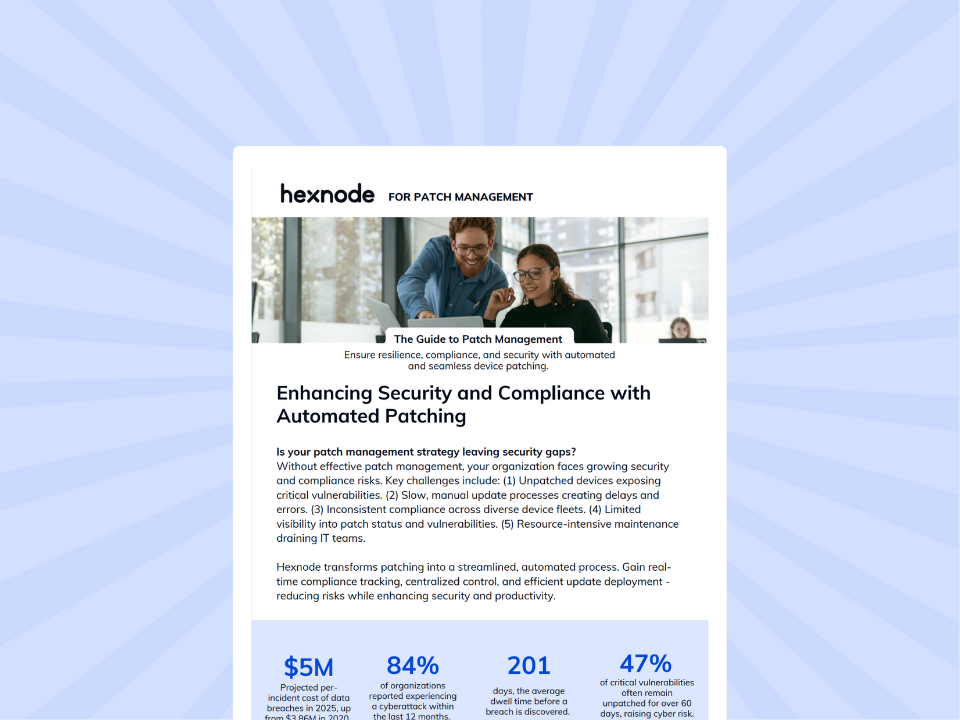
Download the one-pager to discover how Hexnode simplifies patch management and strengthens device security.
Get the one pagerDecentralized infrastructure is only as resilient as the endpoints behind it. The Litecoin MWEB privacy exploit shows how non-updated nodes can turn a software gap into a network-level disruption. For enterprises, the answer is not cryptography alone, but stronger endpoint governance: faster patching, trusted access, continuous visibility, and rapid response.
Hexnode supports this model through UEM patch management, XDR visibility and response, and IdP controls built on device trust and compliance. In 2026, protecting financial infrastructure starts with managing every critical node as a trusted endpoint.
Patch critical systems faster, enforce trusted access, and monitor endpoint risks with Hexnode’s unified endpoint, security, and identity ecosystem.
Signup Now