Puppet RCE CVE-2026-115731 allows crafted agent reports to trigger arbitrary code execution through unsafe deserialization in Puppet Server.
CISA added the vulnerability to its Known Exploited Vulnerabilities catalog on November 17, 2026.
Exploitation requires a CA-signed agent certificate, although weak certificate autosigning can expose the process to unauthenticated attackers.
Organizations should upgrade affected Puppet and OpenVox servers, review certificate-signing policies, and investigate potentially suspicious activity.
How does Puppet RCE CVE-2026-115731 turn an agent report into code execution?
Puppet RCE CVE-2026-115731 is a critical deserialization vulnerability in Puppet Server’s report-processing functionality. It allows an attacker with a CA-signed agent certificate to execute arbitrary code as the server’s service user.
Puppet uses an agent-server architecture. Agents retrieve their desired configuration from a central Puppet Server and apply it locally. They subsequently submit execution reports containing event information to the server for processing.
The vulnerability resides in how Puppet processes report data containing rich-data types.
When an agent submits a report, Puppet processes its serialized event information. The vulnerable deserialization logic accepts attacker-controlled type information and passes it through Ruby object-generation functionality.
Neodyme’s research traced the deserialization process to dynamically generated Ruby classes. These classes can reach Ruby’s class_eval functionality and execute attacker-controlled code.
The documented attack requires a client holding a valid CA-signed agent certificate. It submits a crafted report through a PUT request to the Puppet Server.
However, weak certificate autosigning can create an alternative attack path. An unauthenticated network attacker may obtain a valid certificate when the certificate authority signs requests without adequate verification.
Consequently, certificate issuance and report processing are central to understanding this vulnerability.
Which Puppet versions are affected, and which OpenVox releases fix the same vulnerability?
The underlying report-deserialization vulnerability affects Puppet Enterprise, Puppet, and OpenVox. Perforce tracks the Puppet vulnerability as CVE-2026-115731, while OpenVox tracks the corresponding issue under GHSA-ffr6-rwpm-p5wq. Both advisories classify the vulnerability as critical, with a CVSS v4.0 score of 9.4.
Detail
Information
CVE
CVE-2026-115731
Vendor
Perforce
Primary product
Puppet Enterprise
Vulnerability
CWE-502, deserialization of untrusted data
CVSS
9.4, CVSS v4.0
Required condition
CA-signed agent certificate
Potential impact
Arbitrary code execution as Puppet Server’s service user
Exploitation status
Listed in CISA KEV
KEV addition
November 17, 2026
CISA KEV due date under applicable BOD 26-04 requirements
December 1, 2026
The affected Puppet Enterprise versions are:
2023 branch: 2023.8.0 to before 2023.8.13.
2025 branch: 2025.0.0 to before 2025.12.1.
2026 branch: 2026.0.0 to before 2026.0.1.
The affected Puppet versions include 8.0.0 to before 8.22.2 and 9.0.0 to before 9.1.3. Neodyme also demonstrated that its exploit works against historical open-source Puppet 6.24.0. Organizations running older, unsupported deployments should not assume they are unaffected merely because their versions fall outside the currently published ranges.
Perforce released security updates on November 3, 2026. The fixed Puppet Enterprise and Puppet Enterprise Advanced releases are 2023.8.13, 2025.12.1, and 2026.0.1. The corresponding fixed Puppet Core releases are 8.22.2 and 9.1.3.
The same report-event deserialization vulnerability affects OpenVox and is tracked under GHSA-ffr6-rwpm-p5wq. The vulnerable report-processing path runs the agent’s Ruby code inside OpenVox Server. Consequently, server installations require remediation, while agent-only hosts are not exposed to this vulnerability.
The OpenVox maintainers published these patched releases:
OpenVox Agent: 8.32.0 and 9.3.0.
OpenVox Server: 8.18.0 and 9.2.0.
Organizations should identify their implementation before selecting an update. For OpenVox 9.x, Server 9.2.0 requires Agent 9.3.0 or later on the same host.
Why does compromising a Puppet Server create broader infrastructure risks?
A successful Puppet Server compromise can expose its CA signing keys, potentially allowing attackers to impersonate managed hosts.
If the Puppet service account can modify catalogs, an attacker may also introduce malicious configuration. Managed agents could execute that configuration during subsequent check-ins.
Configured orchestration mechanisms may provide additional attack paths. Neodyme demonstrated a PXP attack path in a Puppet Enterprise lab. After extracting the CA signing keys, the researchers generated a Puppet Server certificate with the required serverAuth and clientAuth extended key usages. They then used the PXP websocket broker to dispatch a task that executed commands as root on a managed host.
In OpenVox, Choria may allow attackers to trigger predefined, strictly limited tasks. However, this requires the orchestration protocol to be configured.
Neodyme also identified a separate certificate-name authorization vulnerability, CVE-2026-115732. It allows a CA-signed certificate with a name extending or shortening an authorized hostname to bypass vulnerable certificate-name matching rules and impersonate another host. Certificate issuance requires approval or an autosigning configuration that permits the colliding name. It should be treated separately from CVE-2026-115731’s report-deserialization vulnerability.
Importantly, remote code execution capability does not establish that attackers actually stole signing keys, deployed malware, or moved laterally in observed attacks. These remain potential consequences, not confirmed outcomes of the reported exploitation.
What has CISA confirmed about Puppet RCE exploitation?
CISA’s KEV listing confirms known exploitation of CVE-2026-115731. However, it does not establish the complete attack chain used in real-world incidents.
The timeline requires an important distinction. Perforce’s initial November 3 security notice stated that the company was unaware of active exploitation and had no evidence of customer data access.
Public reporting subsequently referred to a November 4 user post attributing an intrusion to the vulnerability. However, that report did not establish a complete, independently verified attack chain.
CISA added CVE-2026-115731 to its Known Exploited Vulnerabilities catalog on November 17, 2026.
Its KEV entry lists December 1, 2026, as the remediation due date. Under Binding Operational Directive (BOD) 26-04, mandatory remediation requirements apply to federal civilian executive branch (FCEB) agencies and assets within the directive’s defined scope. This includes qualifying publicly exposed assets that grant total control following exploitation.
CISA’s listing describes the vulnerability’s exploitation mechanism but does not identify the attackers, affected organizations, or specific attack chains used in confirmed incidents. Organizations should therefore avoid assuming that the publicly documented research sequence matches exploitation observed in the wild.
How should enterprises remediate Puppet RCE CVE-2026-115731?
Organizations running affected Puppet or OpenVox installations should prioritize vendor-supported updates rather than wait for routine maintenance cycles.
The immediate remediation priorities are:
Inventory installations: Identify Puppet Enterprise, Puppet Core, and OpenVox Server and Agent installations. Record their current versions and deployment locations.
Upgrade vulnerable components: Use the appropriate vendor-specific instructions. For Puppet Enterprise and Puppet Core, follow Perforce’s upgrade guidance and restart Puppet Server. For OpenVox, follow its package-specific upgrade procedure, including the required agent version and service restart instructions.
Review certificate autosigning: Disable automatic certificate signing where unnecessary. Otherwise, enforce strong validation of certificate signing requests before issuing trusted agent certificates.
Restrict management-server access: Limit Puppet Server network access to the segments and systems that require communication with it. Review certificate authorization rules for unexpected trust relationships.
Investigate suspicious activity: Review available server logs, certificate-signing activity, and administrative changes for unexpected behavior. Patching addresses the vulnerability but does not establish whether exploitation occurred previously.
Separately, OpenVox Server 9.2.0 addresses GHSA-q4hm-33rc-572g, the certificate-name authorization vulnerability corresponding to CVE-2026-115732 in Puppet Enterprise.
After upgrading, administrators should review custom auth.conf rules. Rules relying on the previous partial certificate-name matching behavior may now reject previously accepted names.
Featured Resource
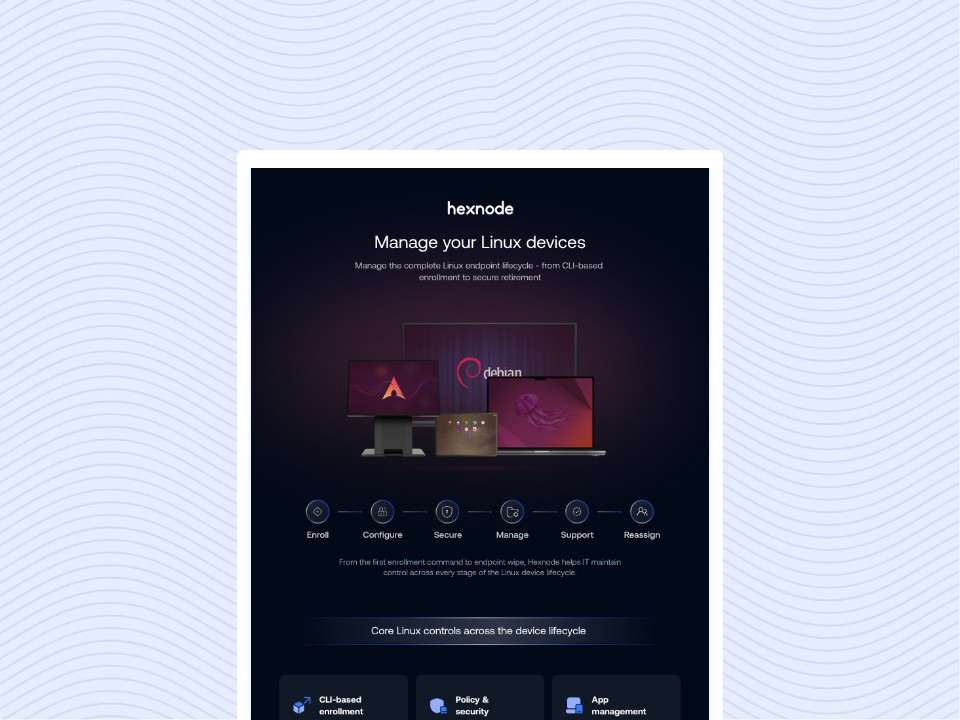
Managing Linux Endpoints with Hexnode UEM
Explore how Hexnode UEM supports Linux endpoint management through centralized device management, OS updates, application deployment, and security policies.
Where does Hexnode UEM fit into the Puppet remediation process?
While Puppet and OpenVox require vendor-specific remediation, endpoint management can support the deployment of compatible Linux updates and administrative scripts.
Hexnode UEM supports native Linux patch management through manual and automated package deployment. However, its documentation does not specifically confirm Puppet Enterprise, Puppet Core, or OpenVox package coverage. Administrators should check package availability and version support before using this workflow.
On supported Debian, Fedora, and Ubuntu devices with the Hexnode Agent installed, administrators can use Hexnode UEM’s Execute Custom Script action to run validated Bash scripts for supported administrative tasks, including invoking approved package-management or vendor upgrade procedures where applicable. These scripts can invoke an organization’s approved package-management or vendor upgrade procedures.
Administrators should validate custom scripts on test machines before broader deployment. Hexnode also provides Action History logs to review script execution results.
Hexnode UEM supports Linux OS and application patch deployment where packages are supported by its patch workflow. Its curated third-party application patch catalog is available for supported Windows applications. The documentation does not specifically confirm Puppet Enterprise, Puppet Core, or OpenVox package coverage.
Hexnode UEM can also support Linux patch deployment and update-status verification for supported packages. Administrators must independently confirm that the required Puppet or OpenVox release was installed. Investigating potential exploitation or previous compromise remains a separate security-response responsibility.
Linux Patch Management Arrives in Hexnode UEM: One Console for Ubuntu and Fedora
Explore how Hexnode UEM brings Linux patch monitoring and manual deployment into a centralized management.
Conclusion
Puppet RCE CVE-2026-115731 exposes a critical weakness in how Puppet Server deserializes agent-submitted report data. Its exploitation requires a trusted agent certificate, making certificate issuance an important part of the security boundary.
Organizations should prioritize fixed releases, review certificate autosigning configurations, and restrict access to their configuration management servers. They should also investigate potentially suspicious activity independently of patch deployment.
A successful update closes the known vulnerability, but it does not establish that the server was never compromised.
Simplify Linux Patch Management
Explore Hexnode UEM's Linux patch deployment and endpoint management capabilities.
I write at the intersection of technology, process, and people, focusing on explaining complex products with clarity. I break down tools, systems, and workflows without any noise, jargon, or the hype.