The IDScan breach involved unauthorized access to customer information stored in the identity verification provider’s cloud platform. IDScan said the affected data may include names and driver’s license or other government-issued identification numbers. Separately, a newly observed service called Nexus advertised access to a much larger collection of identity document images, although its scale and claims of prolonged access have not been independently confirmed.
The incident matters because identity documents can support social engineering, fraudulent account recovery and impersonation even when passwords or MFA secrets are not exposed. Organizations should reduce unnecessary document retention, reassess identity verification vendors and strengthen recovery procedures. Device compliance, controlled endpoint access and endpoint monitoring provide additional layers of defense when identity data alone can no longer be treated as reliable proof of identity.
Introduction
Showing a driver’s license at a counter or uploading it online often feels like a routine part of proving who you are.
In late August 2026, a service called Nexus began advertising access to a large collection of identity documents. On September 4, IDScan.net disclosed that an unauthorized third party may have accessed or copied customer information stored in accounts on its cloud platform.
Researchers have not publicly identified the initial intrusion method or the people responsible. However, the IDScan breach shows why organizations must extend identity verification security beyond document checks. Once attackers obtain identity data, they can use it to make impersonation, social engineering, and account recovery fraud more convincing.
Who is Nexus?
In late August 2026, operators advertised Nexus, a newly observed identity theft service, on a Russian-language cybercrime forum. They claimed that the service offered searchable access to identity documents belonging primarily to people in the United States and Canada. Nexus reportedly showed document previews and charged customers for more complete access.
Analysts should not characterize Nexus as a confirmed threat group. Researchers have not verified the operator’s identity, documented an established history, or found a reliable connection to another cybercriminal operation. The operator claimed to have continuously collected data from a major identity verification company for more than a year, but no evidence has verified that timeline. Nexus disappeared shortly after public reporting began. Analysts should therefore view Nexus as a marketplace or data-access service connected to the incident, not as an attributed attacker.
What happened?
The available evidence supports a cloud data breach, but many technical details remain under investigation.
Incident detail
What is known
Timeline
Nexus was advertised on August 31, 2026. IDScan said it received information about possible unauthorized access on or around September 1 and published its notification on September 4.
Affected organization
IDScan.net, an identity verification provider whose technology is used in industries such as retail, hospitality, transportation and regulated commerce.
Threat actor
Unknown. Nexus advertised access to the data, but its relationship to the intrusion has not been publicly established.
Initial access method
Not disclosed. There is no verified evidence identifying a vulnerability, stolen credential, malicious insider or cloud configuration error as the entry point.
Social engineering
No social engineering method has been tied to the breach itself. Exposed identity information could, however, make later impersonation and phishing attempts more credible.
Platform involved
IDScan confirmed that information stored within customer accounts on the IDScan.net cloud may have been accessed or copied.
Credentials and MFA
No passwords, session tokens or MFA secrets have been publicly identified as affected. There is also no evidence that MFA was bypassed during the incident.
Persistence
No persistence mechanism has been disclosed. Nexus claimed that data had been continuously exfiltrated for more than a year, but this has not been independently confirmed.
Data at risk
IDScan said affected information may include full names and driver’s license or other government-issued identification numbers. Reporting on Nexus also documented front-and-back document images, with some records containing infrared and ultraviolet scans.
Reported scale
Nexus claimed to hold more than 153 million driver’s license records and additional identity documents. That figure came from the service operator and should not be treated as IDScan’s confirmed affected-person count.
Ransomware or extortion
No ransomware deployment, file encryption or direct extortion demand against IDScan has been publicly confirmed. Nexus appeared to be selling access to the records.
This distinction matters. The confirmed disclosure establishes possible unauthorized access to cloud-hosted customer information. The reported driver license data breach provides evidence that real document images were being sold, but the full dataset size, duration of access and exact source of every record remain uncertain.
Even without exposed login credentials, identity documents have security value. Criminals could use accurate names, photographs, addresses and identification numbers to strengthen phishing messages, impersonate a victim or answer knowledge-based verification questions. The same material could also be presented during poorly designed help-desk or account recovery processes.
How to Choose a UEM Platform to Power Your Device as a Service Offering
Choose a UEM that supports multi-client operations, full device lifecycles, automation, and reporting.
Why this matters
Identity proofing checks whether someone appears to be the person named on an identity document. Authentication determines whether the person requesting access is the legitimate account holder. Treating those two steps as interchangeable creates identity proofing risk.
A genuine-looking document may satisfy a manual review while saying nothing about the security of the device, the user’s recent behavior or the context of the request. Passwords and MFA remain important, but recovery workflows can weaken them if support teams are allowed to reset access based mainly on static personal information.
Organizations therefore need layered IAM security. Sensitive applications should evaluate both user identity and device trust. Recovery requests need stronger verification and independent approval. Endpoint visibility is also necessary because a valid account used from a compromised device can still expose sensitive data.
How Hexnode can help
Hexnode cannot prevent misuse of identity documents already stored by another provider. Its relevant products can, however, reduce reliance on identity data alone and strengthen the devices through which sensitive workflows are accessed.
Hexnode UEM: Restrict access to managed, compliant devices
Hexnode UEM can evaluate device conditions such as encryption status, operating system version, jailbreak or root status, and the presence of required or blocklisted applications. These controls help security teams establish whether an endpoint meets organizational requirements.
When integrated with supported identity providers such as Microsoft Entra ID or Okta, device compliance can contribute to conditional access decisions. Organizations can require a managed, compliant endpoint before allowing access to identity verification consoles, customer records or administrative tools.
Application controls can also restrict unapproved software, including unauthorized remote access tools where platform capabilities permit. This is a preventive layer; it does not secure information retained inside a third-party vendor’s cloud.
Hexnode Access: Connect device sign-in to corporate identity
Hexnode Access can let users sign in to supported devices with cloud IdPs such as Microsoft Entra ID, Google Workspace or Okta, enforcing identity-bound local sign-ins and multi-factor authentication (MFA) right at the desktop level. It can also help administrators define which users or groups may access a device and assign suitable privilege levels.
This supports least privilege and reduces dependence on unmanaged local accounts. Periodic reauthentication can help keep device access aligned with the organization’s identity provider rather than leaving access tied indefinitely to a local password.
These controls are useful for devices handling sensitive verification data, but they do not determine whether a scanned identity document is genuine or prevent fraud within an external account recovery process.
Hexnode XDR: Investigate and contain endpoint threats
Hexnode XDR provides threat detection, endpoint telemetry and incident investigation for supported Windows and macOS endpoints. Security teams can examine suspicious activity, correlate endpoint events and take response actions such as terminating harmful processes, quarantining files or isolating affected devices.
This can help identify endpoint compromise associated with stolen accounts or suspicious access to identity-related systems. It also provides context for incident response when an apparently valid login may have originated from a compromised workstation.
Hexnode XDR delivers unified threat visibility across both Windows and macOS endpoints. It should be combined with identity-provider logs, application audit trails, and vendor-side monitoring rather than treated as a complete identity fraud detection system.
Feature Resource
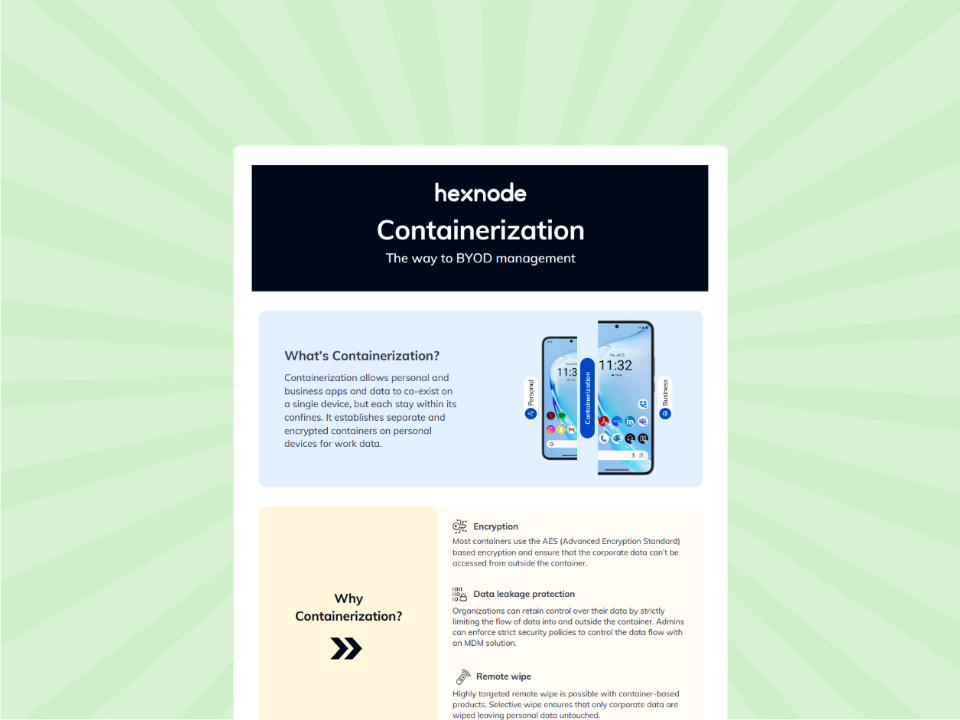
Containerization: Smarter BYOD Management for Enterprises
Discover how containerization transforms BYOD management.
The IDScan breach illustrates a practical weakness in identity-based security: information collected to prove identity can later be reused to imitate that identity. Security teams should assume that names, document numbers and document images may eventually become available outside their intended workflow.
Start by identifying vendors that collect or retain identity documents. Confirm why each data element is needed, how long it is stored and whether it can be deleted after verification. Review contracts, tenant configurations, access logs and breach-notification procedures.
Next, strengthen account recovery. Do not allow a document image or static personal information to authorize an MFA reset on its own. Require independent verification, documented approvals and alerts for sensitive recovery actions.
Hexnode UEM, Hexnode Access and Hexnode XDR can support this approach through device compliance, controlled device login and endpoint investigation across mixed Windows and macOS environments. The practical goal is clear: minimize stored identity data and require multiple trustworthy signals before granting or restoring access.
Try Hexnode Free for 14 Days
Sign up for Hexnode to strengthen device trust, access control and endpoint security.
I’m a technical content writer at Hexnode who loves simplifying tech. I break down complex ideas, remove the fluff, and help readers clearly understand our product for what it actually is: simple, reliable, and built to solve real problems.