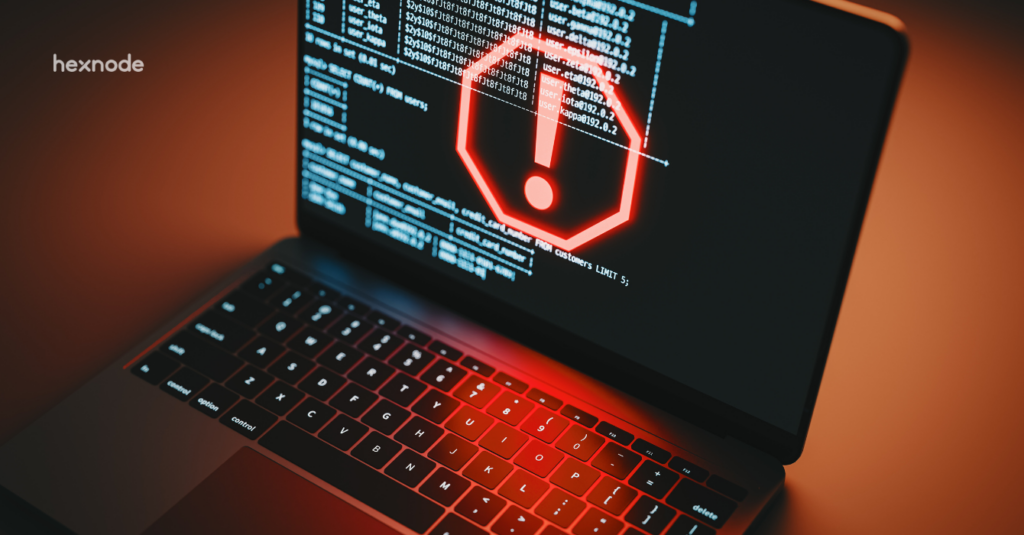
Active AhsayCBS exploitation has enabled webshell deployment, cryptocurrency mining, and persistent Windows host compromise, making investigation essential alongside application patching.
Attackers chained CVE-2026-105133 and CVE-2026-105134 to execute commands, deploy JSP webshells, and establish persistence through a malicious Windows service.
Organizations should restrict vulnerable interfaces, apply Ahsay’s 10.3.4.45 hotfix, investigate host-level compromise, and verify backup operations before restoring service.
Hexnode XDR can support Windows host investigation and containment through Process Tree, process termination, file quarantine, and endpoint isolation.
Active AhsayCBS exploitation has progressed to webshell deployment, cryptocurrency mining, and persistent execution on Windows hosts. Huntress reported five targeted organizations by October 8, 2026. For IT and security teams, the immediate priority extends beyond checking application exposure: affected hosts need investigation for compromise.
A response plan should answer three questions: Can attackers still reach the vulnerable interface? Did they establish execution on the host? What evidence supports returning that system to service? Treat application remediation, endpoint containment, and recovery as separate workstreams with clear ownership.
How does AhsayCBS exploitation establish persistence?
Attackers chained CVE-2026-105133, an authentication flaw, with CVE-2026-105134 to execute commands through the Replication Receiver API. Huntress observed JSP webshells and XMRig mining components disguised as Microsoft Edge. The malicious Windows service MicrosoftEdgeUpdateSvc launched a renamed service utility from a temporary directory with SYSTEM privileges.
Check Windows Logs > System for Service Control Manager Event ID 7045, which records service installation. Search the event details for MicrosoftEdgeUpdateSvc and inspect its executable path and service account to help identify its creation. Correlate findings with process and file evidence.
The attackers’ PowerShell script stopped the mining service while Task Manager ran and restarted it after closure. It also terminated Task Manager under specified timing conditions, including prolonged overnight use.
Featured Resource
Cybersecurity kit
Access essential cybersecurity resources to strengthen security, reduce risk, and improve cyber resilience.
What should an AhsayCBS exploitation investigation prioritize?
Use these observations to guide investigation, while validating each finding against legitimate activity. Examine executable locations, command lines, parent-child relationships, service configuration, and available network records together. A familiar product name alone should never establish trust.
Preserve relevant evidence before making changes where operationally feasible. Record what investigators found, which hosts they examined, and when they applied containment. This creates a reviewable timeline for decisions about remediation and recovery.
Why does compromise require host-level investigation?
For backup-management environments, responders must establish whether they can trust the host before resuming normal operations. A version check answers a software question; it does not establish what happened before remediation.
Ask the backup owner and incident-response team to review the same timeline. Which accounts accessed the console? Which services changed? What backup jobs overlapped with suspicious activity? Which connected systems require further examination? Treat these as investigation questions, without assuming data theft or backup destruction occurred.
Separate observed evidence from potential impact in incident updates. Report confirmed malicious execution directly, identify unresolved questions, and assign follow-up owners. Avoid declaring recovery complete solely because a suspicious process has stopped.
How can Hexnode XDR support investigation and containment?
On compatible Windows hosts enrolled in Hexnode XDR, process, file, network, and configuration telemetry can support investigation. Confirm host compatibility and available telemetry before reviewing suspicious service-related execution. Use the Process Tree to examine parent-child relationships associated with detected threats and validate malicious files and processes.
Hexnode XDR provides immediate threat-containment actions through Isolate Device, Kill Process, Kill Process Tree, and Quarantine File. Analysts should run Kill Process or Kill Process Tree before Quarantine File to ensure active binaries are terminated in memory before quarantine. Confirm successful termination before proceeding. Coordinate containment with the backup-service owner, obtain operational approval, and assess backup dependencies before isolating a host.
Containment does not establish complete recovery. Once investigators verify persistent indicators of compromise, Huntress recommends full host reimaging from a known-good backup. Hexnode XDR’s response capabilities support containment; they do not patch AhsayCBS or guarantee persistence removal. Track application remediation and recovery verification separately.
FAQs
How do CVE-2026-105133 and CVE-2026-105134 enable AhsayCBS exploitation?
Attackers can chain CVE-2026-105133, an authentication flaw, with CVE-2026-105134 to execute commands through the AhsayCBS Replication Receiver API. Huntress observed attackers abusing this access to deploy JSP webshells and establish malicious execution on affected hosts.
What indicators should security teams look for after suspected AhsayCBS exploitation?
Inspect unexpected taskmgr.exe termination loops and scripts that stop or restart suspicious services when Task Manager opens or closes. Examine temporary user paths such as C:\Users\<username>\AppData\Local\Temp for renamed mining utilities. Huntress identified edge.exe as the XMRig miner and msedge.exe as a modified service utility. Correlate these files with MicrosoftEdgeUpdateSvc activity, command lines, and file hashes before classifying them as malicious.
Restrict exposure, apply vendor guidance, and verify recovery
Hexnode UEM supports patch deployment and configuration policies for supported endpoints and applications, while Hexnode XDR provides threat detection and containment. For the AhsayCBS hotfix, follow the vendor’s installation instructions and verify deployment compatibility before using an endpoint-management workflow.
Ahsay’s October 10 notice states that its earlier 10.3.4.0 patch did not fully address the vulnerabilities. The vendor directs affected v10 deployments to the 10.3.4.45 hotfix. Follow the applicable instructions and verify the installed build after remediation.
Restrict management-interface access to trusted addresses or a VPN, and investigate exposed hosts for signs of compromise.
Close the incident only after documenting exposure reduction, application remediation, investigation findings, and recovery checks. Assign an owner to confirm that required backup jobs and restoration workflows function after changes. Keep unresolved evidence gaps visible, especially when logs do not cover the suspected intrusion period.
Strengthen Windows Threat Detection and Response
Investigate suspicious processes, detect persistence, and contain compromised Windows endpoints faster with Hexnode XDR.
Content writer at Hexnode. Fueled by good coffee and the occasional cat cuddle, I enjoy crafting content that informs, connects, and resonates. Nothing excites me more than knowing my words have been read, appreciated, and maybe even bookmarked.