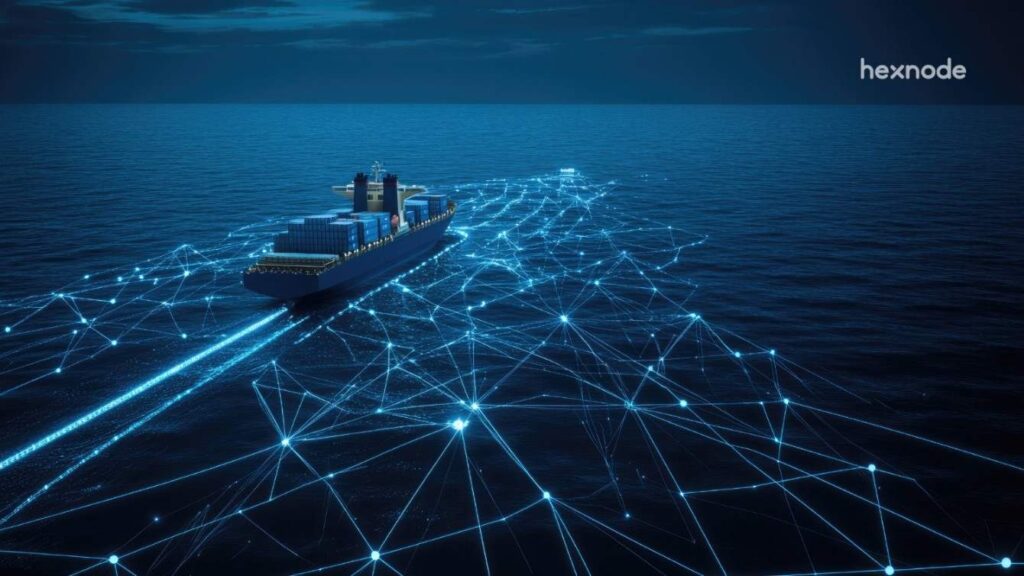
A maritime cyberattack investigation led the Coast Guard and FBI to board two U.S.-bound tankers after indications that their networks were compromised.
Authorities have not confirmed the intrusion method, affected systems, or responsible actor.
Maritime organizations should strengthen asset visibility, remote-access controls, endpoint baselines, and incident-response coordination.
Hexnode UEM and XDR support security for managed IT endpoints, including workstations, tablets, and mobile devices. They do not directly interface with shipboard operational technology (OT) or industrial control systems (ICS).
The maritime cyberattack investigation began after authorities found indications that attackers had compromised the networks of two U.S.-bound foreign-flagged oil tankers. The Coast Guard and FBI boarded the vessels on August 21 and August 24, 2026.
Federal teams assessed the integrity of vessel information technology (IT) and operational technology (OT) systems. Authorities reported no operational disruption or safety impact. They have not publicly disclosed how the vessel networks were compromised.
Maritime Cyberattack at a Glance
Detail
Information
Incident
Compromise of two U.S.-bound vessel networks
Investigation
U.S. Coast Guard and FBI
Boarding dates
August 21 and August 24, 2026
Environment examined
Vessel IT and OT systems
Operational disruption
None reported by authorities
Initial access
Not publicly disclosed
Attribution
Not publicly confirmed
Named vessel
VL Prosperity identified in reporting
Why Did Federal Cyber Teams Board the Two Tankers?
The Coast Guard and FBI described the operations as joint offshore security boardings. They followed indications that the networks of both vessels had been compromised.
The August 21 team included Coast Guard law enforcement personnel, Cyber Protection Team members, a vessel inspector, and FBI Cyber Action Team operators. A similar team conducted the August 24 boarding.
The joint teams combined maritime inspection with on-site cyber investigation.
According to the agencies’ statement, investigators assessed the integrity of the vessels’ OT and IT environments. Crews and shore-side corporate personnel also cooperated with the investigation.
Authorities reported no operational disruptions, vessel instability, physical danger to crews, or environmental impacts at the time of the statement. The Coast Guard also coordinated with port operators, vessel owners, and local maritime stakeholders.
Therefore, evidence of network compromise should not be interpreted as confirmation that attackers successfully manipulated critical vessel operations.
What Do We Know About the Vessel Network Compromise?
Neither the Coast Guard nor FBI publicly described the vulnerability, malware, credentials, remote-access mechanism, or other technique behind the intrusions. Reuters also reported that the agencies provided limited details and noted differences between their public accounts.
One vessel was identified in reporting as the VL Prosperity, a Liberian-flagged crude oil tanker bound for Texas.
Iranian state media alleged a roughly 30-hour communications outage and interference with propulsion-related and other onboard systems. These remain unverified external assertions, not confirmed findings from U.S. authorities.
In contrast, the Coast Guard and FBI reported no operational disruptions, vessel instability, physical danger to crews, or environmental impacts at the time of their statement. Therefore, the available U.S. government reporting does not confirm claims that attackers disrupted propulsion or other critical vessel operations.
Attribution is similarly unresolved. Although reporting has discussed possible Iranian involvement, the United States had not publicly attributed the incidents to Iran or another identified actor when the investigations became public.
Why Vessel IT and OT Boundaries Matter in This Investigation
A vessel can contain multiple cyber-dependent environments serving different operational purposes.
Business and crew-facing IT can coexist with communications infrastructure and systems supporting vessel operations. Consequently, incident responders need to establish which systems were affected before determining operational consequences.
The Coast Guard has previously warned that cyber threats can affect internet-accessible OT across maritime critical infrastructure. Its Maritime Cybersecurity Resource Center also identifies assessment, threat hunting, and incident response as core Cyber Protection Team services.
Coast Guard cybersecurity guidance recognizes the importance of distinguishing and appropriately segmenting IT and OT environments aboard vessels.
For enterprises, accurate asset visibility becomes particularly important during a maritime cyberattack investigation. Responders need to know which endpoints, applications, communications systems, and operational assets belong to each security boundary.
How to Prevent Supply Chain Attacks with XDR
Explore how endpoint visibility and behavioral monitoring can strengthen defenses against supply chain attacks.
What Should Maritime Organizations Learn From This Maritime Cyberattack?
The incident does not provide enough public evidence to prescribe a vulnerability-specific patch or detection rule.
Instead, shipping and logistics organizations can review controls that support investigation and containment when a vessel reports suspicious network activity.
Key priorities include:
Maintain accurate IT and OT inventories. Responders need to distinguish business endpoints from operational systems quickly.
Document network dependencies. Teams should understand which IT, communications, and OT environments exchange data.
Restrict remote access. Vendor and administrative access should be limited to authorized systems and personnel.
Maintain endpoint configuration baselines. Managed laptops, tablets, and mobile devices should follow defined security policies.
Prepare incident-response procedures for offshore assets. Vessel crews, corporate security teams, port stakeholders, and authorities may need to coordinate during an investigation.
Preserve logs and investigation evidence. Incident responders need reliable records when determining which systems were affected.
These controls also align with the Coast Guard’s broader regulatory focus.
Cybersecurity requirements under 33 CFR Part 101, Subpart F became effective on July 16, 2025. They establish minimum cybersecurity requirements for covered U.S.-flagged vessels, facilities, and Outer Continental Shelf facilities. The regulations include cybersecurity planning, assessments, training, and incident-response requirements.
The two vessels in this incident operated under foreign flags, so Subpart F does not directly govern them as U.S.-flagged vessels. Instead, the Coast Guard uses its Port State Control (PSC) program and applicable Maritime Security (MARSEC) Directives to assess foreign-flagged vessels operating in U.S. waters against international conventions, U.S. laws, and security regulations. Coast Guard guidance specifically states that PSC scrutiny can include cybersecurity practices on foreign-flagged vessels.
How Hexnode Supports Endpoint Security Around Maritime Operations
The Coast Guard and FBI investigation covered vessel IT and OT systems. Hexnode’s role sits primarily at the managed endpoint layer rather than the vessel’s specialized operational technology.
Manage Maritime Endpoints with Hexnode UEM
Crew members, port personnel, logistics teams, and shore-side employees may depend on laptops, tablets, smartphones, and other managed endpoints. These devices can connect users to corporate applications and operational workflows.
Hexnode UEM gives IT teams centralized visibility and management across supported endpoint platforms. Administrators can apply security configurations, manage applications, monitor device information, and evaluate device compliance.
For maritime organizations, these capabilities can help maintain a consistent security baseline across distributed devices. Compliance monitoring can also help administrators identify endpoints that fall outside configured requirements.
Hexnode UEM does not detect the vessel network compromises reported in this incident. Instead, it helps organizations manage enrolled endpoints and maintain their security posture across maritime operations.
Investigate Suspicious Endpoint Activity with Hexnode XDR
Hexnode XDR adds an investigation and response layer for supported Windows and macOS endpoints. This becomes relevant when responders need to determine whether suspicious activity has reached managed computers used by crews, administrators, logistics personnel, or shore-side teams.
Security teams can use endpoint telemetry and investigation capabilities to examine suspicious activity. Process information, process-tree context, and chronological telemetry events can provide additional context during an investigation.
When security teams identify malicious activity, they can use documented response capabilities to contain affected endpoints. These actions include Isolate Device, Kill Process, and Quarantine File.
Hexnode XDR does not specifically detect the maritime cyberattack described in this incident. Instead, it can support endpoint-level investigation and containment if suspicious activity appears on managed Windows or macOS devices within the wider maritime environment.
Together, Hexnode UEM and Hexnode XDR address two relevant layers: maintaining managed endpoint posture and investigating suspicious endpoint activity. Neither replaces dedicated monitoring, segmentation, or incident-response controls for vessel OT.
Featured resource
Why XDR Is Stronger With UEM
See how unified endpoint management and XDR can combine proactive endpoint hygiene with threat investigation and response.
Vessel Network Compromise Makes Investigation Scope Critical
The Coast Guard and FBI boardings demonstrate how a maritime cyberattack can involve cyber responders, maritime inspectors, vessel crews, corporate operators, and port stakeholders.
Yet key technical details and attribution remain unresolved.
For maritime organizations, the practical takeaway is to establish clear security boundaries before an incident occurs. Teams should understand where managed endpoints, corporate IT, communications infrastructure, and operational systems intersect.
Clear asset visibility, documented dependencies, controlled access, and coordinated incident-response processes can give responders a stronger foundation when investigating a vessel network compromise.
Strengthen Security Across Your Managed Endpoints
Bring endpoint management, security policies, and device visibility into one console with Hexnode.
I write at the intersection of technology, process, and people, focusing on explaining complex products with clarity. I break down tools, systems, and workflows without any noise, jargon, or the hype.