 Eugene Raynor
Table of Contents
- What is identity and access management?
- What is identity management?
- What is access management?
- What is the purpose of IAM?
- How does identity and access management work?
- Active directory (AD) management
- Single sign-on (SSO) systems
- Multi-factor authentication (MFA)
- Role-based access control (RBAC)
- Federated identity management
- What is Identity-as-a-Service (IDaaS)?
- Identity and access management with Hexnode UEM
- Hexnode’s IAM functionalities
- The future of identity and access management
Back in the old days, maintaining one’s identity in the enterprise was as simple as setting up a username, and associating a password with it.
Fast forward to today, times have changed. Businesses can no longer rely on the old-fashioned and error-prone processes to assign and manage user privileges. Instead, we rely on ‘automation‘ to take over these tasks, thereby reducing the load on IT to maintain an expanding database of identities, and manage their corresponding levels of access. And this, is the foundation over which an identity and access management solution operates.
What is identity and access management?
Identity and access management (IAM) enables businesses to manage identities and define the roles and access privileges for individual users and devices across the enterprise network. This in turn, facilitates the user’s/device’s access to corporate resources within the company’s cloud/on-premise infrastructure.
Or, as the people at Gartner would like to say,
Identity and access management (IAM) is the discipline that enables the right individuals to access the right resources at the right times for the right reasons.
Now, on closer examination, the core functionality of an identity and access management strategy can be derived from the two terms it incorporates. Identity management, and access management.
Let’s take a closer look at these two terms.

Together, they make up a single solution termed ‘identity and access management’.
What is the purpose of IAM?
In today’s distributed business environment, your employees and customers exist globally, and at least some (if not all) of your corporate infrastructure resides in the cloud. As a result, phishing, spoofing and other social engineering attacks have become significant threats to enterprise security. Identity thefts have increased twofold, and enforcing strong usernames and passwords just won’t cut it anymore.
Your business must be ready with a proper solution to validate employee credentials and regulate their access to corporate resources, all the while ensuring that the least possible time is wasted through the authentication process. Identity and access management frameworks aim to accomplish just this.

IAM equips IT with the ability to secure and maintain your employees’ identities, while also controlling their access to sensitive information within the corporate network. With IAM, employee access can be limited to just the tools and resources required to carry out their specific tasks.
Moreover, regulatory guidelines such as the Health Insurance Portability and Accountability Act (HIPAA), hold businesses accountable for managing access to customer and employee information.
In addition, the General Data Protection Regulation (GDPR) mandates that organizations safeguard the personal data and privacy of European Union citizens and businesses. With the help of identity and access management solutions, organizations can ensure that their workflows and processes comply with these regulations.
How does identity and access management work?
On a fundamental level, identity and access management (IAM) solutions perform three key functions: identifying users, authorizing access, and authenticating identities.
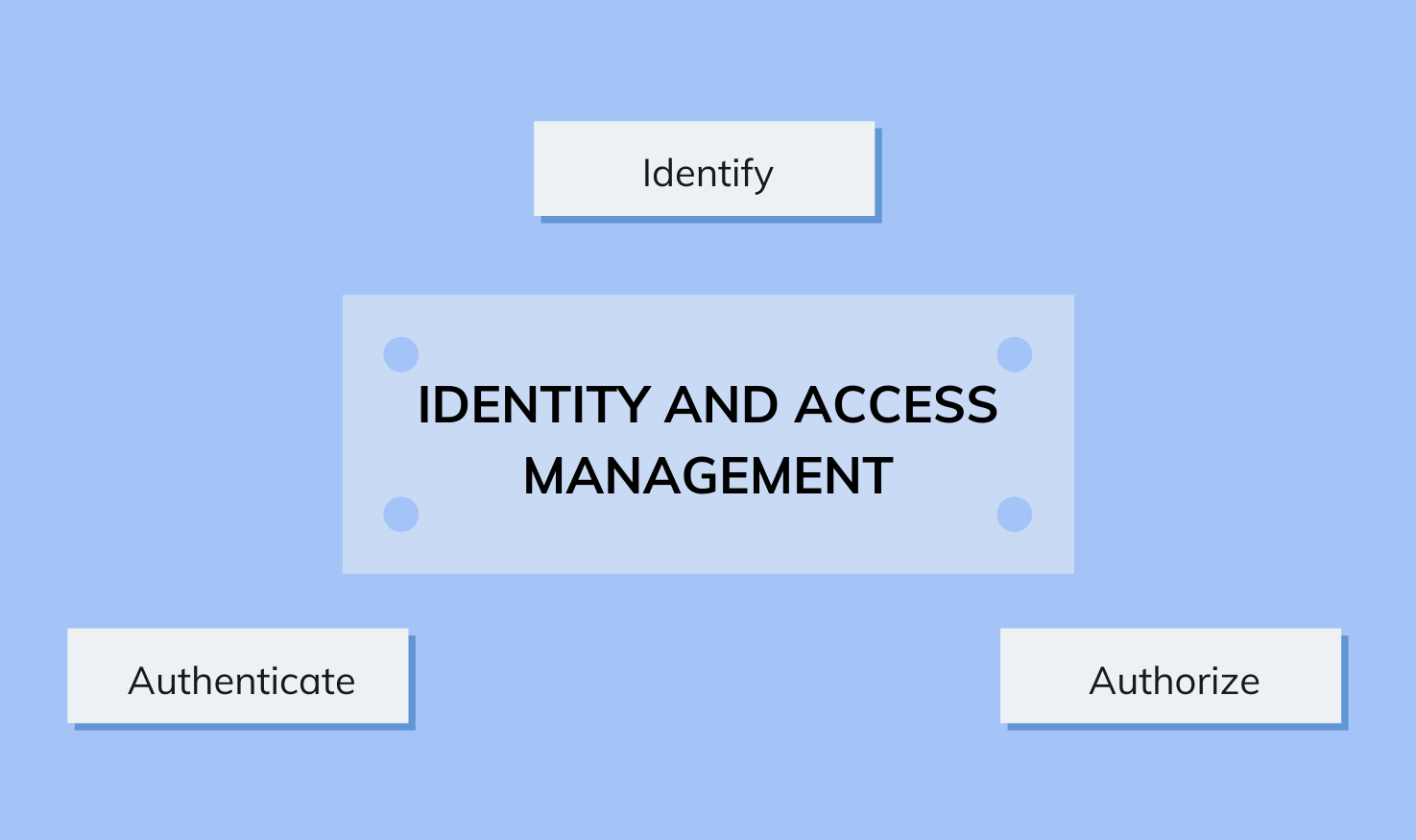
- Identify: Maintain and manage a directory (or repository) containing the attributes, characteristics, and specifications of entities (users and devices) within a system. This includes adding, removing and updating individual entities and their roles within the system.
- Authorize: Assign roles and privileges to individuals or groups of entities in the network, and grant them permission to access the required corporate resources based on their level of authorization.
- Authenticate: Protect sensitive data within the system, and secure corporate infrastructure by enforcing measures to authenticate users and devices that attempt to access the enterprise network.
The methods and tools used by an IAM solution to fulfil the three functionalities mentioned above include,
Today, identity and access management (IAM) solutions include many additional capabilities. These often include biometrics, Fast Identity Online (FIDO) authentication, adaptive MFA, machine learning, artificial intelligence, risk-based authentication, and Zero Trust security.
Moreover, businesses can manage identity and access in the cloud by using third-party service providers. This approach is known as Identity-as-a-Service (IDaaS).
Identity and access management with Hexnode UEM
Hexnode offers a robust suite of identity and access management functionalities, empowering businesses to provide seamless access to corporate resources with minimum downtime.
In addition, by implementing a central identity management platform, Hexnode enables you to enforce advanced security policies in the enterprise, all the while maintaining regulatory compliance requirements.
Hexnode’s IAM functionalities

Enforce authentication
Password policies
Passwords are the first line of defense for any IAM strategy. Prevent identity theft and malicious attacks by enforcing strong password policies across the enterprise. You can also enforce additional controls for password complexity, password history, password age, and the number of failed password attempts before the device automatically wipes itself.
Multi-factor authentication
Enable multi-factor authentication (MFA) to add an extra layer of protection for sensitive corporate data. Hexnode supports third-party authenticator apps, including Google Authenticator and Microsoft Authenticator. These apps help secure access to the management portal by enabling MFA.
Deploy certificates
Overcome the need for memorizing complex passwords by supplementing passwords with suitable certificates that you can deploy to your end-users. Store certificates in the Hexnode portal and deploy them to your managed devices.
Active Directory integration
Maintain and manage employee information and ensure secure access to user data with Hexnode’s seamless integration with Microsoft Active Directory (AD) and Azure Active Directory (Azure AD).
Okta integration
Hexnode’s integration with Okta enables organizations to easily manage access to corporate resources and apps. Businesses can securely onboard devices to Hexnode with Okta directory credentials, and ensure efficient validation of identities with the help of SSO and MFA.
Maintain security
Wi-Fi and VPN configurations
Prevent corporate endpoints from connecting to unprotected networks and remotely set up VPN configurations to secure network connectivity, by pushing Wi-Fi and VPN configurations to managed devices via Hexnode.
Containerization
Hexnode helps you containerize and secure corporate data on managed devices. It uses Work Profile for Android Enterprise devices and Business Container for managed Apple devices.
Compliance checks
With Hexnode, you can define compliance settings to ensure that your endpoints conform to corporate regulations and flag non-compliant endpoints. By enforcing automated and periodic compliance checks, businesses can ensure that all the necessary corporate security controls are in place.
Enforce encryption
With Hexnode, businesses can push device encryption policies to enforce system-level encryption on endpoints. This in turn, secures the critical company data from being accessed by unauthorized users.
Manage access to apps and content
Whitelist/blacklist apps and websites
Hexnode lets businesses deploy application and website blacklist or whitelist policies. These policies ensure that users can access only the apps and websites that meet corporate standards and security requirements.
Manage app permissions
With Hexnode, businesses can remotely manage the permissions accessible to managed apps, thereby protecting users from potentially malicious apps.
Making your apps enterprise ready with custom app configurations
App catalogs and custom app stores
Businesses can provide instantaneous access to their required apps by configuring and deploying custom app stores. Also, IT can quickly provision app catalogs on managed devices to minimize the time wasted searching for the required apps.
The future of identity and access management
We all know what’s happened after the COVID pandemic. Remote work has become the standard for enterprises everywhere. And with more and more influx of devices, employees accessing corporate data through open networks, and the looming threat of cyber attacks, the need for a solid identity and access management solution has now become more crucial than ever.
Hexnode’s IAM solution helps businesses protect sensitive data. It also helps organizations meet evolving regulatory compliance and enterprise security requirements efficiently.
Go ahead, try it out!
Reinforce your business strategies with Hexnode's Unified Endpoint Management solution
Try It Out