The alleged Canvas LMS data breach 2026 involves claims by ShinyHunters that attackers stole data tied to 275 million users across thousands of educational institutions. Instructure confirmed a cybersecurity incident involving exposed user information and messages, although the company has not publicly verified the scale of the breach. Consequently, the incident has renewed concerns about education cybersecurity, phishing risks, LMS security, and the need for stronger student data protection measures.
The education sector’s dependence on centralized cloud platforms has created a new cybersecurity reality: a single breach can affect thousands of institutions simultaneously. The alleged Canvas LMS data breach 2026, claimed by the ShinyHunters extortion group, highlights how attacks on education technology providers can quickly evolve into large-scale identity exposure events.
According to reports, attackers claim to have exfiltrated data tied to approximately 275 million Canvas users connected to Instructure’s cloud-hosted learning platform. As a result, thousands of schools and universities worldwide may have been affected. While investigations remain ongoing and Instructure has not publicly verified the scale of the claim, the incident has intensified concerns around student data protection, LMS security, SaaS security, and third-party risk management.
For educational institutions managing devices and compliance through platforms like Hexnode, the incident reinforces the importance of endpoint visibility, device compliance, and identity-provider-based conditional access.
Before we get into the specifics, here’s a quick look at how the incident unfolded and when it first came to light.
When Did Instructure Confirm the Canvas Cybersecurity Incident?
On May 1, 2026, Instructure disclosed a cybersecurity incident involving Canvas. Later, the company confirmed that some user information and messages had been exposed.
How Large Was the Alleged Canvas LMS Breach?
The ShinyHunters breach allegedly exposed data tied to approximately 275 million users and nearly 9,000 schools and educational institutions. However, Instructure has not publicly verified those figures.
Because of the scale of the alleged breach, the incident quickly became one of the most discussed education cybersecurity stories of 2026.
What Data Was Reportedly Exposed in the Canvas Breach?
Reportedly exposed information includes:
Names
Email addresses
Student ID numbers
Internal Canvas messages
At the time of reporting, there was no public confirmation that passwords or financial information had been compromised.
Why Does the Canvas LMS Breach Matter for Schools?
This incident follows a separate September 2025 event involving Instructure’s Salesforce CRM environment, which the company stated did not involve Canvas product data.
Together, these incidents highlight the growing security risks surrounding centralized education technology platforms and interconnected SaaS ecosystems. More importantly, they demonstrate how a single vendor-side compromise can affect multiple institutions at the same time.
Why the Canvas LMS Data Breach 2026 Matters for Education Cybersecurity
The alleged Canvas LMS data breach 2026 demonstrates how centralized education platforms can amplify the impact of cyberattacks across multiple institutions simultaneously.
When a cloud-hosted LMS becomes compromised:
Multiple institutions may inherit risk exposure at the same time
Student and educator identities become phishing targets
Threat actors can leverage large datasets for credential stuffing and social engineering campaigns
Third-party SaaS platforms become attractive attack surfaces
As a result, IT teams now face a broader challenge. They must manage trust across cloud ecosystems, identities, and connected platforms instead of focusing only on local infrastructure.
How Did the Alleged Canvas LMS Breach Happen?
Public reporting suggests the attack may have involved compromised credentials or exposed integration access within interconnected SaaS environments.
How Can Compromised API Keys Increase SaaS Security Risk?
Reports indicate that Instructure rotated application keys and implemented additional response measures following the incident. These measures reportedly included increased monitoring and credential or access-token remediation activities.
This incident highlights several important LMS security concerns:
Compromised API keys can provide persistent cloud access
SaaS integrations can expand the attack surface
Privileged credentials remain high-value targets for extortion groups
Therefore, organizations must continuously monitor privileged access and third-party integrations.
Why Are SaaS Integrations a Security Risk?
ShinyHunters also claimed that Instructure’s Salesforce environment had been compromised, although the company has not publicly confirmed that claim.
Even so, the incident demonstrates how interconnected SaaS environments can increase organizational risk when integrations and privileged access controls become exposed.
How Do Vendor Breaches Affect Schools Using Shared SaaS Platforms?
Because Canvas operates as a centralized cloud-hosted platform, educational institutions using the service may inherit the impact of a vendor-side breach regardless of their own local infrastructure protections.
Consequently, schools and universities must strengthen endpoint governance and access controls to reduce exposure during third-party incidents.
Dedicated Education MDM: What Are the Hidden Costs of Not Using Them?
Discover the hidden risks schools face when managing student devices without a dedicated education MDM solution.
What Does the Canvas LMS Breach Reveal About Education Security?
The alleged breach reinforces three major realities for school and university IT teams.
Why Are Student Identities a Major Cybersecurity Target?
Student and educator identities are valuable attack targets, especially when exposed information includes institutional email addresses, student IDs, and communication context that can support phishing or social engineering attacks.
As phishing campaigns become more targeted, protecting student data becomes increasingly important for education cybersecurity programs.
Why Do Schools Need Device Visibility for SaaS Security?
Schools cannot directly control third-party SaaS infrastructure. However, they can control the devices, identities, and access conditions connected to those platforms.
Because of this, endpoint visibility and device compliance have become critical components of LMS security.
How Do Managed Devices Reduce Breach Risk?
Limiting access to managed and compliant devices can help reduce exposure from compromised credentials and unmanaged endpoints.
In addition, managed devices allow IT administrators to enforce consistent security policies across student and staff environments.
How Hexnode Helps Schools Strengthen Education Security
In a world of third-party SaaS breaches and identity-focused attacks, educational institutions need layered security controls that extend beyond passwords alone.
How Conditional Access Helps Protect Student Accounts
The Canvas LMS data breach 2026 highlights the risks of relying solely on passwords and implicit trust.
Hexnode integrates with identity providers such as Microsoft Entra ID and Okta, allowing organizations to incorporate device compliance into access decisions.
Educational institutions can use compliance-aware access policies to:
Restrict access from unmanaged devices
Block access from devices that fail compliance checks
Sync device compliance states with identity providers for conditional access decisions
As a result, schools can strengthen student data protection without depending only on passwords.
How Endpoint Management Helps Schools Respond to Breaches
When a large-scale breach occurs, rapid endpoint management becomes critical.
Hexnode UEM provides tools to manage and enforce policies across supported devices.
Organizations can use Hexnode to:
Push security updates and patches to supported devices
Manage school-issued devices through centralized policy enforcement
Configure application and device restrictions on managed endpoints
Consequently, schools can respond more quickly to emerging threats and improve education cybersecurity readiness.
Featured resource
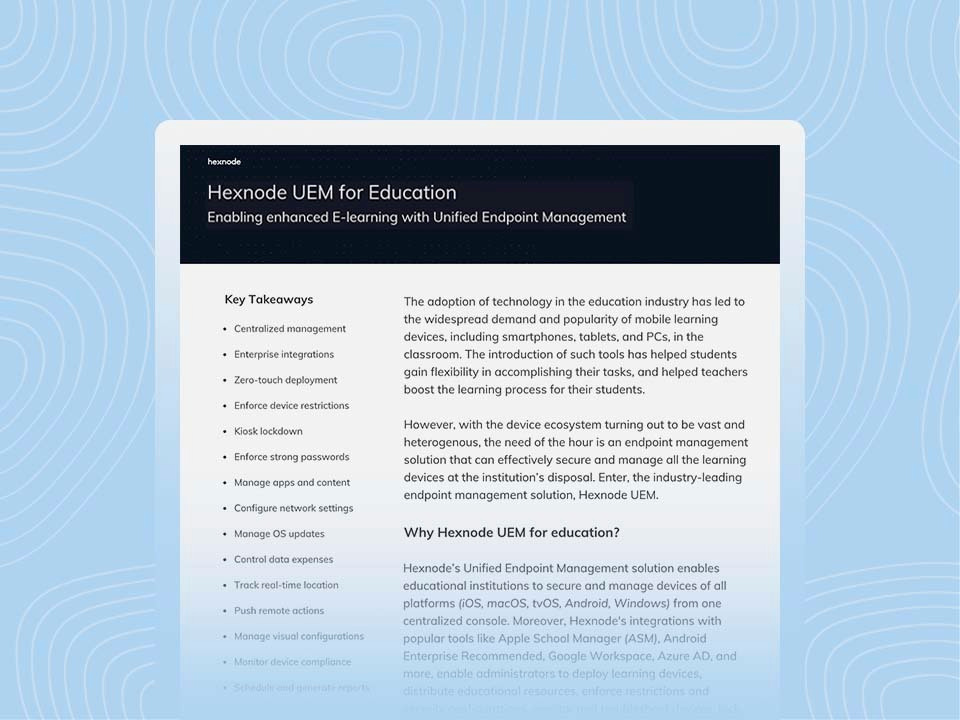
Hexnode UEM for Education
Explore how centralized endpoint management supports education-focused security and device governance workflows.
How Endpoint Monitoring Helps Detect Suspicious Activity
Identity-focused attacks often lead to secondary phishing and credential abuse campaigns.
Hexnode XDR monitors real-time endpoint events to help identify suspicious activity such as:
Anomalous file changes
Unauthorized network beaconing
Because of this visibility, IT teams can investigate suspicious endpoint behavior more efficiently.
What Schools Can Learn from the Canvas LMS Data Breach
Area
Risk
Security Priority
Identity
Credential and identity exposure
Compliance-aware access
SaaS Platforms
Vendor compromise
Third-party risk management
Endpoints
Unmanaged device access
UEM enforcement
Student Data
Large-scale PII exposure
Data governance policies
What Is the Future of Education Cybersecurity?
The Canvas LMS data breach 2026 demonstrates how education cybersecurity is shifting from perimeter-based defense toward identity and device-centric security models.
Schools and universities can no longer rely solely on vendor trust or password-based authentication. Instead, institutions must strengthen endpoint governance, conditional access policies, and visibility into user and device behavior.
As cloud-hosted education ecosystems continue to expand, organizations must prioritize student data protection and LMS security as part of a broader cybersecurity strategy.
Final Thought
The alleged Canvas LMS data breach 2026 is a reminder that educational institutions inherit risk from the platforms they trust every day. Although schools cannot directly control third-party SaaS infrastructure, they can strengthen how users, identities, and devices interact with those environments.
As education cybersecurity threats continue to evolve, organizations must prioritize student data protection through stronger endpoint governance, conditional access policies, and visibility into managed devices. Platforms like Hexnode can help schools improve device management, compliance enforcement, and endpoint visibility across distributed education environments.
Strengthen Education Cybersecurity with Hexnode
Protect student data and enforce compliance-driven access controls across your education environment.
I write at the intersection of technology, process, and people, focusing on explaining complex products with clarity. I break down tools, systems, and workflows without any noise, jargon, or the hype.