- Hexnode CEO Apu Pavithran argued that autonomous IT needs a centralized governance layer because the lines between device, identity and security management are “becoming blurry,” with organizations juggling 60 to 70 tools.
- Futurist Ramy Nassar said accountability for AI outcomes sits with the people who deploy it, citing a tribunal ruling against an airline that argued its chatbot was a separate legal entity.
- Both warned that blanket approval requirements breed rubber-stamping. Nassar described an experiment in which 100% of reviewers approved AI-generated scripts faster than they could have read them.
- Pavithran laid out five questions IT should answer before automating any workflow, from who is accountable to how it can be stopped and recovered.
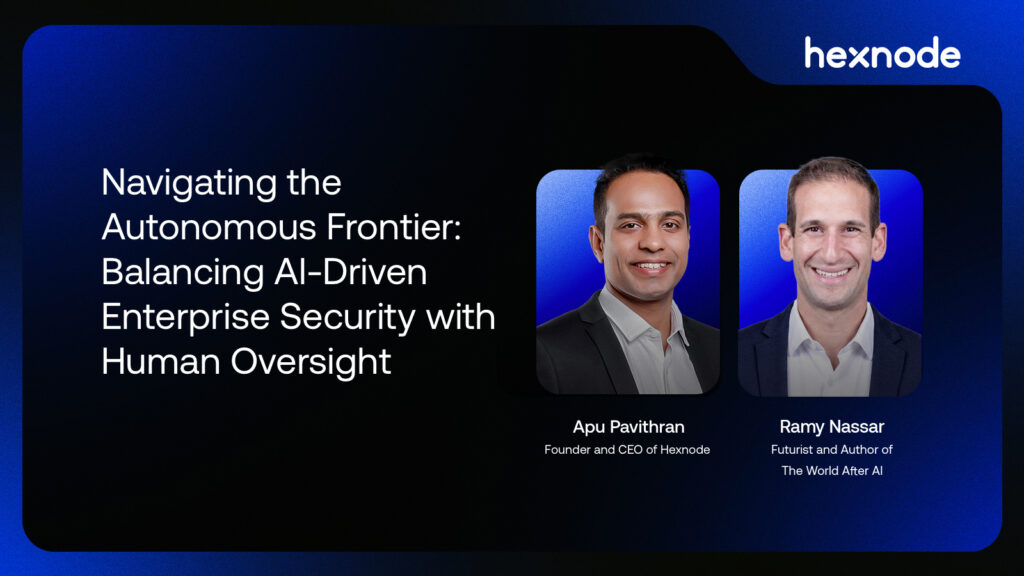
During HexCon26, the question put to Apu Pavithran and Ramy Nassar was deceptively simple: how much should AI be doing, and where does human involvement start and stop?
During the discussion, Apu, CEO and Founder of Hexnode, and Ramy, Futurist and Author of The World After AI, explored how organizations can strike that balance. Drawing on practical examples, they examined how AI-driven operations can reduce administrative effort while keeping human oversight meaningful and manageable.
How Can Organizations Govern Autonomous IT Across Different Systems?
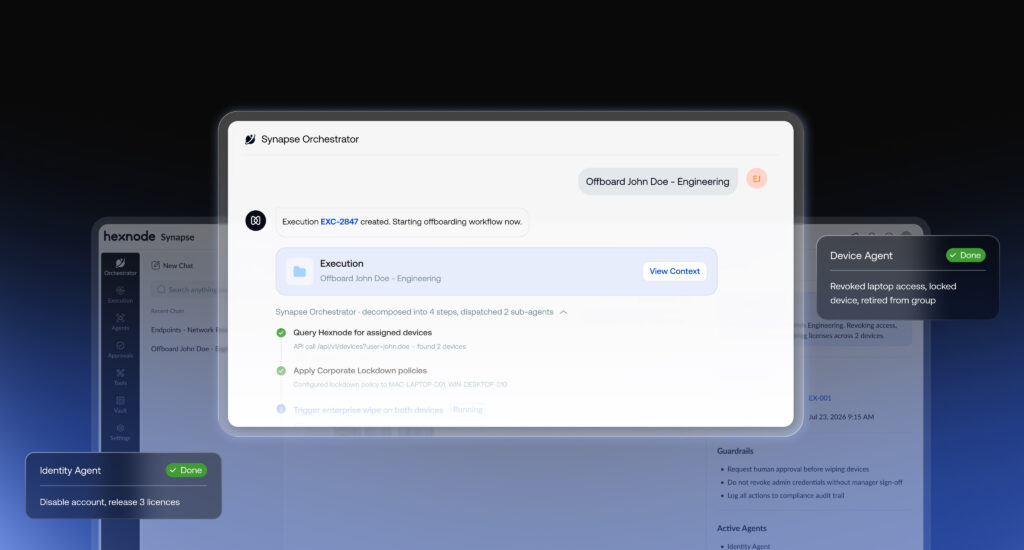
As AI-driven workflows extend across device management, identity and security, IT teams face the challenge of coordinating actions that involve multiple systems.
“There’s less differentiations between managing devices, managing employees, managing users, managing data,” Apu said. “It all becomes blurry.” The underlying goals stay constant, keeping employees productive, devices secure and incidents from damaging the organization, but the systems involved were built as independent domains with independent tools. An average organization, he estimated, runs “60, 70 tools at the very least” just to stay secure.
That fragmentation is the governance problem. “You really have to have a centralized governance system that understands holistically what exactly we are trying to achieve and how we can achieve it,” Apu said. He was clear that this does not mean replacing existing platforms: multiple tools and data planes can remain, provided there is a single mechanism to see across them and measure outcomes.
Who Is Accountable When AI Makes a Mistake?
Ramy came at governance from the other direction: not the IT estate, but the individual employee. He described a client call where a finance employee had built a semantic model for financial planning with no engineering background. Asked about the tech stack, the employee could only say it was “HTML code.”
“AI has moved the start line forward on creating software,” Ramy said. “It has not moved the finish line any closer.” Anyone with a cloud account can now produce a working prototype, but the organization still has to secure, scale and support it, and that creates bottlenecks. His prescription: “How do we not gate creation, gate creativity, gate innovation, but how do we gate and govern deployment?”
One organization he works with wrote an AI usage policy, required every employee to sign it, and made the consequences explicit. “We want people in that organization to use AI to automate, to be more productive,” Ramy said. “But the accountability rests with the person who did it.”
He pointed to a precedent at the corporate level. A Canadian airline’s chatbot quoted a customer the wrong fare; when the customer sought the difference, the airline fought the claim. The airline’s defence, Ramy said, was that “the AI chatbot was a separate legal entity from the airline.” It lost, and he said the ruling has since been cited in at least seven other countries. “If you use AI,” he summarized, “you are accountable for what it does.”
When Should Autonomous IT Require Human Approval?
Both speakers agreed that a human checkpoint is only as good as the attention behind it. Apu described the failure mode from the IT side: set guardrails on everything, and “you get a ton of approval requests for anything and everything. At one point we’d just click, click, click. But are we actually reviewing the outcome? What is the point of having a human in the loop?”
Ramy offered two cases that show how this plays out in practice.
The first involved a 16-year-old in Baltimore, Taki Allen, who was walking out of football practice with a bag of Doritos when one of the school’s AI-enabled cameras identified it as a gun. He was forced to the ground by police at gunpoint and searched, and his home was searched too. “The workflow worked exactly as intended,” Ramy said. “There was no human in the loop there. There was no point at which a human being looked at a still image or a video and said, ‘Hey, system, pause here.’” He also pointed to the systemic bias in the datasets used to train such models.
The second was his own. His team built a tool that generated twelve user acceptance testing scripts for product teams to check. “No one did,” he said. So he changed the process: one script at a time, each requiring the reviewer to type “I approve.” He then compared the time between a script being generated and approved with its word count and average reading speed, multiplied by five to allow for skimming. The share of reviewers flagged for approving faster than they could have read: “It was 100.” Keystroke logging showed the cleverest typed “I approve” once and pressed Ctrl+V for the other eleven.
That experience, he said, is what pushed the organization toward individual accountability. “It’s not your CISO. It is not this AI steering committee. I think accountability starts at the user level,” through a combination of education, training and accountability.
For Apu, the answer is to stop asking for approval on everything and instead define what agents may do on their own. Before automating any workflow, he said, IT should be able to answer five questions:
- Who is accountable for the workflow?
- What can the agent access and change, and in what context?
- What can it do automatically, and what must it ask permission for?
- How will the results of its execution be measured?
- “If things go wrong, do we have a mechanism to stop it, and how do we recover from it?”
Context, he added, matters as much as the action itself. Executing the same remediation on a device belonging to the CISO and one belonging to a SecOps analyst “is all very different,” and the permissions model should reflect that.
How do you govern the governor?
Pressed on how to control an orchestration layer that is itself privileged, Apu’s answer was blunt: “Trust nothing. Only the data.”
His approach is to start with an existing, well-understood workflow, such as a known OS build with a documented install procedure, and automate that first. When the system returns an unexpected result, the result is fed back to a model to generate possible next steps, and those options are validated against the organization’s existing SOPs before anything executes. Only once a workflow has been seen “from all possible angles” does autonomy expand.
He drew a parallel with how Hexnode’s own engineers use AI coding tools: before the AI writes a line, a human has already architected the solution, down to the database columns. “Else this becomes junk,” he said. “At the end of the day, we as human beings are responsible for the agents, whatever they do.”
What should IT teams do on Monday morning?
Asked for a single action attendees could take back to work, Ramy’s answer was to do nothing, deliberately. Close the laptop, switch off the phone, and spend 30 to 60 minutes on one question: “As more of your work gets automated, gets delegated, what is the human remainder? What is left that only you can do?” The stock answer to “will AI take my job,” that someone using AI will, is “a garbage answer,” he said. Relationships, experience, wisdom and judgment are the fundamentals that remain.
Apu’s advice was more incremental: pick small pieces of today’s work, let AI suggest how to handle them, and expand step by step. He ended on the people in the room. IT, he said, has “the most thankless job,” where the only feedback is “it doesn’t work.” The opportunity in autonomous IT is to move from a thankless job to “a bit less thankless job, and an appreciated job.”
Frequently Asked Questions (FAQs)
How can organizations determine whether an AI workflow is ready for autonomous execution?
Organizations should assess whether the workflow has clearly defined conditions, predictable outcomes and established procedures for handling failures. The permissions required by the AI system and the potential consequences of incorrect execution should also be understood.
Testing the workflow under expected and unexpected conditions can help identify where additional safeguards are necessary. Autonomy can then be expanded based on demonstrated reliability.
Why does approval fatigue undermine human-in-the-loop controls?
When every action requires sign-off, approving becomes a repetitive task rather than a judgment. Ramy Nassar’s experiment found 100% of reviewers approved AI-generated scripts faster than they could have read them. Approval requirements should be reserved for consequential or uncertain actions, with routine operations running inside defined guardrails.
What should organizations audit when AI agents perform IT operations?
Who or what initiated the action, which systems were accessed, what was changed, whether approval was required and given, and whether the result matched the intended outcome.